
Are you struggling to manufacture complex, high-precision metal parts without sacrificing durability? Choosing the right production method can make a massive difference in your final product’s quality and your bottom line.
As an industry expert, I know that utilizing stainless steel investment casting is one of the smartest moves you can make for demanding, high-performance applications.
You might already know that this method is famous for its incredible dimensional accuracy and exceptional surface finish…
But how do you navigate the different stainless steel casting grades, strict quality control standards, and find the right manufacturing partner?
Well, you’re in for a treat because I’ve put together a complete guide that breaks down the entire investment casting process.
In this post, you’re going to learn exactly how to leverage stainless steel castings to produce complex parts for the aerospace, medical, and fluid equipment industries.
So if you’re looking to maximize material strength and eliminate costly machining, this guide is for you.
What is Stainless Steel Investment Casting?
Stainless steel investment casting is an advanced manufacturing technique used to produce near-net-shape metal parts. This precision casting method allows us to create intricate geometries that are difficult or impossible to achieve with traditional machining.
The Investment Casting Process Explained
The process relies on creating a temporary mold from a disposable master pattern. Key steps include:
- Wax Pattern Creation: Injecting specialized wax into an aluminum die. We utilize high-end equipment, and as a top-tier wax injection machine Manufacturer and supplier, we ensure pristine pattern quality.
- Tree Assembly: Attaching wax patterns to a central sprue.
- Shell Building: Dipping the assembly into a ceramic slurry.
- Dewaxing: Melting the wax out of the ceramic shell.
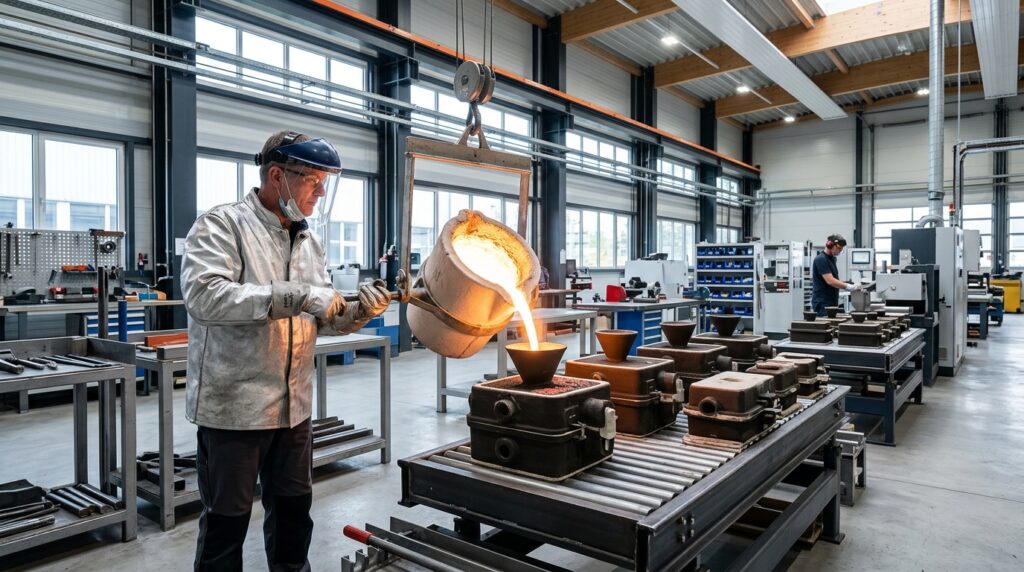
- Pouring: Filling the heated shell with molten stainless steel.
- Knockout: Removing the ceramic to reveal the final casting.
Why Choose Investment Casting for Complex Parts?
Investment casting drastically reduces the need for secondary machining. It accommodates undercuts, thin walls, and complex internal cavities while minimizing material waste, making it highly cost-effective for high-value alloy options.
Key Advantages of Stainless Steel Castings
Precision and Dimensional Accuracy
Investment casting holds tight dimensional tolerances, often eliminating the need for extensive post-casting machining. Parts are delivered reliably and consistently to exact specifications.
Exceptional Surface Finish Quality
The ceramic shell provides a remarkably smooth surface straight out of the mold. This reduces polishing time and ensures immediate aesthetic and functional readiness.
Material Durability and Strength
Stainless steel inherently delivers superior mechanical strength and outstanding corrosion resistance. The casting process preserves these microstructural benefits, ensuring long-lasting performance in harsh environments.
Popular Stainless Steel Casting Grades and Alloys
| Category | Common Grades | Key Characteristics |
|---|---|---|
| Austenitic | 304, 316, 316L | Excellent corrosion resistance, highly ductile, non-magnetic. |
| Ferritic & Martensitic | 410, 416, 430 | High strength, magnetic, excellent wear resistance. |
| Specialty/PH | 17-4 PH, 15-5 PH | High mechanical strength, easily heat-treatable. |
Austenitic Stainless Steels (300 Series)
These casting grades are the most widely used globally. They offer unparalleled resistance to rust and oxidation, making them ideal for aggressive chemical environments.
Ferritic and Martensitic Grades (400 Series)
When hardness and wear resistance take precedence over extreme corrosion resistance, the 400 series delivers robust mechanical properties suitable for demanding industrial tooling.
Precipitation Hardening (17-4 PH) and Specialty Alloys
17-4 PH combines high strength and toughness with excellent corrosion resistance. It is the premier choice when standard 300 series alloys fall short on load-bearing capabilities.
Common Applications and Industries Served
Aerospace and Military Components
We supply mission-critical parts where failure is not an option. Stainless steel investment casting provides the strict tolerances and lightweight structural integrity required for aerospace brackets, housings, and defense hardware.
Fluid Equipment: Pumps and Valves
Fluid handling requires materials that do not degrade. Our castings are widely used for pump impellers, valve bodies, and pipe fittings, ensuring leak-proof and durable performance.
Food Processing and Medical Machinery
Strict sanitation requirements demand smooth, non-porous, and easily cleanable surfaces. Stainless steel precision casting meets FDA and sanitary standards for medical implants, surgical tools, and food-grade machinery.
Quality Control, Tolerances, and Inspection
Linear and Geometric Tolerance Standards
We adhere to strict international standards (such as ISO 8062) to guarantee consistent linear dimensions, flatness, and concentricity across all production runs.
Surface Finish Standards and Defect Prevention
Visual and tactile inspections are strictly enforced. We monitor our wax injection machine parameters and shell humidity to prevent porosity, inclusions, and surface defects before they occur.
Non-Destructive Testing (NDT) Methods
To guarantee internal integrity without damaging the product, we employ:
- X-Ray/Radiography: Detects internal voids or shrinkage.
- Dye Penetrant Testing (PT): Identifies surface micro-cracks.
- Magnetic Particle Inspection (MPI): Locates surface and near-surface flaws in magnetic grades.
Choosing the Right Stainless Steel Casting Manufacturer
Certifications and Industry Compliances
Partner with a manufacturer holding ISO 9001 and specific industry certifications (like AS9100 for aerospace). Quality assurance must be documented and verifiable.
Advanced Technologies (3D Printing & Automation)
Modern foundries integrate 3D printing for rapid prototyping of patterns and utilize robotic automation in shell building to ensure absolute consistency and speed to market.
Value-Added Services: Heat Treatment and Machining
Select a partner that offers turnkey solutions. In-house CNC machining, polishing, and heat treatment streamline your supply chain and reduce lead times.
Frequently Asked Questions
What is the difference between cast 304 and 316 stainless steel?
The primary difference is the addition of Molybdenum to 316 stainless steel. This addition significantly enhances its corrosion resistance, particularly against chlorides and industrial solvents.
Can stainless steel investment castings be heat treated?
Yes. Depending on the specific alloy, castings undergo various heat treatments—such as annealing, quenching, or precipitation hardening—to optimize their hardness and mechanical strength for specific applications.
What are the size limitations for precision stainless steel castings?
Investment casting is highly versatile. We can produce precision parts ranging from a fraction of an ounce (a few grams) up to large components weighing over 200 pounds (90 kg).
 English
  Russian
  German