
2026年11月14日
Master the investment casting shell building process with expert guidance on dipping stuccoing drying defects and automation
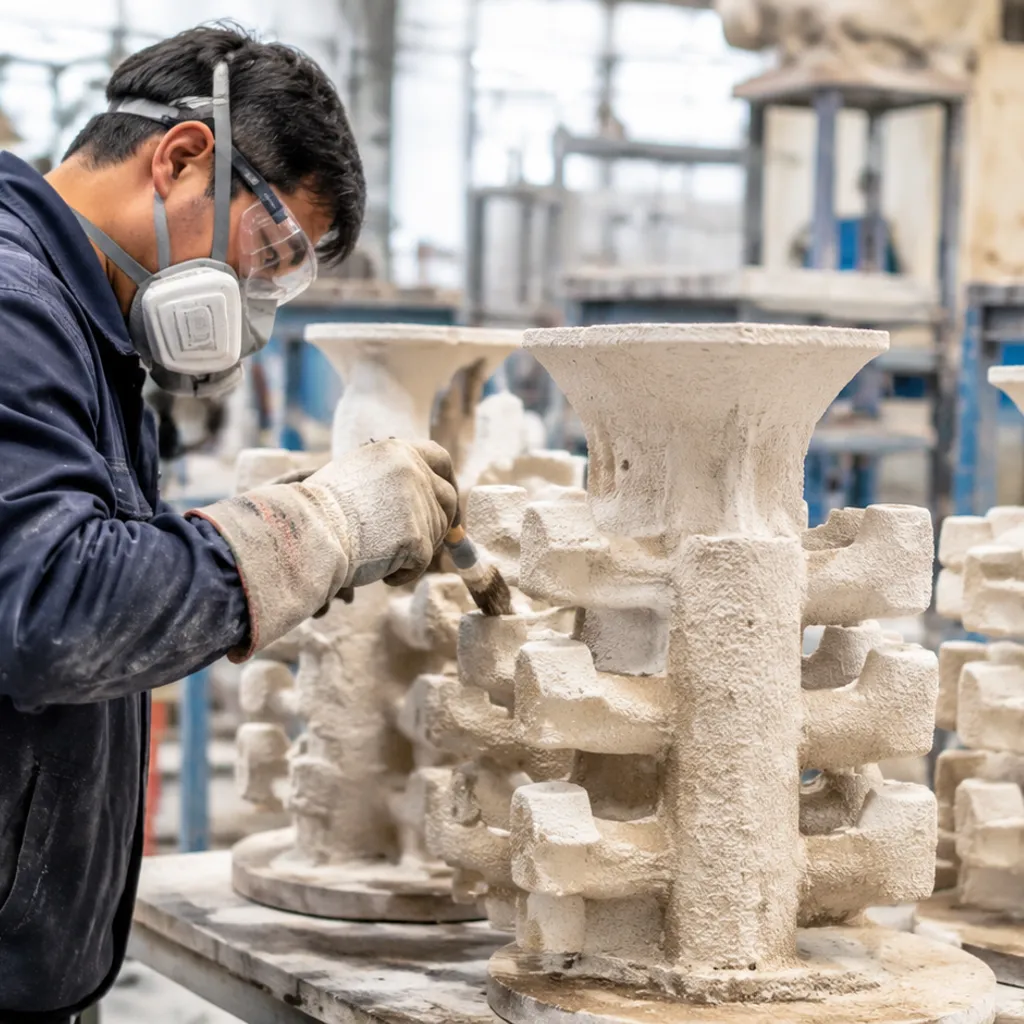
Core Objectives of the Investment Casting Shell Building Process
The ceramic shell building phase converts a sacrificial wax assembly into a robust, high-precision refractory mold. In the investment casting shell building process: dipping, stuccoing and drying, every operational step directly determines whether the mold can survive molten metal casting. A successful shell must meet five fundamental technical objectives:
- High-Fidelity Surface Replication: The primary layer must reproduce the exact contours, micro-details, and surface finish of the wax pattern without pinholes, bubbles, or pattern wetting defects.
- Mechanische Festigkeit: The shell requires sufficient green strength to survive steam autoclave dewaxing and high fired strength to withstand metallostatic pressure during pouring.
- Thermische Schockbeständigkeit: The finished ceramic structure must handle rapid thermal cycling—from room temperature to preheat furnaces exceeding 1000°C—without spalling, micro-cracking, or catastrophic failure.
- Controlled Permeability: The layered refractory matrix must allow core gases and displaced air to escape freely during metal entry, preventing gas entrapment, non-fill, and casting porosity.
- Dimensionsstabilität: The mold must resist deformation, creep, and uneven thermal expansion across all axes to maintain tight dimensional tolerances in the finished casting.
Step 1: Slurry and Wax Assembly Preparation
Before we start building any layers, both the wax tree and the refractory slurry need to be prepped to strict benchmarks. Skipping tight controls at this baseline stage leads directly to shell delamination, inclusions, and ruined castings later in production.
Wax Tree Degreasing and Surface Prep
Wax patterns naturally carry release agents, oils, and static charge from the assembly bench. Left untreated, liquid refractory slurry will bead up instead of wetting the pattern uniformly. Cleaning: We thoroughly wash the assembled wax cluster in an environmentally controlled degreasing solution to remove residual mold-release agents. Etching/Rinsing: A mild chemical wash optimizes surface tension, allowing the primary slurry coat to adhere smoothly across delicate fillets and tight slots. Trocknung: Patterns must dry completely before the first dip; any residual moisture or solvent causes immediate coating rejection.
Slurry Mixing and Conditioning
A durable ceramic mold relies on an evenly dispersed refractory suspension. When formulating slurries meant to withstand the high firing temperatures of a burnout furnace for silica sol shells, binder chemistry and flour consistency are paramount.
| Parameter | Primary Slurry | Backup Slurry |
|---|---|---|
| Binder Type | Colloidal silica | Colloidal silica |
| Refractory Flour | cURL Too many subrequests by single Worker invocation. To configure this limit, refer to https://developers.cloudflare.com/workers/wrangler/configuration/#limits | cURL Too many subrequests by single Worker invocation. To configure this limit, refer to https://developers.cloudflare.com/workers/wrangler/configuration/#limits |
| cURL Too many subrequests by single Worker invocation. To configure this limit, refer to https://developers.cloudflare.com/workers/wrangler/configuration/#limits | cURL Too many subrequests by single Worker invocation. To configure this limit, refer to https://developers.cloudflare.com/workers/wrangler/configuration/#limits | cURL Too many subrequests by single Worker invocation. To configure this limit, refer to https://developers.cloudflare.com/workers/wrangler/configuration/#limits |
| cURL Too many subrequests by single Worker invocation. To configure this limit, refer to https://developers.cloudflare.com/workers/wrangler/configuration/#limits | cURL Too many subrequests by single Worker invocation. To configure this limit, refer to https://developers.cloudflare.com/workers/wrangler/configuration/#limits | cURL Too many subrequests by single Worker invocation. To configure this limit, refer to https://developers.cloudflare.com/workers/wrangler/configuration/#limits |
- cURL Too many subrequests by single Worker invocation. To configure this limit, refer to https://developers.cloudflare.com/workers/wrangler/configuration/#limits cURL Too many subrequests by single Worker invocation. To configure this limit, refer to https://developers.cloudflare.com/workers/wrangler/configuration/#limits.
- cURL Too many subrequests by single Worker invocation. To configure this limit, refer to https://developers.cloudflare.com/workers/wrangler/configuration/#limits cURL Too many subrequests by single Worker invocation. To configure this limit, refer to https://developers.cloudflare.com/workers/wrangler/configuration/#limits.
- cURL Too many subrequests by single Worker invocation. To configure this limit, refer to https://developers.cloudflare.com/workers/wrangler/configuration/#limits cURL Too many subrequests by single Worker invocation. To configure this limit, refer to https://developers.cloudflare.com/workers/wrangler/configuration/#limits.
cURL Too many subrequests by single Worker invocation. To configure this limit, refer to https://developers.cloudflare.com/workers/wrangler/configuration/#limits
cURL Too many subrequests by single Worker invocation. To configure this limit, refer to https://developers.cloudflare.com/workers/wrangler/configuration/#limits.
cURL Too many subrequests by single Worker invocation. To configure this limit, refer to https://developers.cloudflare.com/workers/wrangler/configuration/#limits.
cURL Too many subrequests by single Worker invocation. To configure this limit, refer to https://developers.cloudflare.com/workers/wrangler/configuration/#limits
- cURL Too many subrequests by single Worker invocation. To configure this limit, refer to https://developers.cloudflare.com/workers/wrangler/configuration/#limits cURL Too many subrequests by single Worker invocation. To configure this limit, refer to https://developers.cloudflare.com/workers/wrangler/configuration/#limits 17-4 PH investment casting precision stainless steel service.
- cURL Too many subrequests by single Worker invocation. To configure this limit, refer to https://developers.cloudflare.com/workers/wrangler/configuration/#limits cURL Too many subrequests by single Worker invocation. To configure this limit, refer to https://developers.cloudflare.com/workers/wrangler/configuration/#limits.
cURL Too many subrequests by single Worker invocation. To configure this limit, refer to https://developers.cloudflare.com/workers/wrangler/configuration/#limits
cURL Too many subrequests by single Worker invocation. To configure this limit, refer to https://developers.cloudflare.com/workers/wrangler/configuration/#limits
- cURL Too many subrequests by single Worker invocation. To configure this limit, refer to https://developers.cloudflare.com/workers/wrangler/configuration/#limits cURL Too many subrequests by single Worker invocation. To configure this limit, refer to https://developers.cloudflare.com/workers/wrangler/configuration/#limits.
- cURL Too many subrequests by single Worker invocation. To configure this limit, refer to https://developers.cloudflare.com/workers/wrangler/configuration/#limits cURL Too many subrequests by single Worker invocation. To configure this limit, refer to https://developers.cloudflare.com/workers/wrangler/configuration/#limits.
- Viskositätskontrolle: cURL Too many subrequests by single Worker invocation. To configure this limit, refer to https://developers.cloudflare.com/workers/wrangler/configuration/#limits.
cURL Too many subrequests by single Worker invocation. To configure this limit, refer to https://developers.cloudflare.com/workers/wrangler/configuration/#limits
cURL Too many subrequests by single Worker invocation. To configure this limit, refer to https://developers.cloudflare.com/workers/wrangler/configuration/#limits.
cURL Too many subrequests by single Worker invocation. To configure this limit, refer to https://developers.cloudflare.com/workers/wrangler/configuration/#limits cURL Too many subrequests by single Worker invocation. To configure this limit, refer to https://developers.cloudflare.com/workers/wrangler/configuration/#limits, cURL Too many subrequests by single Worker invocation. To configure this limit, refer to https://developers.cloudflare.com/workers/wrangler/configuration/#limits
- cURL Too many subrequests by single Worker invocation. To configure this limit, refer to https://developers.cloudflare.com/workers/wrangler/configuration/#limits cURL Too many subrequests by single Worker invocation. To configure this limit, refer to https://developers.cloudflare.com/workers/wrangler/configuration/#limits.
- cURL Too many subrequests by single Worker invocation. To configure this limit, refer to https://developers.cloudflare.com/workers/wrangler/configuration/#limits cURL Too many subrequests by single Worker invocation. To configure this limit, refer to https://developers.cloudflare.com/workers/wrangler/configuration/#limits.
cURL Too many subrequests by single Worker invocation. To configure this limit, refer to https://developers.cloudflare.com/workers/wrangler/configuration/#limits
cURL Too many subrequests by single Worker invocation. To configure this limit, refer to https://developers.cloudflare.com/workers/wrangler/configuration/#limits
| cURL Too many subrequests by single Worker invocation. To configure this limit, refer to https://developers.cloudflare.com/workers/wrangler/configuration/#limits | cURL Too many subrequests by single Worker invocation. To configure this limit, refer to https://developers.cloudflare.com/workers/wrangler/configuration/#limits | cURL Too many subrequests by single Worker invocation. To configure this limit, refer to https://developers.cloudflare.com/workers/wrangler/configuration/#limits | Kernfunktion |
|---|---|---|---|
| cURL Too many subrequests by single Worker invocation. To configure this limit, refer to https://developers.cloudflare.com/workers/wrangler/configuration/#limits | cURL Too many subrequests by single Worker invocation. To configure this limit, refer to https://developers.cloudflare.com/workers/wrangler/configuration/#limits | cURL Too many subrequests by single Worker invocation. To configure this limit, refer to https://developers.cloudflare.com/workers/wrangler/configuration/#limits | cURL Too many subrequests by single Worker invocation. To configure this limit, refer to https://developers.cloudflare.com/workers/wrangler/configuration/#limits. |
| cURL Too many subrequests by single Worker invocation. To configure this limit, refer to https://developers.cloudflare.com/workers/wrangler/configuration/#limits | Medium (50–80 Mesh) | Alumino-silicate / Mullite | Bridges fine surface sand to coarse structural layers. |
| Backup Coats | Coarse (30–50 Mesh) | Mullite / Fused Silica | Rapidly builds mold thickness, hoop strength, and gas permeability. |
We apply sand until the wet slurry reaches complete saturation. Avoiding bare spots or sand clumping at this stage is mandatory; uniform particle packing ensures the shell maintains consistent thermal expansion during dewaxing and pouring.
Step 4: Drying — Curing Each Layer Before the Next Coat
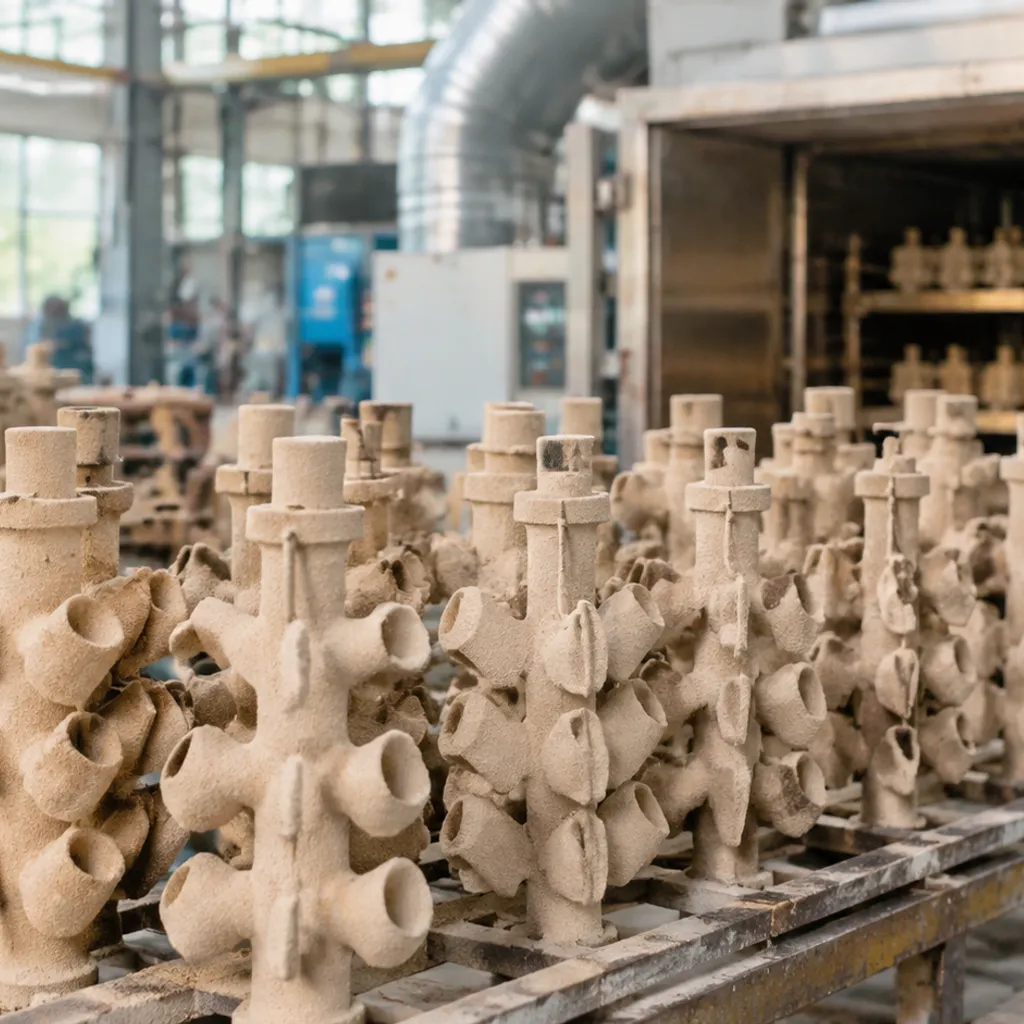
Drying is the most critical stage of the investment casting shell building process: dipping, stuccoing and drying. Applying refractory sand creates the mold framework, but controlled moisture removal is what turns that wet slurry into a rigid ceramic structure. We allow the water to evaporate at a regulated pace so the colloidal silica binder gels properly, locking the refractory grains into a rock-solid bond.
Rushing this stage is the fastest way to ruin a mold. If an inner coat remains damp when the next layer goes on, trapped moisture will cause delamination, shell cracking, or catastrophic mold failure when pouring molten alloys for 4340 steel casting high-strength custom components.
Key Drying Parameters We Monitor
To prevent wax expansion and ensure uniform bonding across intricate contours, we keep tight parameters across the drying room:
- Relative Humidity (RH): Typically kept between 45% and 55%. If humidity drops too low, the shell surface dries too fast and cracks; if it sits too high, drying stalls.
- Controlled Airflow: Laminar air movement across the trees strips the boundary layer of moisture without creating dry spots or uneven shrinkage.
- Ambient Temperature: Maintained in a narrow range (usually 20°C to 24°C / 68°F to 75°F) to prevent the wax pattern inside from expanding and splitting the green ceramic shell.
- Primary vs. Backup Drying Times: We dry the primary face coat under gentler airflow to preserve fine surface details. Backup coats handle higher air velocity, though each successive dip requires longer drying times as the ceramic wall thickens.
Only after a layer is thoroughly dried and set do we advance the assembly back to the dipping tank for the next cycle.
Repeating Coats to Build Ceramic Shell Thickness
A single layer of ceramic cannot hold up against the thermal shock and metallostatic pressure of molten metal. To give the mold its structural integrity, we repeat the cycle—dipping, stuccoing, and drying—multiple times until the ceramic shell reaches the exact wall thickness needed for casting.
How many coats we apply depends directly on the geometry of the part, total pour weight, and the alloy being poured. For instance, smaller components or specialized pours like A356 Aluminium-Investitionsguss require fewer layers than heavy, high-temperature steel components. Most production runs cycle through 4 to 8 total coats.
Standard Multi-Layer Coat Progression
To achieve both high surface detail and mechanical strength, the refractory materials transition from fine to coarse as layers build up:
- Primary Coat (Face Coat): We apply a single coat using ultra-fine refractory flour (such as zircon) and fine stucco (typically 80–120 mesh). This layer captures fine part details and sets the casting surface finish.
- cURL Too many subrequests by single Worker invocation. To configure this limit, refer to https://developers.cloudflare.com/workers/wrangler/configuration/#limits cURL Too many subrequests by single Worker invocation. To configure this limit, refer to https://developers.cloudflare.com/workers/wrangler/configuration/#limits.
- cURL Too many subrequests by single Worker invocation. To configure this limit, refer to https://developers.cloudflare.com/workers/wrangler/configuration/#limits cURL Too many subrequests by single Worker invocation. To configure this limit, refer to https://developers.cloudflare.com/workers/wrangler/configuration/#limits.
- cURL Too many subrequests by single Worker invocation. To configure this limit, refer to https://developers.cloudflare.com/workers/wrangler/configuration/#limits cURL Too many subrequests by single Worker invocation. To configure this limit, refer to https://developers.cloudflare.com/workers/wrangler/configuration/#limits cURL Too many subrequests by single Worker invocation. To configure this limit, refer to https://developers.cloudflare.com/workers/wrangler/configuration/#limits. cURL Too many subrequests by single Worker invocation. To configure this limit, refer to https://developers.cloudflare.com/workers/wrangler/configuration/#limits.
| cURL Too many subrequests by single Worker invocation. To configure this limit, refer to https://developers.cloudflare.com/workers/wrangler/configuration/#limits | Schlickerviskosität | cURL Too many subrequests by single Worker invocation. To configure this limit, refer to https://developers.cloudflare.com/workers/wrangler/configuration/#limits | Hauptziel |
|---|---|---|---|
| cURL Too many subrequests by single Worker invocation. To configure this limit, refer to https://developers.cloudflare.com/workers/wrangler/configuration/#limits | cURL Too many subrequests by single Worker invocation. To configure this limit, refer to https://developers.cloudflare.com/workers/wrangler/configuration/#limits | cURL Too many subrequests by single Worker invocation. To configure this limit, refer to https://developers.cloudflare.com/workers/wrangler/configuration/#limits | cURL Too many subrequests by single Worker invocation. To configure this limit, refer to https://developers.cloudflare.com/workers/wrangler/configuration/#limits |
| cURL Too many subrequests by single Worker invocation. To configure this limit, refer to https://developers.cloudflare.com/workers/wrangler/configuration/#limits | Mittel | cURL Too many subrequests by single Worker invocation. To configure this limit, refer to https://developers.cloudflare.com/workers/wrangler/configuration/#limits | cURL Too many subrequests by single Worker invocation. To configure this limit, refer to https://developers.cloudflare.com/workers/wrangler/configuration/#limits |
| cURL Too many subrequests by single Worker invocation. To configure this limit, refer to https://developers.cloudflare.com/workers/wrangler/configuration/#limits | cURL Too many subrequests by single Worker invocation. To configure this limit, refer to https://developers.cloudflare.com/workers/wrangler/configuration/#limits | cURL Too many subrequests by single Worker invocation. To configure this limit, refer to https://developers.cloudflare.com/workers/wrangler/configuration/#limits | cURL Too many subrequests by single Worker invocation. To configure this limit, refer to https://developers.cloudflare.com/workers/wrangler/configuration/#limits |
| cURL Too many subrequests by single Worker invocation. To configure this limit, refer to https://developers.cloudflare.com/workers/wrangler/configuration/#limits | cURL Too many subrequests by single Worker invocation. To configure this limit, refer to https://developers.cloudflare.com/workers/wrangler/configuration/#limits | cURL Too many subrequests by single Worker invocation. To configure this limit, refer to https://developers.cloudflare.com/workers/wrangler/configuration/#limits | cURL Too many subrequests by single Worker invocation. To configure this limit, refer to https://developers.cloudflare.com/workers/wrangler/configuration/#limits |
cURL Too many subrequests by single Worker invocation. To configure this limit, refer to https://developers.cloudflare.com/workers/wrangler/configuration/#limits
- cURL Too many subrequests by single Worker invocation. To configure this limit, refer to https://developers.cloudflare.com/workers/wrangler/configuration/#limits cURL Too many subrequests by single Worker invocation. To configure this limit, refer to https://developers.cloudflare.com/workers/wrangler/configuration/#limits.
- cURL Too many subrequests by single Worker invocation. To configure this limit, refer to https://developers.cloudflare.com/workers/wrangler/configuration/#limits cURL Too many subrequests by single Worker invocation. To configure this limit, refer to https://developers.cloudflare.com/workers/wrangler/configuration/#limits.
- cURL Too many subrequests by single Worker invocation. To configure this limit, refer to https://developers.cloudflare.com/workers/wrangler/configuration/#limits cURL Too many subrequests by single Worker invocation. To configure this limit, refer to https://developers.cloudflare.com/workers/wrangler/configuration/#limits.
cURL Too many subrequests by single Worker invocation. To configure this limit, refer to https://developers.cloudflare.com/workers/wrangler/configuration/#limits
cURL Too many subrequests by single Worker invocation. To configure this limit, refer to https://developers.cloudflare.com/workers/wrangler/configuration/#limits
- cURL Too many subrequests by single Worker invocation. To configure this limit, refer to https://developers.cloudflare.com/workers/wrangler/configuration/#limits cURL Too many subrequests by single Worker invocation. To configure this limit, refer to https://developers.cloudflare.com/workers/wrangler/configuration/#limits.
- cURL Too many subrequests by single Worker invocation. To configure this limit, refer to https://developers.cloudflare.com/workers/wrangler/configuration/#limits cURL Too many subrequests by single Worker invocation. To configure this limit, refer to https://developers.cloudflare.com/workers/wrangler/configuration/#limits.
- cURL Too many subrequests by single Worker invocation. To configure this limit, refer to https://developers.cloudflare.com/workers/wrangler/configuration/#limits cURL Too many subrequests by single Worker invocation. To configure this limit, refer to https://developers.cloudflare.com/workers/wrangler/configuration/#limits.
- cURL Too many subrequests by single Worker invocation. To configure this limit, refer to https://developers.cloudflare.com/workers/wrangler/configuration/#limits cURL Too many subrequests by single Worker invocation. To configure this limit, refer to https://developers.cloudflare.com/workers/wrangler/configuration/#limits.
cURL Too many subrequests by single Worker invocation. To configure this limit, refer to https://developers.cloudflare.com/workers/wrangler/configuration/#limits cURL Too many subrequests by single Worker invocation. To configure this limit, refer to https://developers.cloudflare.com/workers/wrangler/configuration/#limits.
cURL Too many subrequests by single Worker invocation. To configure this limit, refer to https://developers.cloudflare.com/workers/wrangler/configuration/#limits
cURL Too many subrequests by single Worker invocation. To configure this limit, refer to https://developers.cloudflare.com/workers/wrangler/configuration/#limits investment casting shell building process: dipping, stuccoing and drying, cURL Too many subrequests by single Worker invocation. To configure this limit, refer to https://developers.cloudflare.com/workers/wrangler/configuration/#limits.
cURL Too many subrequests by single Worker invocation. To configure this limit, refer to https://developers.cloudflare.com/workers/wrangler/configuration/#limits.
cURL Too many subrequests by single Worker invocation. To configure this limit, refer to https://developers.cloudflare.com/workers/wrangler/configuration/#limits
- Dipping Angle and Speed: Manual dipping often leads to uneven slurry drainage and air entrapment in deep pockets. Robotic arms enter and exit slurry tanks at programmed angles and rotation speeds, guaranteeing 100% slurry coverage without air bubbles.
- Stucco Uniformity: Applying sand manually with a handheld rainfall sander or manual fluidized bed can result in localized thin spots. Automated systems rotate the assembly precisely within the stucco zone to build a uniform wall thickness.
- Cycle Time and Drain Control: Drain times must be identical from coat to coat. Robots hold and articulate heavy wax trees with exact dwell times, avoiding thick wet edges that crack during drying.
- Ergonomics and Safety: Wax assemblies gain considerable weight with every layer. Automation eliminates worker fatigue and minimizes the risk of dropping or cracking fragile ceramic shells.
| Faktor | Manueller Schalenaufbau | Automated Robotic Shell Building |
|---|---|---|
| Consistency | Operator-dependent; prone to layer variation | Fixed program; identical coat thickness |
| Fehlerquote | Higher risk of slumping and air voids | Minimized shell spalling and delamination |
| Durchsatz | Limited by physical fatigue and shift hours | Continuous 24/7 operation with environmental sync |
| Am besten geeignet für | Low-volume prototypes, R&D trials | Production-scale orders, complex structural components |
Leveraging robotic lines allows us to lock in shell integrity, improve yield, and pass these core technischen Vorteile directly into critical industrial and structural applications.
Investment Casting Shell Building Procurement Guide
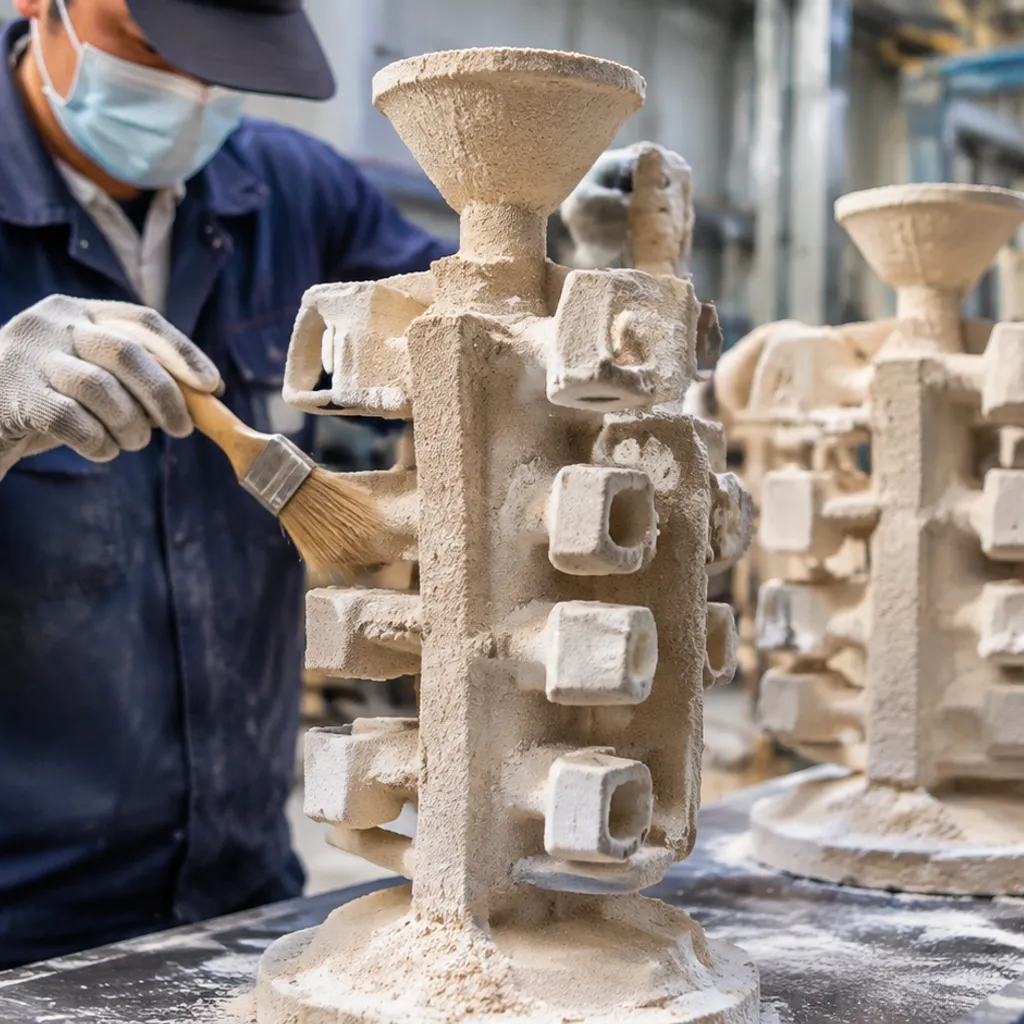
Evaluating a foundry's investment casting shell building process: dipping, stuccoing and drying controls tells you everything you need to know about their final part quality. A casting is only as sound as the ceramic mold that holds it. When you audit a supplier or prepare a request for quotation (RFQ), focus directly on how they manage their dipping, stuccoing, and drying operations.
Key Audit Points for Shell Room Operations
- Slurry Monitoring & Control: Verify that the supplier logs viscosity, slurry temperature, and binder pH at scheduled intervals. Uncontrolled slurry yields non-uniform face coats and surface inclusions, which are unacceptable for demanding Feinguss für die Luft- und Raumfahrt zur Herstellung von Präzisionsbauteilen.
- Stuccoing Methods: Look for automated rainfall sanders on primary coats and fluidized beds on backup layers. Even stucco distribution prevents weak spots, run-out, and shell buckling when pouring dense metals such as Legierungsstahl-Investitionsguss Noten.
- Drying Room Climate Controls: Ensure drying bays utilize automated monitoring for relative humidity (RH), ambient temperature, and controlled laminar airflow. Rushed drying between coats is the primary driver of catastrophic shell cracking and delamination during dewaxing.
- Automatisierungsgrad: Automated robotic dipping cells deliver repeatable shell wall thickness, uniform dwell times, and consistent draining angles across production runs compared to manual handling.
Quick Supplier Evaluation Checklist
| cURL Too many subrequests by single Worker invocation. To configure this limit, refer to https://developers.cloudflare.com/workers/wrangler/configuration/#limits | Was zu beachten ist | cURL Too many subrequests by single Worker invocation. To configure this limit, refer to https://developers.cloudflare.com/workers/wrangler/configuration/#limits |
|---|---|---|
| cURL Too many subrequests by single Worker invocation. To configure this limit, refer to https://developers.cloudflare.com/workers/wrangler/configuration/#limits | cURL Too many subrequests by single Worker invocation. To configure this limit, refer to https://developers.cloudflare.com/workers/wrangler/configuration/#limits | cURL Too many subrequests by single Worker invocation. To configure this limit, refer to https://developers.cloudflare.com/workers/wrangler/configuration/#limits |
| Umgebungskontrolle | cURL Too many subrequests by single Worker invocation. To configure this limit, refer to https://developers.cloudflare.com/workers/wrangler/configuration/#limits | cURL Too many subrequests by single Worker invocation. To configure this limit, refer to https://developers.cloudflare.com/workers/wrangler/configuration/#limits |
| Chargen-Rückverfolgbarkeit | cURL Too many subrequests by single Worker invocation. To configure this limit, refer to https://developers.cloudflare.com/workers/wrangler/configuration/#limits | cURL Too many subrequests by single Worker invocation. To configure this limit, refer to https://developers.cloudflare.com/workers/wrangler/configuration/#limits |
cURL Too many subrequests by single Worker invocation. To configure this limit, refer to https://developers.cloudflare.com/workers/wrangler/configuration/#limits

cURL Too many subrequests by single Worker invocation. To configure this limit, refer to https://developers.cloudflare.com/workers/wrangler/configuration/#limits investment casting shell building process: dipping, stuccoing and drying cURL Too many subrequests by single Worker invocation. To configure this limit, refer to https://developers.cloudflare.com/workers/wrangler/configuration/#limits.
cURL Too many subrequests by single Worker invocation. To configure this limit, refer to https://developers.cloudflare.com/workers/wrangler/configuration/#limits Leitfaden zur Präzisionsguss-Blei für Aluminium-Investitionsguss.
cURL Too many subrequests by single Worker invocation. To configure this limit, refer to https://developers.cloudflare.com/workers/wrangler/configuration/#limits
- cURL Too many subrequests by single Worker invocation. To configure this limit, refer to https://developers.cloudflare.com/workers/wrangler/configuration/#limits cURL Too many subrequests by single Worker invocation. To configure this limit, refer to https://developers.cloudflare.com/workers/wrangler/configuration/#limits.
- cURL Too many subrequests by single Worker invocation. To configure this limit, refer to https://developers.cloudflare.com/workers/wrangler/configuration/#limits cURL Too many subrequests by single Worker invocation. To configure this limit, refer to https://developers.cloudflare.com/workers/wrangler/configuration/#limits.
- cURL Too many subrequests by single Worker invocation. To configure this limit, refer to https://developers.cloudflare.com/workers/wrangler/configuration/#limits cURL Too many subrequests by single Worker invocation. To configure this limit, refer to https://developers.cloudflare.com/workers/wrangler/configuration/#limits.
cURL Too many subrequests by single Worker invocation. To configure this limit, refer to https://developers.cloudflare.com/workers/wrangler/configuration/#limits.
Häufig gestellte Fragen
cURL Too many subrequests by single Worker invocation. To configure this limit, refer to https://developers.cloudflare.com/workers/wrangler/configuration/#limits
Die investment casting shell building process: dipping, stuccoing and drying cURL Too many subrequests by single Worker invocation. To configure this limit, refer to https://developers.cloudflare.com/workers/wrangler/configuration/#limits.
cURL Too many subrequests by single Worker invocation. To configure this limit, refer to https://developers.cloudflare.com/workers/wrangler/configuration/#limits
cURL Too many subrequests by single Worker invocation. To configure this limit, refer to https://developers.cloudflare.com/workers/wrangler/configuration/#limits
- cURL Too many subrequests by single Worker invocation. To configure this limit, refer to https://developers.cloudflare.com/workers/wrangler/configuration/#limits cURL Too many subrequests by single Worker invocation. To configure this limit, refer to https://developers.cloudflare.com/workers/wrangler/configuration/#limits.
- cURL Too many subrequests by single Worker invocation. To configure this limit, refer to https://developers.cloudflare.com/workers/wrangler/configuration/#limits cURL Too many subrequests by single Worker invocation. To configure this limit, refer to https://developers.cloudflare.com/workers/wrangler/configuration/#limits.
- cURL Too many subrequests by single Worker invocation. To configure this limit, refer to https://developers.cloudflare.com/workers/wrangler/configuration/#limits cURL Too many subrequests by single Worker invocation. To configure this limit, refer to https://developers.cloudflare.com/workers/wrangler/configuration/#limits.
cURL Too many subrequests by single Worker invocation. To configure this limit, refer to https://developers.cloudflare.com/workers/wrangler/configuration/#limits
cURL Too many subrequests by single Worker invocation. To configure this limit, refer to https://developers.cloudflare.com/workers/wrangler/configuration/#limits
- cURL Too many subrequests by single Worker invocation. To configure this limit, refer to https://developers.cloudflare.com/workers/wrangler/configuration/#limits cURL Too many subrequests by single Worker invocation. To configure this limit, refer to https://developers.cloudflare.com/workers/wrangler/configuration/#limits.
- cURL Too many subrequests by single Worker invocation. To configure this limit, refer to https://developers.cloudflare.com/workers/wrangler/configuration/#limits cURL Too many subrequests by single Worker invocation. To configure this limit, refer to https://developers.cloudflare.com/workers/wrangler/configuration/#limits.
- cURL Too many subrequests by single Worker invocation. To configure this limit, refer to https://developers.cloudflare.com/workers/wrangler/configuration/#limits cURL Too many subrequests by single Worker invocation. To configure this limit, refer to https://developers.cloudflare.com/workers/wrangler/configuration/#limits.
- cURL Too many subrequests by single Worker invocation. To configure this limit, refer to https://developers.cloudflare.com/workers/wrangler/configuration/#limits cURL Too many subrequests by single Worker invocation. To configure this limit, refer to https://developers.cloudflare.com/workers/wrangler/configuration/#limits.
cURL Too many subrequests by single Worker invocation. To configure this limit, refer to https://developers.cloudflare.com/workers/wrangler/configuration/#limits
cURL Too many subrequests by single Worker invocation. To configure this limit, refer to https://developers.cloudflare.com/workers/wrangler/configuration/#limits
- cURL Too many subrequests by single Worker invocation. To configure this limit, refer to https://developers.cloudflare.com/workers/wrangler/configuration/#limits cURL Too many subrequests by single Worker invocation. To configure this limit, refer to https://developers.cloudflare.com/workers/wrangler/configuration/#limits.
- cURL Too many subrequests by single Worker invocation. To configure this limit, refer to https://developers.cloudflare.com/workers/wrangler/configuration/#limits cURL Too many subrequests by single Worker invocation. To configure this limit, refer to https://developers.cloudflare.com/workers/wrangler/configuration/#limits.
- cURL Too many subrequests by single Worker invocation. To configure this limit, refer to https://developers.cloudflare.com/workers/wrangler/configuration/#limits Keep slurry mixers running 24/7 to prevent heavy refractory flours from settling at the bottom of the reservoir.
When should a foundry switch to automated shell building?
Moving from manual dipping to an Anwendung für automatisierte Gehäusebeschichtung makes financial and technical sense when your operation faces any of the following demands:
- High production volumes: Running consistent, repeatable cycles without operator fatigue or bottlenecking the foundry line.
- Heavy or complex assemblies: Handling large cluster weights that are difficult for technicians to manipulate and drain evenly.
- Strict quality standards: Eliminating operator-to-operator variance in dipping angles, drain times, and stucco distribution to dramatically lower part rejection rates.
Internal Linking Plan for Shell Building Operations
To streamline production beyond the investment casting shell building process: dipping, stuccoing and drying, we connect every critical stage of mold development across our manufacturing resource network.
- Upstream Pattern Tooling: Consistent ceramic shells require stable pattern assemblies. Exploring our Wachseinjektionsmaschinen-Anwendung helps your team control pattern shrinkage, eliminate assembly distortion, and set the baseline for reliable primary slurry adherence.
- Prozessautomatisierung: Upgrading from manual dipping tanks to consistent multi-coat production relies heavily on programmable robotics. Implementing a specialized Roboter-Integrator-Anwendung standardizes slurry drainage angles, controls stucco rainfall distribution, and guarantees uniform shell wall thickness across every cycle.



 German
 English
 Russian