
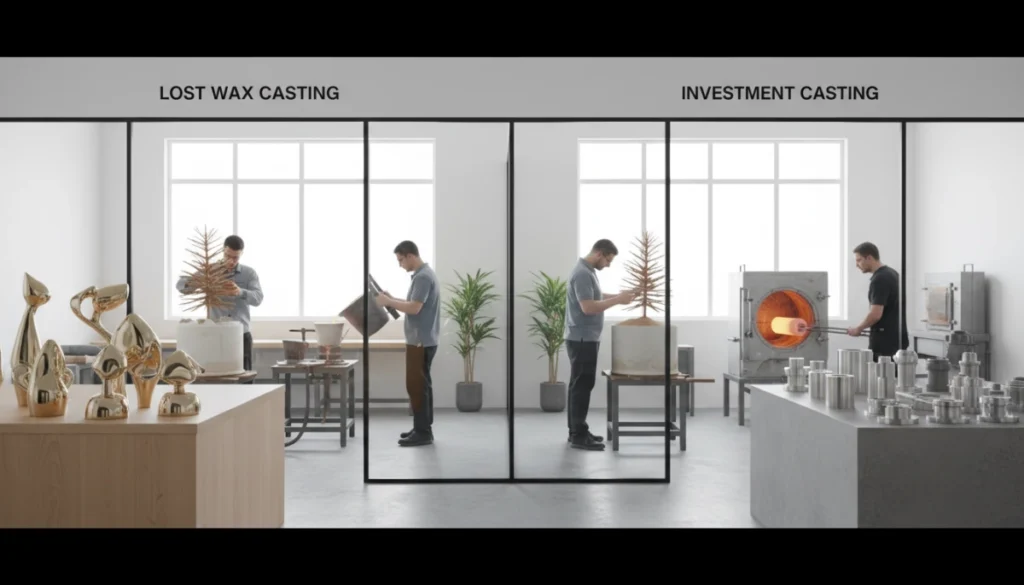
The Historical Origins of Lost Wax Casting
When evaluating lost wax casting vs investment casting, it is essential to understand that they are fundamentally the same process, separated only by time and technological advancement. Lost wax casting is a manufacturing technique with roots stretching back over 5,000 years. Early metallurgists and artisans shaped beeswax by hand, coated it in clay, and melted the wax away to create a hollow mold for molten metals.
Key characteristics of historical lost wax casting:
- Ancient Origins: Pioneered by ancient civilizations in Mesopotamia, Egypt, and Asia.
- Basic Materials: Relied strictly on natural beeswax and rudimentary clay mixtures.
- Artistic Focus: Primarily utilized for crafting one-off jewelry, cultural artifacts, and religious sculptures.
The Modern Industrial Investment Casting Process
Today, this ancient artistic method has evolved into the highly engineered industrial process known as investment casting. The core principle of sacrificing a wax model remains, but modern manufacturing demands absolute precision, tight tolerances, and the ability to pour advanced metal alloys.
The modern process replaces hand-carved beeswax with perfectly injected industrial wax patterns and swaps basic clay for high-strength refractory materials.
The modern industrial process is defined by:
- Automated Wax Injection: Utilizing a state-of-the-art wax injection machine to mass-produce highly accurate, repeatable wax models.
- Advanced Refractory Molds: Coating the wax assembly in specialized slurries to build a durable ceramic shell capable of withstanding extreme thermal shock.
- Unmatched Precision: Delivering intricate metal components with exceptional surface finishes that eliminate the need for secondary machining, far surpassing the capabilities of traditional sand casting or standard die casting.
How Does the Lost Wax Investment Casting Process Work?
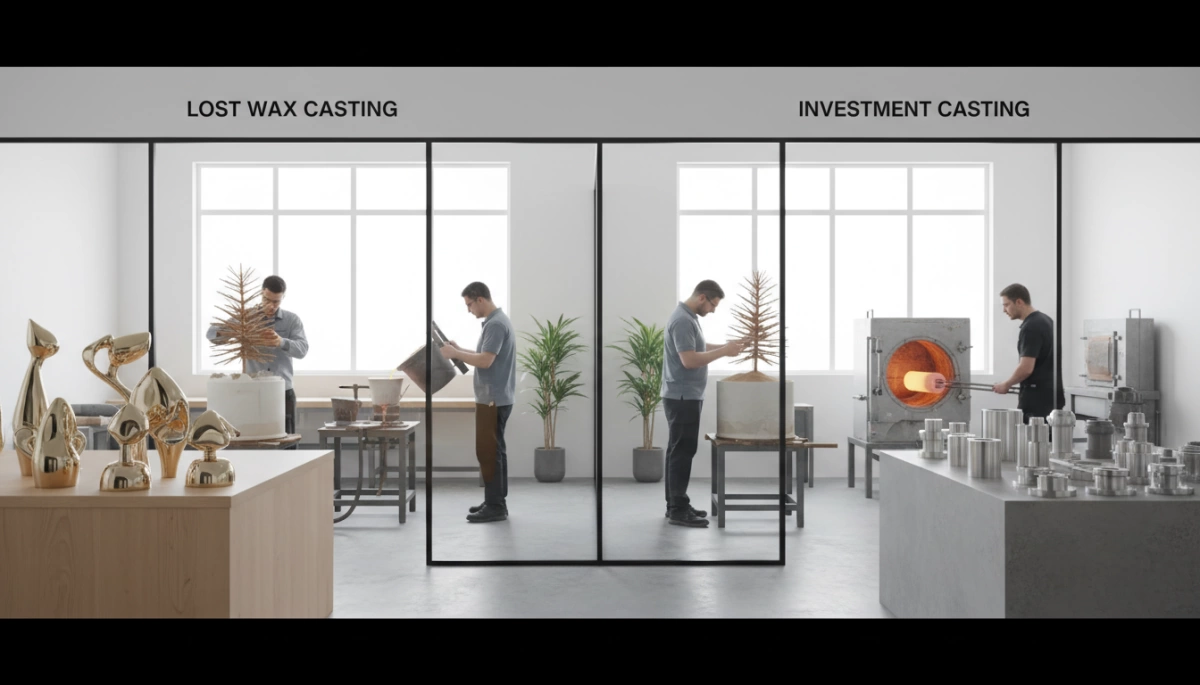
Here is how we turn a simple wax model into a durable metal part.
Creating the Wax Pattern and Assembly
Everything starts with the wax. We inject molten wax into an aluminum die to create exact replicas of the final part. As an experienced wax injection machine Manufacturer and supplier, we provide the automatic wax injection machines that make this initial step incredibly fast and repeatable.
- Pattern Creation: Wax fills the mold to form individual, highly detailed wax patterns.
- Tree Assembly: Workers attach these wax patterns to a central wax sprue. This assembled structure looks exactly like a tree, with the sprue acting as the trunk and the parts as the branches.
Building the Ceramic Shell Mold
Next, we build the rigid mold that will eventually hold the molten metal.
- Slurry Dipping: We submerge the entire wax tree into a liquid ceramic slurry.
- Stuccoing: We immediately coat the wet tree with fine sand and let it dry.
- Layering: We repeat this dipping and coating cycle multiple times. This builds a thick, robust ceramic shell around the wax. This hard outer shell is the key to maintaining tight tolerances during the metal pour.
Melting, Metal Pouring, and Finishing
The final stage requires high heat and precision casting expertise to bring the metal parts to life.
- Dewaxing: We place the hardened shell into a high-heat autoclave. The heat melts the wax, which runs out of the shell completely. This is the “lost wax” step of the lost wax casting process.
- Metal Pouring: We preheat the empty ceramic shell to strengthen it and prevent thermal shock. Then, we pour liquid metal alloys directly into the hollow cavity.
- Finishing: Once the metal cools and solidifies, we break away and remove the ceramic shell. We cut the individual castings off the central sprue, grind down the attachment points, and polish the surfaces. The final results are highly accurate, intricate metal components ready for industrial use.
Key Advantages of Using Investment Casting
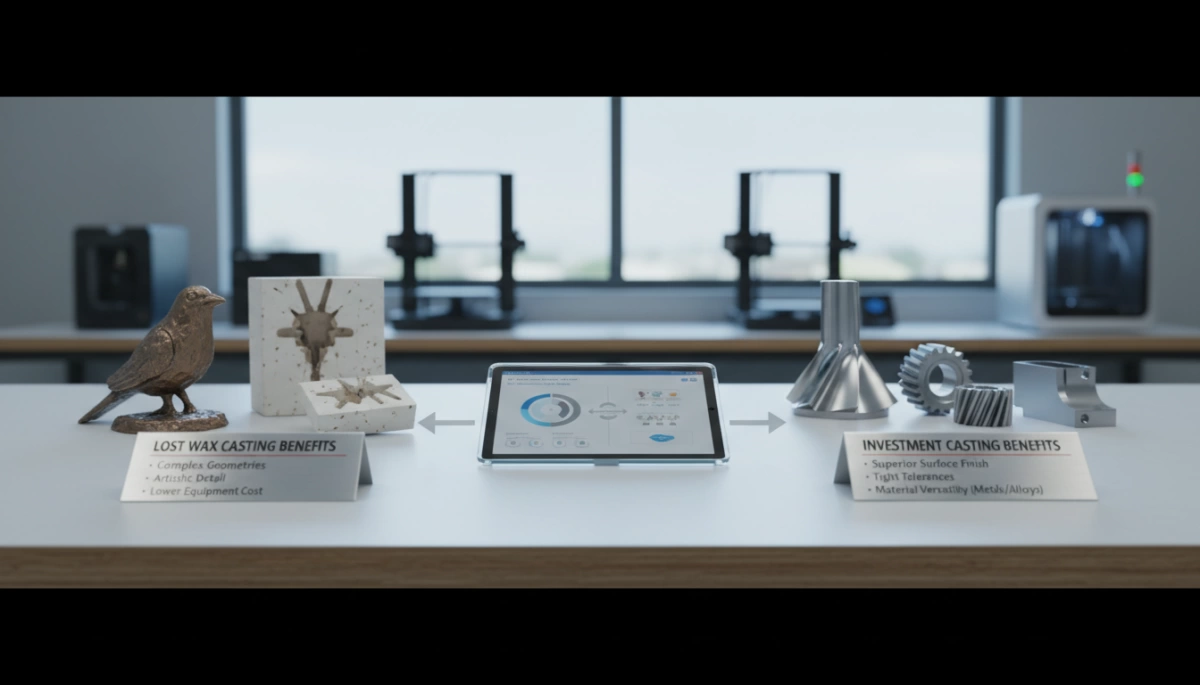
When looking at lost wax casting vs investment casting, you quickly realize they refer to the exact same reliable process. Unlike standard die casting or basic sand casting, this precision casting technique offers unmatched benefits for modern manufacturing.
High Dimensional Precision and Accuracy
- Tight tolerances: Parts come out exact, drastically reducing the need for costly secondary machining.
- Total Consistency: Every single piece matches the original design specs. Leveraging automation in casting processes guarantees this high precision is maintained even across massive production runs.
Excellent Surface Finish Quality
- Smooth out of the mold: The high-quality ceramic shell forms tightly around the incredibly smooth wax patterns, leaving a nearly flawless exterior on the final metal part.
- Direct Cost Savings: You save major time and money because extensive grinding, heavy sandblasting, or manual polishing is rarely needed.
Design Flexibility for Complex Shapes
- No design limits: You can easily produce intricate metal components with severe undercuts, incredibly thin walls, and complex internal channels that other methods simply cannot handle.
- Material variety: You are never locked into one material; this process works flawlessly with a massive variety of hard-to-machine metal alloys.
- This total design freedom is a distinct advantage of investment casting over green sand casting, giving you the power to innovate without strict manufacturing constraints.
Ideal Metals and Materials for Investment Casting
We regularly see foundries pouring almost every type of metal imaginable. This process excels at handling complex metal alloys to create intricate metal components that require tight tolerances. If you want a deeper dive into specific material properties, check out our comprehensive breakdown of lost wax casting materials.
Stainless Steel and Carbon Steel Alloys
Steel alloys are the backbone of industrial precision casting. They offer unmatched durability, strength, and structural integrity for demanding applications.
- Stainless Steel: The go-to choice for parts requiring high corrosion resistance and a clean surface finish. We frequently see this used for medical devices, marine hardware, and food processing equipment.
- Carbon Steel: Delivers excellent mechanical properties and heavy-duty wear resistance at a more economical price point. It is ideal for mining equipment, agricultural tools, and structural brackets.
Aluminum, Brass, and Copper Alloys
When your project calls for lightweight structures or high conductivity, non-ferrous metals are the clear winner. By creating high-quality wax patterns and encasing them in a rigid ceramic shell, this casting method captures the finest details even in these softer metals.
- Aluminum Alloys: Offers an exceptional strength-to-weight ratio. It is highly favored in the aerospace and automotive industries where reducing overall part weight is critical.
- Brass and Copper: Known for superior electrical and thermal conductivity, along with excellent machinability. These alloys are perfect for electrical connectors, plumbing fixtures, and specialized heat exchangers.
Common Industries and Application Scenarios
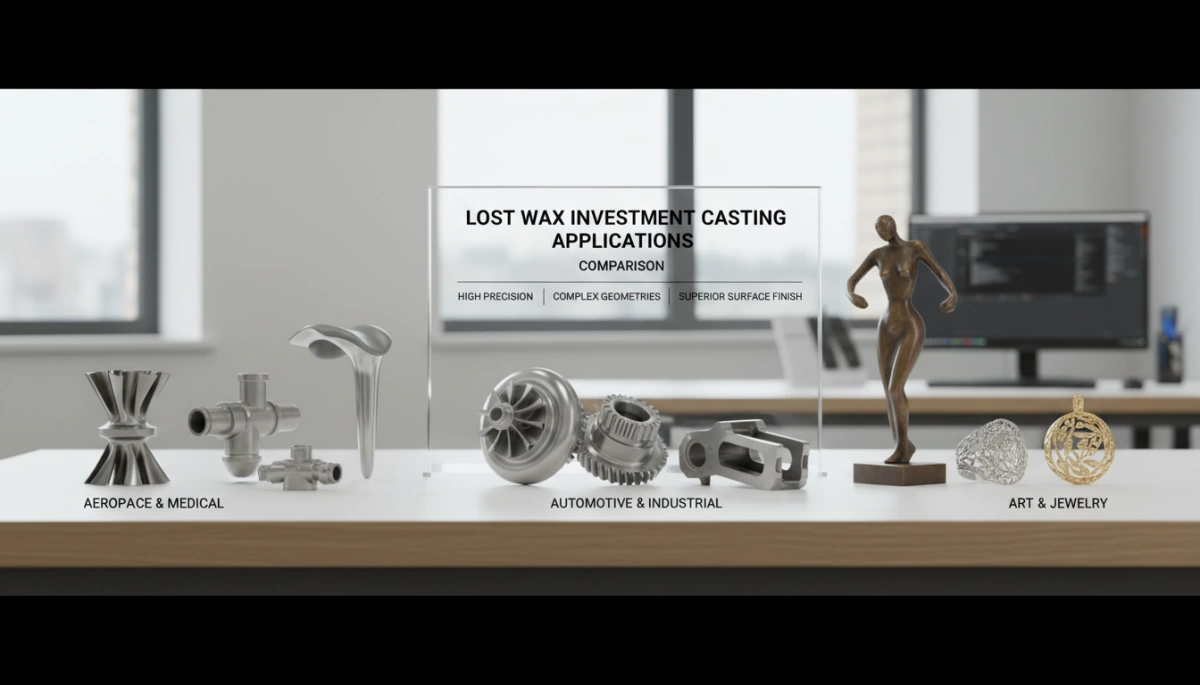
Aerospace and Aircraft Components
The aerospace sector has zero room for error. Flight-critical parts like turbine blades, landing gear structures, and hydraulic fluid components rely entirely on precision casting.
- Heat Resistance: Uses high-performance metal alloys that survive extreme jet engine temperatures.
- Production Scaling: To meet strict dimensional accuracy, modern foundries constantly upgrade their setups, often comparing an investment casting wax injection machine vs two-station wax injection machine to rapidly produce flawless wax patterns.
Automotive and Railway Castings
Vehicle and rail manufacturers prioritize parts that are both lightweight and incredibly durable to maximize fuel efficiency and structural safety.
- Key Applications: Transmission gears, engine mounts, and complex exhaust manifolds.
- Structural Integrity: Creating a robust ceramic shell is just the first step. Using a high-quality dewaxing autoclave ensures the mold is completely clear and ready for molten metal, resulting in defect-free parts that can handle daily high-speed stress.
Agricultural Machinery and Equipment Parts
Farming equipment takes a daily beating from rocks, dirt, and heavy loads. The components keeping these machines running must resist severe wear and tear.
- Tough Components: Cultivator sweeps, heavy-duty brackets, and baler gears.
- Superior Lifespan: For these rugged parts, investment casting consistently outperforms traditional sand casting and die casting. It delivers incredibly strong, wear-resistant parts right out of the mold, eliminating the need for expensive secondary machining.
Investment Casting vs. Other Manufacturing Methods
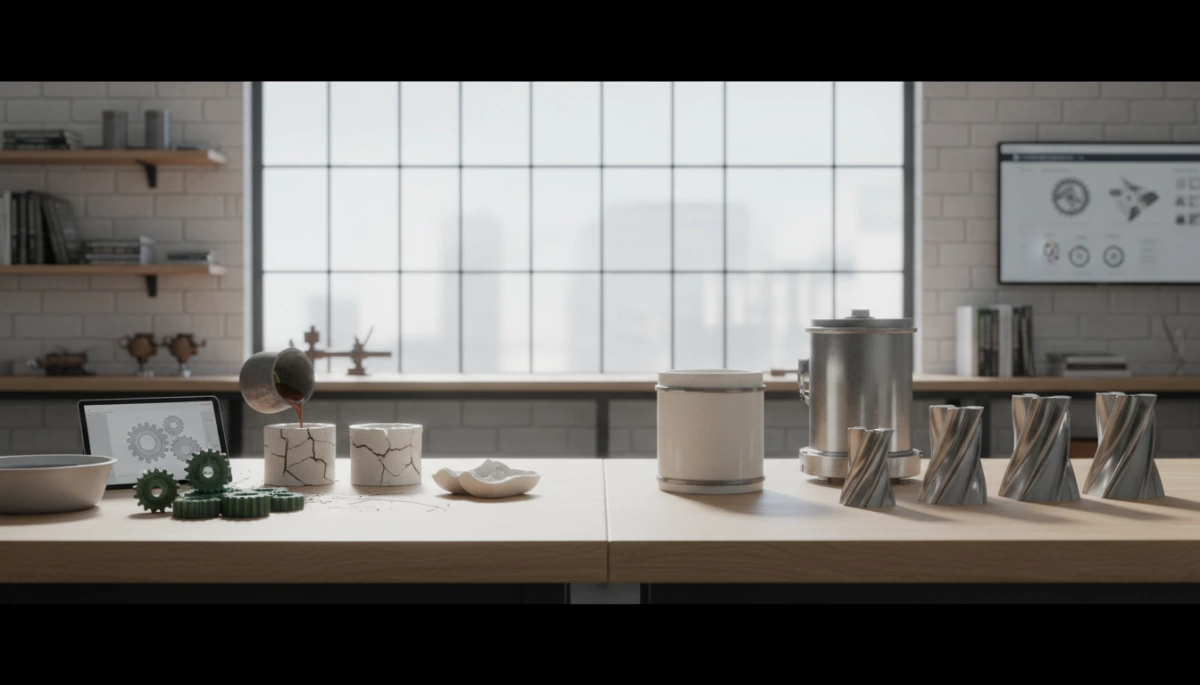
Let’s look at how the lost wax casting vs investment casting process holds up against other popular manufacturing techniques. Choosing the right process depends entirely on your project’s specific need for precision, volume, and material flexibility. Here is how it compares to the alternatives.
Investment Casting vs. Sand Casting
- Surface Finish: Sand casting leaves a rough, textured surface. Investment casting uses a high-quality ceramic shell to deliver superior, smooth finishes right out of the mold, eliminating the need for heavy post-processing.
- Precision: If you are manufacturing intricate metal components, investment casting provides the tight tolerances and thin walls that standard sand casting simply cannot achieve.
- For a broader look at alternative casting environments, you can review the core differences between die casting vs sand casting.
Investment Casting vs. Die Casting
- Material Options: Die casting is generally limited to non-ferrous materials like aluminum and zinc. Investment casting handles a massive variety of metal alloys, including high-grade stainless steels and titanium.
- Tooling Costs: Die casting requires extremely expensive, hardened steel molds designed for massive production runs. The wax patterns used in investment casting keep upfront tooling costs significantly lower, making it the smarter choice for low-to-medium volume production.
Investment Casting vs. CNC Machining
- Material Waste: CNC machining carves parts out of a solid metal block, generating high amounts of scrap. Precision casting is a near-net-shape process, drastically reducing material waste and raw material costs.
- Design Freedom: Machining complex internal cavities can be difficult, expensive, or downright impossible. Casting handles these internal geometries effortlessly. Often, the most cost-effective route is a hybrid approach—using investment casting to form the complex base shape and reserving CNC machining strictly for finalizing the most critical mating surfaces.
How to Choose the Right Casting Method for Your Project
Deciding the best manufacturing route often comes down to understanding the nuances of lost wax casting vs investment casting—which are two names for the same process—and comparing it against other methods. To make the right call for your intricate metal components, you must weigh several core production factors.
Evaluating Production Volume and Lead Times
Your expected production run size heavily dictates the method you choose. Precision casting is ideal for low-to-medium volume runs. It inherently takes time to build the ceramic shell and melt out the wax patterns.
Here is a quick breakdown to guide your timeline and volume expectations:
| Casting Method | Ideal Production Volume | Typical Lead Time |
|---|---|---|
| Investment Casting | Low to Medium | Moderate to Long |
| Die Casting | Very High | Short (after long initial setup) |
| Sand Casting | Low to High | Short to Moderate |
Assessing Tooling Costs and Part Complexity
Tooling costs and design complexity are where investment casting takes the lead. The tooling needed to create wax molds is significantly cheaper than the hardened steel tools required for die casting.
If your design demands tight tolerances, thin walls, or complex internal cavities, investment casting is your best option. The accuracy of the final piece relies heavily on the quality of the initial wax mold. As a dedicated wax injection machine Manufacturer and supplier, we know firsthand that producing high-quality parts from various metal alloys starts with flawless wax injection. Compare your tooling budget against your need for extreme detail, and the right manufacturing choice becomes clear.
 English
  Russian
  German