
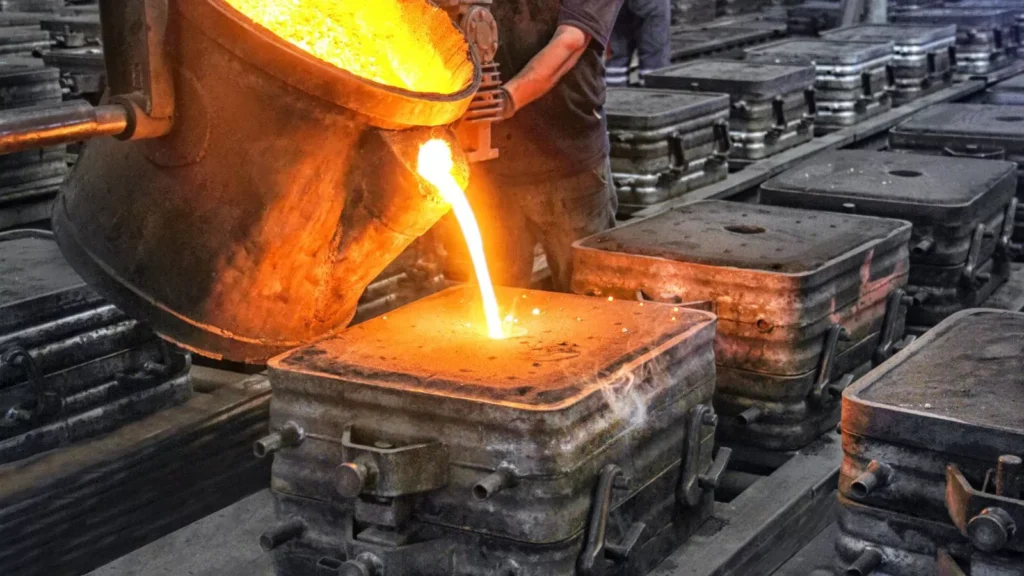
Discover precision sand mold casting services by Vastpce for steel and alloy parts with CNC machining and advanced quality testing.
The Anatomy of the Sand Casting Process
At Vast Precision, we transform raw blueprints into durable industrial components through a rigorous sand mold casting workflow. This process is not merely packing sand around a shape; it is a precise engineering cycle designed to minimize defects and maximize structural integrity. From metal casting pattern making to final shakeout, every step is calculated to ensure the final part meets strict dimensional tolerances.
Step 1: Pattern Making and Shrinkage Calculation
The foundation of any successful sand casting mold is the master pattern. We do not simply replicate the final part dimensions; we engineer the pattern to account for thermal contraction.
- Shrinkage Allowance: Molten metal shrinks as it solidifies and cools. We oversize the pattern—typically by 1% to 2% depending on whether we are pouring ductile iron or steel—to ensure the final metal casting in sand meets the required specifications.
- Draft Angles: We incorporate slight tapers on vertical walls to ensure the pattern can be removed from the casting sand without damaging the mold cavity.
Step 2: Mold Preparation (Green Sand vs. Resin Sand)
Selecting the right molding medium is critical for balancing cost against surface finish requirements. We specialize in two primary methods:
- Green Sand: A mixture of silica sand, clay, and water. This is our go-to for cost-effective, high-volume production of small to medium parts.
- Resin Sand: Uses chemical binders to create a harder, more rigid mold. We use this for larger, complex components requiring superior surface finishes and tighter dimensional accuracy.
Creating Internal Cavities:
For parts like pump housings or manifolds, we utilize sand cores. These are hardened sand shapes inserted into the mold to define internal voids where molten metal cannot flow.
Step 3: Assembly (Cope & Drag) and Gating System Design
Once the mold halves—the cope and drag mold—are prepared, we assemble them with the cores set firmly in place. The success of the pour depends heavily on the gating and riser system:
- Gating Design: We engineer the runners and gates to control the velocity of the molten metal. Proper flow prevents turbulence, which is a primary cause of gas porosity and sand inclusion defects.
- Risers: We place reservoirs of molten metal (risers) at critical points to feed the casting as it shrinks during solidification, preventing voids in the final part.
Step 4: Pouring, Solidification, and Shakeout
With the sand casting molding assembly clamped securely, we pour the specific alloy grade into the cavity. After controlled solidification, the casting undergoes shakeout, where the metal casting sand mold is vibrated away. This reveals the rough casting, which is then moved to our finishing department for gate removal and secondary CNC machining.
Material Capabilities: What Can We Cast?
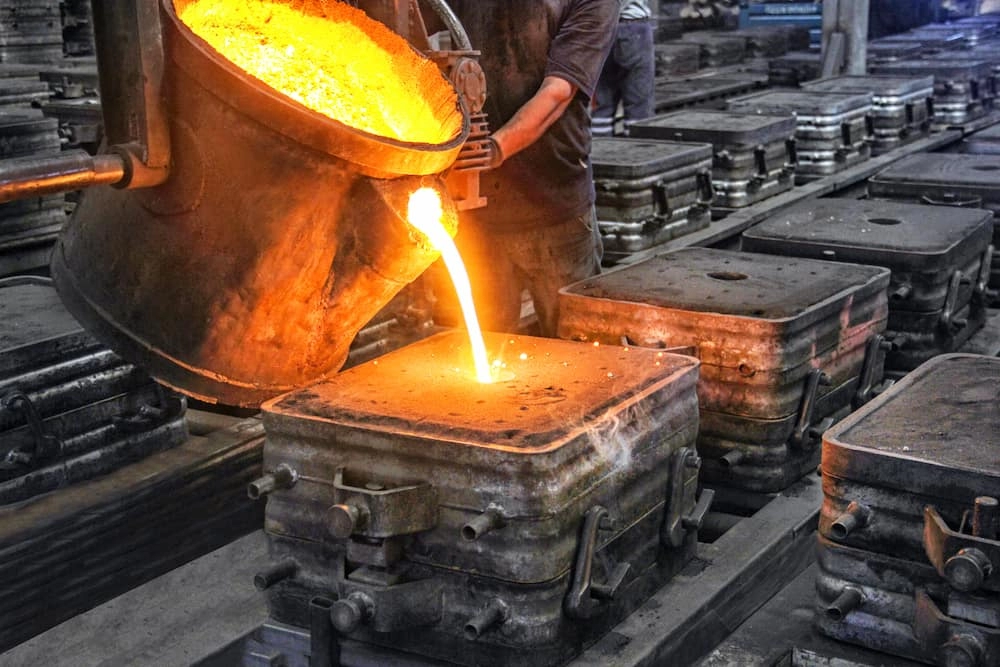
At Vast Precision, we specialize in ferrous metal casting using advanced sand molding techniques. One of the biggest advantages of sand mold casting is the freedom to choose from a massive library of alloys without the strict limitations found in other manufacturing processes. This material versatility is often a deciding factor when comparing die casting vs. sand casting for high-melting-point industrial parts.
We tailor our material selection to meet specific mechanical properties, ensuring every component performs reliably in its intended environment:
- Carbon Steel: The standard for heavy-duty structural components. We cast carbon steel for parts where high tensile strength, durability, and impact resistance are non-negotiable.
- Stainless Steel: We frequently process grades like 304, 316, and 17-4PH. These are essential for applications requiring superior corrosion resistance, such as fluid handling or marine equipment.
- Heat-Resistant Alloys: For machinery operating in extreme thermal conditions, we utilize specialized steel alloy casting grades that maintain structural integrity at high temperatures.
- Iron Alloys: Our foundry also handles Ductile Iron (GGG40, GGG50) and Gray Iron for applications requiring excellent machinability and vibration damping.
Adhering to Global Standards
We don’t just pour metal; we engineer to specification. Our production strictly follows international ASTM casting standards, as well as DIN and EN equivalents. Whether you need a specific material grade for the US market or a metric equivalent for Europe, we ensure the chemical composition and mechanical properties match your blueprint requirements exactly.
Sand Casting vs. Investment Casting: Making the Right Choice
Deciding between sand mold casting and investment casting often comes down to balancing precision requirements with budget constraints. At Vast Precision, we handle both processes, allowing us to objectively analyze your blueprints and recommend the method that best fits your project’s volume and technical specifications.
Comparing Surface Finish and Precision
If your component requires a smooth surface straight out of the mold, investment casting is typically superior. It achieves lower Surface finish (Ra values) and tighter tolerances, reducing the need for secondary processing. Sand casting generally produces a rougher surface texture; however, our resin sand process significantly improves surface quality compared to traditional green sand. For projects demanding high-precision investment casting, consistent shell building via automated shell coating is critical for maintaining dimensional accuracy.
Cost Efficiency and Tooling Expenses
Budgeting for casting involves looking at both upfront tooling and per-unit costs:
- Sand Casting: Offers lower tooling costs, making it the most cost-efficient choice for low-to-medium production volumes or large structural parts.
- Investment Casting: Requires higher initial investment to create metal dies for the wax injection machine. However, this method often lowers total project costs for high-volume runs by eliminating extensive machining requirements.
Size Constraints and Volume Considerations
Sand mold casting is the undisputed champion for large, heavy-duty components. We can cast parts weighing several hundred kilograms, such as large pump housings or engine blocks, which would be impossible with investment casting. Conversely, investment casting is ideal for small, complex steel alloy parts with thin walls and intricate internal passageways that sand molds cannot support.
Beyond the Mold: The One-Stop Manufacturing Advantage
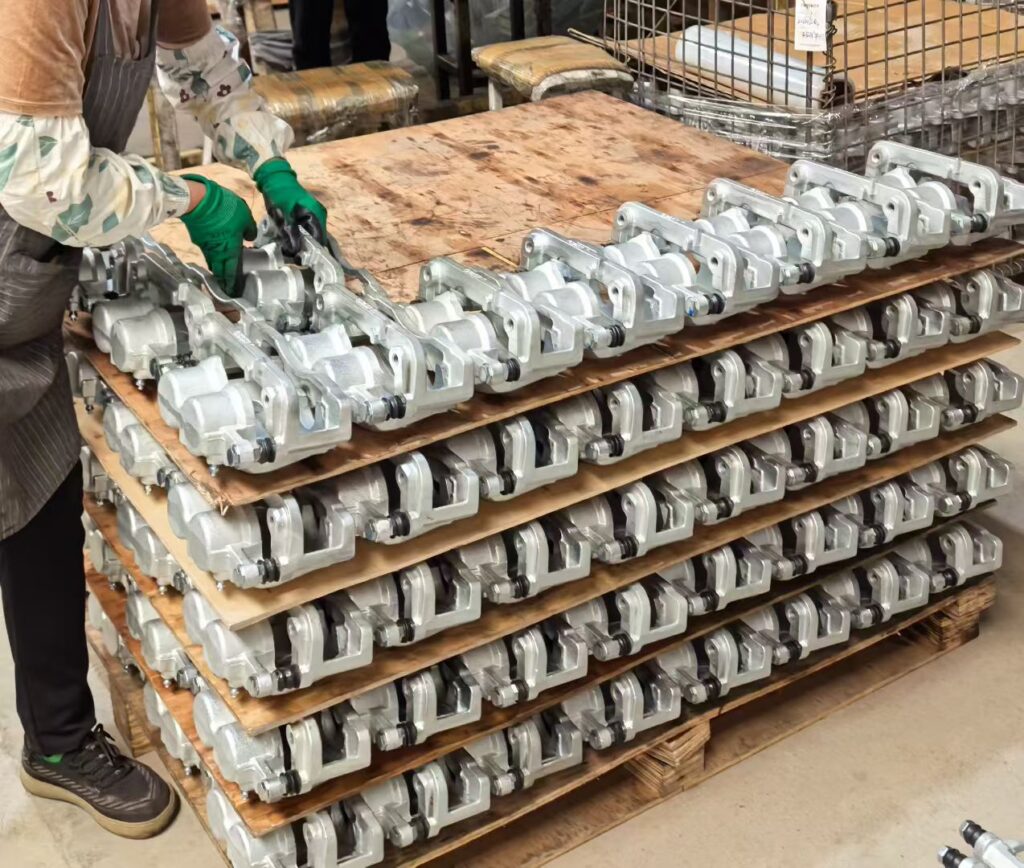
Producing a raw casting is often just the first step in the manufacturing journey. While sand mold casting provides the fundamental geometry of your component, most industrial applications require further refinement to meet strict operational specifications. At Vast Precision, we transition from a simple foundry to a comprehensive manufacturing partner, bridging the gap between raw metal and assembly-ready parts.
Precision CNC Machining
Sand casting inherently produces parts with rougher surface finishes and wider dimensional variances compared to other methods. To bridge this gap, we integrate secondary CNC machining castings capabilities directly into our workflow. Whether you need to bore a cylinder to H7 tolerances or face a flange for a perfect seal, our in-house machining ensures that the final dimensions match your blueprints exactly. This eliminates the headache of coordinating between a foundry and a separate machine shop.
Essential Secondary Operations
We offer a full suite of post-casting treatments to enhance the mechanical properties and aesthetics of your parts:
- Heat Treatment: We perform annealing, normalizing, and tempering to adjust the hardness and ductility of carbon steel and iron castings, ensuring they meet mechanical performance standards.
- Surface Finishing: From shot blasting to remove sand residue, to polishing, zinc plating, and painting, we deliver parts that are protected against corrosion and look professional.
- Assembly Readiness: We can drill, tap, and prep surfaces so your team can install the component immediately upon arrival.
Reducing Supply Chain Complexity
Sourcing sand casting mold production, machining, and finishing from different vendors introduces unnecessary risk, delays, and quality disputes. By consolidating these processes, we take full responsibility for the quality of the final component. Our integrated approach and global service support ensure that lead times are minimized and accountability is centralized. You get a finished product ready for the production line, not just a piece of raw metal.
Quality Assurance and Defect Prevention
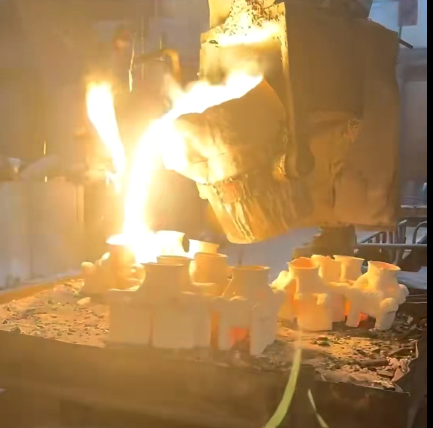
At Vast Precision, we treat quality control as an integrated part of the manufacturing cycle, not just a final checkpoint. Ensuring the reliability of a sand mold casting requires a combination of proactive engineering and rigorous scientific testing. Our ISO 9001:2015 certified facility employs strict protocols to ensure every component meets the exact durability and safety requirements of your industry.
Proactive Design and Gating Systems
Defect prevention starts before the metal is even melted. We utilize advanced simulation software to optimize the gating and riser system for every mold. By carefully calculating the flow and cooling rates of the molten metal, we effectively mitigate common issues like shrinkage and foundry porosity defects. This engineering-first approach ensures that the internal structure of the casting is sound and consistent, reducing material waste and lead times.
Material and Mechanical Verification
We validate raw materials and finished parts through comprehensive internal testing:
- Spectrometer Analysis: We perform chemical analysis on every batch to verify that the alloy composition matches your specifications perfectly, whether it is ductile iron, gray iron, or steel.
- Mechanical Testing: Our lab tests for tensile strength, yield strength, and elongation. We also conduct hardness testing to ensure the material meets the required physical properties for machining and end-use application.
Non-Destructive Testing (NDT) Capabilities
For critical components used in high-stress environments, surface inspection is not enough. We offer a range of Non-destructive testing (NDT) methods to detect internal flaws without damaging the part:
- X-Ray & Radiography: To identify deep internal voids or inclusions.
- Ultrasonic Testing: For detecting subsurface discontinuities and measuring thickness.
- Magnetic Particle Inspection (MPI): To reveal surface and near-surface cracks in ferromagnetic materials.
By combining these methods, we ensure that every part shipped is free from critical defects and ready for immediate machining or assembly.
Common Industrial Applications
Sand mold casting is the backbone of heavy industry, providing the versatility needed to produce parts ranging from a few ounces to several tons. At Vast Precision, we supply critical components across sectors where durability and complex geometries are non-negotiable. Our foundry adapts to specific industry standards to ensure every part performs reliably under stress.
Automotive and Transportation
The automotive sector relies heavily on casting for engine components that require high heat dissipation and structural integrity. We manufacture robust parts like engine blocks, cylinder heads, and exhaust manifolds. By using specific grades of gray and ductile iron, we ensure these components can withstand the thermal cycling and vibration common in vehicle operation.
Fluid Handling Systems
For industries managing liquids and gases, leak-proof performance is essential. We produce industrial valve components, pump housings, impellers, and pipe fittings. By utilizing stainless steel and specialized alloys, we ensure these parts resist corrosion and maintain pressure tightness in demanding environments. You can explore our diverse industry applications to see how we support fluid control sectors with precision-engineered castings.
Heavy Machinery and Agriculture
Construction and farming equipment demand rugged parts capable of withstanding extreme wear and impact. Our sand casting process is particularly effective for creating large-scale components such as:
- Gearbox housings for tractors and excavators.
- Counterweights for cranes and forklifts to ensure stability.
- Structural brackets and chassis parts that require high tensile strength.
Frequently Asked Questions About Sand Mold Casting
What is the difference between green sand and resin sand?
The main difference lies in the bonding agent and the resulting finish. Green sand uses a mixture of sand, clay, and water. It is highly cost-effective and ideal for high-volume production runs where standard tolerances are acceptable. Resin sand (often used in furan processes) uses chemical binders to create a harder, more rigid mold. We typically recommend resin sand for larger, heavier components or when the project requires a superior surface finish and higher dimensional accuracy.
How do you control dimensional tolerances in sand casting?
Precision starts with the pattern design. We calculate specific shrinkage allowances based on the material grade—whether it’s ductile iron or stainless steel—to ensure the part solidifies to the correct size. We adhere to international standards like ISO 8062 to maintain consistency. For projects requiring extremely tight tolerances (such as H7), we leverage our technical manufacturing capabilities to perform secondary CNC machining, ensuring the final part fits your exact specifications.
Can sand casting be used for mass production?
Yes, absolutely. Green sand casting is the industry standard for mass production because the molding process is fast, and the sand is reusable, which significantly lowers material costs. While resin sand is better suited for low-to-medium volume or large custom parts, our green sand lines are optimized to handle high-volume orders efficiently without sacrificing quality.
What are the most common defects in sand mold casting?
The most frequent challenges include foundry porosity defects (air pockets), shrinkage cavities, and sand inclusions. At Vast Precision, we prevent these issues during the engineering phase by optimizing the gating and riser systems to ensure smooth metal flow and proper solidification. We also conduct rigorous quality control, including spectrometer analysis and mechanical testing, to ensure every part meets our strict durability standards before shipment.
 English
  Russian
  German