

What Is Brass Investment Casting?
Brass investment casting is a premier manufacturing technique used to produce intricate, high-precision components from copper-based alloys. By utilizing the lost wax casting method, we create parts that meet demanding industrial specifications while maintaining exceptional aesthetic quality. This process is the gold standard for industries requiring a balance of strength, corrosion resistance, and complex geometry that other methods simply cannot achieve.
Defining the Lost Wax Process for Brass
The process relies on a sequence of precision steps to transform a digital design into a solid metal component. It begins with high-quality wax patterns created via a professional wax injection machine.
- Pattern Assembly: Detailed wax replicas are attached to a central sprue to create a casting "tree."
- Ceramic Shell: The assembly is repeatedly dipped into a refractory slurry to build a durable ceramic shell.
- Dewaxing: The shell is heated in an autoclave to melt away the wax, leaving a perfect negative cavity of the part.
- Metal Pouring: Molten brass is poured into the preheated shell, ensuring the metal fills even the thinnest sections.
- Divestment: After cooling, the ceramic shell is vibrated or blasted away to reveal the precision brass component.
Key Properties of Brass Materials
Brass is favored in the global market for its unique physical and chemical characteristics, making it indispensable for high-performance applications:
| Property | Benefit for Engineering |
|---|---|
| Corrosion Resistance | Highly resistant to oxidation and saline environments. |
| Excellent Machinability | Allows for tight tolerances and easy post-casting threading. |
| High Conductivity | Ideal for electrical hardware and heat exchange components. |
| Ductility | Ensures the material can be formed into complex shapes without becoming brittle. |
| Surface Quality | Produces a smooth, refined finish that requires minimal secondary polishing. |
This combination of the lost wax process and the inherent strengths of brass allows for the production of components that are both functional and durable.
Top Benefits of Brass Investment Casting
Superior Surface Finish and Precision Detail
One of the biggest reasons we recommend brass investment casting is the incredible surface quality it delivers. Because the process uses a fine-grained ceramic shell, the final parts come out smooth and ready for use with minimal cleanup. We consistently hit tight tolerances that often make expensive secondary machining unnecessary. To ensure every part meets these high standards, we prioritize process control in investment casting for defect-free precision, keeping dimensions consistent from the first piece to the last.
Exceptional Corrosion Resistance and Conductivity
Copper-based alloys like yellow brass are naturally resistant to oxidation and corrosion. This makes them the primary choice for marine hardware, fluid handling, and outdoor fixtures. Beyond durability, brass offers excellent thermal and electrical conductivity, making it a staple for high-performance electrical connectors and heat sinks where reliability is non-negotiable.
Cost-Efficiency for Complex Part Geometries
When parts have internal cavities, undercut features, or intricate thin walls, machining them from solid blocks is slow and wasteful. Brass investment casting allows us to create these complex shapes in a single pour. By utilizing automation in casting process for high precision investment castings, we reduce manual labor costs and significantly cut down on material scrap.
| Benefit | Impact on Your Project |
|---|---|
| Near-Net Shape | Reduces or eliminates the need for grinding and milling. |
| Material Savings | Drastically cuts waste compared to subtractive manufacturing. |
| Design Freedom | Allows for complex internal paths and fine aesthetic details. |
| High Repeatability | Ensures every part in a large batch is identical. |
Key Advantages at a Glance:
- Reduced Lead Times: Faster production for complex geometries.
- Better Aesthetics: Smooth finishes that are perfect for plating or polishing.
- Structural Integrity: Dense, high-strength parts with fewer internal defects.
Common Brass Alloys and Grades for Casting
In our facility, we don't just pour metal; we select specific copper-based alloys to match your part’s exact environment. Choosing the right material for brass investment casting is the difference between a part that lasts decades and one that fails under pressure.
Standard Yellow and Red Brass Options
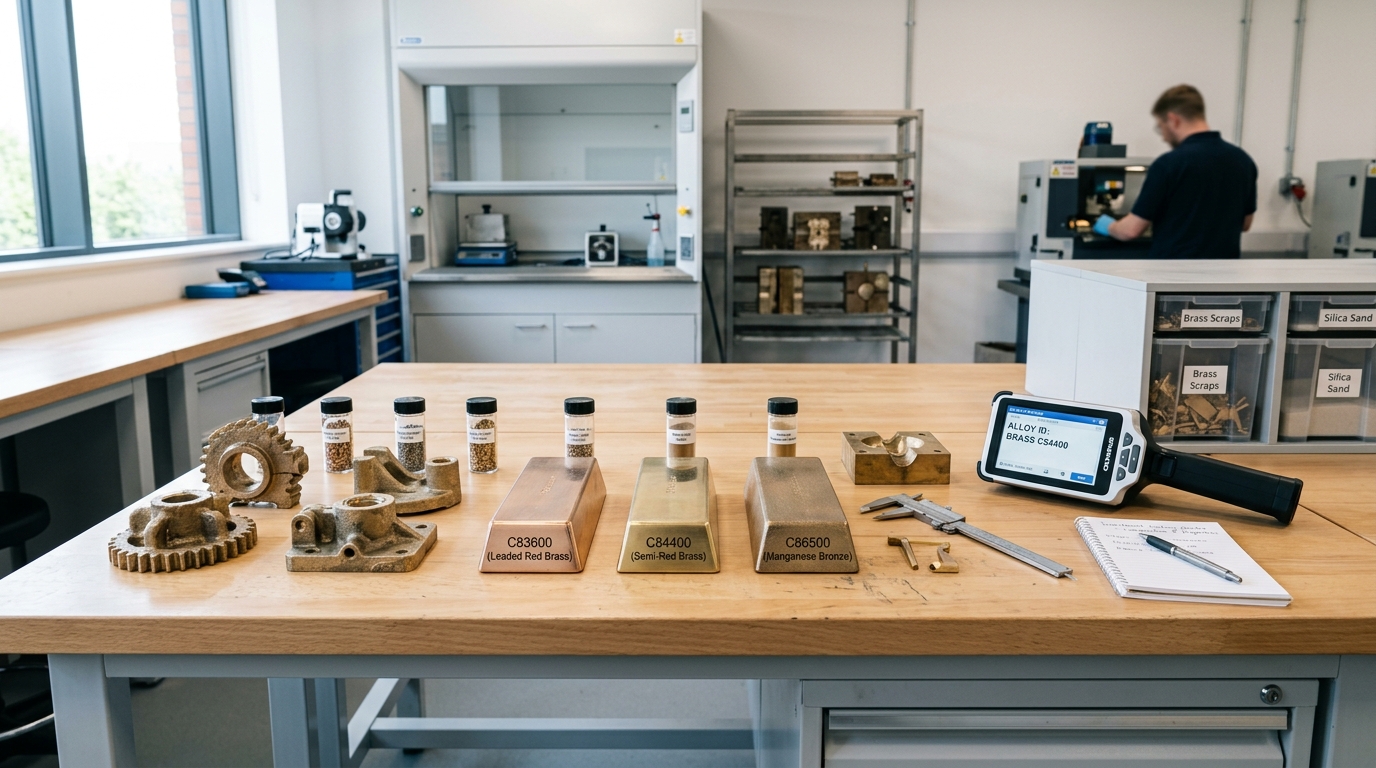
We often recommend Yellow Brass (like C85200) for projects where cost-effectiveness and a bright, gold-like appearance are priorities. It’s the standard for plumbing and decorative hardware. However, if your project demands better "red" strength and superior corrosion resistance, we turn to Red Brass (C83600). It contains more copper and tin, making it much tougher against dezincification in water-rich environments.
Silicon and Manganese Brass Alloys
When the job gets heavy-duty, we move into high-performance grades. Silicon Brass offers excellent fluidity during the pour, allowing us to capture intricate details while providing high strength. Manganese Brass, often called "Manganese Bronze," is our go-to for high-load applications like gears or marine hardware because of its incredible wear resistance.
Selecting the Right Grade for Your Project
To help you decide, we've broken down the most common grades we use in our brass investment casting process:
| Alloy Type | Common Grade | Key Characteristics | Best For |
|---|---|---|---|
| Yellow Brass | C85200 | High machinability, bright finish | General hardware, plumbing |
| Red Brass | C83600 | Great corrosion resistance | Valves, pumps, water fittings |
| Silicon Brass | C87500 | Excellent detail, high strength | Intricate mechanical parts |
| Manganese Brass | C86300 | Very high strength, wear-resistant | Heavy-duty gears, marine parts |
We ensure every melt is precise by utilizing advanced foundry casting robotics integration to maintain consistent temperature and purity across all alloy grades. Picking the right grade involves balancing tight tolerances, environmental exposure, and your total budget. If you need a part that survives salt water or high-friction movement, we'll guide you to the specific manganese or silicon blend that fits.
The Brass Investment Casting Process Explained
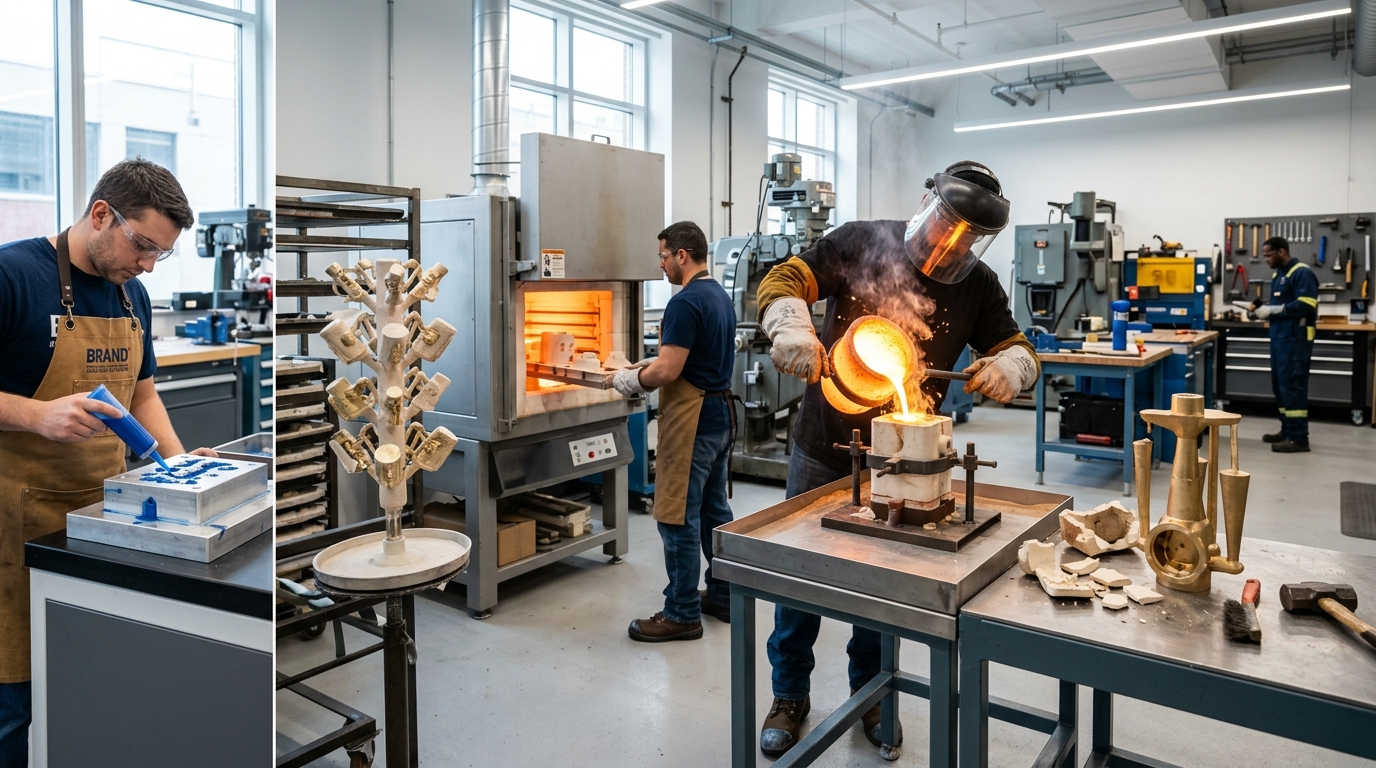
We’ve refined our production to ensure every brass investment casting meets exact specifications. The investment casting process is a multi-step journey that balances ancient techniques with modern technology to deliver high-performance parts.
Wax Pattern Creation and Shell Building
Everything starts with the wax pattern. We use high-precision wax injection machines to create an exact replica of your design. These patterns are then assembled onto a "tree" and dipped repeatedly into a liquid refractory slurry. This building phase creates a durable ceramic shell that can withstand the intense heat of molten metal.
Precision Metal Pouring and Cooling
Once the shell is hardened, we heat it to melt the wax away—the core of the lost wax casting method. This leaves a hollow cavity ready for the metal. We pour molten copper-based alloys into the preheated shell at controlled temperatures. This ensures the metal reaches every fine detail of the mold while maintaining tight tolerances as it cools and solidifies.
Post-Casting Finishing and Quality Inspection
After the metal has fully cooled, we break the ceramic shell away to reveal the raw casting. Our finishing team then takes over to ensure the part is ready for the field. Our standard finishing protocol includes:
- Gate Removal: Cutting and grinding the entry points where metal entered the mold.
- Surface Treatment: Sandblasting or chemical cleaning to remove any remaining ceramic bits.
- Precision Machining: If your project requires even tighter specs than the cast can provide.
- Rigid Inspection: Every batch undergoes dimensional checks and visual audits to guarantee quality.
Primary Industries and Applications
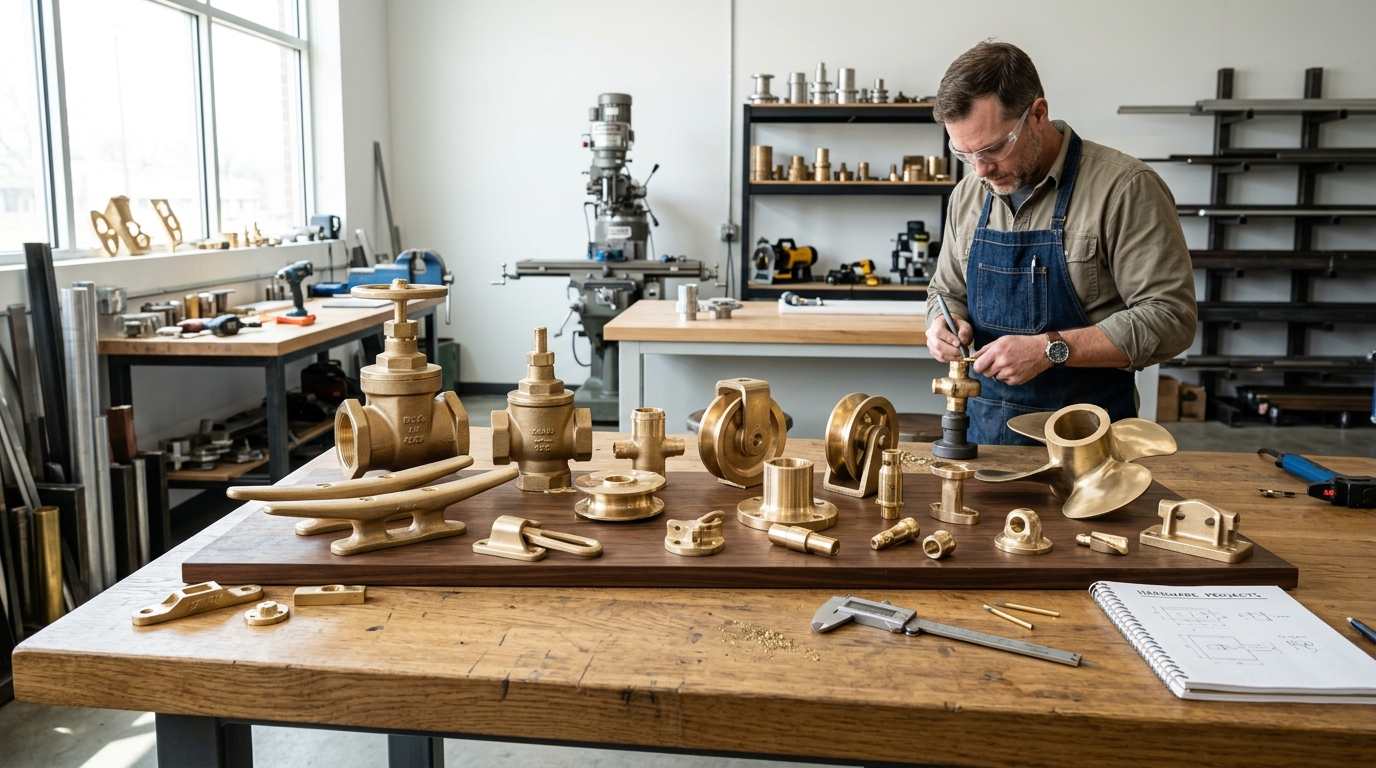
We provide brass investment casting solutions across diverse sectors where durability and precision are non-negotiable. Because brass is easy to machine and naturally resistant to the elements, it’s the top choice for parts that need to look good and work hard.
Fluid Handling, Pumps, and Valve Components
In the world of fluid dynamics, reliability is everything. We cast intricate internal geometries for pump impellers, valve bodies, and meters that standard machining just can't reach. Our process ensures these copper-based alloys remain pressure-tight and leak-proof. To hit the required specs for pressurized systems, we often integrate our casting with a precision machining component guide for high-tolerance parts to ensure every seal is perfect.
- Non-sparking properties: Essential for fuel and gas handling.
- Anti-biofouling: Naturally resists algae and bacterial growth in water systems.
Marine and Electrical Hardware
Saltwater is brutal on metal, but our brass castings thrive in it. We supply the marine industry with corrosion-resistant propellers, rowlocks, and through-hull fittings that withstand years of offshore exposure.
On the electrical side, the high conductivity of brass makes it ideal for:
- Heavy-duty connectors and terminals
- Switchgear components
- Grounding clamps
Architectural and Decorative Brass Parts
For high-end architecture, the finish is just as important as the strength. We use the lost wax casting method to capture fine textures and sharp details for luxury hardware. These parts often serve as the "jewelry" of a building, offering a premium feel that lasts for decades.
- Door and Window Hardware: Handles, hinges, and ornate locks.
- Plumbing Fixtures: High-end faucets and decorative drains.
- Signage: Custom plaques and raised lettering with a polished or antique patina.
Design and Engineering for Precision Brass Castings
In our engineering department, we don't just "pour metal." We design for performance. Brass investment casting allows for incredible design freedom, but it requires a deep understanding of how copper-based alloys behave when transitioning from liquid to solid. We work closely with you to ensure your CAD models are optimized for the lost wax casting process, minimizing material waste while maximizing strength.
Managing Dimensional Tolerances and Accuracy
Precision is our baseline. When we talk about tight tolerances, we mean hitting exact specs consistently across thousands of parts. To achieve this, we account for the linear shrinkage of yellow brass and other alloys during the cooling phase.
- Standard Accuracy: We typically achieve ISO 8062 accuracy standards to ensure parts fit into your assemblies without heavy rework.
- Wax Pattern Precision: By using a high-stability wax injection machine, we create patterns that are identical to the digital design.
- Tooling Compensation: Our molds are engineered with precise "shrinkage factors" specific to the brass grade you choose.
Optimizing Wall Thickness and Geometry
The beauty of the ceramic shell used in this process is its ability to capture fine detail. However, for a perfect cast, wall thickness must be managed carefully to ensure even metal flow and cooling.
| Feature | Design Recommendation | Benefit |
|---|---|---|
| Minimum Wall Thickness | 1.5mm to 3mm (depending on part size) | Prevents "cold shuts" and incomplete fills. |
| Draft Angles | Often 0° is possible, but 0.5° is safer | Easier removal from the wax injection mold. |
| Fillets & Radii | Use generous curves at junctions | Reduces stress concentration and cracking. |
For parts that require ultra-precise mating surfaces or threaded holes, we often combine the casting process with secondary CNC machining to give you the best of both worlds: complex geometry and aerospace-level precision. This approach ensures that even the most intricate wax pattern translates into a functional, durable component.
Comparing Investment Casting with Other Methods
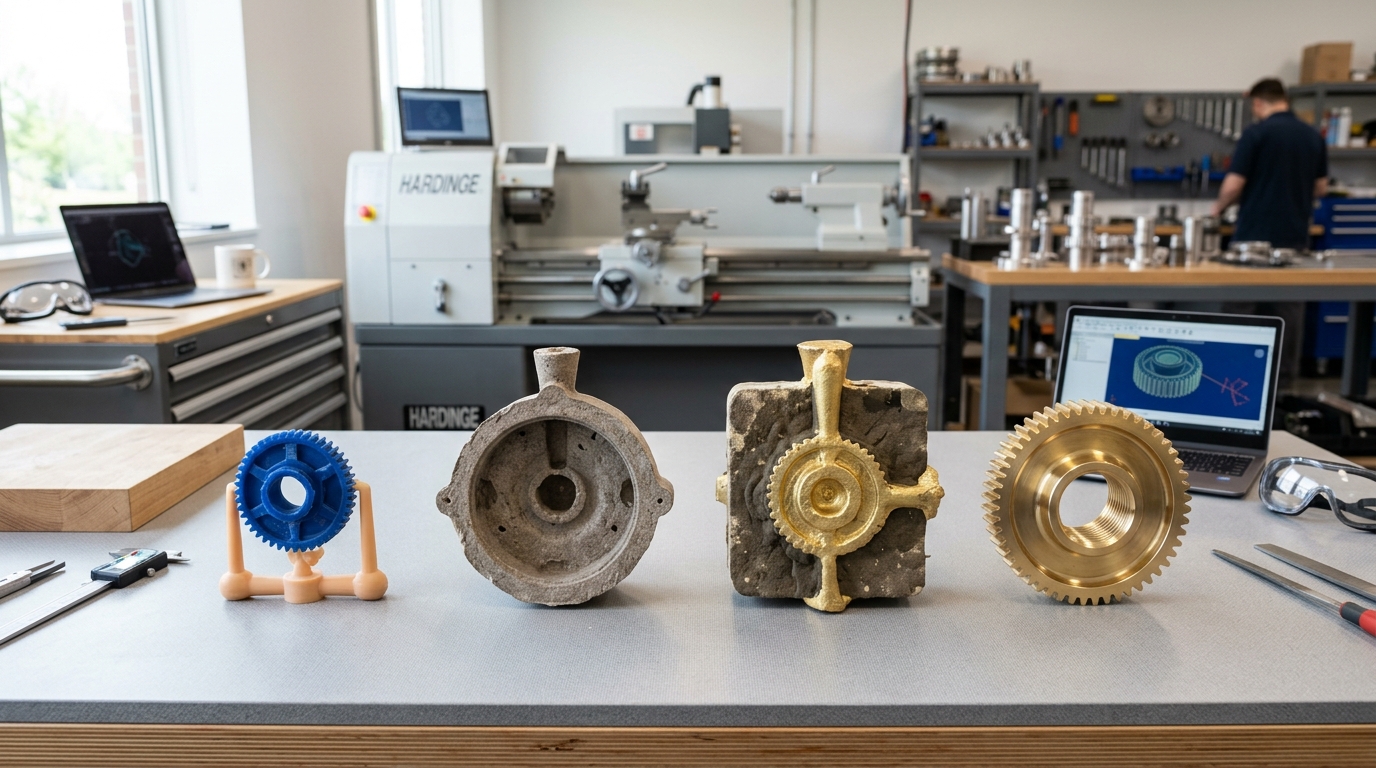
Choosing the right manufacturing route is about balancing precision with production costs. While we specialize in brass investment casting, we know that every project has unique requirements. Understanding how this process compares to traditional methods ensures you don't overpay for quality you don't need or compromise on details you do.
Investment Casting vs. Sand Casting
For many of our clients, the choice comes down to the level of detail required. Sand casting is great for massive, simple parts, but it often leaves a rough surface that requires heavy machining. In contrast, brass investment casting utilizes a ceramic shell that captures every fine detail of the wax pattern.
- Surface Finish: Investment casting produces a near-net-shape finish, significantly reducing post-processing.
- Tolerances: We achieve much tightened tolerances compared to the looser dimensions found in sand molds.
- Complexity: If your part has thin walls or intricate internal paths, the lost wax method is the clear winner.
Understanding the fundamental differences in lost wax casting vs sand casting is essential for optimizing your manufacturing budget and part performance.
Investment Casting vs. Die Casting
While die casting is a powerhouse for high-volume production, it comes with a massive upfront "buy-in" due to the cost of hardened steel dies. Brass investment casting offers a more flexible middle ground, especially for copper-based alloys like yellow brass and bronze alloys which can be hard on die-casting equipment.
| Feature | Investment Casting | Die Casting |
|---|---|---|
| Tooling Cost | Moderate (Aluminum/Steel) | Very High (Hardened Steel) |
| Material Choice | Wide range of copper-based alloys | Limited to specific low-melt alloys |
| Part Complexity | High (Undercuts and internal cores) | Moderate (Limited by mold release) |
| Lead Time | Faster for initial prototypes | Long (Months for die fabrication) |
We often recommend looking at die casting vs sand casting comparisons to see where investment casting fits as the precision alternative for medium-to-high complexity parts without the astronomical tooling overhead. By using a high-quality wax injection machine, we can maintain high repeatability and corrosion resistance across every batch we deliver.
Criteria for Choosing a Brass Casting Provider
Selecting the right partner for your brass investment casting projects determines the longevity and performance of your final components. We believe that a reliable provider should act as a technical extension of your own team, offering more than just a part, but a complete manufacturing solution.
Quality Control and ISO Certifications
Quality isn't just a buzzword; it’s a measurable standard. When we evaluate or provide casting services, we focus on rigorous inspection protocols to ensure every piece meets tight tolerances.
- ISO 9001 Certification: This is the baseline for any professional foundry to ensure consistent management and production.
- Material Verification: We use digital spectrometry to confirm the exact chemical composition of copper-based alloys.
- Testing Procedures: Look for providers offering X-ray, magnetic particle inspection, and pressure testing for fluid-handling parts.
- Dimensional Accuracy: High-precision CMM (Coordinate Measuring Machine) reports should be available to verify complex geometries.
Production Capacity and Value-Added Services
A great provider must scale with your business. We leverage high-efficiency equipment, such as our specialized wax injection machine for investment casting, to ensure that even high-volume orders maintain the same precision as the initial prototype.
| Feature | Why It Matters for Your Project |
|---|---|
| In-House Tooling | Reduces lead times and allows for quicker design iterations. |
| Secondary Machining | Provides "ready-to-install" parts via CNC milling and turning. |
| Surface Finishing | Offers polishing, plating, or sandblasting for better aesthetics. |
| Technical Support | Expert advice on optimizing wall thickness to reduce material waste. |
We focus on delivering a "one-stop-shop" experience. By choosing a provider that handles everything from the initial wax pattern creation to final surface treatment, you eliminate the logistical headaches of managing multiple vendors and ensure a much higher standard of accountability.
 English
  Russian
  German