2026年8月16日
die casting vs investment casting guide comparing cost materials volume and design to help you choose the best process
Die Casting vs Investment Casting
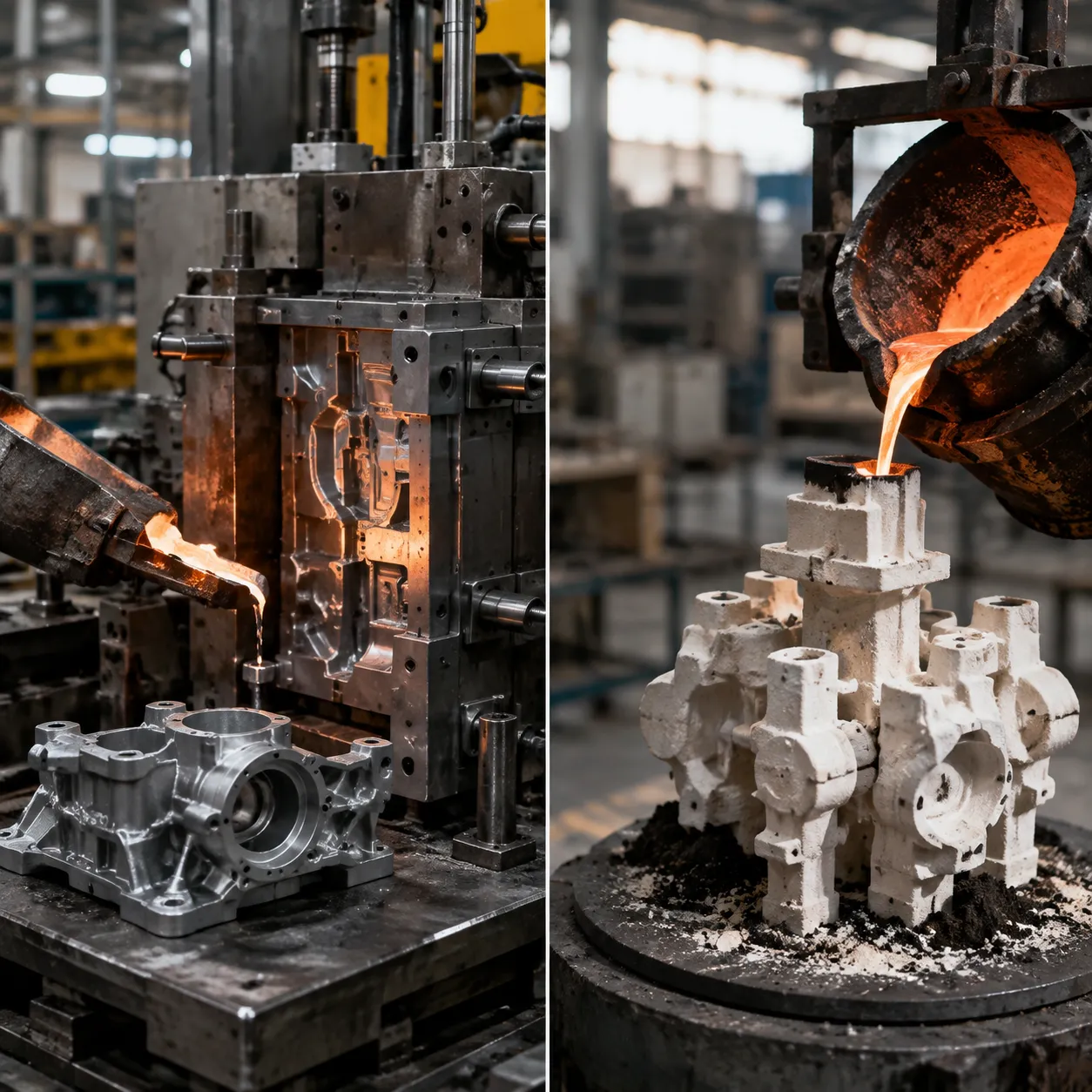
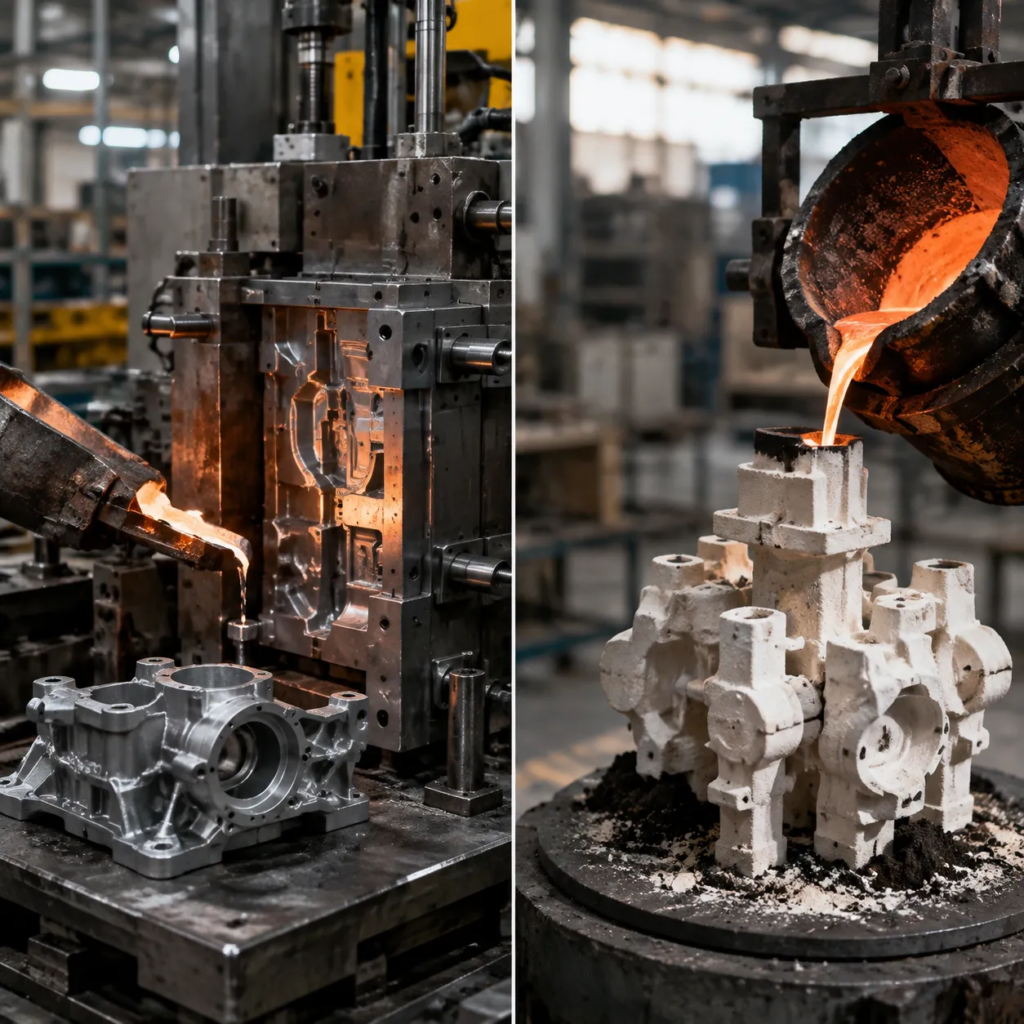
Choosing between die casting vs investment casting comes down to balancing high-volume manufacturing efficiency with intricate design flexibility. We utilize high pressure die casting to rapidly inject molten metal into reusable steel molds for massive production runs. Alternatively, our lost wax casting process uses sacrificial wax patterns to build ceramic molds capable of forming complex geometries that traditional tooling cannot achieve.
Core Process Comparison
| Feature | High Pressure Die Casting | Investment Casting |
|---|---|---|
| Core Advantage | Rapid high-volume efficiency | Intricate design flexibility |
| Molding Technique | High-pressure molten metal injection | Sacrificial wax pattern molding |
| Tooling Type | Permanent reusable steel dies | Sacrificial wax / expendable ceramic |
| Production Speed | Fast (seconds per part) | Slow (multi-step batch process) |
Material Options and Alloy Compatibility
- Die Casting Alloys: Optimized primarily for non-ferrous metals with lower melting points, including aluminum die casting alloys, zinc, and magnesium.
- Investment Casting Alloys: Exceptionally versatile across non-ferrous and ferrous metals, including stainless steel casting, carbon steels, tool steel, and high-temperature nickel superalloys.
How High Pressure Die Casting Works
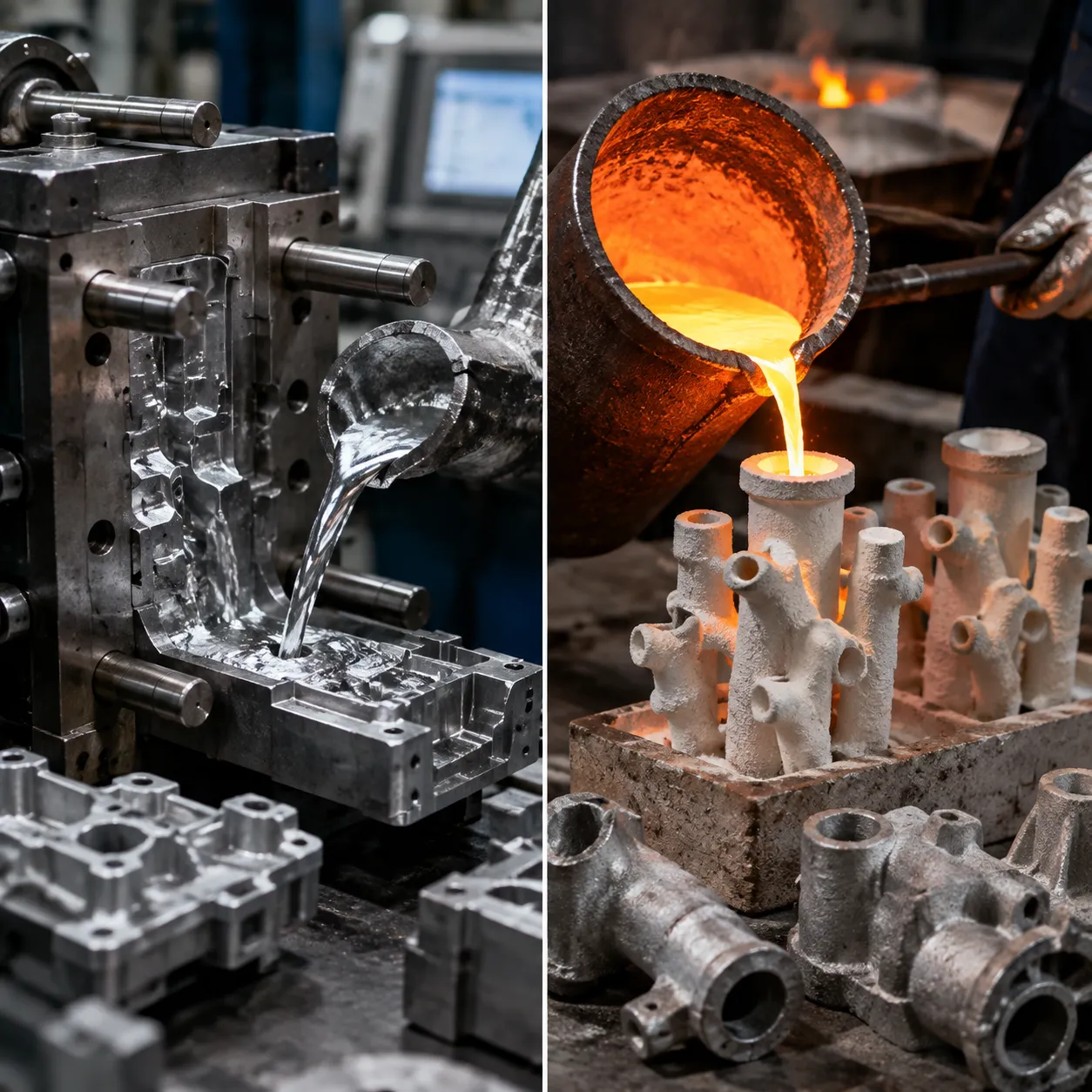
We use high pressure die casting when projects demand extreme speed, repeatable accuracy, and high production volumes. We inject molten metal into reusable steel molds under intense pressure. The metal solidifies in seconds, allowing us to eject finished parts rapidly and repeat the cycle thousands of times per day.
The High Pressure Injection Process
- Mold Clamping: Hydraulic clamps lock two hardened steel die halves together under extreme pressure.
- Metal Injection: A mechanical shot sleeve forces liquid metal into the mold cavity at high velocity.
- Rapid Cooling: The metal solidifies almost instantly inside the liquid-cooled mold.
- Part Ejection: Dies open, ejector pins push the part out, and the automated cycle resets.
Best Metals for Die Casting
Non-ferrous alloys perform best in die casting due to their lower melting points and high fluidity:
| Metal | Key Advantage | Common Applications |
|---|---|---|
| Aluminum | Lightweight, high dimensional stability, heat resistant | Automotive engine parts, structural housings |
| Zinc | High ductility, long tool life, easy to plate | Precision connectors, lock hardware, small gears |
| Magnesium | Lowest density, excellent strength-to-weight ratio | Laptop frames, power tool casings, aerospace components |
Tooling Cost vs. Unit Cost Tradeoffs
Custom steel dies require significant upfront capital investment. However, this initial tooling cost drops individual part prices dramatically once mass production begins. Reviewing die casting cost and volume guidelines highlights how high-volume runs easily absorb initial mold expenses, delivering the lowest per-unit manufacturing cost of any metal casting method.
How Investment Casting Works: Precision and Complex Geometry
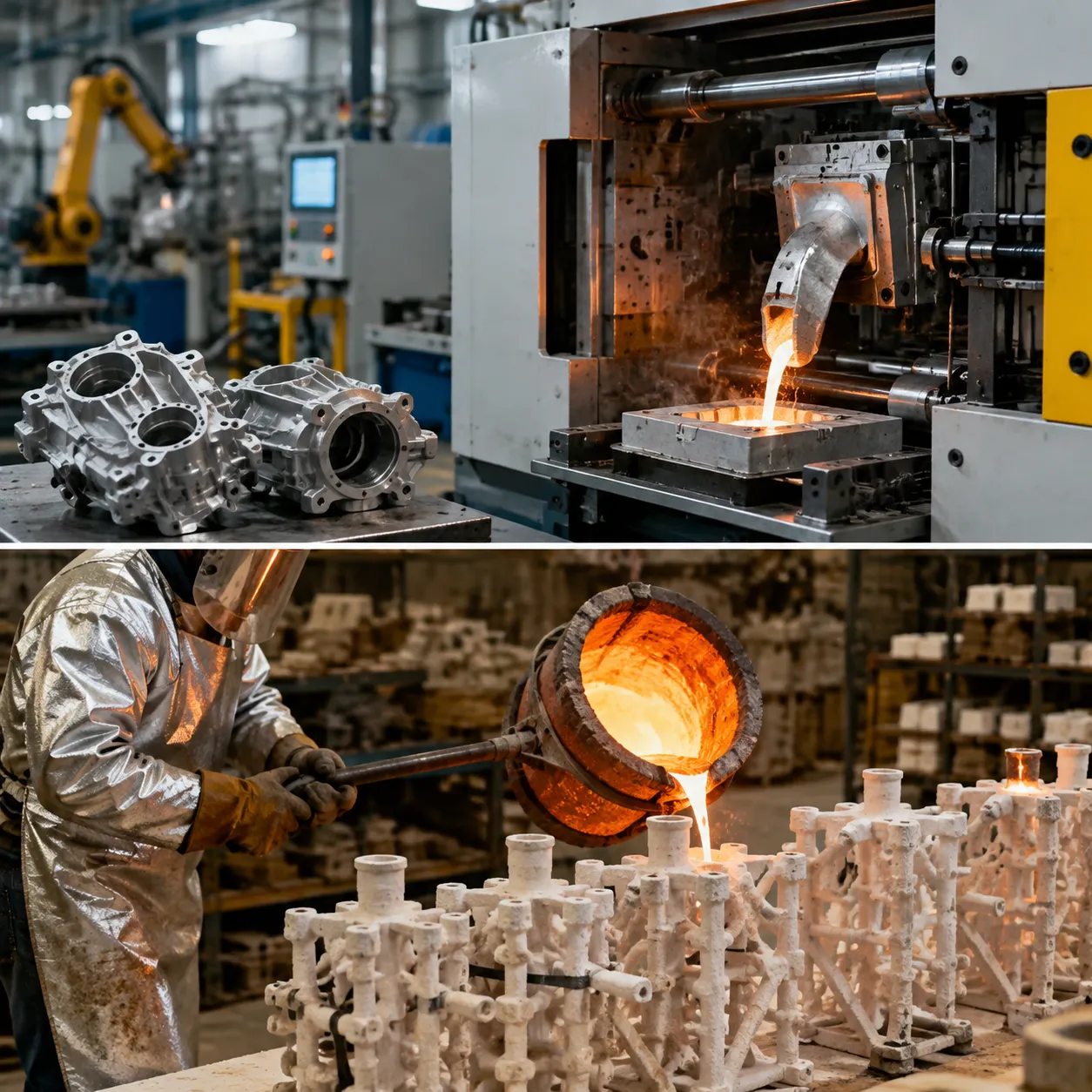
When we need complex geometries, fine details, or thin walls without heavy post-machining, we rely on the lost wax casting process. Unlike pressure die casting, investment casting builds a ceramic mold around a disposable wax pattern, letting us cast intricate shapes that would be impossible to eject from a rigid metal die. Through our precision investment casting capabilities, we manufacture near-net-shape components with minimal material waste and total design freedom.
Step-by-Step Lost-Wax Process
- Wax Pattern Creation: We inject wax into a master mold to form an exact replica of the target part.
- Tree Assembly: Multiple wax patterns are welded onto a central wax sprue to form an assembly tree.
- Ceramic Shell Coating: We repeatedly dip the wax tree into liquid ceramic slurry and coat it with fine sand until a durable ceramic shell forms.
- Dewaxing: The shell is heated in an autoclave to melt out the wax, leaving behind a seamless, hollow ceramic cavity.
- Pouring & Knockout: Molten metal is poured into the preheated ceramic mold. Once cooled, we break away the ceramic shell to retrieve the cast parts.
Broad Alloy Compatibility
A major edge of investment casting vs die casting is material versatility. Because ceramic molds withstand extreme temperatures, we can cast high-melting-point metals that would destroy reusable steel dies:
- Stainless Steel & Carbon Steel: Excellent for high strength, corrosion resistance, and structural integrity (see our custom cast stainless steel alloys).
- High-Temp Superalloys: Cobalt and nickel-based alloys designed for turbine blades and aerospace parts.
- Non-Ferrous Metals: Aluminum, copper, brass, and bronze alloys for electrical and marine hardware.
Tight Tolerances and Surface Finish
Investment casting delivers tight dimensional tolerances (typically ±0.005 in/in) and exceptional surface finishes (125 RMS or better). Because the ceramic mold has no parting lines, parts come out smooth and ready for assembly, eliminating hours of costly secondary machining and hand finishing.
Comparing Manufacturing Capabilities and Limits
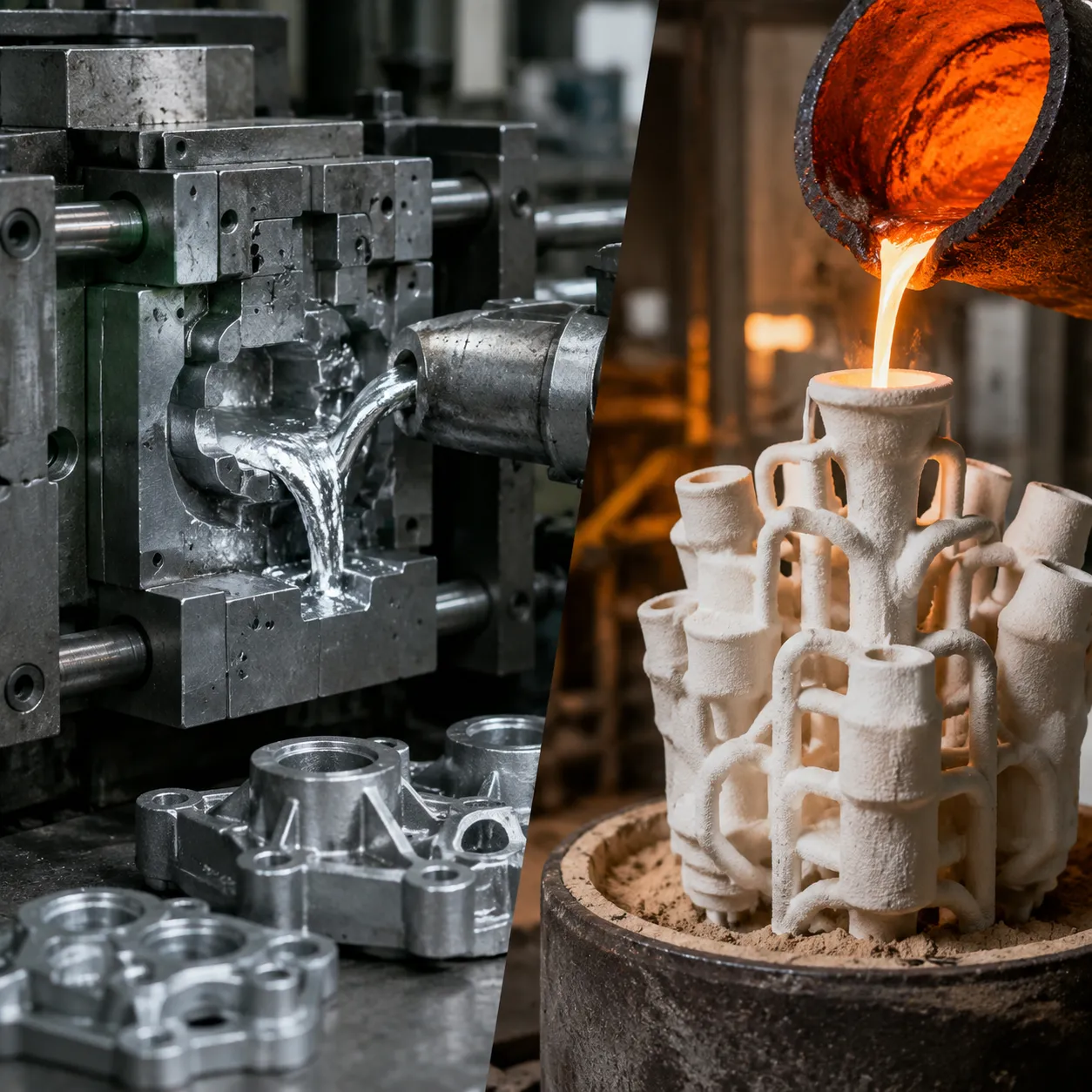
When we evaluate die casting vs investment casting, knowing where each process shines—and where it hits a wall—saves you time and capital. Both metal casting methods yield high-quality parts, but their tolerances, structural limits, and lead times differ significantly.
Dimensional Accuracy and Surface Roughness
- Die Casting: Uses hardened steel dies under high pressure to achieve tight, repeatable dimensional tolerances. It delivers a smooth surface finish ideal for high-volume non-ferrous parts.
- Investment Casting: Delivers exceptional detail on complex, curved geometries. When your design demands high precision without extensive secondary machining, choosing a high-performance precision casting solution ensures exact contours right out of the mold.
Wall Thickness Limits and Structural Strength
- Wall Thickness: Die casting excels at ultra-thin walls (down to 0.5 mm – 1.0 mm) without compromising mold filling. Investment casting generally requires minimum wall thicknesses around 1.5 mm to ensure complete fill through the ceramic shell.
- Structural Integrity: High-pressure injection in die casting can trap minor gas porosity, which limits post-cast heat treatment options. Investment casting yields dense, uniform grain structures. When severe mechanical loads are factor, evaluating stainless steel strength in investment-cast alloys gives you maximum structural dependability.
Lead Times and Initial Tooling Investment
- Tooling Costs: Die casting molds demand heavy steel machining, leading to higher upfront tooling costs manufacturing investments. Investment casting relies on aluminum wax-injection dies, significantly cutting your initial setup expenses.
- Lead Time and Volume: Die casting produces parts in seconds, making it unrivaled for mass production. Investment casting requires multi-step ceramic coating, drying, and dewaxing, which extends overall per-part cycle times.
| Performance Metric | High Pressure Die Casting | Investment Casting |
|---|---|---|
| Typical Tolerances | ±0.02 mm – ±0.1 mm | ±0.05 mm – ±0.2 mm |
| Minimum Wall Thickness | 0.5 mm – 1.5 mm | 1.5 mm – 3.0 mm |
| Initial Tooling Cost | High ($10,000 – $50,000+) | Moderate ($2,000 – $10,000) |
| Production Speed | High speed (seconds per part) | Moderate (multi-step process) |
| Alloy Flexibility | Non-ferrous (Aluminum, Zinc, Magnesium) | Ferrous & Non-ferrous (Steel, Stainless, Titanium) |
Cost Analysis: Tooling, Unit Price, and Volume Thresholds
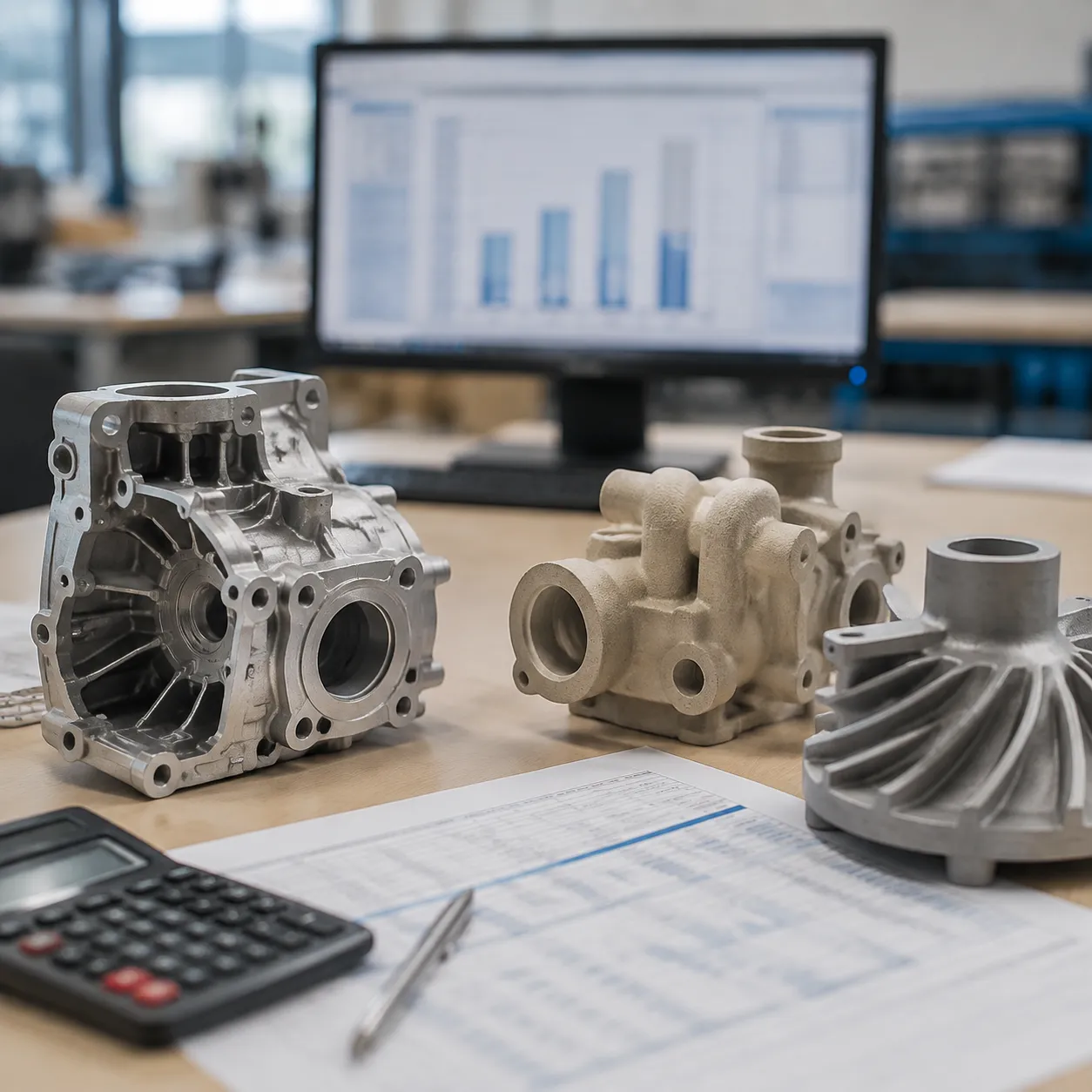
When evaluating die casting vs investment casting, the right financial choice comes down to balancing your upfront capital against expected production run size. We analyze three main cost factors to help you optimize your bottom line.
Upfront Tooling Costs for Molds and Dies
Tooling costs in manufacturing represent the biggest initial hurdle when starting a production run:
- Die Casting Tooling: Requires heavy-duty hardened steel dies built to withstand extreme mechanical pressure. Upfront mold costs typically range from $10,000 to $100,000+.
- Investment Casting Tooling: Uses aluminum master dies to form sacrificial wax patterns. Upfront costs are far lower, usually between $2,500 and $15,000.
Per-Part Production Cost Breakdown
Once tooling is cut, the unit economics flip significantly between the two methods:
| Cost Component | Die Casting | Investment Casting |
|---|---|---|
| Cycle Speed | Seconds per part (Fully automated) | Minutes to hours per cycle (Multi-step process) |
| Labor Overhead | Low (Minimal manual handling) | High (Manual dipping, dewaxing, and assembly) |
| Unit Cost at Scale | Extremely Low | Moderate to High |
Production Volume Break Even Point
Determining your production volume break even point ensures you don't overspend on tooling or waste money on high per-part labor.
- Low to Mid Volumes (Under 5,000 units): Investment casting is almost always more economical because the low initial tooling cost keeps your total investment manageable. For prototype quantities or ultra-short runs, looking into a sand casting manufacturer for custom metal parts can also lower upfront barrier costs.
- High Volumes (10,000+ units): Aluminum die casting or high pressure die casting in zinc becomes the clear winner. The massive savings on per-unit labor rapidly absorb the initial mold expense, giving you the lowest total cost per component.
Frequently Asked Questions: Die Casting vs Investment Casting
Which process yields a better surface finish?
Investment casting consistently delivers a smoother, higher-quality surface finish directly out of the mold. Because it uses fine ceramic slurries to form the mold shell, it achieves tight dimensional tolerances and smooth surface finishes (typically 3.2 to 6.3 µm Ra) with minimal need for secondary machining. High-pressure die casting also provides a clean finish, but parts often display minor parting lines or flow marks. For a complete side-by-side performance breakdown, check out our full die casting vs investment casting comparison.
Is investment casting cheaper than die casting for short runs?
Yes, investment casting is significantly more cost-effective for low-to-medium production runs. Lower Tooling Investment: Wax pattern tooling costs a fraction of the hardened steel dies required for pressure die casting. Faster Setup: Initial production setup is simpler, making short runs economically viable. Design Flexibility: Modifications to aluminum wax tooling are far easier and less expensive to implement.
If your total volume sits under a few thousand units, investment casting offers a much lower upfront break-even threshold.
Can die casting handle ferrous metals like steel?
No, standard die casting cannot reliably handle ferrous metals like carbon steel or stainless steel. The extreme melting temperatures of steel rapidly erode and destroy reusable steel dies, which is why die casting focuses on non-ferrous metals like aluminum, zinc, and magnesium.
When you need high-strength steel components, investment casting is the industry standard. We routinely rely on 17-4 investment casting custom stainless steel parts to manufacture complex, corrosion-resistant hardware without worrying about tool degradation.
 English
  Russian
  German