
2026年8月15日
Die Casting vs Sand Casting Compare cost volume tolerance finish and material options to choose the best process
What Is Sand Casting and How Does It Work?
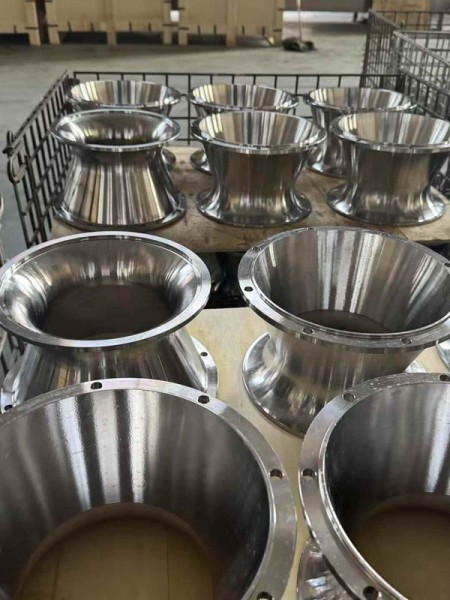
Sand casting is one of the most versatile and cost-effective manufacturing methods we use to produce custom metal components. The sand casting process forms parts by pouring molten metal into a temporary mold made from compressed sand mixtures. Because sand withstands extreme temperatures, this traditional technique allows us to pour virtually any alloy into shapes ranging from simple brackets to massive engine blocks.
Core Components of the Sand Mold
Creating a high-quality mold requires four critical components working together:
| Component | Function in the Casting Line |
|---|---|
| Pattern | A durable physical replica of the part used to form the mold cavity. |
| Green Sand | A recyclable mix of silica sand, clay, and moisture used for green sand molding. |
| Mold Boxes | A two-part container split into an upper box (cope) and a lower box (drag). |
| Cores | Specially cured sand inserts placed in the cavity to create hollow interior geometry. |
Compatible Metal Alloys
One of the biggest advantages of sand casting is its broad material capability:
- Ferrous Alloys: Ductile iron, gray iron, carbon steel, and heat-resistant stainless steel.
- Non-Ferrous Metal Alloys: Aluminum, bronze, brass, and copper-based materials.
Key Pros and Cons of Sand Casting
Here is a quick look at how sand casting performs in real-world production settings:
- Pros:
- Low Initial Investment: Simple pattern creation leads to significantly lower upfront tooling costs.
- Size Flexibility: Capable of producing oversized components weighing hundreds or thousands of pounds.
- Material Versatility: Casts high-melting-point ferrous alloys that would destroy permanent metal dies.
- Ideal for Short Runs: Highly cost-effective for low volume metal casting and rapid prototyping.
- Cons:
- Rougher Surface Finish: Parts often require secondary machining to reach smooth mating surfaces.
- Wider Tolerances: Lower dimensional accuracy compared to high-pressure metal mold processes.
- Lower Production Output: Molds must be destroyed and rebuilt for every cycle, increasing unit labor time.
What Is Die Casting and How Does It Work?
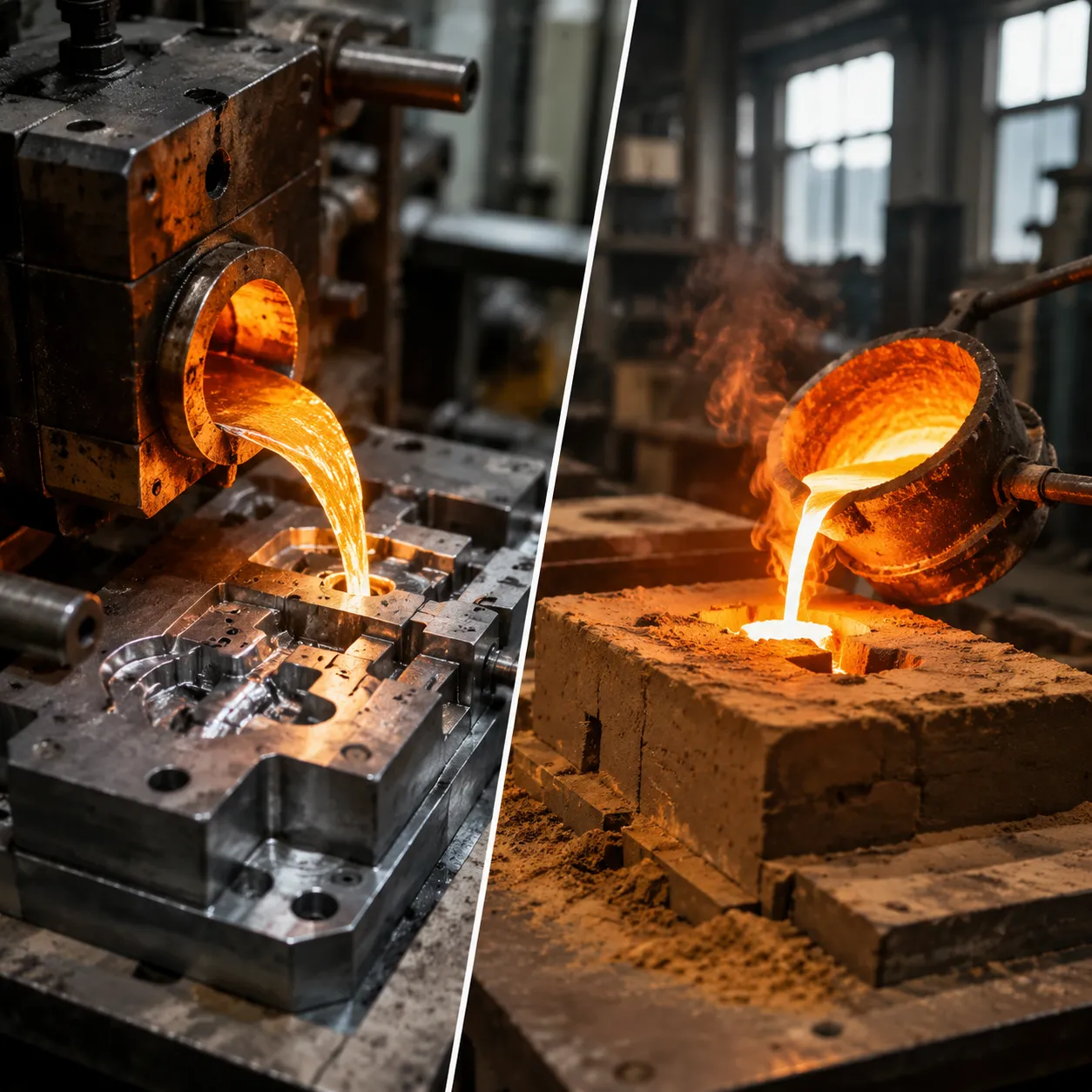
When we need high-volume production with exceptional precision, we rely on die casting. Unlike temporary molds, this process injects molten metal into custom, highly durable steel molds to produce identical parts quickly and consistently.
We generally categorize the process into two main techniques:
- High-Pressure Die Casting (HPDC): Molten metal is injected under extreme pressure into the mold cavity at high speeds. This is our go-to method for rapid, large-scale manufacturing and parts with intricate, thin-walled geometries.
- Gravity Die Casting: Molten metal is poured into the mold using natural gravity. It works best for thicker-walled components and medium-volume production runs where extreme pressure isn't required.
Core Components of the Die Casting Process
- Reusable Steel Dies: Hardened tool steel molds engineered to withstand thousands of high-temperature cycles while maintaining precise dimensions.
- Metal Injection Mechanism: A powered hydraulic piston that forces liquid alloy into every intricate crevice of the die under controlled pressure.
- Ejector Pins: Integrated mechanical pins that cleanly push the cooled, solidified part out of the open die cavity to keep cycle times fast.
Suitable Materials
Die casting is optimized for non-ferrous metal alloys with lower melting points that won't degrade the tool steel:
- Aluminum Alloys: Excellent strength-to-weight ratio, high thermal conductivity, and strong corrosion resistance. Perfect for aluminum die casting applications in automotive and industrial hardware.
- Zinc Alloys: Highly ductile with low melting points, allowing for long tool life, extremely complex shapes, and ultra-thin wall sections.
- Magnesium Alloys: The lightest structural metal available, delivering superior stiffness-to-weight performance and excellent EMI shielding.
Key Pros and Cons of Die Casting
| Advantages | Limitations |
|---|---|
| Rapid Production Speeds: Cycle times take seconds, making it the most scalable option for mass production. | High Tooling Costs: Custom reusable steel dies require a significant upfront capital investment. |
| Superior Surface Finish: Smooth, consistent finishes right out of the mold require minimal post-processing. | Material Restrictions: Primarily limited to non-ferrous metals; high-melting-point metals like steel aren't suitable. |
| Tight Tolerances: High dimensional accuracy and repeatability across millions of units. | Part Size Limits: Equipment size caps the maximum physical dimensions of cast components. |
Evaluating these trade-offs against your design requirements is an essential step in our complete die casting vs sand casting manufacturing comparison.
Die Casting vs Sand Casting: Key Differences Compared
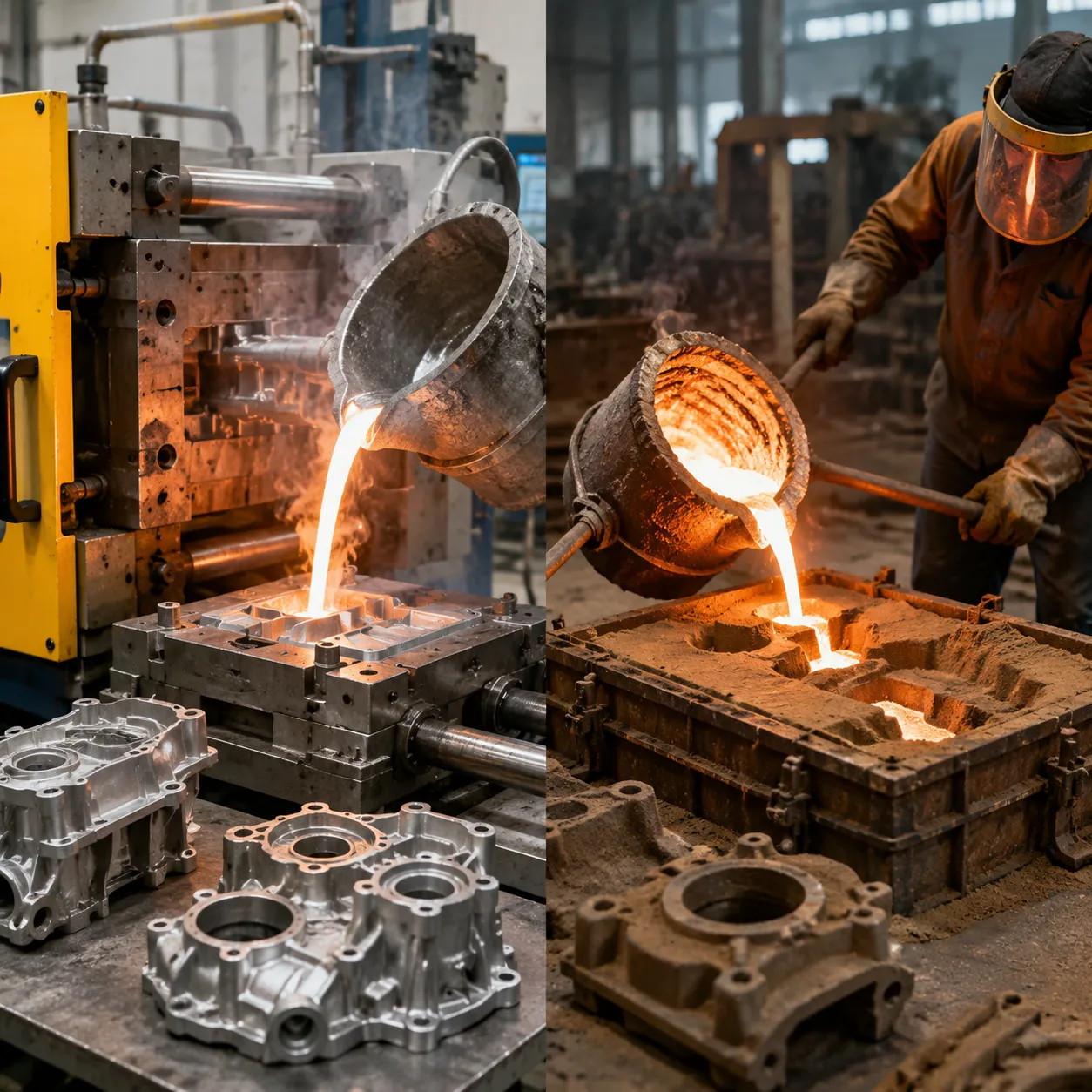
Choosing between die casting vs sand casting comes down to balancing your production volume, surface finish needs, material choice, and budget. Here is a direct breakdown of how these two manufacturing methods compare in key operational areas.
Comparison Overview
| Feature | High Pressure Die Casting | Sand Casting Process |
|---|---|---|
| Ideal Production Volume | High volume (10,000+ units) | Low to medium volume (1 to 5,000 units) |
| Upfront Tooling Cost | High | Low |
| Per-Unit Cost | Very low at scale | Moderate to high |
| Dimensional Accuracy | High (± 0.002 to ± 0.005 in) | Moderate (± 0.010 to ± 0.030 in) |
| Surface Finish | Smooth (32-125\ μin) | Rough (250-500\ μin) |
| Material Options | Non-ferrous alloys (Aluminum, Zinc, Mg) | Ferrous and non-ferrous metals |
Production Speed and Volume Scalability
- High Pressure Die Casting: Highly automated. Injecting molten metal into reusable steel dies takes only seconds per cycle, making it the most efficient choice for mass production.
- Sand Casting Process: Labor-intensive. Molds must be recreated for every single pour. While traditional green sand vs dry sand casting methods offer unmatched material flexibility, they cannot match the rapid cycle times of automated die casting.
Dimensional Accuracy, Tolerances, and Surface Finish
- Die Casting: Provides superior dimensional accuracy casting and exceptionally fine casting surface finish tolerances. Parts often require little to no post-machining.
- Sand Casting: Leaves a grainy texture on the final part and looser tolerances. When evaluating forging and casting strength, cost, and tolerance, die casting consistently delivers tighter precision directly out of the mold compared to sand molds.
Material Compatibility and Alloy Restrictions
- Sand Casting: Handles almost any metal. It easily pours high-melting-point ferrous metals like steel, stainless steel, and ductile iron, as well as non-ferrous metal alloys.
- Die Casting: Restricted primarily to non-ferrous alloys (aluminum, zinc, and magnesium). High-temperature metals like iron or steel would rapidly melt or thermally shock the steel dies.
Initial Tooling Cost vs Per-Unit Manufacturing Cost
Understanding the die casting vs sand casting cost dynamic requires weighing upfront capital against piece-price savings:
- Initial Tooling Costs: High-grade steel dies require significant upfront investment, whereas sand casting patterns are inexpensive to produce.
- Per-Unit Cost: Once tooling is paid off, die casting delivers extremely low unit prices. Sand casting carries higher labor and cycle costs per part, making it ideal mainly for low volume metal casting.
How to Choose the Best Casting Process for Your Part
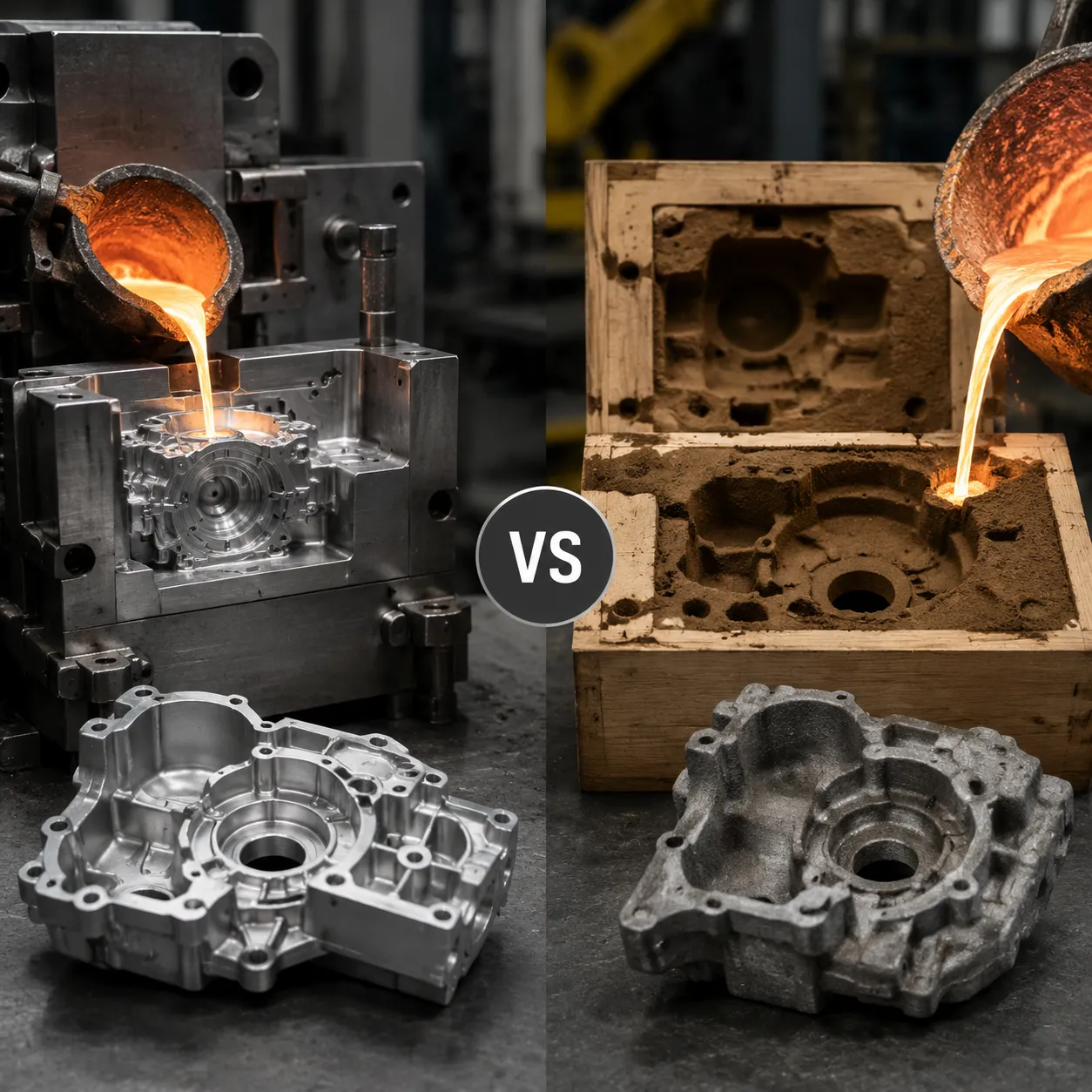
Selecting between die casting vs sand casting comes down to four critical project requirements: production volume, tooling budget, part geometry, and surface finish needs. We walk our clients through these key factors to ensure the right manufacturing path for their parts.
1. Match Production Volume and Tooling Costs
Your overall volume dictates whether you should pay higher upfront tooling costs or absorb higher per-unit processing costs.
- Low-Volume Runs (<1,000 units): Sand casting is the ideal choice. Pattern costs are very low, making it cost-effective for prototypes, legacy replacements, and short production runs. Working with a reliable sand casting manufacturer for custom metal parts keeps initial capital investment minimal.
- High-Volume Runs (5,000+ units): Die casting wins on scale. Hardened steel dies require a high upfront investment, but fast cycle times deliver the lowest per-unit manufacturing cost at high volumes.
| Selection Factor | Sand Casting | Die Casting |
|---|---|---|
| Upfront Tooling Cost | Low | High |
| Per-Unit Production Cost | Moderate to High | Low |
| Ideal Production Volume | 1 – 1,000 parts | 5,000+ parts |
| Tooling Lead Time | 1 – 3 weeks | 6 – 12 weeks |
2. Evaluate Geometry and Wall Thickness Limits
Part design and physical size strongly influence which method will work:
- Wall Thickness: High pressure die casting easily handles thin-walled parts (1 mm – 1.5 mm). Sand casting requires thicker minimum wall sections (3 mm+) to prevent premature freezing of the molten metal.
- Overall Part Size: Sand casting has virtually no upper size limit, easily producing heavy structural components weighing hundreds of pounds. Die casting is constrained by the physical size and clamping force of the press machine.
3. Factor in Tolerances and Surface Finishing
Post-processing adds both time and cost to your production workflow:
- Die Casting: Delivers exceptionally smooth surface finishes and tight dimensional accuracy straight out of the mold, minimizing or completely eliminating secondary machining.
- Sand Casting: Produces a rougher surface texture and wider tolerances. Critical features like bearing seats or mating faces will require secondary CNC machining. If you need tight tolerances on complex geometries but low volumes, reviewing an investment casting vs sand casting process comparison can help you weigh alternative precision options.
Frequently Asked Questions About Die Casting and Sand Casting
Which process is cheaper for low-volume orders?
For low volume metal casting runs, sand casting is significantly cheaper. High-pressure die casting requires expensive reusable steel dies that take thousands of parts to justify the cost. Sand patterns require a fraction of that upfront investment, making sand casting ideal for prototyping or small batch production.
Can you cast ferrous metals like steel using die casting?
No, standard high pressure die casting is generally restricted to non-ferrous alloys like aluminum, zinc, and magnesium. Steel and iron have high melting temperatures that rapidly destroy steel die molds. For steel components, sand casting is the proven industry standard. You can check our detailed guide to casting stainless steel to explore optimal methods for high-temp alloys.
Which process provides tighter dimensional tolerances?
Die casting delivers superior dimensional accuracy casting capability and smooth surface finishes straight out of the mold. Sand molds expand slightly under extreme heat, which means sand cast parts usually require secondary machining to achieve tight casting surface finish tolerances. To see how traditional sand methods compare to tighter manufacturing processes, review our breakdown of the green sand casting process and precision alternatives.
How do lead times compare between die casting and sand casting?
Lead times depend on whether you are measuring initial setup or active production:
- Sand Casting: Faster initial startup (1 to 3 weeks) due to simple pattern building, but slower part-by-part production speed.
- Die Casting: Longer initial setup (6 to 12 weeks) to precision-machine steel tooling, followed by lightning-fast production cycles that yield thousands of parts daily.
 English
  Russian
  German