
2026年11月16日
Foundry Robot Integration Checklist for Investment Casting Lines guides safe scalable automation sourcing with clear scope interfaces testing and supp
1. Project Definition and Baseline Audit
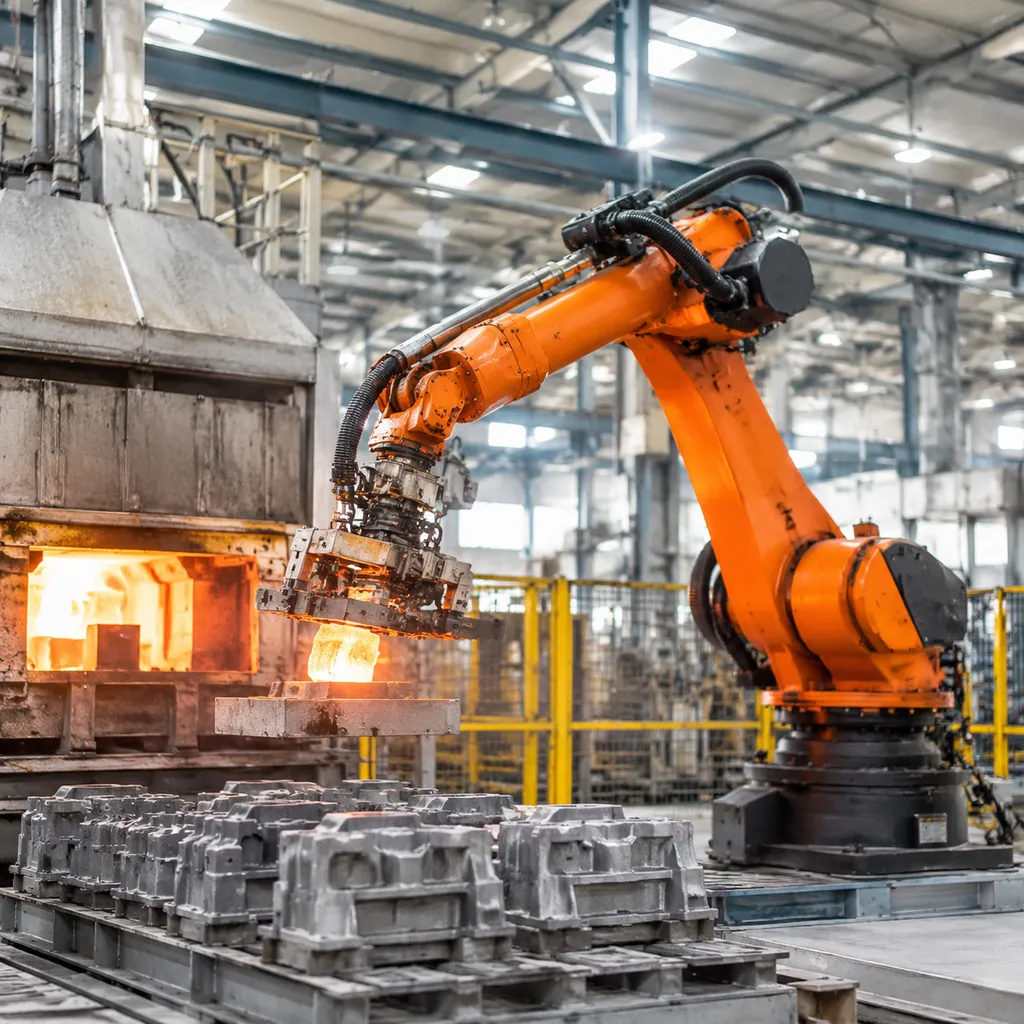
A successful automated investment casting deployment begins with a rigorous evaluation of your existing plant layout, process bottlenecks, and operational objectives. Before selecting hardware, every production parameter must be documented to establish a clear baseline for automation.
Feasibility and Target Station Selection
Identify the specific investment casting stages earmarked for robotic handling: Wax Assembly: Handling delicate wax patterns, runner gating, and cluster mounting. Shell Room Automation: Robotic dipping, slurry tank immersion, rain sander application, and drying room transfers. Post-Cast Operations: Knockout, gate cutting, abrasive grinding, and finished part sorting.
Facility and Footprint Constraints
Physical plant constraints dictate cell geometry and reach envelopes. Evaluate: Ceiling Height and Overhead Clearances: Critical for deep slurry tanks, vertical sanders, and tree inversion maneuvers. Floor Loading Capacities: Structural reinforcement requirements for high-payload robotic pedestals. Environmental Obstacles: Slurry splash zones, silica dust exposure paths, and ventilation hood clearances.
Baseline Assessment Matrix
| Evaluation Parameter | Key Engineering Consideration | Impact on System Design |
|---|---|---|
| Gross Payload | Combined weight of wet ceramic tree, slurry drag force, and EOAT | Determines robot axis payload margin and moment of inertia |
| Kinematic Reach | Tank depth, rain sander drop points, and carousel transfer radius | Defines pedestal height and arm reach requirements |
| Cycle Time Target | Dip-and-drain duration per coat; transfer speeds between dips | Establishes required axis speeds and cell throughput limits |
| Facility Utility Access | High-pressure pneumatic lines, clean 480V power, industrial Ethernet | Dictates field distribution and control cabinet placement |
Establishing these operational boundaries prevents downstream engineering changes and provides a solid foundation for equipment specification.
2. Part, Tooling, and Process Requirements

A successful foundry robot integration checklist for investment casting lines starts with defining the physical behavior of your wax assemblies and ceramic shells. If you do not map every gram of payload and every millimeter of clearance early, the cell will struggle with drop-offs, uneven coatings, or mechanical wear.
Component and Tree Payload Thresholds
- Dry vs. Wet Tree Weight: Calculate maximum payload using the fully built, wet ceramic shell, not just the raw tree from wax injection. Factor in the slurry retention weight during extraction.
- Center of Gravity (CoG) Shifts: As successive refractory layers build up during shell coating, the CoG migrates outward. Your robot payload curve must account for dynamic torque during high-angle tilts.
- Runner and Tree Geometry: Standardize tree heights, runner diameters, and hanging lugs across part families to minimize rapid changeovers.
End-of-Arm Tooling (EOAT) and Gripper Design
- Positive Mechanical Clamping: Friction-only air grips fail when coated in slippery primary slurry or fine zircon flour. We specify mechanical locking lugs or pneumatic clamps with mechanical detents to secure the assembly if air pressure drops.
- Abrasive Ingress Sealing: Keep gripper cylinders, linear guides, and sensors isolated from falling stucco sand, silica dust, and liquid binders.
- Compliance and Buffering: Build controlled compliance into the gripper interface to cushion the transfer of delicate wax patterns without inducing micro-fractures.
Slurry Dipping and Shell Building Parameters
| Process Parameter | Critical Specification | Integration Impact |
|---|---|---|
| Dipping Speed | 50 to 150 mm/s programmable entry/exit | Prevents air entrapment and slurry wash-off |
| Axis Manipulation | Multi-axis continuous rotation (360°) | Eliminates bubbles in deep blind holes and sharp corners |
| Drain Angle Profiles | Variable dynamic tilt (30° to 85°) | Ensures consistent wall thickness across complex precision casting clusters |
| Layer Compatibility | Primary, intermediate, and backup coats | Prepares the mold structure for clean dewaxing and subsequent firing in a 1200C energy-saving burnout furnace for silica sol shells |
Controlling these mechanical constraints upfront allows the robot to reproduce precise, repeatable dipping recipes without manual intervention.
3. Robots, End-of-Arm Tooling, and Workstation Layout

Selecting the right mechanical architecture is critical to our foundry automation strategy. On an active investment casting line, standard industrial robots fail quickly without the right environmental protection and payload calculations. We focus on matching ruggedized kinematics to the exact physical demands of the dipping and shell-building sequence.
Robot Selection and Foundry Hardening
Precision casting environments generate abrasive slurry splatter, airborne refractory dust, and stucco sand. We evaluate robotic arms using strict environmental and kinematic criteria:
- Ingress Protection (IP) Ratings: We mandate minimum IP65 or IP67-rated arms with sealed joints to prevent silica slurry and dust ingress into gearboxes and motors.
- Protective Jacketing and Coatings: We use pressurized arm suits or specialized foundry-grade polyurethane coatings to repel wet slurry wash-off and resist thermal radiation near preheat areas.
- Dynamic Payload Margins: Payload calculations must account for the dry tree weight, the cumulative weight of wet ceramic layers, end-of-arm tooling (EOAT), and the drag resistance generated when pulling assemblies through high-viscosity slurries. We maintain a 30% to 40% payload overhead margin to prevent joint strain during high-torque manipulation.
End-of-Arm Tooling (EOAT) Design
The gripper bridges the mechanical arm and the delicate wax assembly. A drop inside a slurry vat halts production and creates costly downtime:
- Pneumatic vs. Mechanical Gripping: We prioritize mechanical fail-safe locking mechanisms backed by pneumatic clamps. In the event of a sudden air-line drop, the gripper retains mechanical holding force on the pouring cup or runner bar.
- Tool Center Point (TCP) Stability: Stiff, vibration-free clamping prevents pattern deflection during rapid immersion. This rigidity ensures repeatable wall thickness on tight-tolerance products, including 17-4 investment casting custom stainless steel parts.
- Slurry Deflection: Gripper assemblies require mechanical deflectors and non-stick shielding to prevent ceramic slurry buildup on pneumatic actuators and sensors.
Workstation Integration and Motion Envelopes
A high-performance robotic shell-coating cell demands tight coordination between stationary equipment and the robot’s path:
| Cell Element | Integration Requirement | Primary Risk Mitigated |
|---|---|---|
| Slurry Tanks | Variable immersion depths with low-speed entries | Slurry wash-off and wax cluster damage |
| Rain Sanding Towers | Synchronized multi-axis rotation within the sand curtain | Non-uniform stucco deposition and thin shell walls |
| Drying Conveyors | Indexed drop-off nests with interlocked position feedback | Part collisions during automated load/unload |
| Cell Footprint | Overhead clearance checks and floor anchoring analysis | Dynamic deflection under heavy, extended payloads |
We engineer motion trajectories with smooth acceleration and deceleration profiles. Controlled handling prevents wax tree distortion, minimizes air pocket entrapment in interior part cavities, and ensures uniform shell thickness across the entire casting batch.
4. Safety, Compliance, and Human-Machine Interaction (HMI)

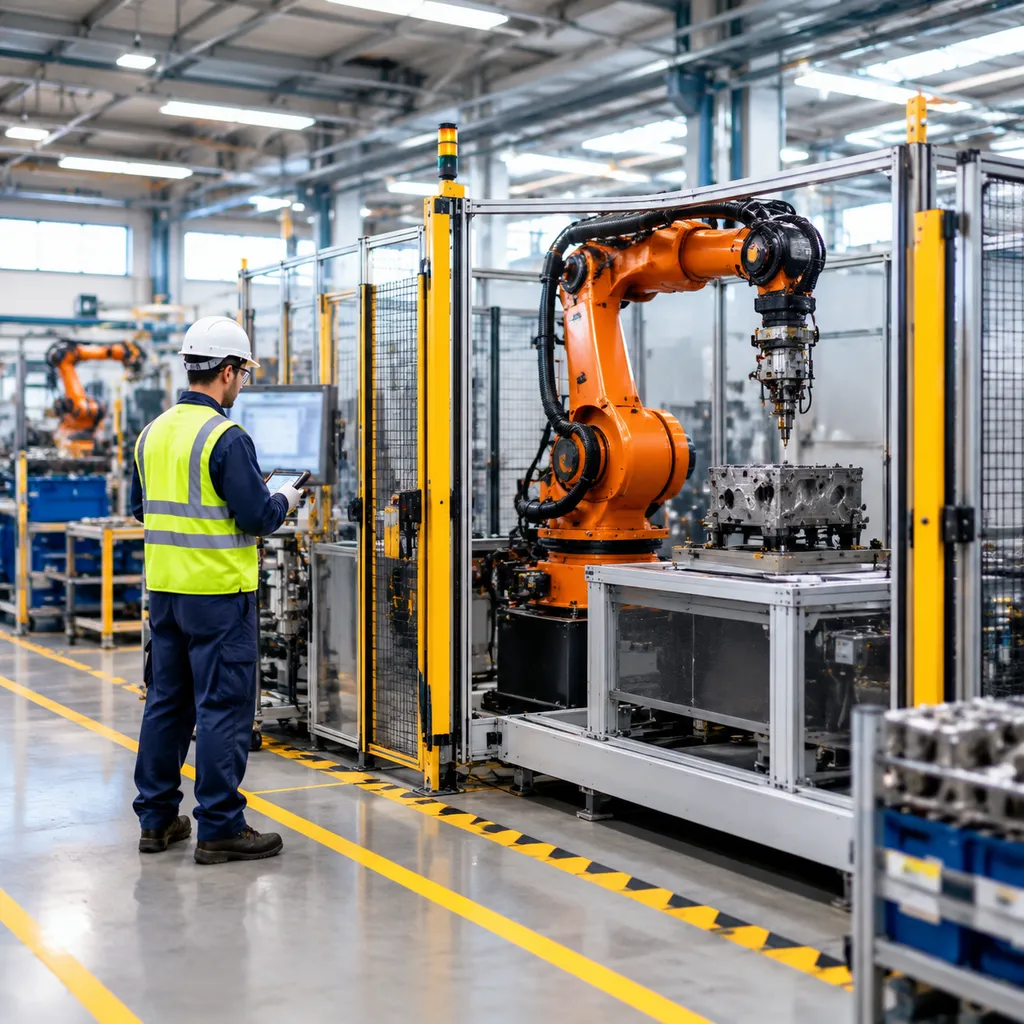
A successful foundry robot integration checklist for investment casting lines demands strict safety guarding and intuitive shop-floor controls. Moving heavy clusters between dipping tanks and sanders introduces pinch points, mechanical hazards, and airborne silica. We build our safety architecture around international standards to protect operators while keeping cycle times efficient.
Core Safety and Compliance Essentials
- Global Standard Adherence: Every cell meets ISO 10218-1/2 and ANSI/RIA R15.06 requirements for industrial robotic systems and system integration.
- Perimeter Guarding & Interlocks: Heavy-duty physical enclosures isolate slurry dipping and rain sanding areas. Integrated safety interlock doors and optical light curtains immediately pause robot motion if an operator breaches the zone.
- Safety Zones & E-Stop Routing: Zoned emergency stops allow maintenance crews to service an auxiliary slurry mixer without dropping power to the entire investment casting shell room.
- Safe Speed Monitoring: Dual-channel safety logic limits robot travel speed during teaching or visual shell inspections. This reduces collision risks when handling delicate 3D printed wax patterns for rapid investment casting during setup runs.
HMI & Operator Usability
| Feature | Production Benefit |
|---|---|
| Recipe-Based Batch Controls | Operators switch shell coating sequences, drain angles, and dry timers with a single touch. |
| Fault Recovery Routines | Step-by-step graphical guides walk operators through safe arm recovery after power disruptions without requiring manual robot jogging. |
| Access-Level Management | Restricts robot trajectory editing to automation engineers, preventing accidental speed or point modifications on the floor. |
5. Data, Traceability, and Acceptance
A reliable foundry automation setup relies on verified data flow and rigorous qualification benchmarks. In investment casting lines, our robotic cells must do more than move assemblies; they must log operational parameters and prove operational capability before entering live production.
Real-Time Process Data and Line Communication
To maintain total control over your investment casting operations, your robot cell needs seamless integration into existing plant architectures.
- Fieldbus Integration: Verify stable industrial communication protocols (PROFINET, EtherNet/IP, or Modbus) between the robotic controller, plant PLC, and SCADA systems.
- Process Parameter Monitoring: Log slurry tank temperatures, ambient drying room humidity, rotational dipping speeds, and drain angles in real time.
- Alarm and Fault Archiving: Ensure the system records every mechanical or process deviation, such as gripper pressure drops or axis torque spikes, to prevent sudden line stops.
Recipe Management and Component Traceability
Complex casting lines handle mixed-part production where consistency is critical. Advanced recipe management tracks individual tree assemblies through every coat, ensuring that precision components—such as 416 stainless steel investment castings—receive exact shell thicknesses and dry times.
- RFID and Barcode Tracking: Match each cluster or tree fixture with a dedicated serial ID before dipping or handling.
- Automated Recipe Switching: Automatically recall dipping depth, axis acceleration, slurry drain profiles, and sanding sequences based on specific alloy and part geometries.
- Layer Verification: Record the exact number of slurry and stucco layers applied to eliminate human error during multi-day shell-building cycles.
Acceptance Testing Checklist (FAT & SAT)
Never sign off on an automation cell based solely on simulated cycles. Complete sign-off requires systematic Factory Acceptance Testing (FAT) at the integrator site and Site Acceptance Testing (SAT) on your active casting floor.
- Tool Center Point (TCP) Calibration: Validate TCP accuracy under maximum payload conditions to ensure consistent immersion depths and assembly alignment.
- Dry-Cycle and Wet-Load Runs: Conduct continuous dry-run cycle testing followed by full-weight dipping trials with actual wet tree payloads to verify motor torque limits and zero-slip gripper integrity.
- Safety Circuit Validation: Test all physical interlocks, area scanners, light curtains, and zoned E-stop functions under active load conditions.
- Repeatability Run: Execute an uninterrupted multi-hour batch run to confirm that cycle times, drain angles, and part positions stay within specified engineering tolerances.
6. Commercial Comparison and After-Sales Support
A complete Foundry Robot Integration Checklist for Investment Casting Lines requires looking beyond the initial equipment price tag. When assessing proposals or issuing a casting RFQ, we evaluate total lifecycle costs, system warranties, and real-world after-sales responsiveness to prevent costly line stoppages in demanding precision casting environments.
Evaluating Integrator Proposals
Not every automation quote includes the same deliverables. When working with a potential foundry robot integrator, compare bids line-by-line using these core benchmarks:
- Full Scope of Delivery: Verify whether the quote covers cell simulation, end-of-arm tooling (EOAT), safety guarding, offline programming, and onsite commissioning, or if those carry separate fees.
- Process Compatibility: Ensure the integrator has proven experience handling delicate wax patterns, slurry tanks, and abrasive stucco sand common in A356 aluminum investment casting and related alloy operations.
- Warranty Terms: Secure a minimum 12-month full-system warranty that covers both the manipulator and custom interface hardware, not just individual off-the-shelf components.
- Software Licensing: Confirm that software licenses, recipe configuration tools, and PLC code access are fully transferred without recurring proprietary lock-in fees.
Total Cost of Ownership (TCO) Breakdown
| Cost Category | Key Considerations | Impact on Investment Casting Lines |
|---|---|---|
| Initial CapEx | Robot arm, EOAT, controls, cell safety fencing | Sets the entry barrier; must reflect true turnkey capability. |
| Wear & Consumables | Seals, protective jackets, gripper pads, cable dress packs | High impact in slurry dipping and sand coating zones. |
| Integration & Rework | Mechanical alignment, line retrofits, trials | Poor integration causes pattern breakage and shell defects. |
| Downtime & Support | Hourly emergency service rates, remote access | Unplanned downtime disrupts shell drying and pouring schedules. |
Critical After-Sales Support Checklist
Foundry automation operates in harsh, particulate-heavy environments that accelerate mechanical wear. We prioritize partners who deliver reliable technical support and proactive maintenance:
- Guaranteed Response Times: Define clear Service Level Agreements (SLAs) for remote diagnostic support (under 2 hours) and on-site emergency dispatch (under 24–48 hours).
- Critical Spares Package: Stock essential spare parts on-site from day one, including spare servo motors, pneumatic valves, sensor kits, and gripper fingers.
- Hands-On Training: Demand structured, multi-tier training programs for machine operators, maintenance technicians, and cell programmers prior to formal handoff.
- Preventive Maintenance Audits: Schedule routine technical reviews to recalibrate robot paths, check joint backlashes, and inspect protective seals against silica dust.
Frequently Asked Questions
What does a foundry robot integrator deliver?
A full-scope integration package delivers a turnkey automation cell built specifically for harsh foundry environments. We provide:
- Hardware & Tooling: Foundry-hardened robotic arms, pressurized protective jackets, and custom pneumatic or mechanical fail-safe end-of-arm tooling (EOAT).
- Controls & Software: Pre-programmed PLC, SCADA, and cell controllers utilizing standard protocols (EtherNet/IP, PROFINET, Modbus) with embedded recipe management systems for shell layer dipping and drying cycles.
- Safety Integration: Physical safety fences, optical light curtains, interlocks, and zoned E-stop controls aligned with ISO 10218 and ANSI/RIA standards.
- Execution & Training: Complete cell layout design, Tool Center Point (TCP) calibration, and operator handover protocols through our one-stop service model.
Should you select the robot before mapping out the process?
Never choose the robotic arm before completing a detailed process audit. In investment casting lines, the process dictates the robot:
- Payload & Dynamics: You must calculate total weight including the heaviest tree assembly, absorbed wet slurry, end-of-arm tooling, and dynamic drag forces during dipping.
- Kinematic Reach: Ceiling heights, slurry tank depths, and fluid fluid-bed sander clearances dictate arm reach and joint limits.
- Environmental Exposure: The choice of sealing, pressurized jacketing, and IP rating depends directly on the concentration of airborne refractory dust, thermal radiation, and liquid silica.
Finalize your motion profiles, cycle times, and tree weights first. Hardware selection happens only after these boundaries are locked down.
Can an integrator interface with existing investment casting equipment?
Yes. Retrofitting modern robotics into established shell rooms and casting lines is standard practice. Integrating with existing equipment involves:
- Legacy I/O Handshaking: Interfacing existing slurry mixers, rain sanders, and conveyors via industrial fieldbus networks or hardwired digital I/O blocks.
- Cell Synchronization: Synchronizing rotational speeds of existing tanks with the robot's motion control to eliminate slurry wash-off and pattern distortion.
- Controls Modernization: Upgrading central control cabinets to support multi-recipe handling without replacing functioning mechanical machinery, relying on our core technical advantages to minimize line downtime during transition.
What should be included in acceptance testing?
Acceptance testing must be split into Factory Acceptance Testing (FAT) at the build facility and Site Acceptance Testing (SAT) on your foundry floor. The checklist includes:
- Gripper Retention Testing: Verifying mechanical or pneumatic grip retention under simulated power loss with maximum wet tree weight.
- TCP & Path Repeatability: Validating Tool Center Point calibration through repeated dip, drain, and stuccoing motion profiles.
- Communication Handshakes: Verifying real-time signal transmission between the robot controller, peripheral casting equipment, and the plant-wide SCADA system.
- Safety & E-Stop Verification: Testing reaction times and safety circuit integrity across all light curtains, interlocked gates, and emergency stop zones.
- Full-Rate Production Run: Operating the cell at target cycle speeds with production recipes to confirm shell thickness consistency and zero thermal or payload tripping.
Related Foundry Automation and Investment Casting Resources
A complete foundry robot integration checklist for investment casting lines connects robotic hardware directly to core metallurgical and tooling processes. To evaluate operational trade-offs and process capabilities across your facility, explore our dedicated engineering guides:
- Process Fundamentals & Feasibility: Before configuring automated dipping, drying, and assembly cells, review the core mechanics and trade-offs outlined in our breakdown of the advantages and disadvantages of lost wax casting.
- Method Comparison & Upgrades: For facilities optimizing line throughput or shifting tooling methods prior to cell commissioning, review the operational advantage of investment casting over green sand casting to determine payload and precision requirements.
- Automation RFQ Preparation: Cross-reference shell room cycle times, slurry viscosity controls, and wax pattern handling metrics against your production targets before finalizing workcell footprints.
Next Steps: Request an Integration Review
Transitioning from an operational audit to active deployment requires turning your checklist into an engineered layout. Using our Foundry Robot Integration Checklist for Investment Casting Lines, we evaluate your existing floor space, production cycle targets, and handling demands to build a solid automation roadmap.
Whether automating shell coating sequences for alloy steel investment casting or configuring tight-tolerance dipping recipes for aerospace investment casting for precision components, conducting an upfront technical review prevents layout revisions, payload mismatches, and unplanned downtime during commissioning.
Integration Proposal Requirements
To initiate a structured integration assessment, provide your facility and line documentation:
- Pattern & Tree Metrics: Maximum wet tree weights, overall assembly dimensions, and center-of-gravity shifts during dipping.
- Process Sequences: Target dipping times, slurry viscosities, drain angles, sanding methods, and drying cell parameters.
- Facility Layouts: 2D or 3D floor plans, overhead clearances, ventilation points, and existing utility locations (pneumatics, power, networking).
- Line Deliverables: Required takt times, safety fencing footprint boundaries, and plant communication protocols (EtherNet/IP, PROFINET).
We review your production data to deliver 3D reach simulations, payload and moment-of-inertia verifications, end-of-arm tooling concepts, and full cell safety zoning tailored to your foundry automation targets.
 English
 Russian
 German