
2026年8月11日
Aluminum investment casting for custom precision parts with tight tolerances alloy options rapid prototyping and finishing
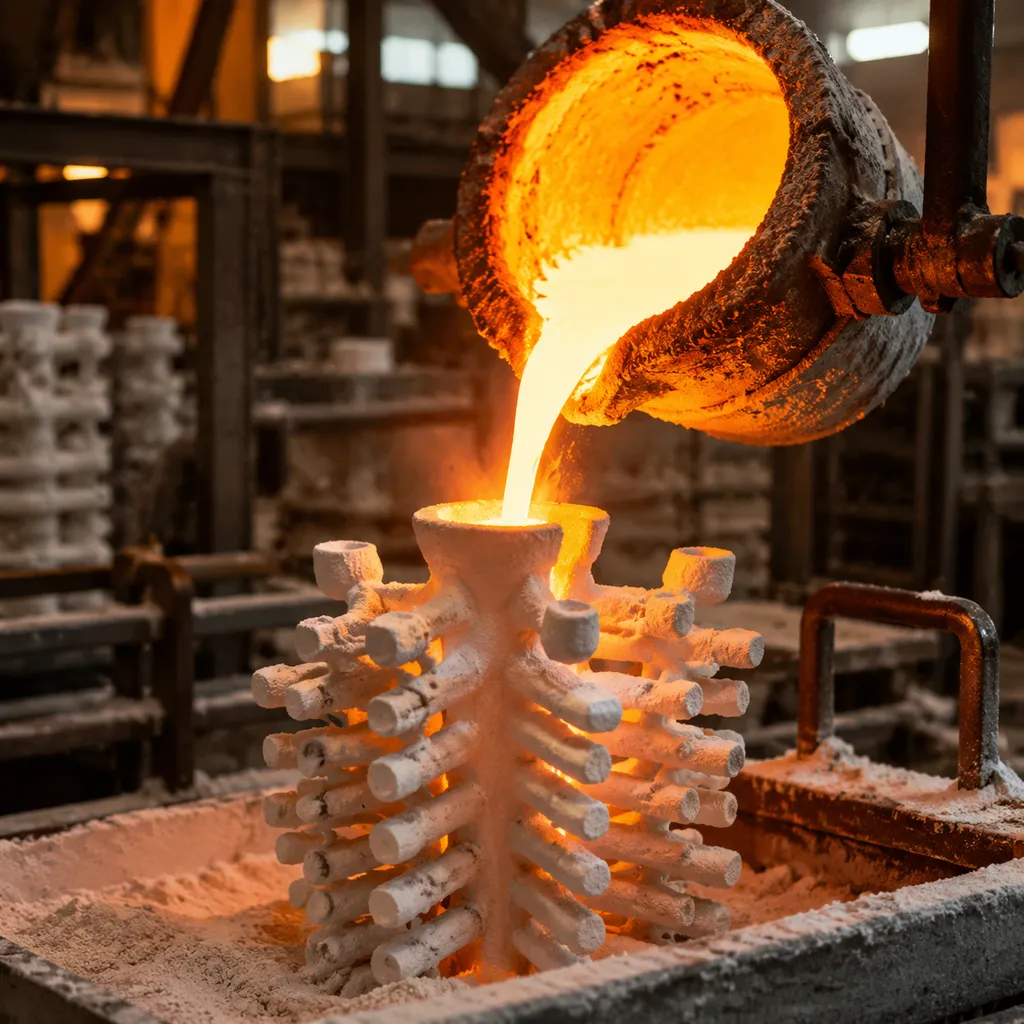
Understanding Aluminum Investment Casting
Are you struggling with complex metal components that demand tight tolerances, lightweight strength, and smooth surface finishes without triggering sky-high CNC machining costs? We get it. When standard manufacturing methods fail to deliver intricate geometries reliably, aluminum investment casting provides the ultimate precision solution.
What Makes Lost Wax Aluminum Casting Unique
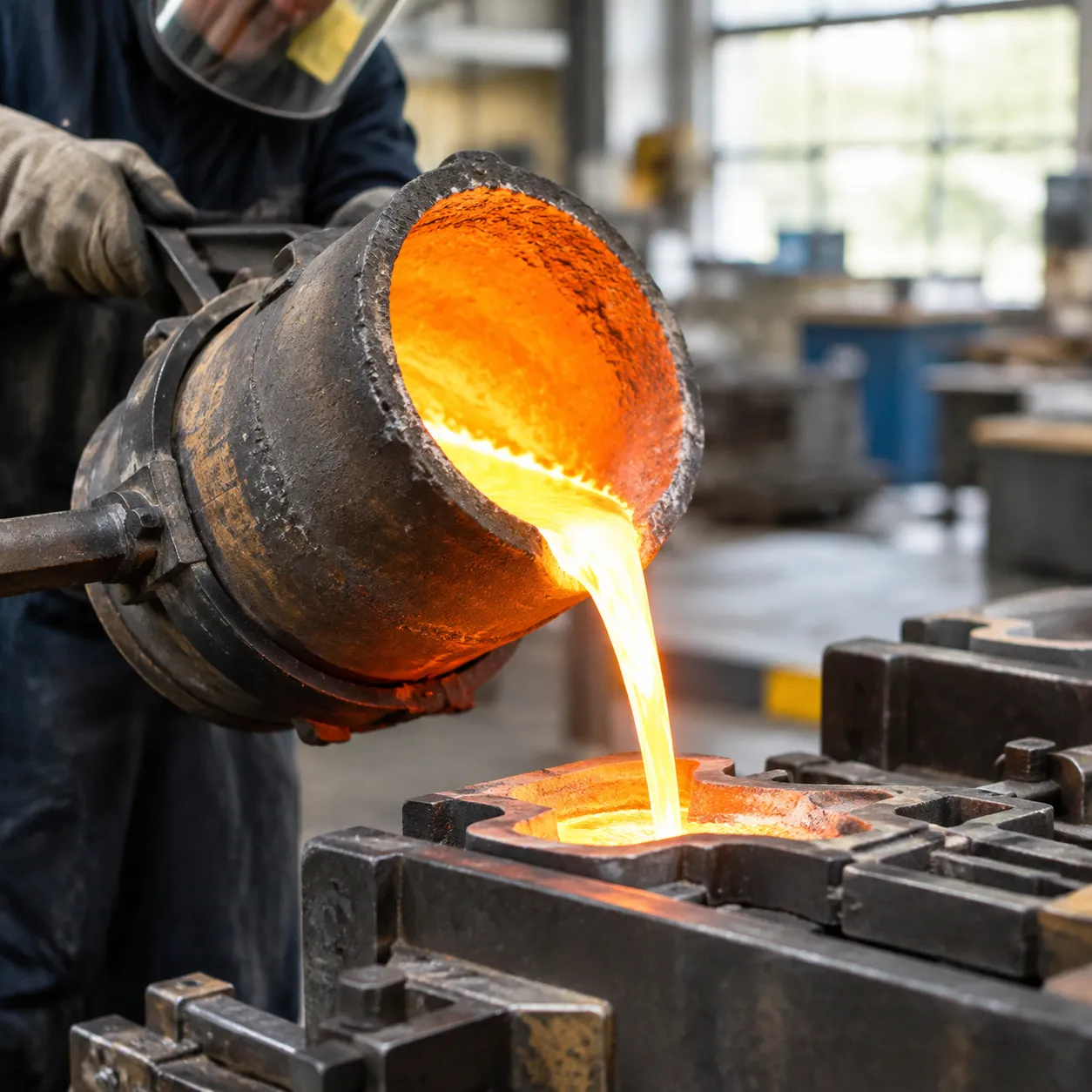
The lost wax process enables us to replicate complex internal channels, thin walls, and fine details that traditional metalworking cannot match. By surrounding an exact wax pattern with a durable ceramic shell and melting the wax away, we pour molten alloy into a seamless mold.
- Zero Draft Angles: Cast complex geometries without forcing artificial draft angle design compromises.
- Near-Net Shape Accuracy: Drastically reduces or eliminates expensive secondary post-cast machining operations.
- Superior Surface Finish: Delivers exceptionally smooth surfaces right out of the ceramic shell.
Key Advantages Over Die Casting and Sand Casting
Selecting the right manufacturing route directly impacts your tooling budgets, material performance, and production timeline. Here is how precision aluminum casting stack up against alternate methods:
| Manufacturing Factor | Aluminum Investment Casting | Die Casting | Sand Casting |
|---|---|---|---|
| Design Complexity | High (intricate voids & thin walls) | Moderate (limited by hard tooling) | Low to Moderate |
| Initial Tooling Cost | Low to Moderate | High | Very Low |
| Surface Smoothness | Excellent (125 RMS standard) | Good | Rough |
| Machining Required | Minimal to None | Moderate | High |
| Production Flexibility | Prototype to Medium-Volume | High-Volume Only | Prototype & Low-Volume |
Applications in Aerospace and Automotive
We supply high-integrity, lightweight cast components engineered to handle brutal thermal and physical stresses in demanding sectors:
- Aerospace Aluminum Casting: Critical fuel system housings, environmental control valves, mounting brackets, and structural drone fittings requiring exceptional strength-to-weight ratios.
- Automotive Aluminum Investment Casting: Custom turbocharger impellers, intake manifolds, brake calipers, and lightweight EV powertrain enclosures.
Popular Aluminum Alloys and Material Selection
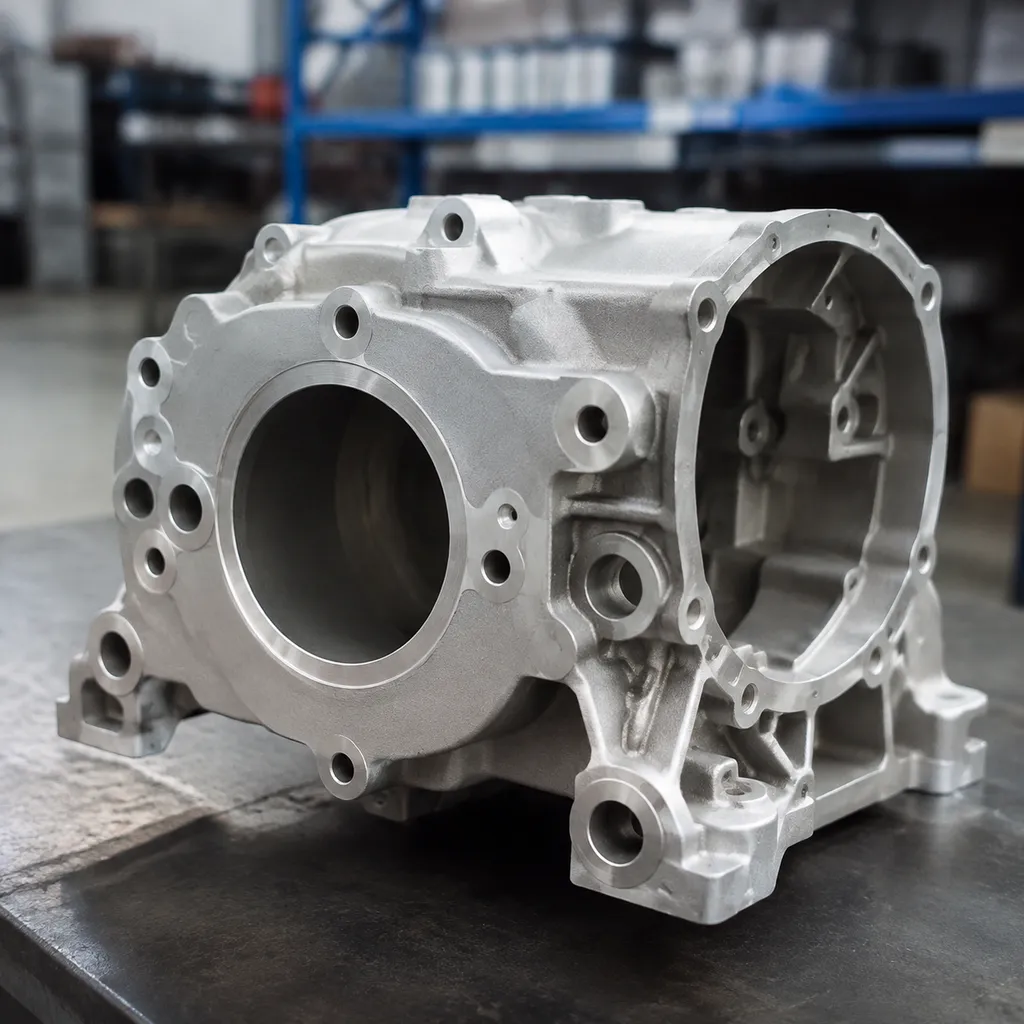
Choosing the right alloy for aluminum investment casting directly impacts mechanical strength, weight, and thermal resistance. Partnering with an experienced precision aluminum casting foundry ensures your components meet strict structural demands while remaining cost-effective to produce.
A356 Aluminum Investment Casting for High Strength
A356 is our primary workhorse material for structural components. Composed of 7% silicon and 0.3% magnesium, A356 aluminum investment casting offers an ideal balance of fluidity, strength, and corrosion resistance.
- Primary Uses: Structural aerospace fittings, automotive control arms, pump housings, and marine hardware.
- Core Benefits: Exceptional castability, minimal micro-porosity, and high impact resistance after heat treatment.
C355 Aluminum Alloy for High Temperature Performance
When components face elevated operating temperatures or demand extreme pressure tightness, C355 is the superior material choice. Containing 1.25% copper, 5% silicon, and 0.5% magnesium, it provides higher tensile strength at elevated thermal ranges than standard alloys.
- Primary Uses: Turbocharger impellers, compressor wheels, aviation engine brackets, and high-pressure valve bodies.
- Core Benefits: High yield strength under thermal stress, superior pressure tightness, and clean machinability.
Heat Treatment Options and T6 Conditioning
Raw investment castings undergo thermal processing to optimize their final mechanical properties. We utilize specific heat treatments depending on your structural requirements:
- T6 Conditioning: Solution heat-treated and artificially aged. Delivers maximum yield strength, hardness, and load capacity.
- T51 Conditioning: Thermally stress-relieved to prevent dimensional warping during post-casting CNC machining.
- T4 Conditioning: Solution heat-treated and naturally aged to maximize ductility and shock absorption.
| Alloy & Temper | Tensile Strength | Yield Strength | Primary Performance Highlight |
|---|---|---|---|
| A356-T6 | ~260 MPa | ~185 MPa | Balanced strength, ductility, and corrosion resistance |
| C355-T6 | ~310 MPa | ~250 MPa | High-temperature strength and pressure containment |
The Precision Aluminum Investment Casting Process
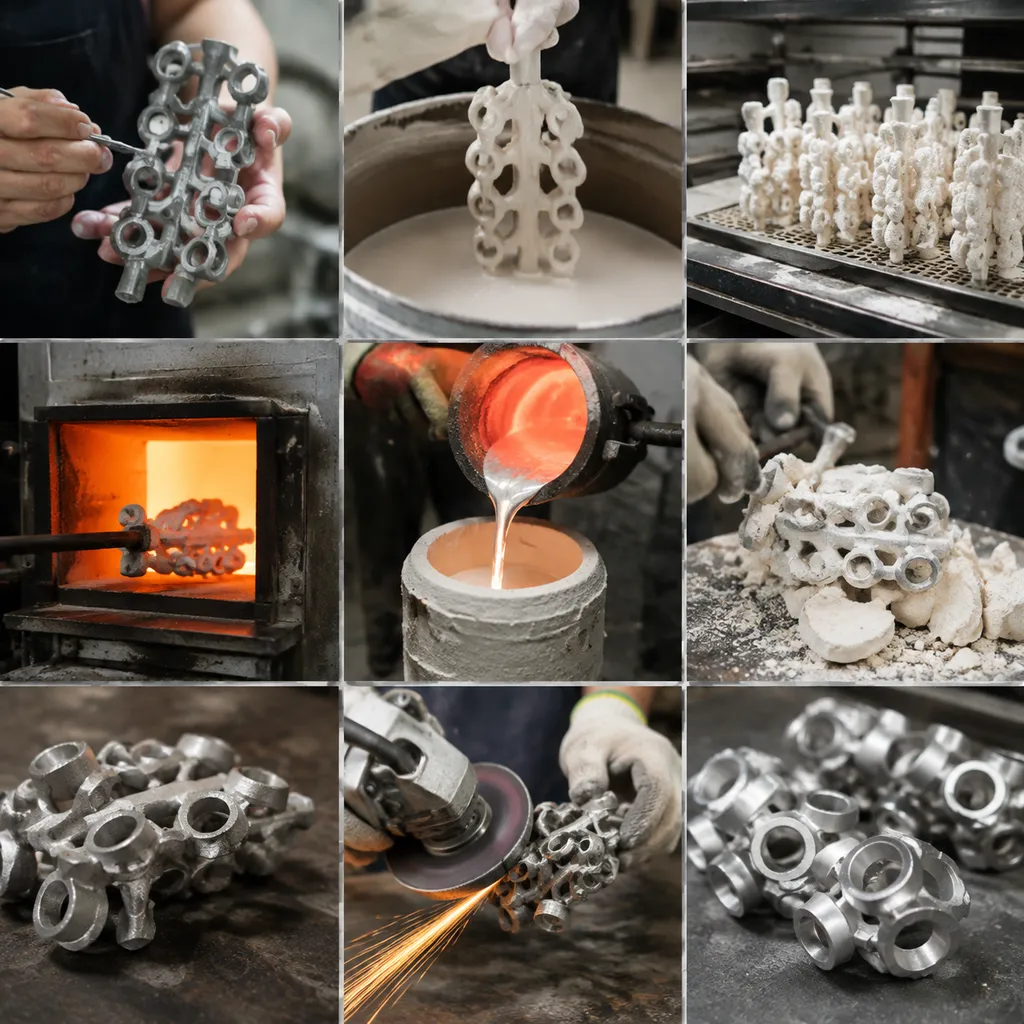
We follow a strict step-by-step precision aluminum casting process to turn complex designs into high-strength, lightweight metal parts. Every step in our lost wax aluminum casting line is engineered to ensure tight tolerances and smooth surface finishes.
Wax Patterns and 3D Printed Models
We start by crafting an exact replica of your part using high-precision tooling or additive manufacturing. Wax Injection: Injecting wax into metal dies works best for high-volume production. 3D Printed Patterns: Direct 3D printed wax patterns accelerate prototyping aluminum investment casting without upfront tooling expenses. Tree Assembly: We attach individual wax patterns to a central sprue to form a pourable cluster tree.
Building the Ceramic Shell
The wax tree undergoes repeated dipping cycles to build a durable, heat-resistant ceramic mold around the wax structure. Slurry Dipping: We submerge the wax assembly into a liquid ceramic slurry. Stucco Coating: Refractory sand coats the wet slurry to build structural strength. Multi-Layering: We repeat this process multiple times until the shell achieves the exact thickness needed.
Dewaxing and Mold Burnout
Once dry, we melt away the inner wax structure to leave a hollow, precise ceramic cavity. Autoclave Dewaxing: High-pressure steam heat removes over 95% of the wax. High-Temp Burnout: Firing the ceramic shell at high temperatures burns off residual wax and hardens the mold for pouring.
Gravity and Vacuum Metal Pouring
We melt high-grade aluminum alloys and pour the liquid metal directly into the preheated ceramic mold.
| Pouring Method | Primary Application | Core Benefit |
|---|---|---|
| Gravity Pouring | Standard geometry and medium walls | Cost-effective with reliable metal flow |
| Vacuum-Assisted Pouring | Thin wall aluminum casting components | Eliminates trapped gas and fills micro-features completely |
Shell Knockout and Surface Finishing
After the molten aluminum cools and solidifies, we break open the ceramic shell to release the metal castings. Knockout: High-frequency vibrators and water jets blast away the ceramic mold. Cut-Off: Cut-off saws trim individual parts away from the central sprue. Finishing: Media blasting, grinding, and machining yield an ideal surface finish investment casting standard ready for end-use assembly.
Design Guidelines and Precision Tolerances
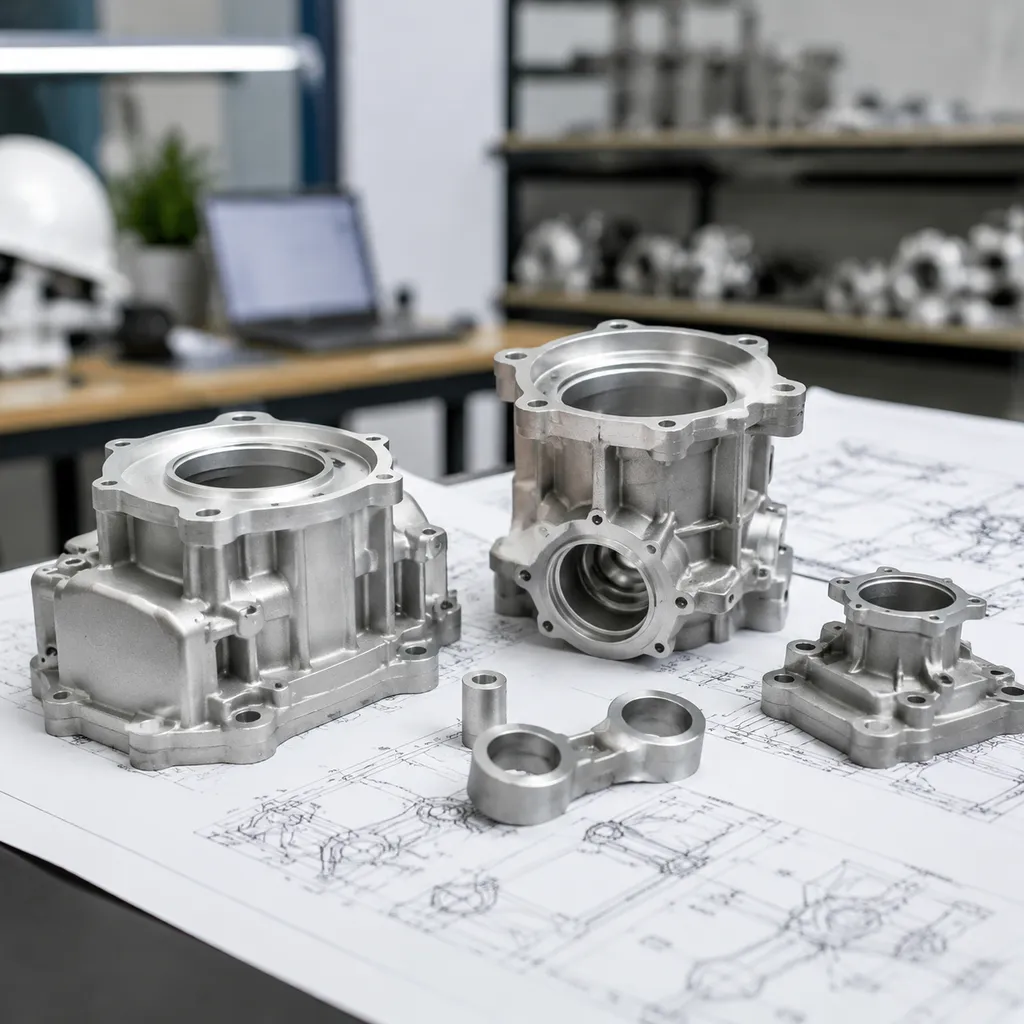
Designing parts for precision aluminum casting lets you create complex, lightweight shapes without paying for excessive CNC machining. We work closely with engineering teams to optimize designs early, making sure your components meet tight dimensional specs while avoiding common foundry defects.
Thin Wall Aluminum Casting Limits
Pushing for thin wall aluminum casting cuts part weight and material costs, but going too thin can cause incomplete fills. We recommend these baseline wall thickness targets:
- Small, localized areas: Down to 0.060 in (1.5 mm) for features under 2 inches long.
- Large surface areas: Keep walls at 0.080 in to 0.100 in (2.0 to 2.5 mm) so molten metal fills the ceramic shell smoothly.
- Wall transitions: Always taper thickness changes gradually (using a 3:1 ratio) to prevent shrinkage voids.
Standard Aluminum Investment Casting Tolerances
Our investment casting process delivers tighter linear tolerances than standard sand or die casting methods.
| Feature | Standard Tolerance | Tight Precision Tolerance |
|---|---|---|
| First Inch (Linear) | ±0.010 in (±0.25 mm) | ±0.005 in (±0.13 mm) |
| Each Additional Inch | ±0.003 in/in | ±0.002 in/in |
| Flatness & Straightness | 0.005 in per inch | 0.003 in per inch |
| Hole Concentricity | ±0.005 in (±0.13 mm) | ±0.003 in (±0.08 mm) |
Draft Angles and Undercut Considerations
Because we remove the pattern by melting wax out of a ceramic shell, aluminum investment casting tolerances allow for design freedom that hard-mold processes cannot match.
- Zero draft angles: We can cast zero-draft parallel walls on many features, saving you secondary machining steps.
- Recommended draft: Adding 0.5° to 1° draft reduces wear on tooling wax dies and speeds up production.
- Internal undercuts: We use soluble wax cores or multi-piece tooling to form complex internal passages and deep undercuts easily.
Fillet Radii Best Practices
Sharp internal corners create localized stress concentrations and hot spots, leading to cracks, porosity, or tear defects during cooling.
- Inside fillets: Design inside radii to equal 1.0 to 1.5 times the section wall thickness (minimum 0.060 in / 1.5 mm).
- Outside fillets: Set the outer radius equal to the inner radius plus the wall thickness to keep wall dimensions uniform.
- Better flow: Generous fillets help liquid metal flow cleanly through the ceramic mold, producing cleaner surface finishes.
Tooling Costs and Prototyping in Aluminum Investment Casting
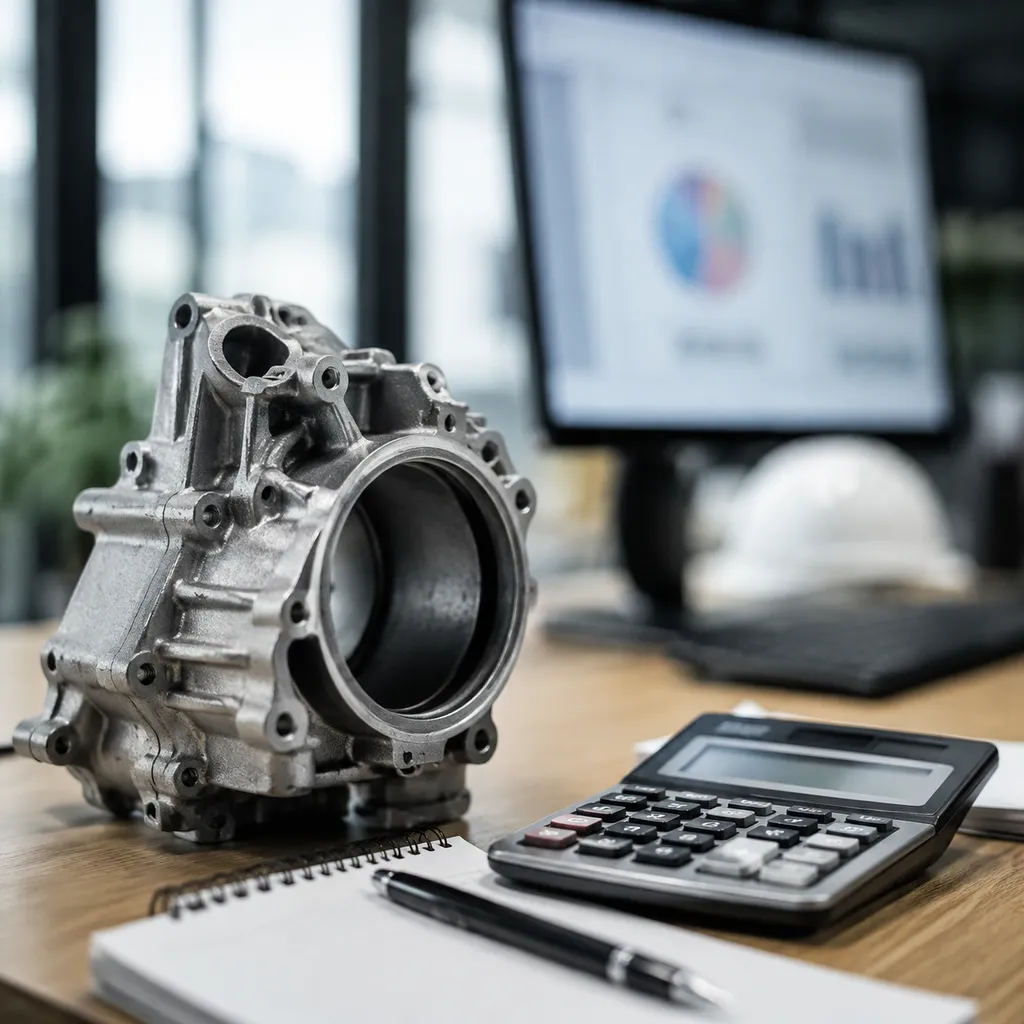
Worried that initial tooling costs will push your project over budget? We break down the math so you can choose the most cost-effective path for your production volume.
Tooling Investment vs. Unit Cost
When starting an aluminum investment casting project, your main upfront expense is the master die used to inject wax patterns. While hard tooling requires an initial investment, it dramatically lowers your price per part over time.
- Upfront Tooling: Machined aluminum dies create thousands of identical wax patterns with virtually zero dimensional drift.
- Unit Price Savings: Once the die is built, your piece price drops significantly, making long runs cost-effective.
- Tool Longevity: Quality aluminum tooling easily yields tens of thousands of wax patterns before needing service.
Prototyping Aluminum Investment Casting with 3D Printing
You do not need to invest thousands in metal dies just to test a design. We utilize rapid prototyping aluminum investment casting methods to deliver real metal components quickly.
Instead of cutting a metal mold, we 3D print sacrificial wax or resin patterns directly from your CAD files. We then build the ceramic shell around these printed models and pour metal using our traditional lost wax aluminum casting line.
- Zero Die Expense: Skip mold costs entirely during design validation.
- Rapid Turnaround: Go from a digital file to physical, fully functional aluminum parts in days.
- Design Agility: Modify CAD models between test runs without re-machining expensive tooling.
Low-Volume vs. High-Volume Production
Choosing between 3D-printed patterns and hard metal tooling depends entirely on your total production quantity and project timeline:
| Production Factor | Low-Volume (3D Printed Patterns) | High-Volume (Hard Tooling) |
|---|---|---|
| Initial Tooling Cost | $0 (No metal die needed) | Higher upfront investment |
| Unit Price | Higher (Includes pattern print time) | Lowest (Rapid automated wax molding) |
| Lead Time | Fastest (First parts in days) | Standard (Requires mold build time) |
| Design Modifications | Instant (Update the CAD file) | Requires Mold Rework |
| Best Application | Prototypes & runs under 100 units | Scaled production over 100+ units |
Frequently Asked Questions
Investment Casting vs Die Casting
When comparing investment casting vs die casting, the right choice comes down to part complexity and order volume. We recommend aluminum investment casting for intricate geometries, internal voids, and lower upfront tooling costs—making it ideal for low-to-medium production runs. Die casting suits ultra-high-volume runs where fast cycle times justify much higher initial mold costs.
Surface Finish Capabilities
Our lost wax aluminum casting delivers an exceptionally smooth as-cast surface.
- Standard Finish: 125 to 250 RMS (3.2 to 6.3 µm Ra)
- Secondary Finishing: Additional bead blasting or anodizing can easily enhance surface quality further
- Machining Savings: High dimensional accuracy drastically reduces or eliminates secondary machining
Thin Wall Aluminum Casting
We routinely manufacture thin wall aluminum casting designs for weight-critical aerospace and automotive parts.
- Minimum Wall Thickness: Down to 0.060 inches (1.5 mm) in localized areas
- Standard Wall Thickness: 0.090 to 0.125 inches (2.3 to 3.2 mm) for uniform strength
- Flow Control: Vacuum-assisted pouring ensures complete metal fill without cold shuts
Lead Times for Tooling and Production
We keep production schedules lean to get your precision aluminum casting parts delivered fast.
- 3D Printed Prototypes: 1 to 2 weeks (no hard tooling required)
- Custom Tooling Build: 4 to 6 weeks
- First Article Samples: 1 to 2 weeks post-tooling
- Full Production Run: 3 to 5 weeks following sample approval
 English
  Russian
  German