
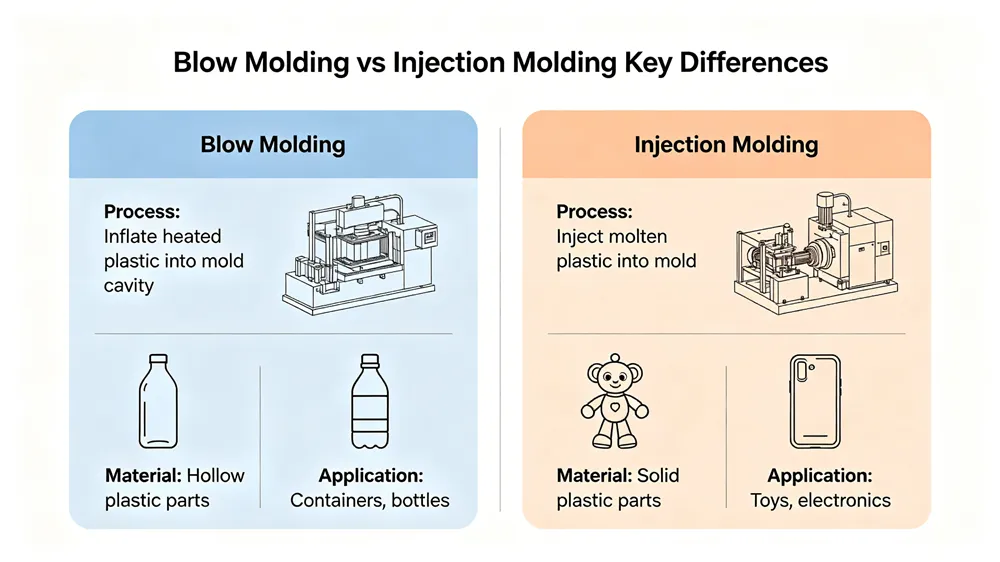
How They Work
When deciding between blow molding vs injection molding, the first thing we look at is the structure of the final product. Are you making a hollow container or a solid, high-precision component? Many manufacturers worry about whether the process they choose will handle their specific wall thickness or if the tooling costs will spiral out of control. We simplify these mechanics to help you identify the most efficient path for your production.
The Blow Molding Process
Think of blow molding as a combination of extrusion and air pressure. It is the go-to method for creating hollow objects.
- The Parison (Molten Tube): We begin by extruding a hot, hollow tube of plastic called a parison.
- Air Pressure and Expansion: Once the parison is dropped into the mold, the mold halves close, and high-pressure air is blown into the tube. This forces the plastic to expand and take the shape of the mold cavity.
- Continuous vs. Accumulator Head:
- Continuous Extrusion: Ideal for small to medium parts like bottles where the parison is constantly formed.
- Accumulator Head: Used for massive industrial parts. We gather the molten material and "shoot" it out in one large volume to ensure structural integrity in large-scale items.
The Injection Molding Process
This process is built for speed, precision, and solid parts. It relies on mechanical force rather than air expansion.
- High-Pressure Molten Injection: We melt thermoplastic resins and inject them into a metal mold at incredibly high pressures. This ensures every corner of a complex design is filled perfectly.
- The Mold Cavity and Cooling: The mold is a precision-engineered "negative" of the part. Advanced cooling systems are integrated into the mold to quickly solidify the plastic, allowing for rapid cycle time efficiency.
- Precision and Repeatability: Because the material is forced into a fixed space, we achieve unmatched consistency. This is why it is the preferred method for parts requiring tight tolerances and repeatable surface finish quality.
Core Differences at a Glance
| Feature | Blow Molding | Injection Molding |
|---|---|---|
| Part Type | Hollow (Bottles, Tanks) | Solid (Gears, Housings) |
| Primary Force | Air Pressure | Mechanical Injection Pressure |
| Starting Form | Parison (Tube) | Molten Pellets |
| Complexity | Limited to outer shell | High internal/external detail |
Key Structural Differences: Hollow vs. Solid
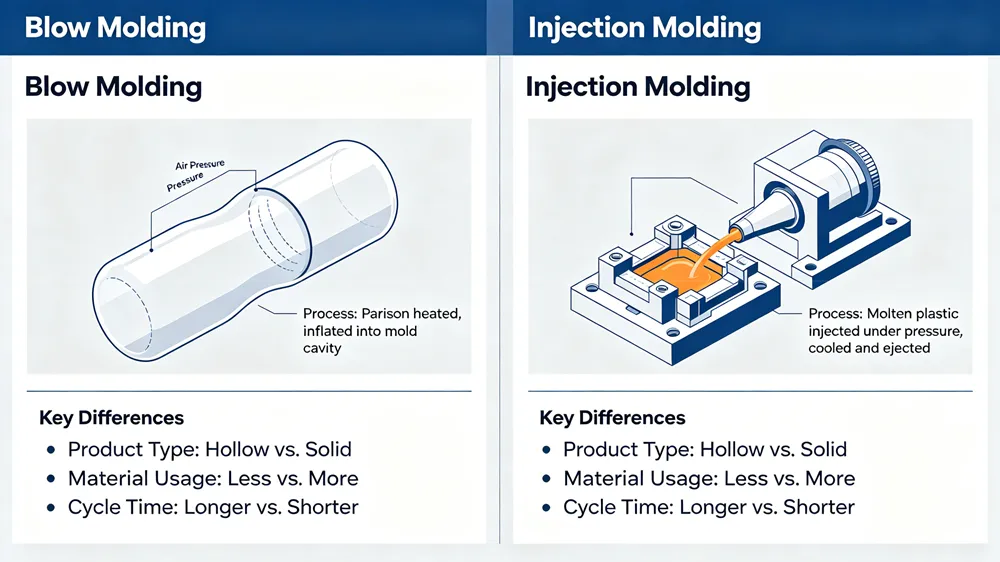
The most fundamental difference in the blow molding vs injection molding debate lies in the final structure of the part. Blow molding is designed specifically to create hollow parts, while injection molding is the gold standard for producing solid, high-precision components.
Wall Thickness and Uniformity
In blow molding, we stretch a molten tube (parison) against a mold wall. Because the material must travel different distances to reach the corners, wall thickness uniformity is often variable. Corners and edges tend to be thinner than the center walls.
Conversely, injection molding offers absolute precision. We inject material into a fixed cavity under extreme pressure, allowing for:
- Constant wall thickness across the entire part.
- Tight tolerances for mating components.
- Elimination of "thin spots" that could lead to structural failure.
Part Complexity: Ribs, Bosses, and Geometries
If your design requires intricate internal details, injection molding is the only choice. It excels at incorporating complex geometries, such as internal ribs for reinforcement, threaded bosses, and snap-fit joints. Blow molding is generally limited to the exterior shape of the container; adding internal structural features is difficult, if not impossible, due to the air-expansion process.
Structural Integrity and Performance
The structural needs of your project dictate the method. Hollow parts produced via blow molding are engineered for impact resistance and fluid containment—think of how a plastic bottle can deform and bounce without breaking. Solid parts from injection molding are built for mechanical strength, rigidity, and long-term durability in load-bearing applications.
| Feature | Blow Molding | Injection Molding |
|---|---|---|
| Part Structure | Hollow | Solid |
| Wall Thickness | Variable (thinner at corners) | Highly Uniform |
| Internal Detail | Low (mostly exterior) | High (ribs, bosses, threads) |
| Structural Goal | Impact resistance/Containment | Mechanical strength/Precision |
When we look at the mold and cast guide for industrial production, it is clear that the choice between these two depends entirely on whether the part needs to hold air/liquid or function as a rigid mechanical component. For those moving into high-precision metal components, our wax injection machine technology applies these same injection principles to create perfect patterns for investment casting.
Material Selection in Blow Molding vs Injection Molding

Choosing the right material is a critical step in deciding between blow molding vs injection molding. Most high-volume production runs utilize common thermoplastic resins, but the way these materials behave under stress determines which process is viable for your part geometry.
- Common Materials: HDPE, LDPE, PP, and PET are the industry standards for both processes due to their durability and recyclability.
- Injection Molding Behavior: The material must have a high flow rate to fill the complex corners of a mold cavity under intense clamping pressure. This ensures excellent surface finish quality and precise wall thickness uniformity.
- Blow Molding Behavior: The resin needs high melt strength. During parison extrusion, the material must hang vertically without stretching too thin before the air expansion phase pushes it against the mold walls.
While standard plastics dominate consumer goods, specialized manufacturing requires a different approach. In our facility, we extend these precision principles to the production of investment casting patterns. Instead of traditional thermoplastics, we utilize specialized waxes designed for extreme accuracy. Our wax injection machine for investment casting is engineered to handle these materials, providing the stability and detail required for industrial-grade metal components. Whether you are working with HDPE for a hollow container or specialized wax for a turbine blade, understanding material behavior under pressure is the key to maintaining structural integrity and manufacturing scalability.
Cost Analysis: Tooling and Production Efficiency
In the debate of blow molding vs injection molding, the financial decision usually hinges on the initial investment versus the long-term output.
Initial Tooling Costs
Blow molding is typically the more cost-effective choice for tooling. Because the internal pressures are relatively low, we can utilize aluminum molds rather than the expensive, hardened steel required for injection molding. This makes the entry cost for blow molding significantly lower, especially for larger parts. Injection molding tooling costs are higher due to the precision and durability needed to withstand high-pressure molten plastic injection.
Cycle Times and Mass Production
- High-Speed Output: Injection molding is the gold standard for cycle time efficiency when producing small, solid components in massive quantities.
- Hollow Efficiency: Blow molding dominates the mass production of bottles and containers, where speed is matched by the ability to create thin-walled structures quickly.
- Automation: To maximize these speeds, we often look toward foundry casting robotics integration and automated handling solutions to manage part removal and secondary processing, ensuring the line never stops.
Waste Management
Both processes are designed to be sustainable through the use of regrind, keeping material expenses in check.
- Blow Molding: Produces "flash" (excess material at the mold's edge) which is trimmed and recycled back into the hopper immediately.
- Injection Molding: Generates waste through sprues and runners, which are also easily reground and reused.
- Consistency: Effective waste management and automated trimming ensure that material costs remain low even during high-volume runs, maintaining a competitive edge in the market.
Feature Comparison
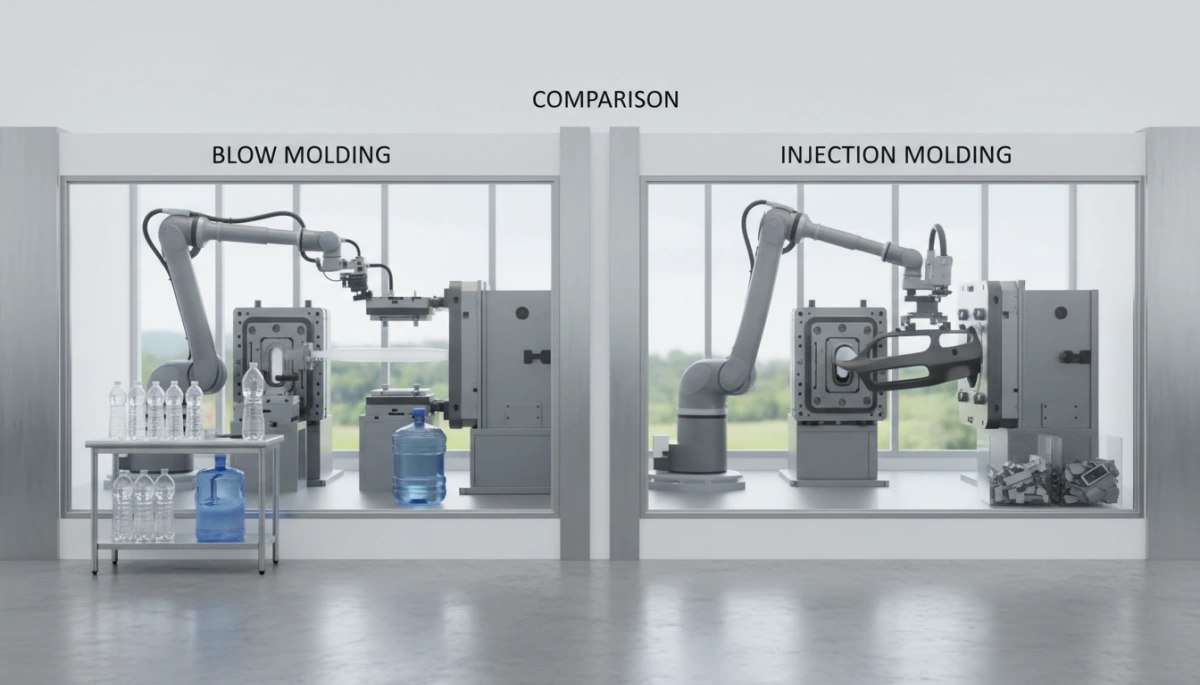
Deciding between blow molding vs injection molding depends entirely on your part's intended use and your budget for initial setup. We have analyzed the core metrics to show how these processes stack up in a real-world production environment.
| Feature | Blow Molding | Injection Molding |
|---|---|---|
| Part Geometry | Hollow parts (bottles, cases) | Solid, complex parts (gears, lids) |
| Tooling Costs | Generally lower | Higher due to mold complexity |
| Lead Time | Shorter mold fabrication | Longer engineering and build time |
| Typical Volume | High-volume production | Mass production scalability |
| Surface Finish Quality | Good, but limited by air pressure | Exceptional precision and detail |
For a more technical breakdown of how different equipment handles these production demands, you can view our machines comparison to see which setup aligns with your output goals.
Key Takeaways for Production Planning
- Part Geometry: Blow molding is the industry standard for hollow containers. If your design requires solid walls, internal ribs, or high-precision bosses, injection molding is the only viable path.
- Tooling Costs: Because blow molding operates at lower pressures, the molds are often made from aluminum or lighter alloys, making them significantly cheaper than the hardened steel molds required for high-pressure injection.
- Surface Finish Quality: Injection molding provides a much higher level of control over the final aesthetic. This is critical for parts that require specific textures or high-gloss finishes directly out of the mold.
- Manufacturing Scalability: While both processes support large-scale runs, injection molding offers unmatched cycle time efficiency for small, intricate parts produced in the millions.
When to Choose Blow Molding vs Injection Molding

Selecting the right manufacturing process depends entirely on the design and function of your part. If your product needs to be hollow, blow molding is the industry standard. If your part requires high structural strength, solid walls, or intricate details, injection molding is the superior choice.
Best Applications for Blow Molding
Blow molding is designed for thin-walled, hollow objects. It is the go-to method for products that need to hold liquids or air without the weight of a solid plastic mass.
- Consumer Goods: Plastic bottles, jugs, and watering cans.
- Automotive: Large fuel tanks and fluid reservoirs.
- Industrial: Bulk storage drums and large protective cases.
- Toys: Hollow balls and lightweight plastic play equipment.
Best Applications for Injection Molding
Injection molding excels at producing solid, high-precision components. It is the preferred method for parts that require tight tolerances and complex internal geometries, such as ribs or bosses. For those expanding into high-precision metal production, understanding wax injection machine applications is vital for creating the patterns used in advanced investment casting.
- Medical Devices: Syringes, surgical tools, and diagnostic equipment.
- Electronics: Computer housings, phone cases, and internal connectors.
- Automotive Interior: Dashboards, knobs, and intricate vent assemblies.
- Industrial Parts: Gears, valves, and heavy-duty mechanical components.
Application Comparison Table
| Feature | Blow Molding Choice | Injection Molding Choice |
|---|---|---|
| Part Structure | Hollow or double-walled | Solid and high-density |
| Complexity | Simple exterior shapes | Intricate internal/external details |
| Primary Goal | Volume and containment | Precision and mechanical strength |
| Typical Products | Bottles, tanks, containers | Gears, housings, medical tools |
Deciding between blow molding vs injection molding comes down to the "hollow vs. solid" rule. If the part must be a single-piece hollow vessel, blow molding wins on cost and efficiency. For everything else requiring high-speed repeatability and structural integrity, injection molding remains the gold standard.
The Precision of Wax Injection (Beyond Plastics)
While the debate of blow molding vs injection molding usually focuses on plastic products, the core principles of high-pressure injection are vital for high-end metal manufacturing. At Vastpce, we take these concepts into the realm of investment casting. Our industrial wax equipment for investment casting utilizes advanced wax injection technology to create the sacrificial patterns necessary for the lost wax process.
The transition from a plastic prototype to an industrial-grade metal component requires a level of precision that mirrors the best injection molding practices. We provide the machinery that makes this possible, ensuring that every wax pattern is a perfect replica of the final metal part.
- High-Precision Patterns: We focus on intricate geometries and tight tolerances that blow molding cannot achieve.
- Industrial Scalability: Our fully automatic machines are designed for high volumes and speeds, ensuring manufacturing efficiency.
- Seamless Transition: We enable the move from initial plastic concepts to durable, high-strength metal components used in aerospace and medical fields.
By applying the rigor of injection molding to wax, we ensure that the resulting metal parts maintain superior structural integrity and surface finish quality. This specialized focus allows us to support industries that require more than just a hollow plastic shell, delivering the foundation for high-performance metal engineering.
Common FAQs: Blow Molding vs Injection Molding
Is blow molding cheaper than injection molding?
Generally, yes, when looking at tooling costs. Blow molding operates at significantly lower pressures, which allows us to use aluminum molds instead of the expensive, hardened steel required for injection molding. This makes the initial investment for blow molding much lower, especially for large-scale parts like tanks or bulky containers.
Can you injection mold hollow parts?
It is possible, but it is not the primary strength of the process. To create a hollow object with injection molding, you usually have to mold two separate pieces and bond them together, or use complex "gas-assist" technology. If your goal is a seamless, one-piece hollow structure like a bottle, blow molding is the standard and most efficient method.
Which process is faster for high-volume production?
Both processes excel at mass production, but injection molding typically offers better cycle time efficiency for solid, complex parts. For hollow items, blow molding is incredibly fast. The choice depends entirely on the part geometry; injection molding is the king of high-speed precision for solid components, while blow molding dominates the speed requirements for containers.
What are the limitations of wall thickness in blow molding?
The biggest hurdle is wall thickness uniformity. Because blow molding relies on air to stretch the plastic against the mold walls, the material naturally becomes thinner at corners and deep-drawn areas. Injection molding provides much tighter control, ensuring the thickness remains consistent throughout the entire part.
How does surface finish compare between the two methods?
Injection molding consistently delivers a superior surface finish quality. Because the molten material is forced into a precision-machined cavity under extreme pressure, it captures every detail of the mold. This allows for high-gloss finishes, knurling, and intricate textures that are difficult to achieve with the air-expansion nature of blow molding.
How do these processes relate to precision patterns?
While these methods focus on plastic, the same principles of precision apply to investment casting. At our facility, we bridge the gap between plastic prototypes and metal production. We use advanced wax injection processes to create high-fidelity patterns. Understanding the nuances of making a mold for wax casting is essential for transitioning from a basic plastic design to a high-performance metal component.
 English
  Russian
  German