
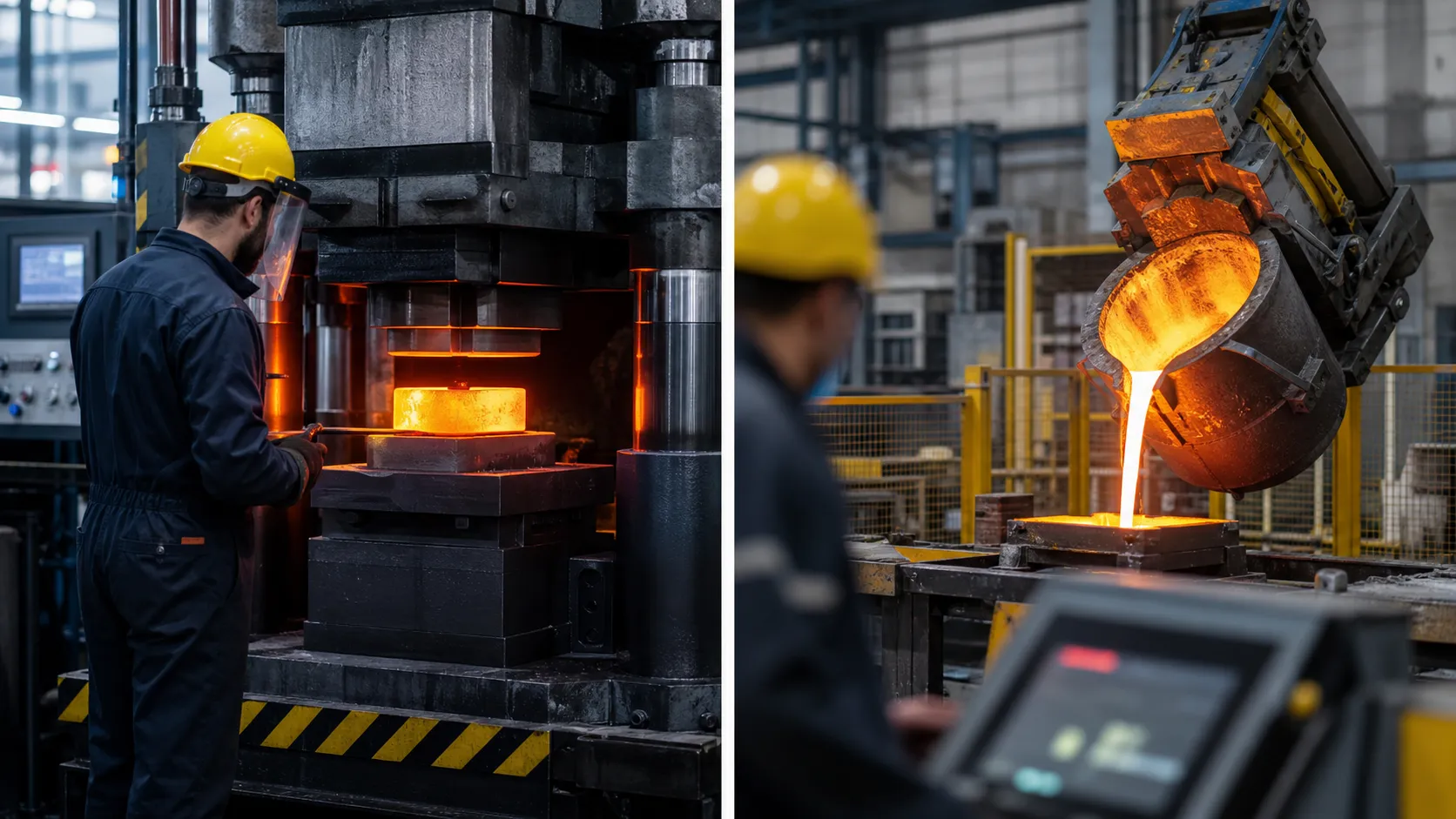
Difference between forging and casting explained with strength cost design and application comparisons for engineers and buyers
What is Forging?
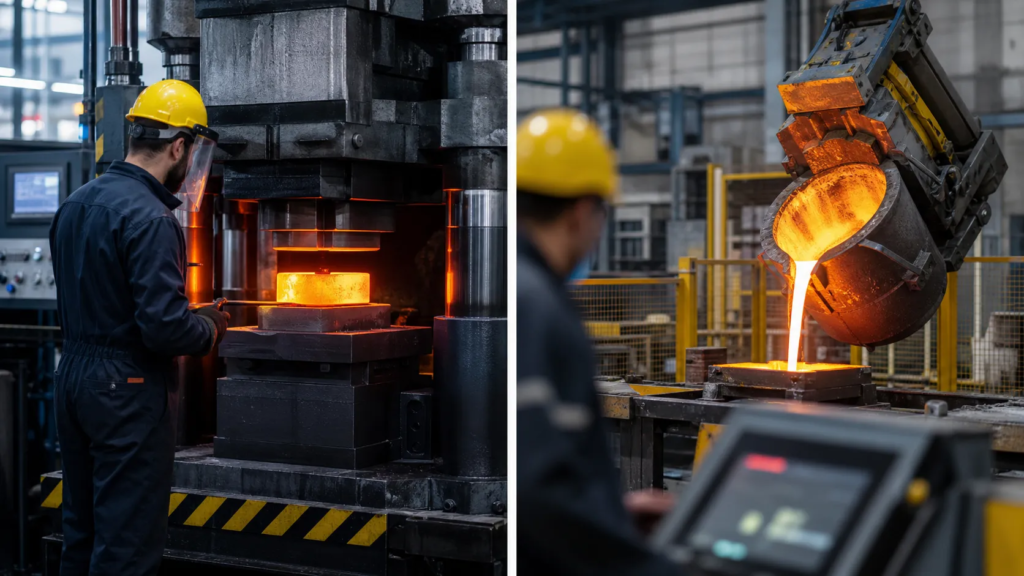
Forging is a core metal fabrication process where we shape solid metal using compressive, localized forces. Instead of melting the metal down, we deform solid stock using hammers, dies, or hydraulic presses.
This mechanical working refines the internal grain flow structure, aligning the metal's internal grain along the contours of the part. That structural alignment eliminates internal voids and gas pockets, giving forged components unmatched tensile strength, impact resistance, and long-term metal component durability.
How the Forging Process Works
We take a solid metal piece (a billet or ingot) and subject it to extreme mechanical pressure.
- Heating: The metal is brought to a specific temperature based on the required technique—ranging from room temperature to extreme heat.
- Deformation: Heavy industrial machinery compresses and hammers the solid stock into a defined shape.
- Finishing: Excess material (flash) is trimmed away, and the part undergoes heat treatment or surface finishing to achieve final strength specs.
Types of Forging Techniques
Different applications require distinct temperature ranges to balance malleability, force, and precision.
- Hot Forging: We heat metal above its recrystallization temperature (up to 2,200°F for steel). High heat makes the metal extremely malleable, requiring less force to shape heavy components while preventing strain hardening.
- Warm Forging: Performed between room temperature and the recrystallization point (roughly 1,200°F to 1,500°F for steel). It offers a balance: better dimensional accuracy and cleaner surface finish than hot forging, with lower force required than cold forging.
- Cold Forging: Conducted at or near room temperature. It requires tremendous mechanical force but delivers exceptional dimensional tolerances, smooth surface finishes, and increased tensile strength through work hardening.
Common Materials Used in Forging
We select metals with strong ductility and plastic deformation capabilities to ensure structural integrity under pressure.
- Carbon & Alloy Steels: The most frequent choice for high-stress automotive and structural parts.
- Stainless Steel: Delivers outstanding corrosion resistance paired with high mechanical strength.
- Aluminum Alloys: Perfect for lightweight, high-strength aerospace and automotive components.
- Titanium: Reserved for extreme heat and high-strength applications like jet engine hardware and critical medical implants.
Understanding the Casting Process
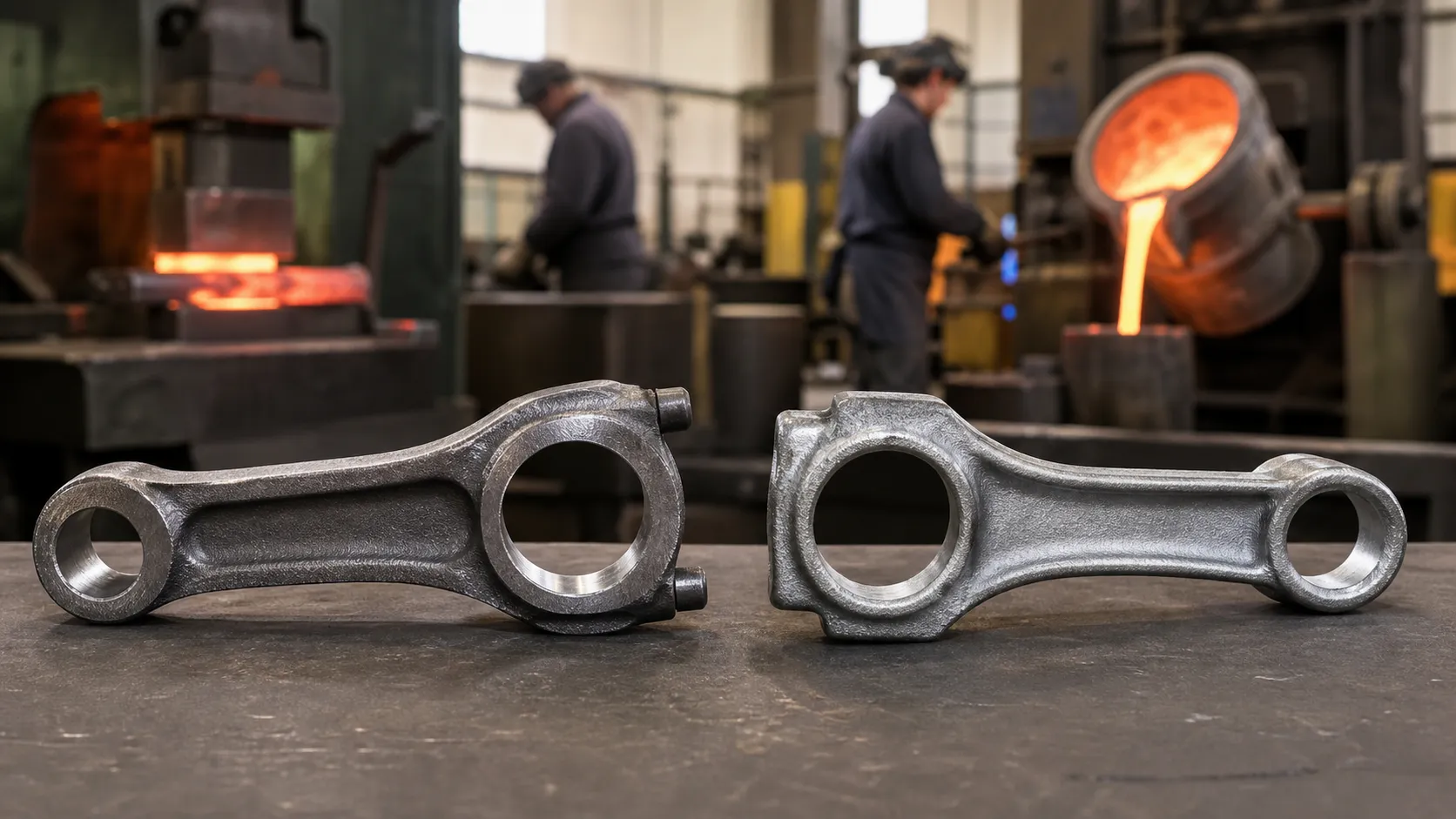
Casting is a foundational metal fabrication process where we melt metal into a liquid state and pour it into a pre-shaped mold. Once the molten metal cools and solidifies, it takes the exact shape of the mold cavity. It is the go-to method when you need to create complex geometries or hollow parts that would be incredibly difficult or expensive to machine out of a solid block.
How Metal Casting Works
The process follows a straightforward, reliable sequence to turn raw ingot into a finished component:
- Patternmaking: We design a physical model (pattern) of the final part to create the mold impression.
- Mold Preparation: The mold is formed using materials like sand, metal dies, or ceramic, depending on the required precision.
- Molten Metal Pouring: We heat the alloy past its melting point in a furnace and carefully pour the liquid metal into the mold.
- Cooling and Solidification: The metal cools down and hardens inside the cavity.
- Ejection and Finishing: We remove the solid part from the mold and cut away excess material, runners, and gates.
Common Types of Casting Methods
Different projects require different molds. We generally rely on three main casting methods depending on your budget and design:
- Sand Casting: Great for large components and low production runs. We pack specialized sand around a pattern to form the mold. It features low tooling and mold costs but leaves a rougher surface finish.
- Die Casting: Perfect for high-volume mass production of non-ferrous metals like aluminum and zinc. We force liquid metal into reusable steel dies under high pressure, delivering tight dimensional accuracy.
- Investment Casting: Also known as lost-wax casting. We create a wax pattern, coat it in a ceramic shell, melt the wax out, and pour metal into the remaining shell. It yields incredible detail and intricate internal cavities.
Materials Best Suited for Casting
Not every metal flows easily when melted. For dependable industrial metalworking, we typically look to materials with excellent fluidity and low shrinking properties. Gray iron and ductile iron are industry staples for heavy machinery blocks, while aluminum and zinc alloys dominate die casting for lightweight automotive and electronic components. Steel can also be cast, though it requires much higher temperatures and specialized handling.
For high-quality results across various manufacturing projects, partnering with an experienced provider like Vastpe ensures you choose the right material and method for your specific application requirements.
Key Difference Between Forging and Casting
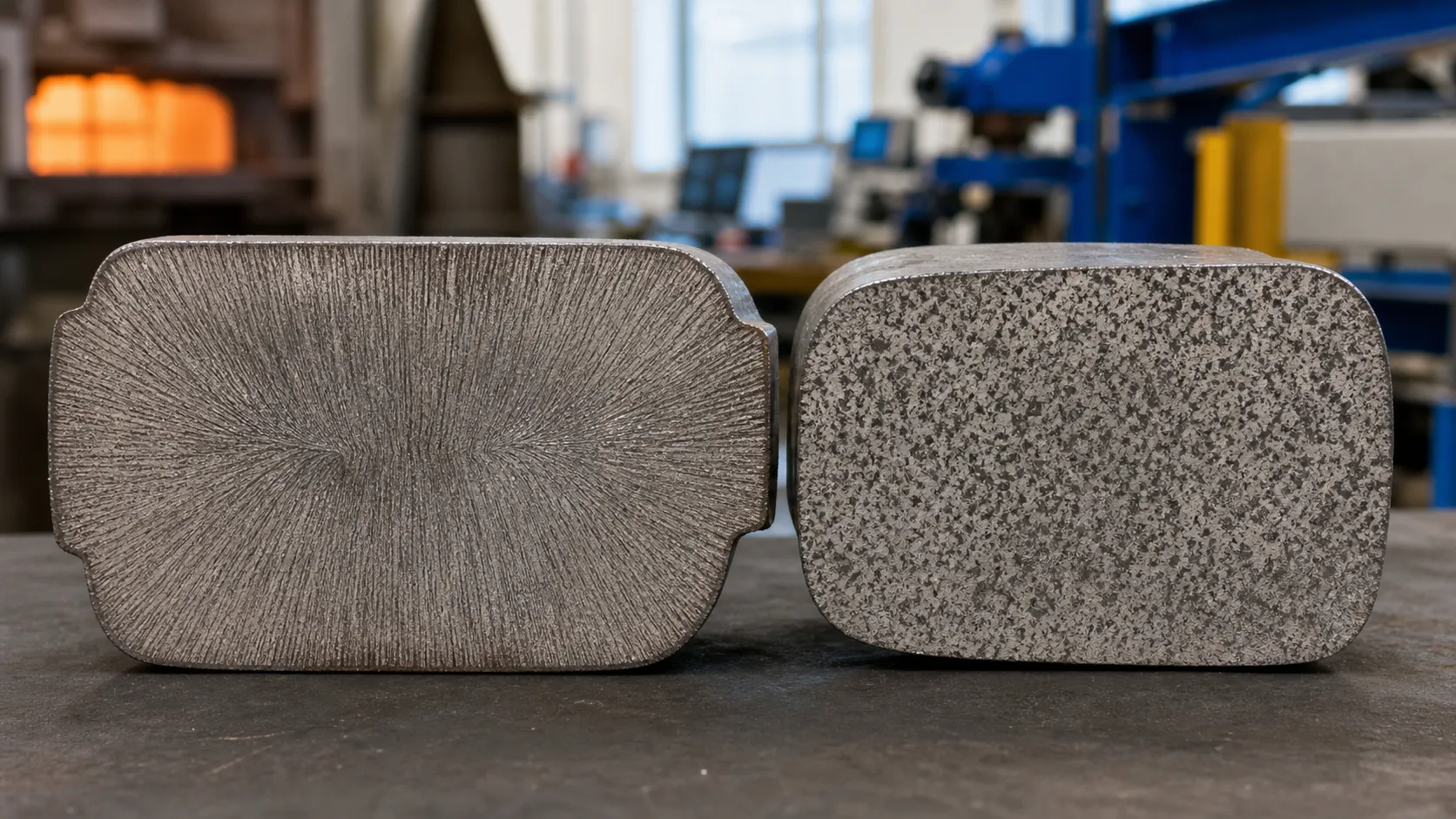
When we manufacture metal parts in our facility, deciding between forging and casting comes down to what the component needs to do. The fundamental difference between forging and casting lies in how the metal is shaped: forging uses extreme pressure to compress solid metal into shape, while casting pours molten metal into a mold cavity.
Grain Flow Structure and Structural Integrity
Forging aligns the internal grain of the metal along the contour of the part. This continuous grain flow structure eliminates internal voids, gas pockets, and porosity.
Casting, on the other hand, creates a uniform, non-directional grain layout as liquid metal solidifies. While excellent for isotropic consistency, cast parts carry a higher risk of micro-porosity and internal shrinkage defects.
Tensile Strength and Metal Component Durability
Forged parts deliver unmatched tensile strength, impact resistance, and fatigue performance. The mechanical working refines the grain size and improves metal component durability, making forged steel up to 26% stronger than equivalent cast steel.
Cast components offer solid compressive strength, but their lower impact resistance makes them more prone to sudden cracking under high stress or cyclic loads.
Design Complexity and Shape Limitations
- Casting wins on geometry: Pours seamlessly into intricate internal cavities, thin walls, and complex curves that would be impossible to forge.
- Forging faces shape limits: Best suited for solid, simpler geometries, though multi-directional closed-die setup can handle moderate complexity.
Surface Finish and Dimensional Accuracy
Precision die casting delivers tight tolerances (down to ±0.002 inches) and smooth surface finishes right out of the mold, requiring minimal secondary machining.
Forged parts generally develop surface scale during thermal processing and require post-machining or shot blasting to reach tight dimensional accuracy and finished tolerances.
Tooling Costs and Manufacturing Cost Per Part
| Factor | Forging | Casting |
|---|---|---|
| Upfront Tooling and Mold Costs | High (expensive hardened steel dies) | Moderate to Low (sand casting molds are inexpensive) |
| Manufacturing Cost Per Part | Lower for high-volume runs | Highly cost-effective for short runs or ultra-complex geometry |
| Material Waste | Minimal flash waste | Higher (requires removing gates, risers, and sprues) |
| Ideal Production Volume | High-volume production ($>1,000$ units) | Low to high volume, depending on method |
When to Choose Forging Over Casting
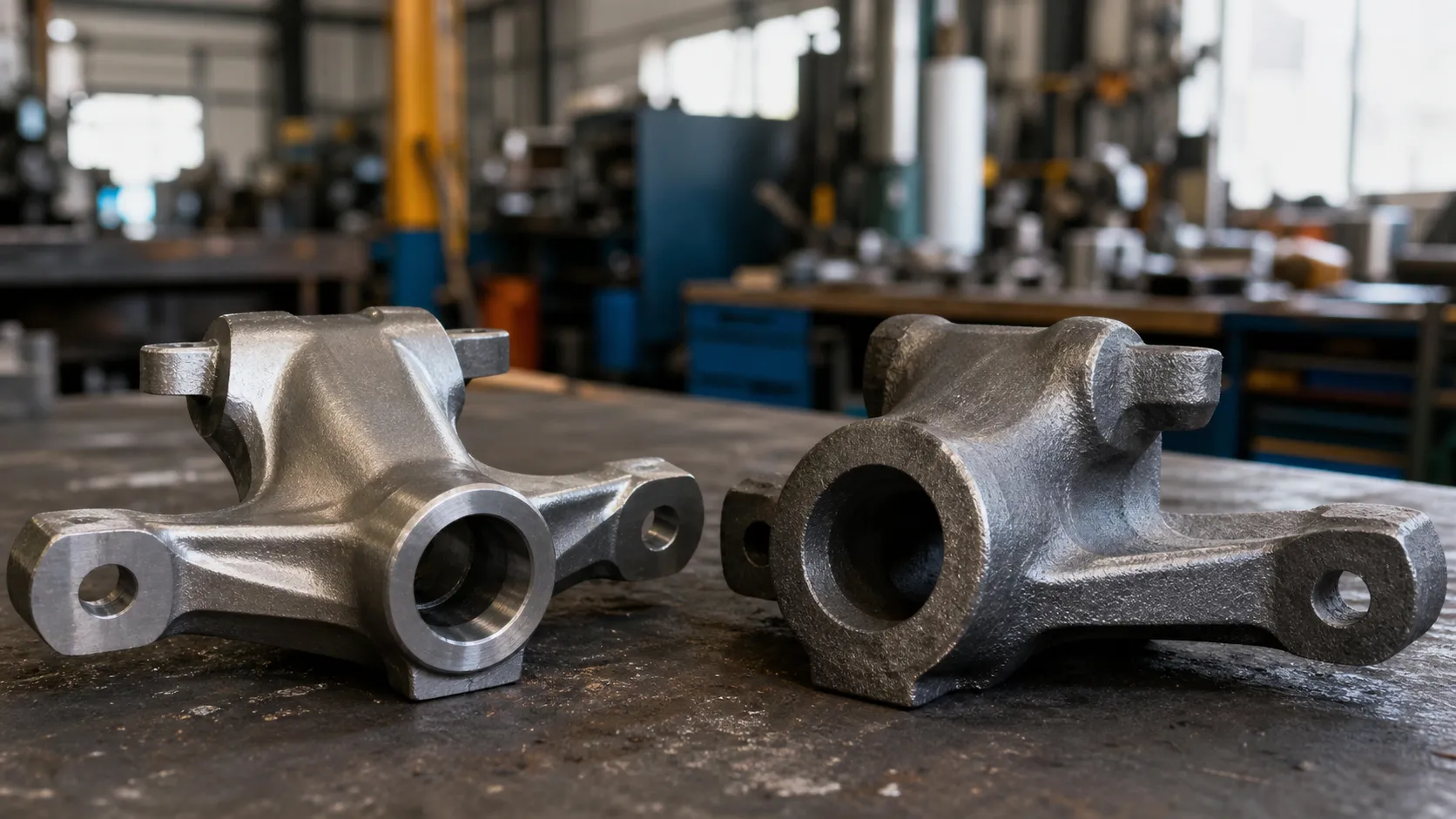
When we look at heavy-duty industrial metalworking, picking the right method comes down to how much abuse a part has to take. I always recommend forging when structural integrity and maximum reliability are non-negotiable.
High-Stress and Heavy-Duty Applications
For parts exposed to extreme loads, constant impact, or severe fatigue, forging beats casting every time. The intense mechanical pressure aligns the metal's grain structure, eliminating internal voids.
- Aerospace landing gear: Withstands massive drop impacts.
- Automotive crankshafts: Handles high rotational torque and continuous friction.
- Industrial hooks and rigging: Prevents sudden snapping under heavy loads.
Safety-Critical Components
If a part failure could lead to catastrophic accidents, we rely on forged metal component durability.
| Application | Why Forging Wins |
|---|---|
| Oil and Gas Valves | Resists extreme pressure without leaking or rupturing. |
| Cranes and Lifting Equipment | Delivers predictable tensile strength under peak loads. |
| Military and Defense Hardware | Survives harsh combat environments and shock loads. |
When to Choose Casting Over Forging
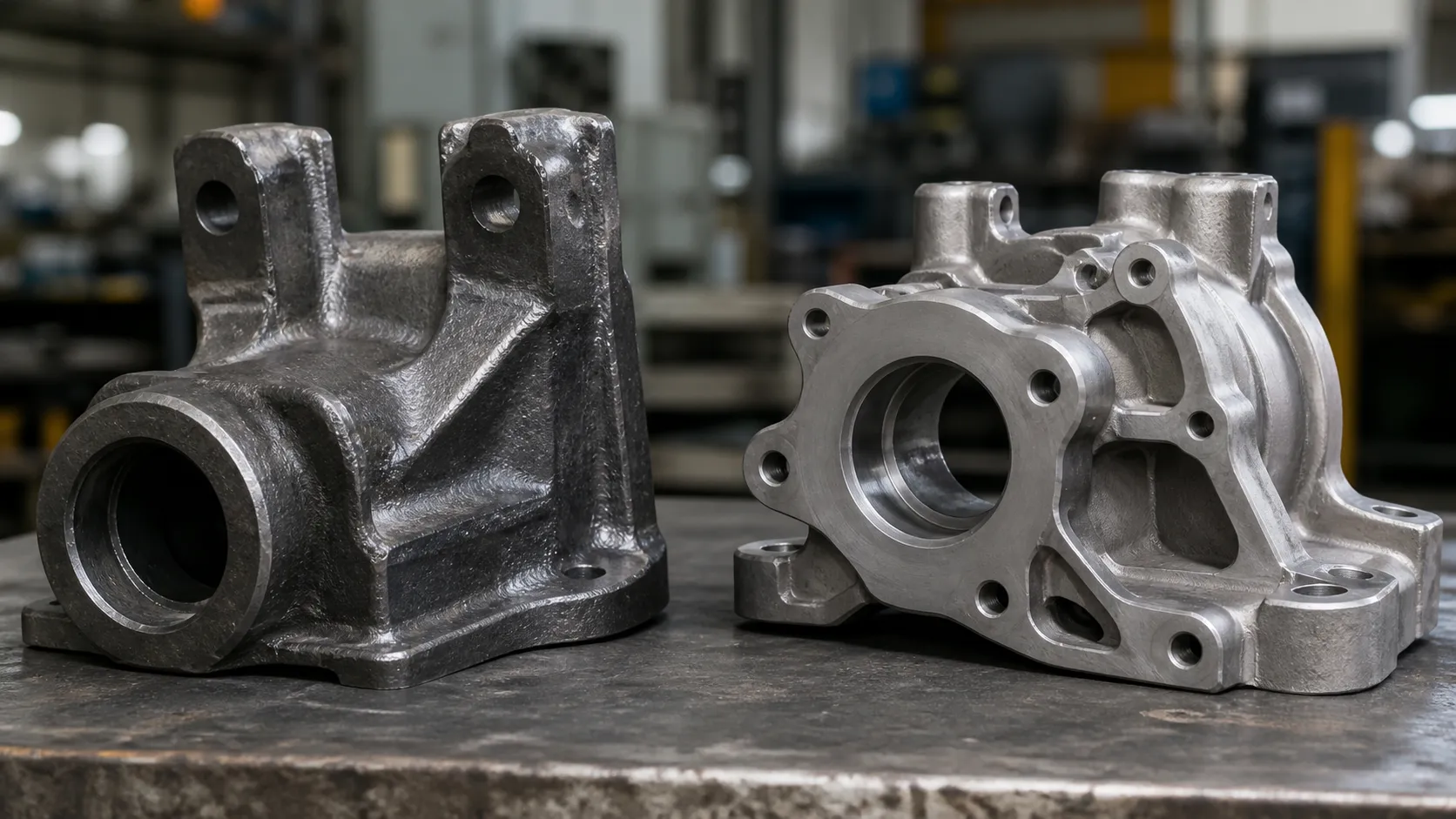
While forging wins on raw strength, casting is our go-to choice when part designs get complicated or when manufacturing costs need to stay low. Pouring molten metal into a mold allows us to create shapes that hammered solid metal simply can't achieve.
Complex Geometries and Intricate Cavities
Casting shines when you need detailed features, curved internal channels, or thin walls. Because liquid metal flows everywhere inside a mold, it fills tiny gaps and complex spaces effortlessly.
- Internal Passages: Perfect for engine blocks, pump housings, and valve bodies with hollow chambers.
- Complex Curves: Creates smooth, organic shapes without expensive multi-axis machining.
- Zero Assembly Needed: Allows us to combine multiple smaller parts into a single cast component.
Cost-Effective Mass Production for Complex Parts
When producing thousands of detailed components, casting drastically reduces your overall manufacturing cost per part. Tooling and mold costs are higher upfront, but the savings on labor and machining make up for it quickly.
| Feature | Casting Process | Forging Process |
|---|---|---|
| Shape Flexibility | Virtually unlimited; ideal for intricate parts | Limited to simpler, solid geometries |
| Machining Required | Minimal (near-net shape out of the mold) | Extensive for complex features |
| Material Scrap | Very low; excess metal gets remelted | Higher due to trimmed flash and machining |
| Unit Cost (High Volume) | Significantly lower for complex shapes | Higher due to extra processing steps |
If your design requires internal cavities or intricate details, casting gives you the best balance of design freedom and production efficiency.
Frequently Asked Questions
Is forging stronger than casting?
Yes, forging yields stronger components. When we forge metal, extreme pressure aligns the internal grain flow structure with the shape of the part. This alignment eliminates internal voids, gas pockets, and porosity, giving forged parts superior tensile strength, impact resistance, and fatigue durability compared to cast parts.
Which process is more cost-effective?
It depends on the component design and order volume. Casting offers lower tooling and mold costs, making it the most cost-effective choice for low volumes, complex geometries, or large parts with intricate internal cavities. Forging carries higher upfront tooling expenses, but it becomes extremely economical for high-volume production runs where component failure isn't an option.
Can the same metal be both forged and cast?
Absolutely. Common industrial metals like aluminum, steel, iron, and titanium can undergo either process. However, the exact alloy grade usually dictates the preferred path. Some alloys flow better when melted for casting, while others possess the ductility required to withstand the high forces of hot or cold forging.
 English
  Russian
  German