
2026年8月21日
What is investment casting Learn the lost wax process tolerances alloys and benefits vs sand and die casting
How Investment Casting Works: Step-by-Step Process
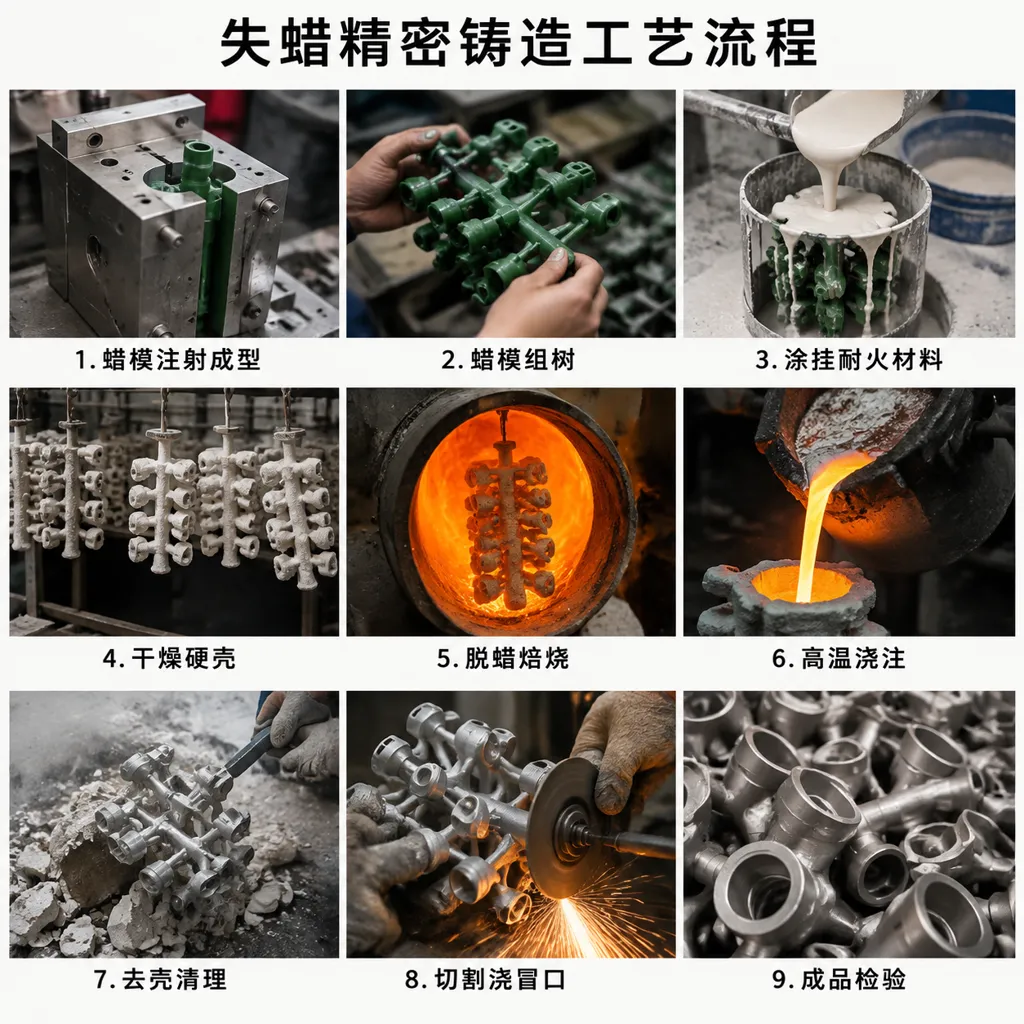
The lost wax casting process transforms raw metal into high-precision, net-shape components with complex geometries. We rely on this modernized manufacturing technique to deliver exceptional dimensional accuracy and superior surface finishes without excessive machining. Here is how we take a part from initial design to finished metal component.
1. Wax Pattern Creation and Tree Assembly
We begin by injecting molten wax into a precision metal die to create an exact replica of the final component. Pattern Production: Each wax replica accounts for precise metal shrinkage rates. Tree Assembly: We weld multiple wax patterns onto a central wax pattern sprue, creating a structured gate and runner system that allows liquid metal to flow evenly.
2. Ceramic Shell Slurry Dipping and Stuccoing
To construct the ceramic mold casting shell, the assembled wax tree undergoes repeated dipping and coating cycles. Primary Slurry Dip: The assembly is submerged into a fine liquid ceramic slurry to capture tight surface details. Stuccoing: Fine ceramic grains are dusted onto the wet slurry coat to build structural integrity. Shell Building: We repeat this process multiple times to build a durable, heat-resistant shell capable of handling molten metal.
3. Dewaxing Autoclave Process
Once the ceramic shell dries, we place the entire structure into a high-pressure dewaxing autoclave. Rapid, high-pressure steam melts out the interior wax within minutes, preventing thermal expansion from cracking the ceramic walls. The reclaimed wax drains out completely, leaving a clean, hollow ceramic cavity ready for metal filling.
4. High-Temperature Metal Pouring and Cooling
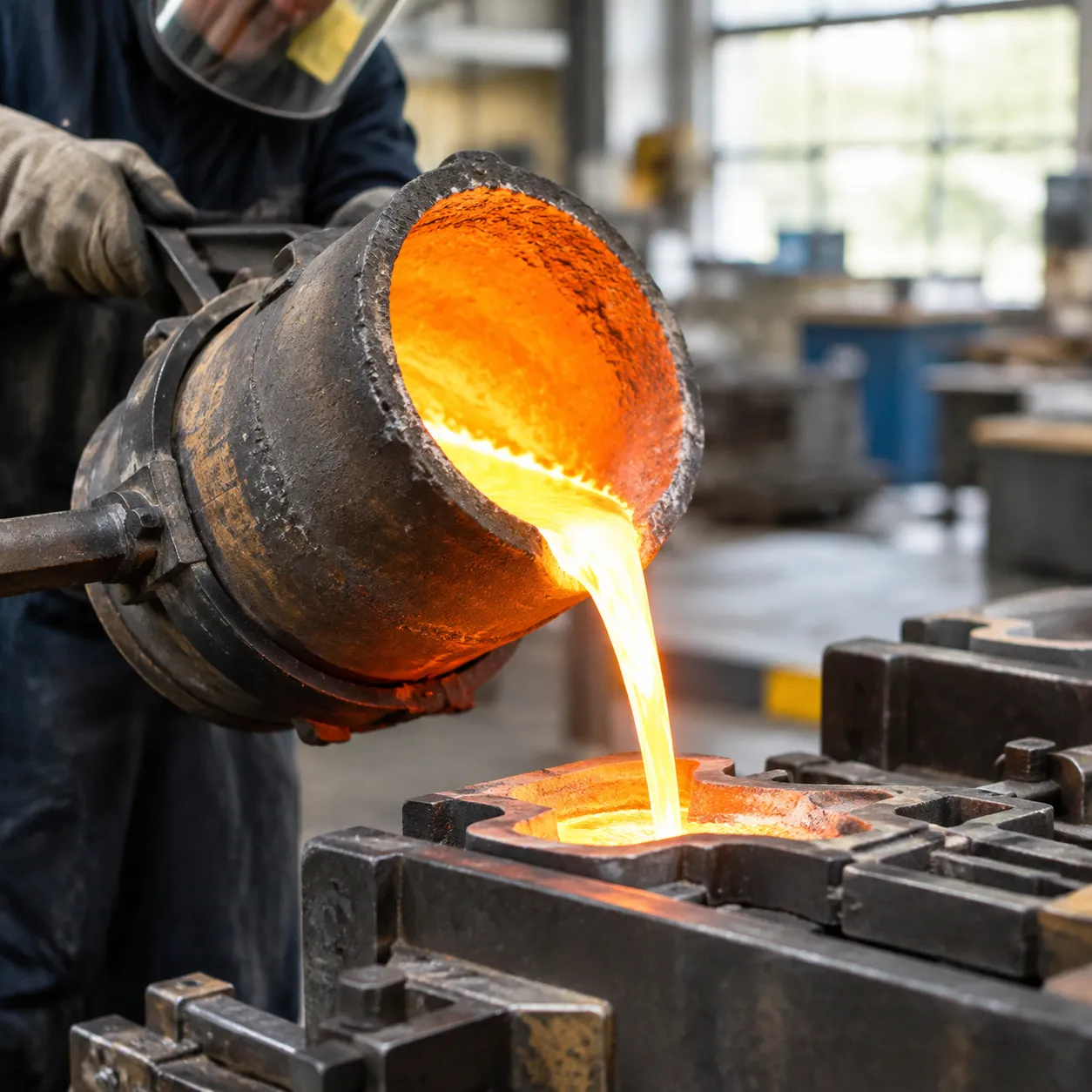
Before liquid metal hits the mold, we preheat the hollow ceramic shell in a furnace to burn off micro-residues and prevent thermal shock. Metal Alloy Pouring: We melt specified alloys—from stainless steel to specialized superalloys—and execute precise metal alloy pouring directly into the preheated shell. Controlled Cooling: The metal solidifies within the heat-resistant ceramic mold, forming a solid, near net shape casting.
5. Shell Knockout and Surface Finishing
After the metal cools completely, we remove the outer ceramic mold and isolate the individual parts. Shell Knockout: Vibratory hammers and high-pressure water blasts destroy the outer ceramic shell. Part Cut-off: We cut individual metal components away from the central sprue tree. Finishing: Parts undergo shot blasting, grinding, and heat treatment to achieve exact dimensional tolerances and optimal surface finish Ra standards.
| Process Step | Phase | Key Manufacturing Action |
|---|---|---|
| Step 1 | Wax Assembly | Inject wax patterns and assemble onto a central sprue tree. |
| Step 2 | Shell Building | Dip in fine ceramic slurry and apply refractory stucco layers. |
| Step 3 | Dewaxing | Melt out interior wax inside a high-pressure autoclave. |
| Step 4 | Metal Pouring | Preheat ceramic mold and pour molten alloy under strict thermal control. |
| Step 5 | Knockout & Finish | Remove ceramic shell, sever parts from sprue, and shot blast surfaces. |
Investment Casting vs Other Casting Methods
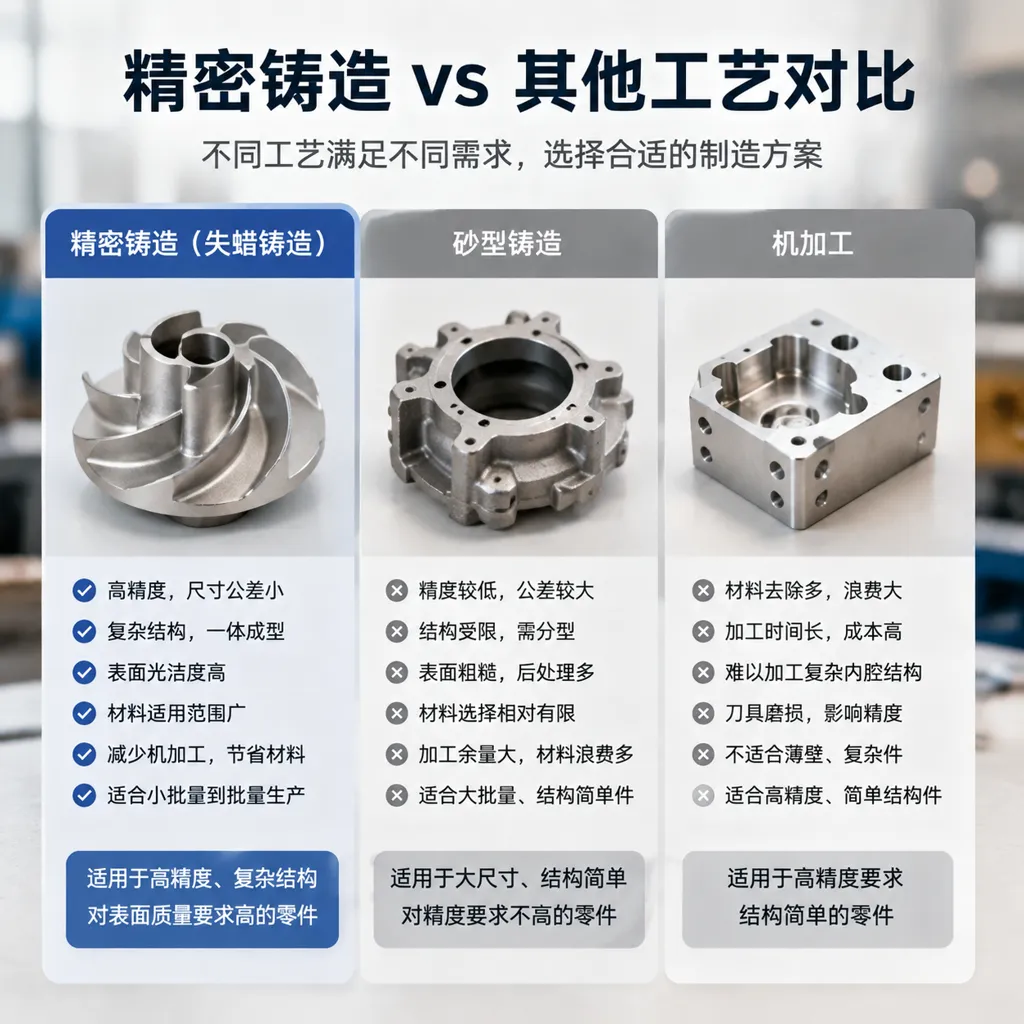
We often evaluate different manufacturing routes to hit the exact balance between part performance and production cost. Choosing the right process comes down to your target volume, material choice, and required dimensional tolerances.
Investment Casting vs Sand Casting
While sand casting works well for massive, low-volume structural parts, we rely on precision investment casting when tight geometric accuracy and smooth surfaces are non-negotiable.
- Surface Finish: Investment casting yields a smooth surface finish Ra of 3.2 to 6.3 µm, eliminating heavy secondary grinding.
- Tolerance: We achieve tight dimensional tolerances (±0.005 in/in), reducing the need for post-cast machining.
- Complexity: Casts thin walls, fine lettering, and blind channels that sand molds cannot replicate.
To see how these two processes compare on the shop floor, review our guide on the advantages of investment casting over green sand casting.
Investment Casting vs Die Casting
Die casting excels at high-speed production of non-ferrous parts, but investment casting gives us total alloy freedom and complex core capabilities.
- Material Versatility: We pour stainless steel, carbon steel, nickel superalloys, and titanium—metals that destroy high-pressure die casting molds.
- Tooling Investment: Wax pattern tooling requires lower upfront capital than heavy steel die-casting dies.
- Internal Geometry: Soluble wax cores allow complex undercuts and hollow structures that rigid die-casting molds cannot eject.
For a full cost breakdown based on volume and alloy type, check out our comparison on die casting vs investment casting.
Precision Casting vs CNC Machining
Machining a complex part out of a solid billet wastes valuable metal and burns through expensive machine hours.
| Feature | Precision Investment Casting | CNC Machining |
|---|---|---|
| Material Utilization | Near net shape casting slashes metal scrap | High material waste from solid block removal |
| Internal Passages | Seamlessly creates curved internal cavities | Limited by straight-line tool paths and reach |
| Volume Efficiency | Cost per part drops rapidly at scale | Unit cost remains flat across large runs |
| Lead Time | Requires pattern tooling upfront | Faster setup for single-part prototypes |
Compatible Metals and Alloys for Precision Investment Casting
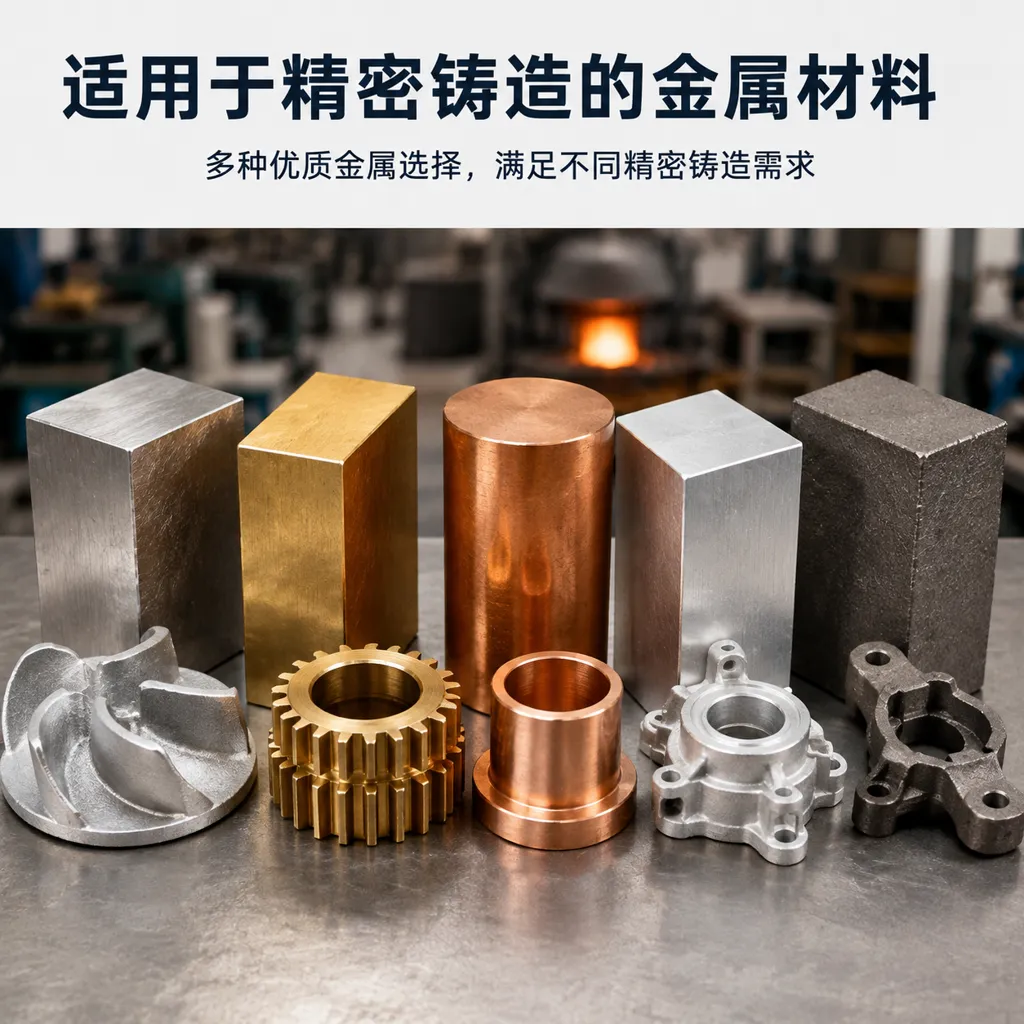
When clients ask us what is investment casting best suited for, alloy versatility is always at the top of the list. We pour a broad range of ferrous and non-ferrous metals to achieve near net shape casting with reliable dimensional tolerances and a fine surface finish Ra.
Stainless Steel and Carbon Steel Alloys
Steel remains the primary choice in precision investment casting due to its versatility, structural strength, and pressure tightness.
- Stainless Steels (300 & 400 Series, 17-4 PH): Essential for valves, pumps, and hardware requiring corrosion resistance. We produce a wide range of cast stainless steel custom casting alloys and grades designed for harsh marine and chemical environments.
- Carbon and Low-Alloy Steels: Cost-effective solutions offering high tensile strength and wear resistance, perfect for heavy equipment, brackets, and structural foundry casting components.
Aluminum and Titanium for Lightweight Applications
When weight reduction directly impacts performance, non-ferrous metal alloy pouring offers high strength-to-weight ratios without sacrificing durability.
- Aluminum Investment Casting: Delivers excellent thermal conductivity and lightweight strength, making it ideal for electronics enclosures, automotive brackets, and aerospace components.
- Titanium Alloys: Offers extreme corrosion resistance and biocompatibility, serving high-stress aerospace structures and medical implants.
Nickel and Cobalt Superalloys
When severe temperatures and aggressive environments exhaust standard metals, specialized superalloys ensure long-term performance.
- Nickel-Based Alloys (Inconel, Hastelloy): Maintain high yield strength and creep resistance inside gas turbines and power generation equipment.
- Cobalt-Based Alloys: Provide exceptional hot-corrosion resistance and durability. Reviewing specialized cobalt alloys for high wear and heat resistance provides critical advantages for high-friction industrial uses.
Key Advantages of Precision Investment Casting
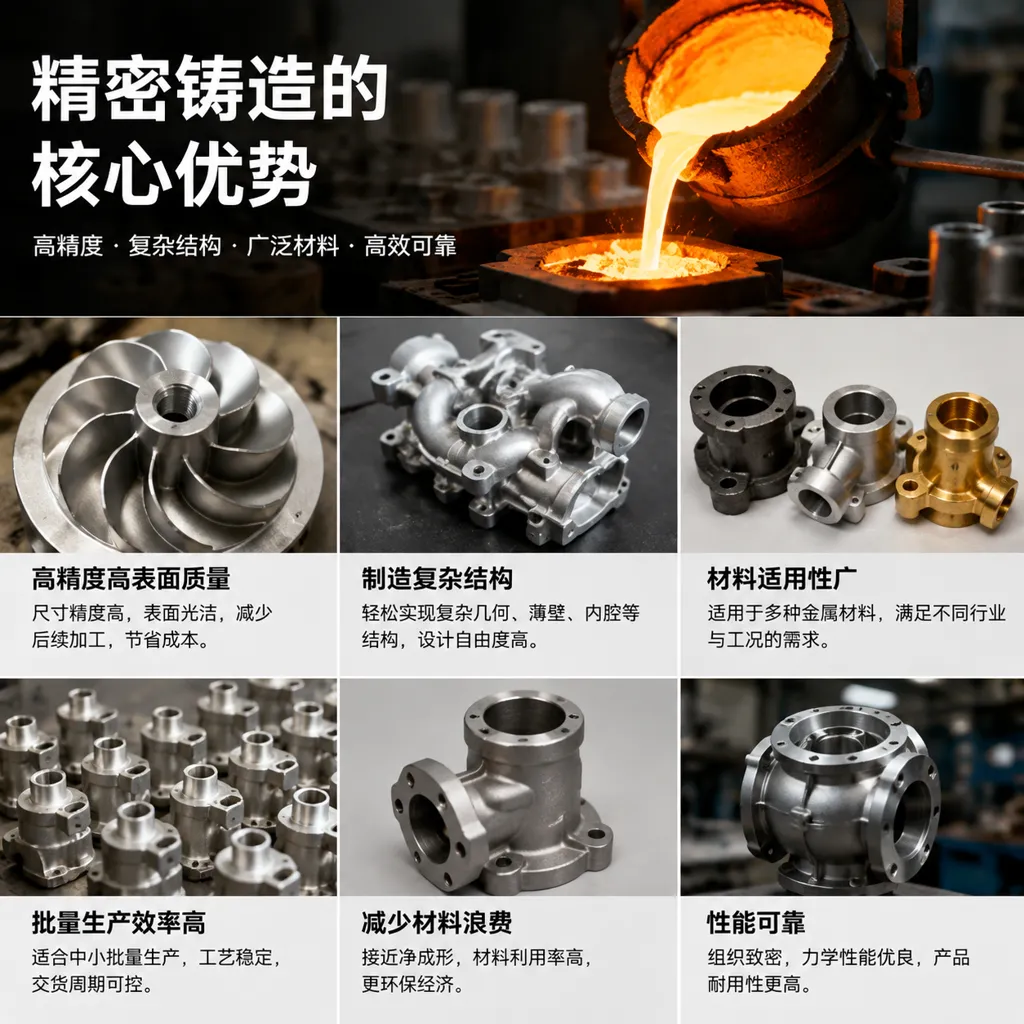
We use precision investment casting and prototypes to manufacture complex foundry casting components that meet demanding mechanical standards while keeping production efficient.
Complex Geometry and Thin-Wall Capabilities
- Intricate Design Freedom: We cast complex internal cavities, undercuts, and thin walls down to 0.040 in (1.0 mm) that standard cutting tools cannot execute.
- Part Consolidation: By producing single near net shape casting components, we merge multi-piece assemblies to eliminate joinery, weld lines, and structural weakness points.
Superior Surface Finish and Tight Tolerances
| Parameter | Capability Standard | Performance Advantage |
|---|---|---|
| Surface Finish Ra | 125 µin (3.2 µm) or better | Smooth tactile finish out of the mold; minimizes secondary polishing |
| Dimensional Tolerances | ±0.005 in/in (±0.13 mm) | Precise, repeatable accuracy across high-volume production runs |
Reduction in Secondary Machining and Scrap
- Minimal Alloy Waste: Forming parts directly to near net shape reduces high-cost material loss during metal alloy pouring.
- Cut Machining Cycles: Minimizing post-cast precision casting and CNC machining lowers tooling costs, shortens production lead times, and decreases overall cost per part.
Common Applications Across Key Industries
When critical industries require complex geometries, thin walls, and smooth surfaces without expensive post-machining, precision investment casting is our go-to solution. We manufacture high-integrity near net shape casting parts that meet stringent standards across several major global sectors.
Aerospace and Defense Components
Aerospace engineering leaves zero room for failure. We supply flight-critical structural parts, fuel system fittings, turbine components, and military hardware built to survive extreme temperatures and pressures. Utilizing high-performance materials like aluminum grade 357 components allows us to deliver high strength-to-weight ratios for lightweight aerospace applications.
Medical Device and Surgical Tool Manufacturing
Healthcare applications require exceptional dimensional accuracy and bio-compatible surface finishes. Using lost wax techniques, we manufacture: Surgical instruments: Handles, forceps, clamps, and specialized scalpel housings. Orthopedic implants: Joint replacement components cast from durable cobalt-chrome and titanium alloys. Diagnostic equipment: Brackets and housings for imaging devices and surgical robotics.
Automotive, Pump, and Valve Hardware
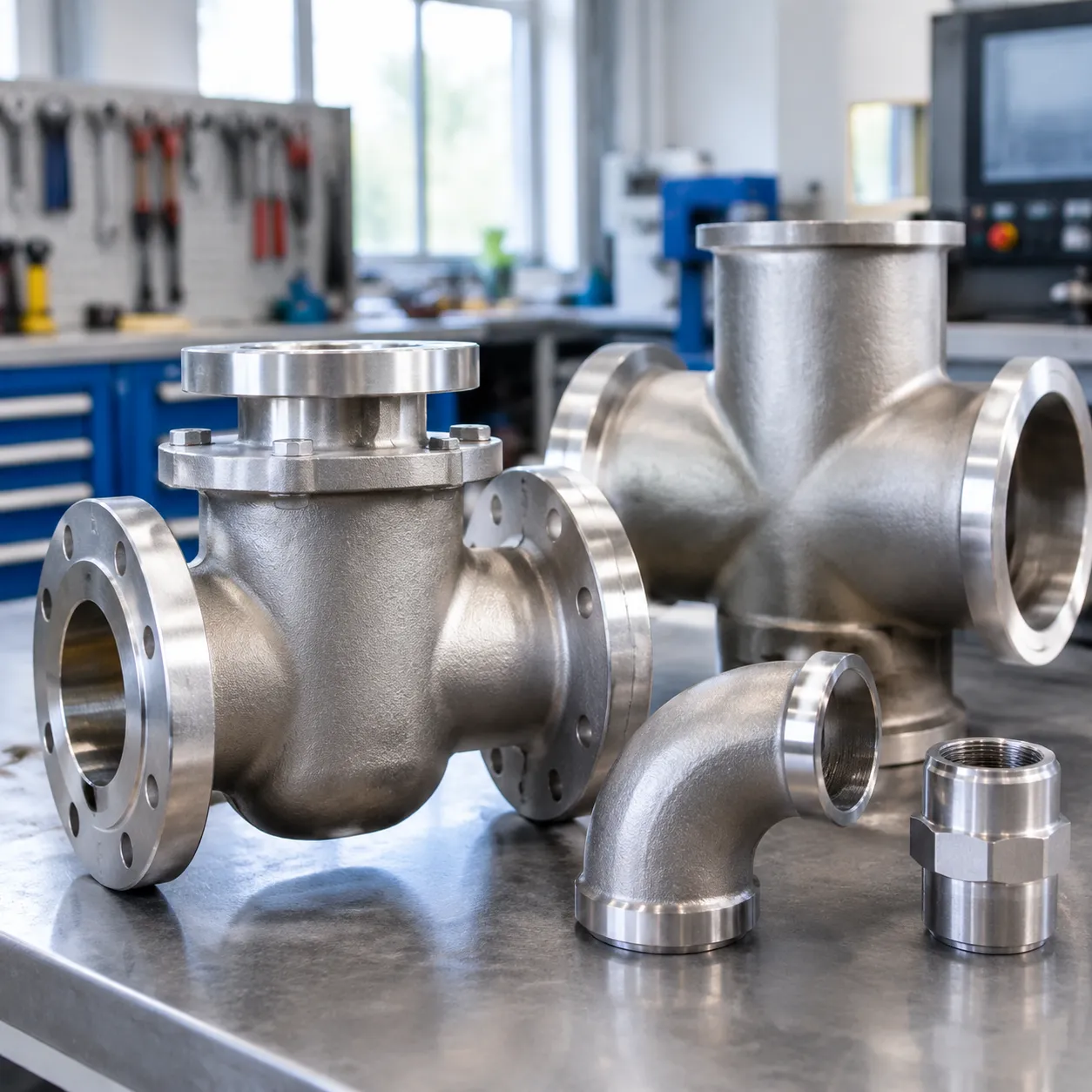
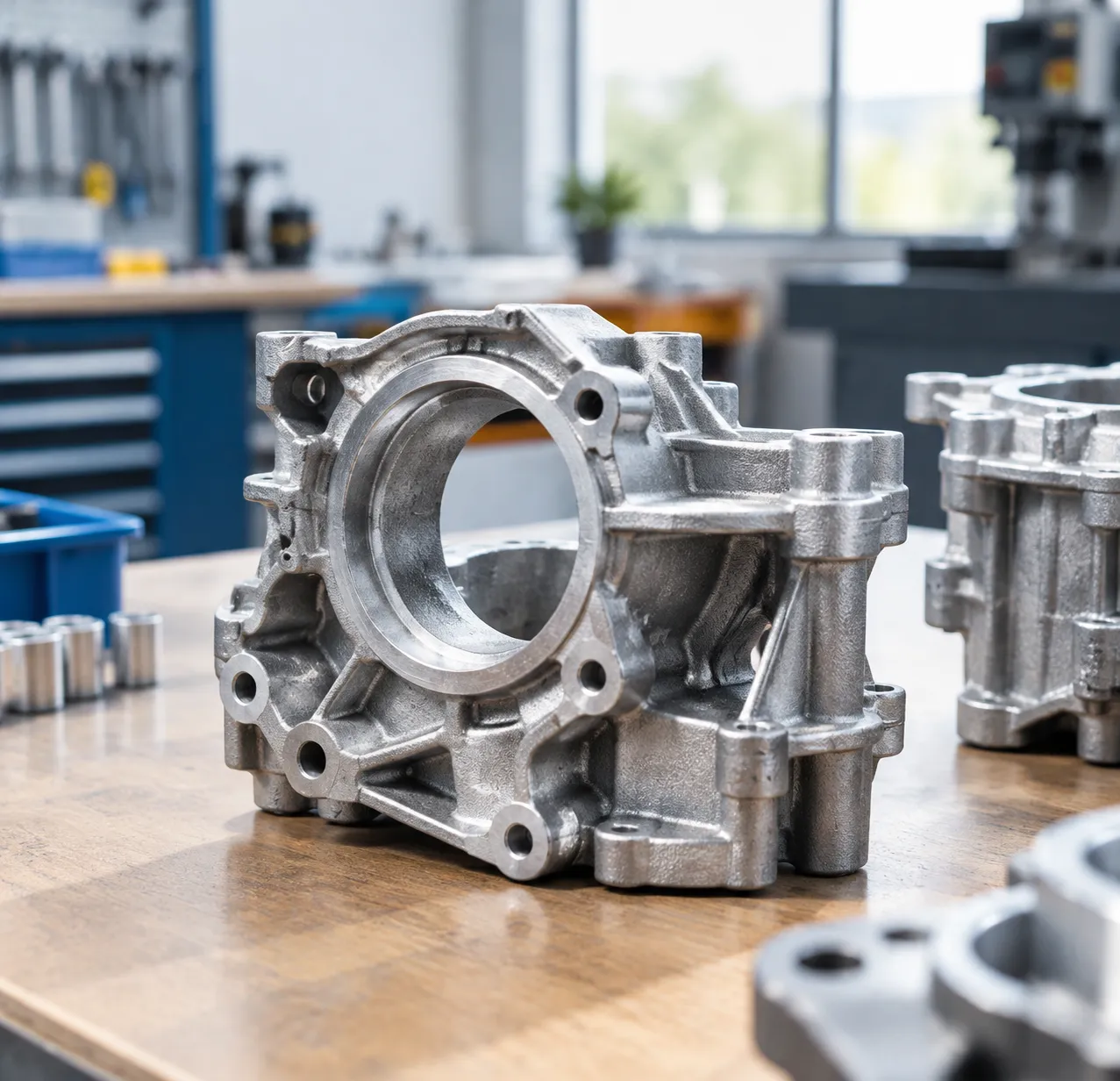
Heavy-duty industrial applications depend on durable foundry casting components that withstand high fluid pressures and constant friction. By leveraging tough materials like 4140 alloy steel components, we deliver reliable parts for demanding environments: Automotive: Turbocharger impellers, rocker arms, shift forks, and exhaust manifolds. Pumps & valves: High-pressure valve bodies, fluid impellers, pump housings, and manifolds.
Frequently Asked Questions About Investment Casting
Why Is It Called Investment Casting?
The term "investment" comes from the traditional definition of "investing"—meaning to clothe, surround, or coat an object. We surround a high-precision wax pattern with a liquid ceramic slurry to form a durable ceramic mold casting shell. Once the shell hardens, the wax melts out, leaving an accurate hollow cavity ready for high-temperature metal alloy pouring.
Is Lost Wax Casting the Same as Investment Casting?
Yes, lost wax casting and precision investment casting refer to the same fundamental process. "Lost wax" describes the core mechanism where wax patterns melt away inside a dewaxing autoclave. Understanding the origins of lost wax casting vs investment casting highlights how modern industrial foundries elevated ancient lost-wax techniques into a high-tech, automated manufacturing process.
Size and Weight Limits of Cast Parts
Investment casting handles an exceptionally broad range of part sizes, delivering near net shape casting results across various metal alloys:
- Weight Range: From delicate 5-gram medical components up to 150-kilogram heavy industrial hardware.
- Dimensional Envelope: Typical dimensions range from a few millimeters up to 1.5 meters.
- Tolerances & Finish: Achieves tight dimensional tolerances (±0.005 in/in) and smooth surface finish Ra values (125 RMS) directly out of the shell.
Whether producing heavy steel hardware or lightweight aluminum investment casting geometries, size limits depend mostly on mold handling equipment and furnace melt capacities.
How Expensive Is Investment Casting Tooling?
Upfront aluminum injection die tooling for wax patterns typically ranges from $1,500 to $10,000+, depending on part complexity, core requirements, and cavity counts. While tooling costs are higher than sand casting, we eliminate expensive secondary CNC machining and reduce scrap material, making investment casting significantly more cost-effective for medium to high-volume production runs.
 English
  Russian
  German