
2026年10月1日
Discover reliable aluminum foundry solutions with quality casting processes durable materials and precision engineered components for diverse industri
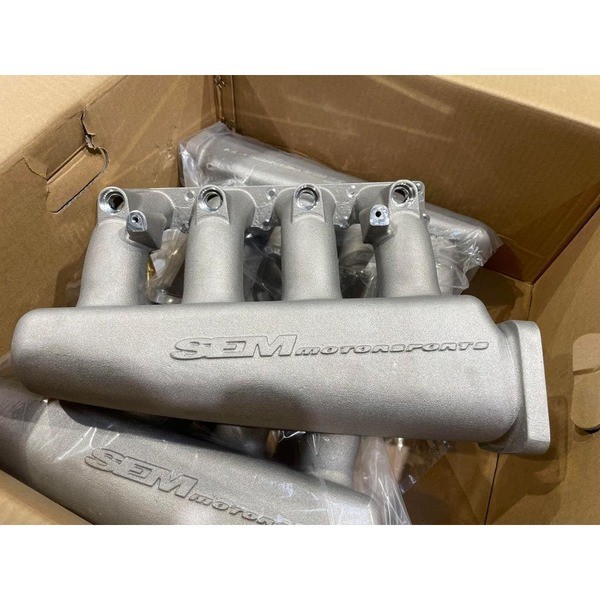
Aluminum Foundry Casting Processes
At our aluminum casting foundry, we match your exact component geometry, mechanical requirements, and production volume with the optimal casting method. As a full-service non-ferrous foundry, we operate advanced melting and pouring lines designed to deliver superior metallurgical integrity and repeatable dimensional accuracy across every batch.
Sand Casting for Low-to-Medium Volume Production
Our aluminum sand casting process provides unmatched flexibility and cost efficiency, especially for prototypes, low-to-medium runs, and oversized structural components.
- Cost-Effective Tooling: Significantly lower initial pattern costs compared to metal tooling.
- Large Part Capability: Capable of pouring massive components weighing from a few pounds up to several tons.
- Rapid Iterations: Quick design modifications and fast turnaround on initial sample runs.
High-Pressure Die Casting for High Volume and Thin Walls
Our aluminum die casting foundry utilizes automated high-pressure cold-chamber machines to deliver rapid cycle times, high repeatability, and lightweight part consolidation.
- Precision & Consistency: Produces complex shapes with tight dimensional tolerances and exceptional repeatability.
- Thin-Wall Aluminum Casting: Injects molten alloy under extreme pressure to fill thin walls down to 1.5 mm.
- High-Volume Efficiency: Optimized for large production runs exceeding thousands of units with minimal unit costs.
Permanent Mold Casting for High Strength and Structural Integrity
Our gravity-fed permanent mold aluminum casting uses reusable steel dies to create dense, pressure-tight parts with superior mechanical properties.
- Superior Mechanical Strength: Rapid chilling produces a fine grain structure that enhances tensile and yield strength.
- Low Porosity: Controlled gravity filling minimizes turbulence, oxide formation, and entrapped gas defects.
- Surface Finish: Delivers smooth, uniform surfaces that reduce the need for extensive post-cast finishing.
Investment Casting for Intricate Details and Tight Tolerances
For components requiring complex internal passages, thin features, and razor-sharp detail, our investment casting aluminum process delivers near-net-shape accuracy.
- Complex Geometries: Accommodates intricate undercuts, thin ribs, and fine core details using lost-wax methods.
- Near-Net Shapes: Dramatically reduces or eliminates secondary machining operations.
- Superior Surface Quality: Yields smooth surface finishes directly out of the ceramic shell.
Casting Process Comparison
| Casting Method | Optimal Volume | Tooling Cost | Wall Thickness Capability | Dimensional Accuracy |
|---|---|---|---|---|
| Sand Casting | Low to Medium (1 – 5,000) | Low | Standard to Heavy (≥ 4.0 mm) | Moderate |
| Die Casting | High (5,000+) | High | Ultra-Thin (≥ 1.5 mm) | High |
| Permanent Mold | Medium to High (1,000 – 50,000) | Medium | Medium (≥ 3.0 mm) | High |
| Investment Casting | Low to Medium (100 – 10,000) | Medium to High | Thin to Intricate (≥ 2.0 mm) | Very High |
Common Aluminum Alloys in Foundry Operations
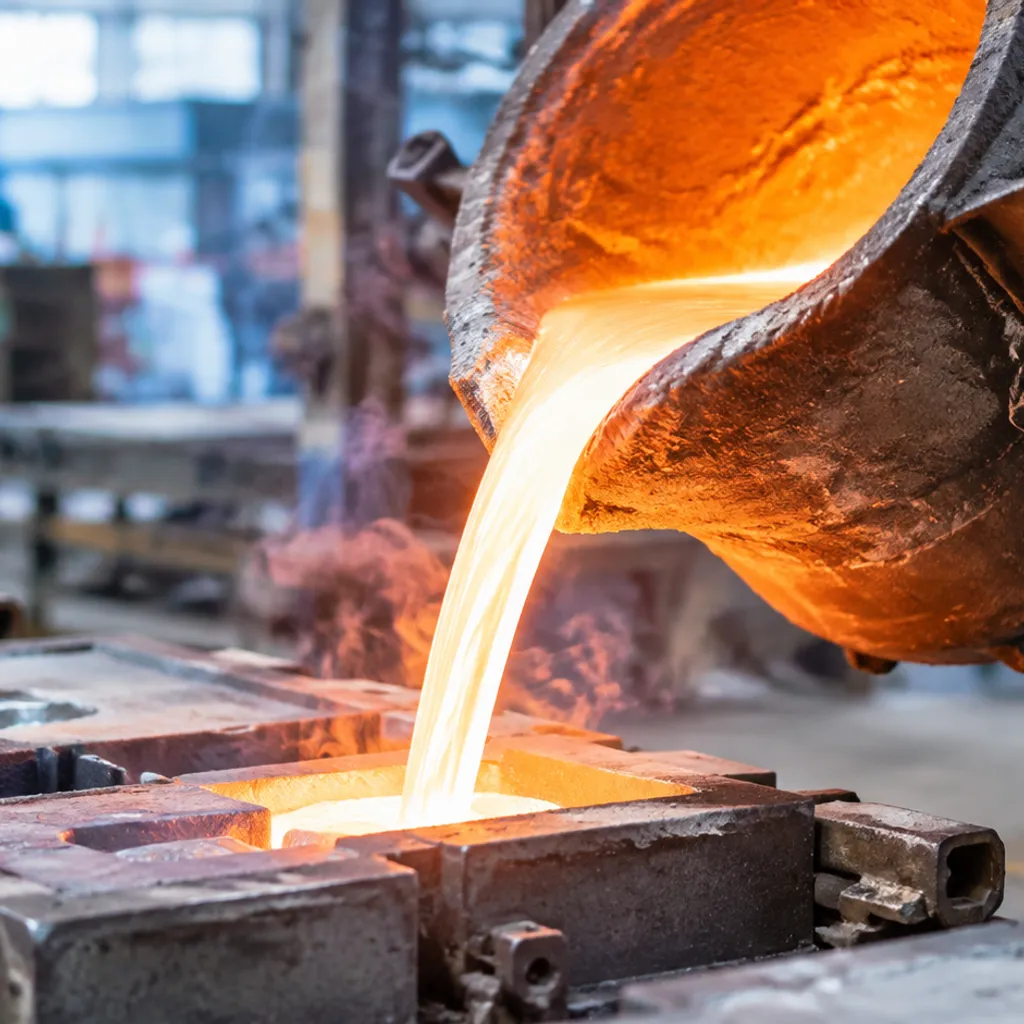
Selecting the right material is critical to achieving target mechanical performance, thermal management, and cost efficiency. In our aluminum foundry, we pour a wide range of production-grade alloys tailored to specific structural demands, casting methods, and post-machining requirements.
For a deeper breakdown of material choices across different pouring methods, consult our comprehensive aluminum alloy casting guide.
A356 and A356-T6 for High-Strength Structural Components
A356 is the primary workhorse for sand and permanent mold casting when structural integrity cannot be compromised. Key Strengths: Excellent castability, high fracture toughness, and superior weldability. T6 Heat Treatment: Applying a T6 heat treatment to A356 significantly boosts tensile and yield strength, making it ideal for automotive suspension arms, high-load brackets, wheel hubs, and aerospace housings. Alternative Options: For applications needing even higher yield strength and strict pressure tightness, premium Al-Si-Mg variants like aluminum grade 357 offer higher mechanical thresholds.
A380 for All-Purpose Die Casting and Thermal Stability
A380 cast alloy is the industry standard in high-pressure aluminum die casting foundry operations. Key Strengths: Optimized balance of fluid dynamics, thermal conductivity, and pressure tightness. Best Used For: Thin-wall electronics enclosures, pump housings, heavy-duty heat sinks, and brackets where fast cycle times and tight dimensional consistency are required.
319 Aluminum for Engine Components and Industrial Use
319 is an aluminum-silicon-copper alloy optimized for general sand casting and permanent mold casting. Key Strengths: Outstanding fluidity, high hot-tear resistance, and good machinability. Best Used For: Engine blocks, intake manifolds, crankcases, oil pans, and general-purpose industrial machinery covers.
Al-Si-Mg Alloys for Superior Corrosion Resistance
High-purity Aluminum-Silicon-Magnesium alloys are designed for severe working environments requiring exceptional resistance to chemical exposure and marine corrosion. Key Strengths: High strength-to-weight ratio, minimal porosity during solidifying, and excellent surface passivation. Best Used For: Marine hardware, outdoor lighting enclosures, fluid-handling valves, and chemical processing manifolds.
Aluminum Casting Alloy Comparison
| Alloy Grade | Primary Casting Method | Tensile Strength (Yield / Ultimate) | Key Advantage |
|---|---|---|---|
| A356-T6 | Sand / Permanent Mold / Investment | 165 MPa / 230 MPa | High impact resistance & elongation |
| A380 | High-Pressure Die Casting | 160 MPa / 320 MPa | Superior fluidity & thin-wall stability |
| 319 | Sand / Permanent Mold | 125 MPa / 185 MPa | Excellent castability & easy machining |
| Al-Si-Mg (A357) | Permanent Mold / Investment | 260 MPa / 340 MPa | Maximum structural strength & corrosion resistance |
Secondary Manufacturing and Value-Added Services
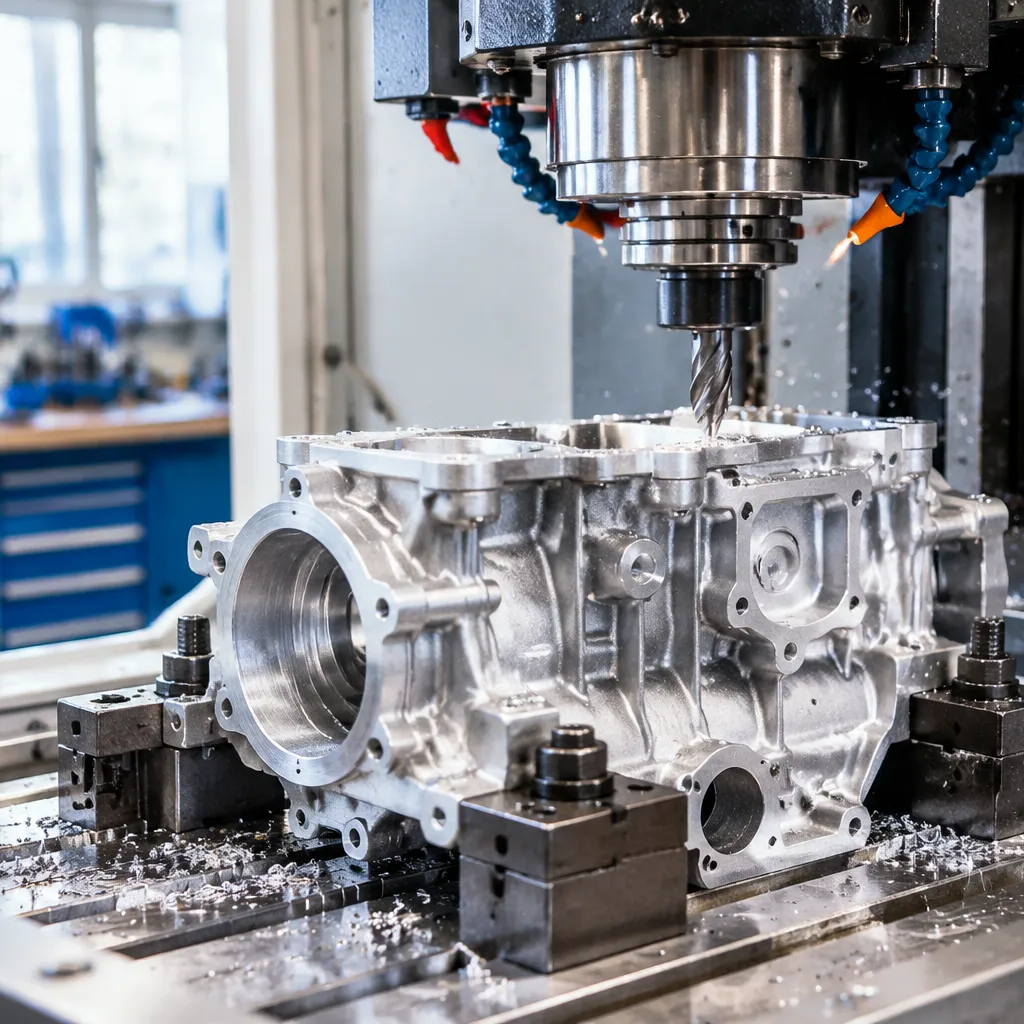
As a full-service aluminum foundry, we deliver complete, ready-to-assemble components under one roof. Our turnkey value-added operations eliminate supply chain delays, reduce scrap rates, and ensure every casting meets your exact engineering specifications.
In-House Tooling and Precision Pattern Making
We engineer and manufacture custom aluminum tooling, core boxes, and durable patterns in-house. Using advanced CAD/CAM software and high-speed milling, we rapidly develop tooling for both prototype aluminum casting runs and high-volume production. In-house control allows us to modify gates, runners, and parting lines quickly, cutting lead times and optimizing metal flow before pouring.
Post-Cast CNC Machining for Critical Tolerances
While casting gives parts their near-net shape, critical assembly points require tighter tolerances. Our climate-controlled machine shop provides multi-axis precision casting and CNC machining capabilities:
- Tolerances: Down to ±0.005 mm (±0.0002 in) on critical bores, mating faces, and threaded holes.
- Equipment: High-speed 3-axis, 4-axis, and 5-axis CNC machining centers and CNC lathes.
- Features: Precision boring, tapping, profiling, reaming, and multi-face milling in a single setup.
Metallurgical Heat Treatment (T4, T5, T6)
We optimize mechanical properties using precisely controlled thermal cycles to match your load and stress requirements:
- T4 Treatment: Solution heat-treated and naturally aged to enhance ductility and impact resistance.
- T5 Treatment: Artificially aged directly after casting to improve dimensional stability and moderate hardness without high-temperature quenching.
- T6 Heat Treatment: Solution heat-treated, water-quenched, and artificially aged to achieve maximum tensile strength, yield strength, and hardness in alloys like A356.
Surface Finishing Options
Our cast aluminum surface finishing processes protect against corrosion, improve wear resistance, and provide clean cosmetic finishes.
| Value-Added Process | Options & Specifications | Primary Benefit |
|---|---|---|
| Mechanical Finishing | Shot blasting (stainless steel / glass bead), vibratory deburring, hand grinding | Cleans parting lines, removes flash, creates a uniform matte texture |
| Anodizing | Type II (decorative/colored), Type III (hardcoat) | Significantly boosts wear and corrosion resistance |
| Protective Coatings | Electrostatic powder coating, liquid painting, e-coating | Provides durable environmental barrier and custom RAL colors |
| Chemical Conversion | Chromate conversion (chem film / Alodine) | Improves electrical conductivity and serves as a paint primer |
| Leak Sealing | Vacuum pressure impregnation (liquid resin) | Eliminates micro-porosity for pressure-tight fluid and gas housings |
Foundry Quality Assurance and Testing Standards
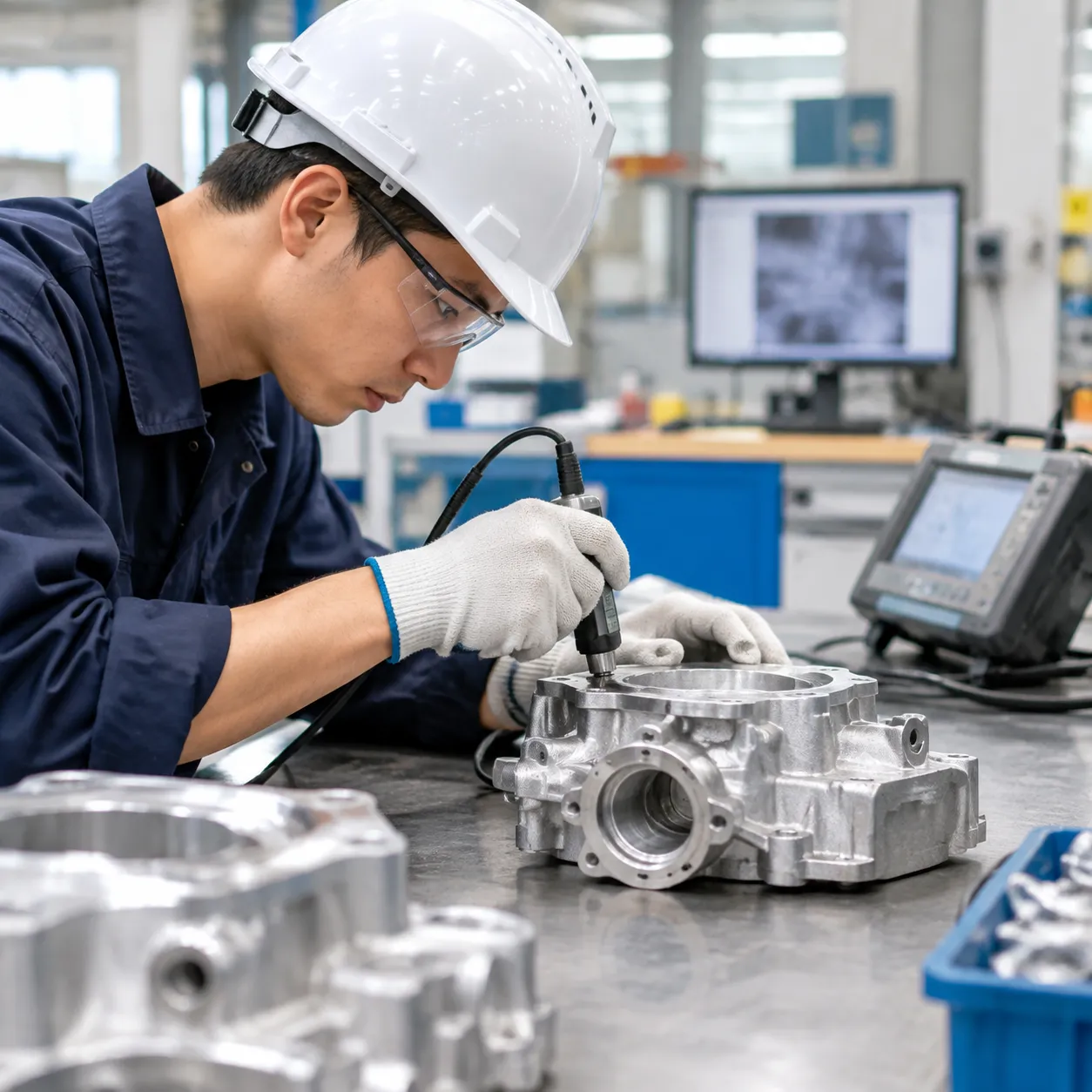
At our aluminum foundry, defect prevention and structural integrity are non-negotiable. We enforce rigorous casting quality standards for reliable metal parts to guarantee that every casting meets exact mechanical, chemical, and dimensional specifications before delivery.
X-Ray and Radiographic Testing for Subsurface Porosity
We utilize real-time digital radiography and industrial X-ray systems to inspect internal structures without damaging the part. This non-destructive testing (NDT) identifies: Subsurface gas porosity and micro-shrinkage voids Internal oxide inclusions and cold shuts Structural density issues in critical, pressure-tight walls
Coordinate Measuring Machine (CMM) Dimensional Verification
To guarantee complete dimensional accuracy, our quality lab uses automated multi-axis CMM equipment and high-resolution 3D optical scanning. GD&T Validation: We measure tight geometric tolerances, hole concentricity, and profile positions directly against your 3D CAD model. First Article Inspection (FAI): We provide detailed dimensional inspection reports to qualify new tooling and setup adjustments rapidly.
Optical Emission Spectrometry for Exact Chemical Alloy Verification
Alloy purity directly affects casting strength, corrosion resistance, and machinability. Using optical emission spectrometry (OES), we verify the melt chemistry before, during, and after pouring: Real-time analysis of primary and trace elements (such as Silicon, Magnesium, Copper, and Iron) Traceable chemical certification reports (MTRs) linked directly to each production heat Zero risk of cross-contamination between different aluminum alloys
Tensile, Yield, and Hardness Mechanical Property Testing
Every heat-treated batch is mechanically verified using test bars cast alongside your production parts. We ensure our foundry aluminum casting output matches your exact engineering requirements:
| Test Type | Metric Evaluated | Primary Objective |
|---|---|---|
| Tensile Strength | Ultimate tensile stress (MPa / ksi) | Verifies maximum load capacity before fracture |
| Yield Strength | 0.2% offset yield point | Ensures parts resist permanent deformation under load |
| Elongation | Percentage stretch (% EL) | Confirms material ductility and impact resistance |
| Hardness Testing | Brinell (HBW) / Rockwell (HRB) | Confirms effective T4, T5, or T6 metallurgical heat treatment |
Key Industrial Applications for Aluminum Foundry Castings
As a full-service aluminum foundry, we engineer and pour high-integrity components for industries that demand strength, weight reduction, and superior thermal efficiency. Our foundry aluminum casting capabilities serve critical sectors worldwide:
- Automotive & Commercial Vehicles: We cast lightweight powertrain and structural parts that withstand high vibrational stress and heat, including:
- Transmission cases and bell housings
- Engine blocks and cylinder heads
- Engine mounting brackets, control arms, and suspension nodes
- Aerospace & Defense: For high-performance flight hardware and fluid systems, our precision casting methods provide high strength-to-weight ratios. We produce:
- Avionics structural enclosures and chassis
- Hydraulic manifolds and fluid handling components
- Thin-wall airframe brackets utilizing advanced aluminum investment casting techniques
- Industrial Fluid Power & Machinery: Our foundry pours dense, leak-free castings rated for hydraulic pressure and continuous industrial operation:
- High-pressure pump housings and impellers
- Pneumatic and hydraulic valve bodies
- Heavy-duty industrial gearboxes and drive housings
- Electronics & Commercial Lighting: Leveraging aluminum's natural thermal conductivity, we manufacture protective, thermally efficient housings:
- High-power LED lighting enclosures for outdoor and hazardous environments
- Power inverter and motor drive housings
- Heavy-duty electronic heat sinks requiring complex fin geometries
| Industry Sector | Primary Cast Components | Key Performance Demands |
|---|---|---|
| Automotive | Transmission cases, engine blocks, brackets | Lightweighting, fatigue resistance, thermal endurance |
| Aerospace | Fluid manifolds, avionics enclosures | Pressure tightness, tight tolerances, high strength-to-weight ratio |
| Industrial | Pump housings, valve bodies, gearboxes | Zero porosity, wear resistance, dimensional repeatability |
| Electronics | Heat sinks, LED luminaire housings | Heat dissipation, IP-rated sealing, corrosion resistance |
Selecting the Right Aluminum Foundry Partner
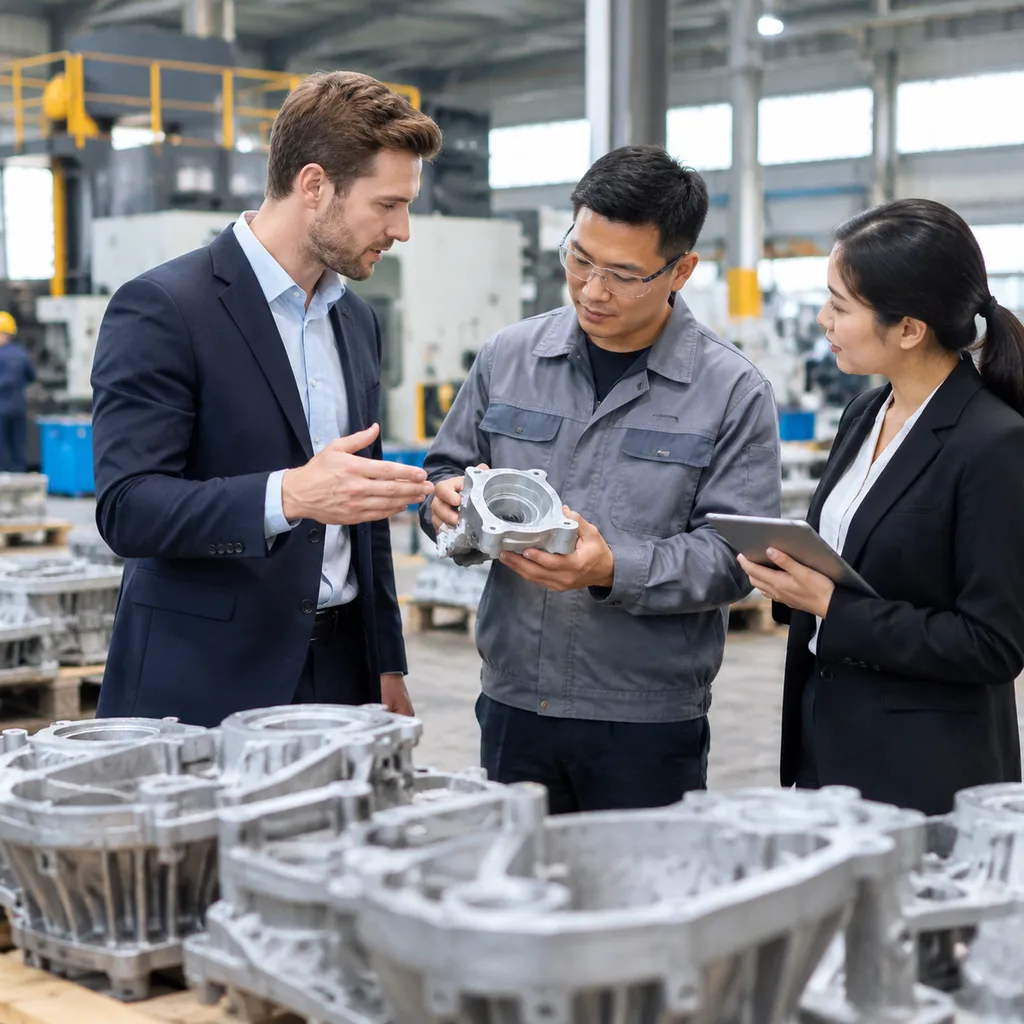
Choosing the right aluminum foundry directly impacts your production timeline, part quality, and final manufacturing costs. We work as an extension of your engineering team, ensuring your components transition seamlessly from early prototypes to stable, high-volume production runs.
Prototype to Mass Production Scalability
A reliable manufacturing partner must handle your program at every stage of its lifecycle. We align casting processes with your specific volume demands:
- Low-Volume & Prototyping: Rapid prototyping and sand casting allow for fast design iterations and low-cost initial testing.
- Medium-to-High Volume: Semi-permanent mold and automated die casting processes deliver rapid cycle times, high dimensional consistency, and optimal per-part economics.
- Process Flexibility: Our comprehensive precision casting solutions ensure seamless scalability as your production volumes grow.
Certified Quality: ISO 9001 and IATF 16949
Consistent quality requires verifiable process controls. As an established IATF 16949 aluminum foundry and ISO 9001 certified supplier, our production processes follow rigorous quality management frameworks:
| Quality System Requirement | Manufacturing Impact | Customer Benefit |
|---|---|---|
| IATF 16949 Compliance | Standardized automotive-grade process control | Complete traceability and zero-defect consistency |
| ISO 9001 Protocols | Documented workflows and calibration audits | Repeatable quality across every production lot |
| PPAP / First Article (FAIR) | Comprehensive pre-production sample verification | Guaranteed dimensional conformity before ramp-up |
Engineering Support and DFM Optimization
The best results start before molten metal ever enters a mold. Our in-house engineering team conducts detailed Design for Manufacturability (DFM) evaluations to optimize part geometry for the foundry aluminum casting process:
- Wall Thickness Uniformity: Eliminating hot spots and preventing shrinkage defects.
- Draft Angle and Radius Placement: Ensuring clean part ejection while reducing tool wear.
- Mold Flow Simulation: Optimizing runner, gate, and riser layouts to eliminate trapped air and gas porosity.
Balancing Tooling Investment and Unit Economics
Selecting the right tooling strategy depends on your product's total volume and production lifecycle. We balance initial capital expenditures with unit prices to maximize your return on investment:
- Sand Casting Tooling: Low initial pattern cost, ideal for prototypes, large industrial components, and low-run orders.
- Permanent Mold & Die Tooling: Higher upfront investment in hardened steel dies, offset by low per-piece costs, tight dimensional tolerances, and high production speeds.
- Tooling Maintenance: We provide full lifecycle maintenance and tool preservation for all custom aluminum tooling run in our foundry.
Aluminum Foundry FAQs
What is the difference between die casting and sand casting at an aluminum foundry?
The primary differences lie in tooling costs, production volume, surface finish, and dimensional tolerances:
| Feature | Aluminum Sand Casting | High-Pressure Die Casting |
|---|---|---|
| Optimal Volume | Low to medium (1 to 5,000+ parts/year) | High volume (10,000+ parts/year) |
| Initial Tooling Cost | Low (inexpensive wood, resin, or aluminum patterns) | High (hardened steel dies) |
| Wall Thickness | Typically $\ge$ 3.0 mm | Thin walls down to 1.5 mm |
| Surface Finish | Standard cast finish (Ra\ 6.3 - 12.5\ μm) | Smooth, as-cast finish (Ra\ 1.6 - 3.2\ μm) |
| Part Size Capability | Large, heavy components | Small to medium components |
For complex geometries and scalable short runs, working with an experienced sand casting manufacturer for custom metal parts keeps up-front capital low, while die casting minimizes unit costs at scale.
How do foundries eliminate gas porosity and shrinkage defects?
We eliminate defects through strict metallurgical control and thermal gating simulation:
- Rotary Degassing: Injecting inert nitrogen or argon into molten aluminum to remove dissolved hydrogen gas.
- Fluxing & Dross Removal: Removing non-metallic inclusions prior to pouring.
- Optimized Gating & Risers: Directing uniform solidification and feeding molten metal to prevent shrinkage cavities.
- Mold Venting & Chills: Strategic placement of internal chills and vacuum vents to equalize cooling rates and evacuate trapped air.
- Real-Time Process Simulation: Computer-aided solidification modeling to detect and fix potential hot spots before tool cutting.
What is the typical lead time for aluminum casting tooling and first articles?
Lead times depend on the specific casting method and part complexity:
- Rapid Prototype Sand Castings: 1 to 3 weeks using 3D-printed sand molds or quick-turn patterns.
- Production Sand & Permanent Mold Tooling: 3 to 5 weeks for pattern fabrication and first article inspection (FAI).
- Die Casting & Investment Casting Tooling: 5 to 8 weeks for hardened steel dies, core mechanisms, and complete CMM dimensional reports.
- Turnkey Machined Samples: Add 1 to 2 weeks for custom CNC fixturing and post-cast machining setup.
For complex, close-tolerance components, our dedicated aluminum investment casting services for precision parts ensure rapid design validation and first-article turnaround.
Which aluminum alloy is most suitable for pressure-tight applications?
A356-T6 is the industry benchmark for pressure-tight, leak-proof components such as fluid manifolds, pump housings, and valve bodies. Its high silicon content (6.5–7.5%) provides superior fluidity and low shrinkage during solidification, preventing micro-porosity.
For high-pressure die casting operations, A380 offers dependable thermal stability and leak integrity when paired with optimized die vacuum systems.
Can an aluminum foundry provide fully finished, ready-to-assemble parts?
Yes. We provide complete end-to-end turnkey foundry solutions, managing every production phase in-house:
- Metallurgical Heat Treatment: Solutionizing and aging (T4, T5, T6) to reach exact yield and tensile targets.
- Precision CNC Machining: Tight-tolerance multi-axis milling, turning, boring, and threading.
- Surface Finishing: Shot blasting, vibratory deburring, hard-coat anodizing, chromate conversion, and powder coating.
- Testing & Sub-Assembly: Pressure decay leak testing, bushing installation, bearing pressing, and final packaging for immediate production-line integration.
 English
  Russian
  German