
2026年11月10日
Automate your Investment Casting Production Line with reliable solutions that improve precision productivity and cost efficiency
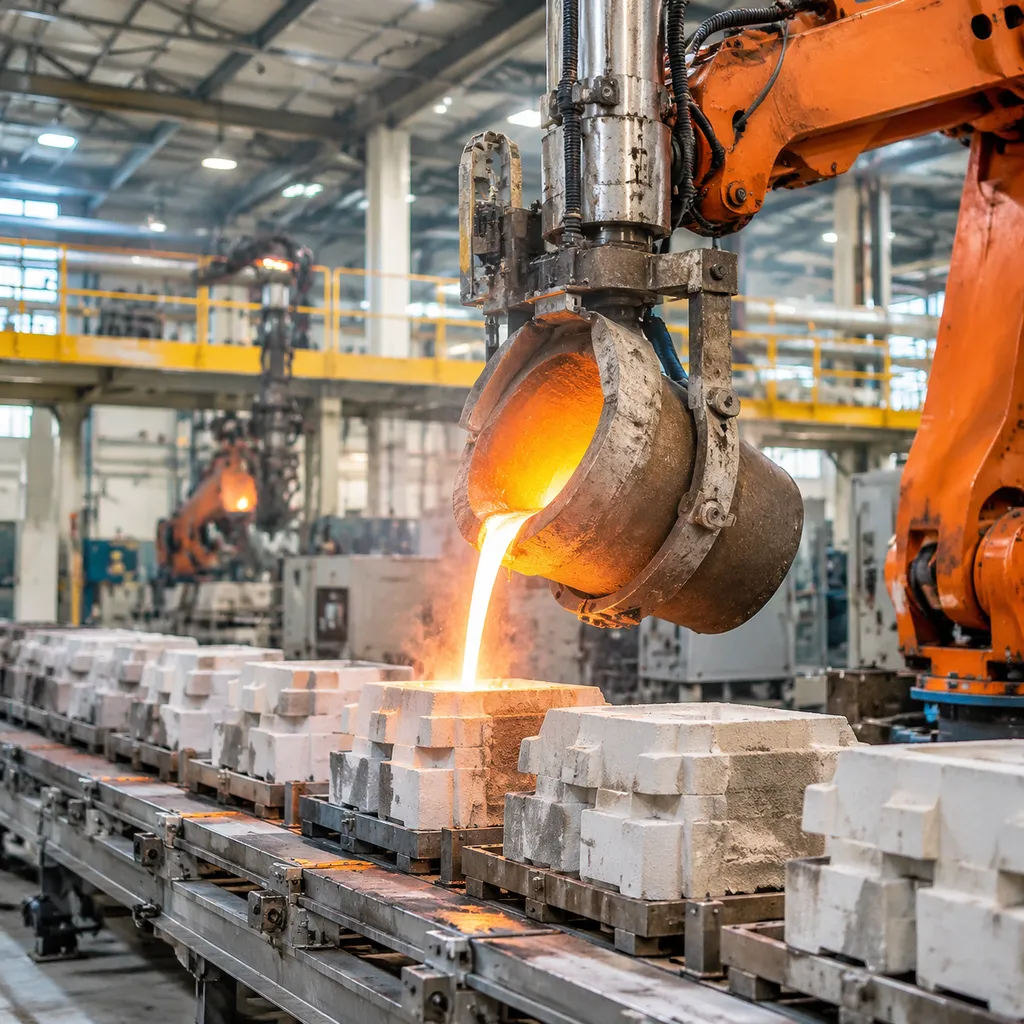
System Overview: Modernizing the Lost-Wax Casting Process
Traditional investment casting operations face strict limits when relying on manual labor: fluctuating shell thickness, inconsistent slurry drainage, long cycle times, and high scrap rates. We design investment casting production line automation solutions that transform manual lost-wax casting into a deterministic, highly repeatable manufacturing workflow. By replacing operator variance with precision automation, our systems ensure exact coating uniformity, controlled slurry penetration, and reliable output across every production shift.
- Process Repeatability: Standardized dipping speeds, angles, and draining trajectories across every cycle.
- Scrap Minimization: Direct reduction of shell cracking, inclusions, and runout defects.
- Maximized Throughput: Continuous 24/7 operation without operator fatigue or process drift.
The Shift from Manual Handling to Intelligent Robotics
Manual manipulation of heavy wax trees compromises mold integrity and exposes workers to repetitive strain and hazardous dust. Our lost-wax casting automation replaces manual handling with high-payload, multi-axis foundry dipping robots engineered specifically for harsh environments.
| Production Factor | Manual Handling | Automated Robotic Cell |
|---|---|---|
| Cluster Weight Capacity | Limited to 15–25 kg per operator | Up to 500+ kg with multi-axis arms |
| Drain Angle Accuracy | Variable and operator-dependent | ±0.5° precise kinematic control |
| Workplace Safety | High silica dust and ergonomic strain | Enclosed cells with zero operator exposure |
| Cycle Cadence | Inconsistent across shifts | Fixed, recipe-driven cycle times |
By automating the manipulation of delicate wax trees and heavy ceramic shells, our robotic shell building systems maintain uniform layer thickness on complex geometries, deep pockets, and blind holes.
Modular Scalability: From Single Robotic Cells to Fully Integrated Plants
Every foundry operates under unique footprint, payload, and throughput requirements. We deliver modular architectures that scale seamlessly with production demand:
- Entry-Level Dipping Cells: Standalone robotic investment casting dipping cells paired with rotating slurry tanks and sanders for targeted bottleneck relief in existing plants.
- Semi-Automated Lines: Robotic dipping cells interfaced with manual-load batch drying rooms or indexing buffer conveyors.
- Fully Integrated Turnkey Systems: Complete automated ceramic mold production lines integrating wax tree transfer, robotic dipping, rainfall sanding, fluidized bed stuccoing, multi-tier overhead drying conveyors, and environmental climate control under centralized supervisory management.
This modular structure allows foundries to automate critical process stages immediately without disrupting current capacity, providing a straightforward engineering path to full plant modernization.
Core Modular Workstations & Engineering Architecture
Our investment casting production line automation systems are engineered around modular, plug-and-play cells. Instead of locking foundries into rigid, monolithic setups, we structure each station to operate independently or interlock seamlessly into a fully synchronized plant workflow.
Automated Wax Tree Pattern Assembly & Transfer
We eliminate manual handling bottlenecks right at the start of the process. Our automated wax assembly stations position, weld, and secure patterns to central runners with precise thermal control, preventing pattern stress and distortion. Vision-Guided Alignment: Precision sensors verify gate alignment and joint integrity before indexing. Automated Transfer Racks: Assembled trees transfer straight to buffer stations or overhead conveyors without human touch, preserving pattern dimensional stability.
Heavy-Duty Multi-Axis Robotic Shell-Making Cell
At the core of the slurry room, high-payload industrial robots take over the dipping sequence. Utilizing an automated shell coating line with robotic precision, our multi-axis dipping units control immersion depth, rotation angle, and draining trajectories down to the millimeter. Payload Capacity: Built to manipulate clusters weighing from 50 kg up to 500+ kg without cycle fatigue. Slurry Uniformity: Controlled multi-axis articulation ensures complete slurry penetration into tight pockets while actively draining excess slurry to eliminate pooling and air entrapment.
Precision Stuccoing & Sanding Systems
Uniform refractory application is critical for shell integrity and thermal shock resistance. Our cells combine rainfall sanders and fluidized beds designed to switch grain sizes dynamically across primary and backup coats: Rainfall Sanders: Deliver an even, gravity-fed shower of refractory sand over primary coats, protecting delicate wax geometries from structural wash. Fluidized Beds: Fluidize coarse sands with uniform low-pressure airflow for backup layers, ensuring deep, bubble-free adhesion across dense cluster branches.
Smart Climate-Controlled Shell Drying Conveyor Lines
Shell drying is historically the biggest bottleneck in precision casting. Our overhead conveyor lines continuously move ceramic shells through enclosed, multi-zone drying tunnels: Dynamic Climate Control: Independent control zones strictly regulate ambient air velocity, temperature, and relative humidity. Controlled Dehydration: Prevents moisture gradients that lead to shell cracking, cutting dry times significantly while guaranteeing mold stability coat after coat.
Dewaxing, Preheating & Pouring Automation Interface
Once drying is finished, the line indexes green shells directly into the thermal processing stages. Minimizing thermal shock and controlling pressure ramps during this phase is vital, which is why optimizing steam dewaxing parameters for preventing shell defects is fully integrated into the PLC recipe controls. Autoclave Transfer: Fast, automated loading systems seal shells into the steam autoclave, executing rapid depressurization cycles to melt wax out without cracking the ceramic. Preheat & Pouring Hand-Off: Robotic transfer arms transport dewaxed shells directly to high-temperature preheat furnaces and position them accurately at the pouring station, protecting operators from extreme radiant heat.
Industrial Control Systems & Industry 4.0 Integration
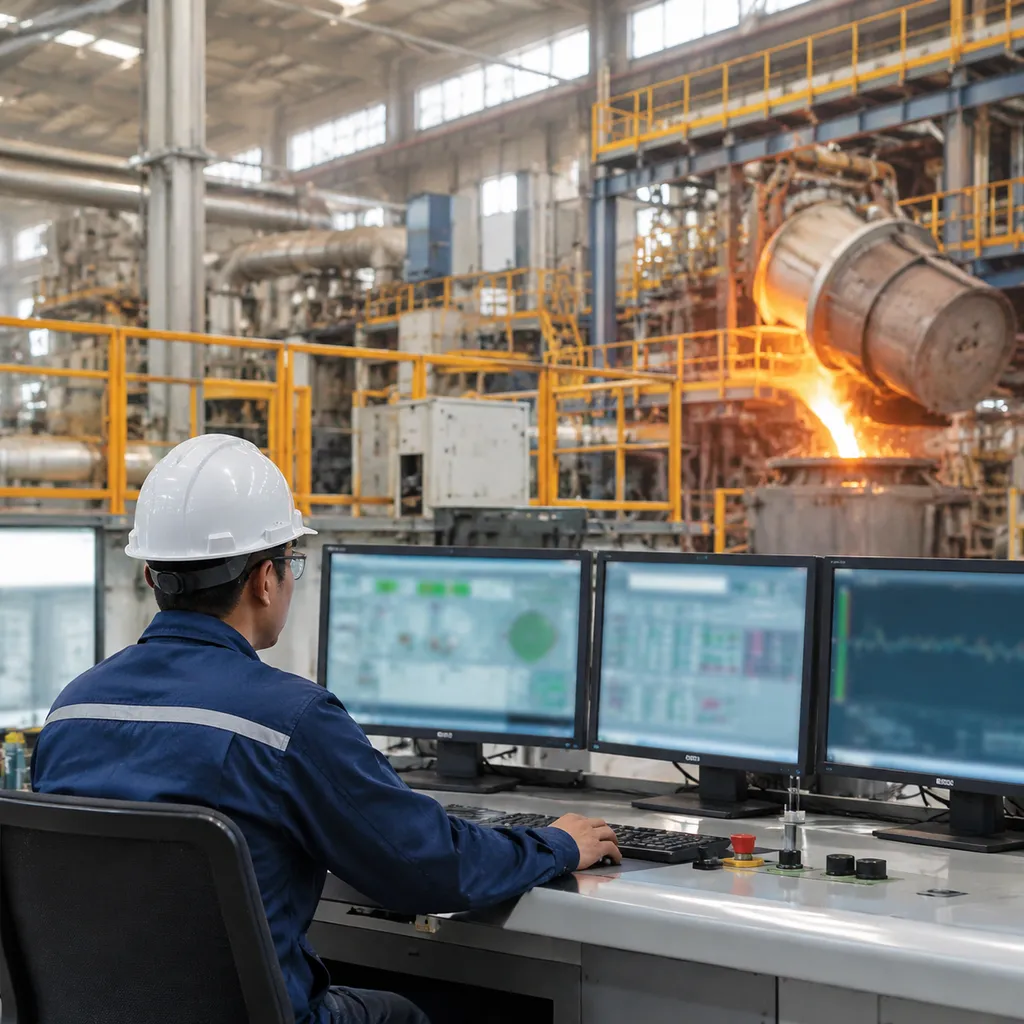
Modern investment casting production line automation relies on clear data and rock-solid controls. We engineer our automation platforms to eliminate process variation by connecting mechanical hardware directly to digital plant infrastructure. This delivers complete visibility over every shell, dipping cycle, and drying phase.
Centralized SCADA & Distributed PLC Architecture
Our automation packages utilize a multi-tier control design that separates immediate machine motion from high-level scheduling:
- Distributed Industrial PLCs: Dedicated field controllers execute sub-second robotic maneuvers, slurry tank rotation, and conveyor indexing without latency.
- Unified SCADA Supervisor: A single central interface coordinates all cell activity, recipe management, and line balancing across the shop floor.
- Open Fieldbus Communication: High-speed Ethernet/IP and Profinet links tie together robots, sanders, drives, and environmental sensors.
- Recipe Selection via Barcode/RFID: Operators or automated carriers scan a wax tree tag, and the line instantly loads the exact dipping speeds, dip angles, sand types, and dry times.
Real-Time Telemetry & Process Traceability
Consistent shell molds require relentless consistency at every stage. We build comprehensive process control in investment casting for defect-free precision straight into our software layer.
| Monitored Parameter | Control Mechanism | Target Tolerance |
|---|---|---|
| Slurry Viscosity | Automatic inline viscometers & solvent dosing | ±0.5 seconds (Zahn/Ford cup equivalent) |
| Slurry Bath Temperature | Integrated tank cooling/heating jackets | ±1.0°C |
| Drying Airflow & RH | Modulating air handlers and dehumidifier loops | ±2% RH / ±0.2 m/s airflow |
| Dip Acceleration | Closed-loop robot servo feedback | Smooth, surge-free motion |
Every tree's full lifecycle data—from first slurry dip to final dry—is archived to your local network or MES for audit-ready batch traceability.
Safety, Diagnostics & Remote Maintenance
We prioritize operator safety and uninterrupted machine uptime across every cell:
- Hardware-Grade Safety Interlocks: Integrated safety light curtains, perimeter safety fencing, and redundant safety gates safeguard all automated movement corridors.
- Proactive Machine Diagnostics: The control system continuously tracks drive currents, pneumatic pressures, and gearbox temperatures to flag maintenance issues before a breakdown stops the line.
- Secure Remote Support: Encrypted remote access modules enable our engineers to provide instant troubleshooting, logic updates, and system tuning without travel delays.
Technical Specifications Matrix
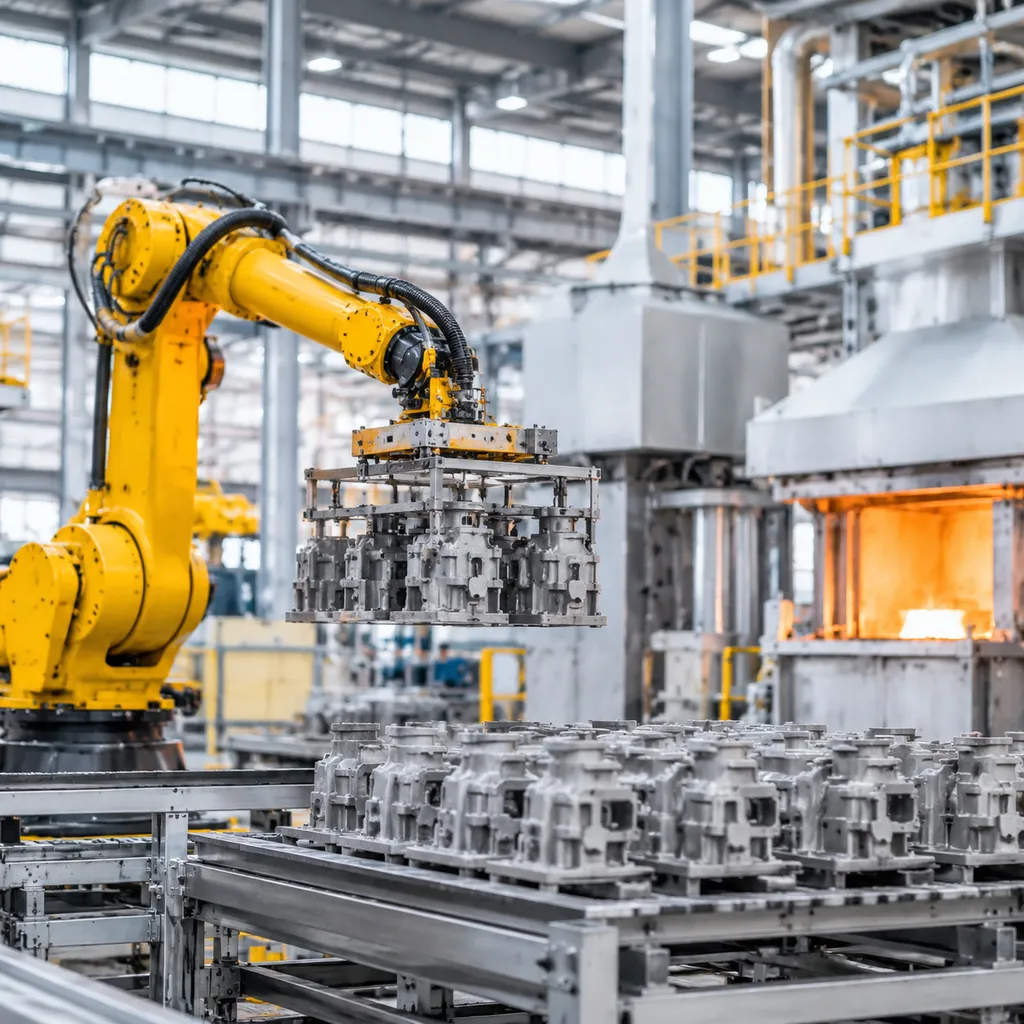
Our investment casting production line automation systems are engineered for high-throughput, repeatable output under continuous foundry duty cycles. We tailor payload ranges, tank volumes, and conveyor configurations to match your exact part envelope and shell growth requirements.
| System Parameter | Standard Specification Range | Heavy-Duty Option |
|---|---|---|
| Max Tree/Cluster Payload | 50 kg – 150 kg (including fixture) | Up to 500 kg+ |
| Cluster Envelope (Dia. x Height) | Ø600 mm × 800 mm | Ø1,200 mm × 1,500 mm |
| Robot Arm Degrees of Freedom | 6-Axis articulated industrial arm | 6-Axis with auxiliary 7th linear track |
| Slurry Tank Capacity | 300 L – 800 L continuous agitation | 1,200 L – 2,500 L jacketed tanks |
| Sanding Systems | Dual rainfall sanders + fluidized beds | Multi-station custom grit array |
| Drying Conveyor Cadence | Indexed 15–30 min cycles (adjustable) | Continuous multi-tier continuous chain |
| Control Architecture | Siemens S7-1500 / Allen-Bradley PLC | Full SCADA & MES integration |
Max Cluster Payload and Dimensional Capacity
We build each robotic investment casting dipping cell to handle assemblies ranging from compact precision medical trees up to massive structural industrial clusters. Standard payloads: 50 kg to 150 kg net capacity covering 80% of aerospace, automotive, and commercial valve work. Heavy-payload cells: High-torque wrist mechanisms rated up to 500 kg, preventing robot arm deflection during slurry withdrawal and high-speed manipulation. Part envelopes: Standard swing clearance accommodates trees up to 1,200 mm in diameter and 1,500 mm in total drop height.
Robotic Dipping Arms and Slurry Tank Capacity
Coating consistency relies on precise kinematic control and fluid stability across 24/7 operating shifts. Multi-axis foundry dipping robot: Sealed IP67-rated arms protect gearboxes against abrasive ceramic slurries and airborne silica dust. Slurry tanks: 304/316 stainless steel tanks featuring low-shear, variable-speed rotation paddles that eliminate dead zones and skinning. Level & viscosity controls: Automated level probes trigger slurry top-offs, paired with inline temperature monitoring to preserve binder chemistry.
Rainfall Sanding and Fluidized Bed Stuccoing Stations
To build balanced primary and backup coats, our automated lines integrate dedicated ceramic stucco application units. Rainfall sander for investment casting: Precision oscillating curtain sanders apply fine zircon or fused silica evenly across primary coats without pattern wash. Fluidized bed stuccoing machine: Aerated coarse-grain beds apply backup coats, utilizing balanced airflow diffusers to penetrate deep undercuts, ribs, and pockets. Dust containment: Fully enclosed hoods integrate directly into plant dust collection ducting to keep ambient particulate counts well within standard foundry limits.
Environmental Drying Tunnel Cycle Cadence and Output
Drying speed determines mold structural integrity and cycle cadence before parts move downstream toward the dewaxing autoclave stage. Overhead shell drying conveyor system: Multi-tier, indexed overhead chain conveyors route shell trees through zoned drying chambers. Climate control loops: Microprocessor-controlled airflow nozzles direct uniform, low-velocity air across every tier, maintaining ±1.5°C temperature and ±3% relative humidity across drying zones. Cadence management: Programmable drying recipes automate dry times between 1.5 to 4 hours per coat, matching slurry chemistry and layer depth.
PLC Architecture and Electrical Compliance
- Standard hardware: Industrial-grade Siemens S7-1500 or Allen-Bradley ControlLogix platforms with color touchscreen HMIs.
- Compliance standards: Built to CE, UL 508A, and NFPA 79 specifications, featuring segregated high-voltage and low-voltage enclosures.
- Safety integration: Category 4 / SIL 3 safety circuits, interlocking light curtains, and safety fencing integrate directly into the main control interlock network.
Operational Advantages & Foundry ROI
Implementing an investment casting production line automation setup transforms foundry floor economics. By replacing manual dipping, handling, and drying with synchronized robotics, our systems target the three largest cost drivers in lost-wax casting: scrap rates, direct labor, and inconsistent cycle times.
Uncompromising Shell Quality & Defect Reduction
Manual dipping often introduces inconsistencies in slurry thickness, drainage angle, and stucco coverage. Our automated shell-making line delivers repeatable multi-axis motion paths to guarantee uniform shell build across complex geometries, deep pockets, and thin fins.
- Uniform Shell Thickness: Programmed dipping angles eliminate slurry pooling and thin edge build-up.
- Controlled Drainage: Precise spin and tilt cycles prevent slurry bridging and shell-cracking stress points.
- Scrap Rate Minimization: Standardized automation directly eliminates process-induced flaws. Discover practical steps on how to reduce casting defects for better quality across your shell room operations.
Substantial Labor & Material Savings
Heavy wax trees and hazardous silica dust environments drive high operator turnover and physical strain. Our robotic shell-building systems handle heavy payloads continuously without fatigue, while optimizing raw consumable usage.
- Slurry & Stucco Conservation: Controlled withdrawal speeds and targeted rainfall sanding cut refractory waste by 15% to 25%.
- Labor Reallocation: A single technician can oversee multiple automated dipping cells and conveyor lines instead of dedicating teams to manual dipping.
- Safer Work Environment: Fully enclosed sanders and automated handling keep operators isolated from airborne particulates.
Predictable Production Lead Times
Manual batch processing causes variable shell drying times and shift-to-shift scheduling bottlenecks. Our overhead shell-drying conveyor systems enforce continuous, first-in-first-out drying cycles tailored to your exact layer specifications.
| Operational Metric | Manual Shell Building | Automated Production Line |
|---|---|---|
| Shell Consistency | Variable across operator shifts | 100% path & cycle repeatability |
| Dipping Cycle Cadence | Inconsistent, prone to delays | Fixed, recipe-driven cycle times |
| Heavy Payload Handling | Limited by human physical limits | Handles trees exceeding 100 kg |
| Production Planning | Subject to attendance & pace | Predictable 24/7 takt time |
With predictable layer application and climate-controlled curing, our automation architecture stabilizes delivery schedules, shortens production lead times, and delivers full capital payback within typical foundry operational horizons.
Target Industry Applications & Component Scope
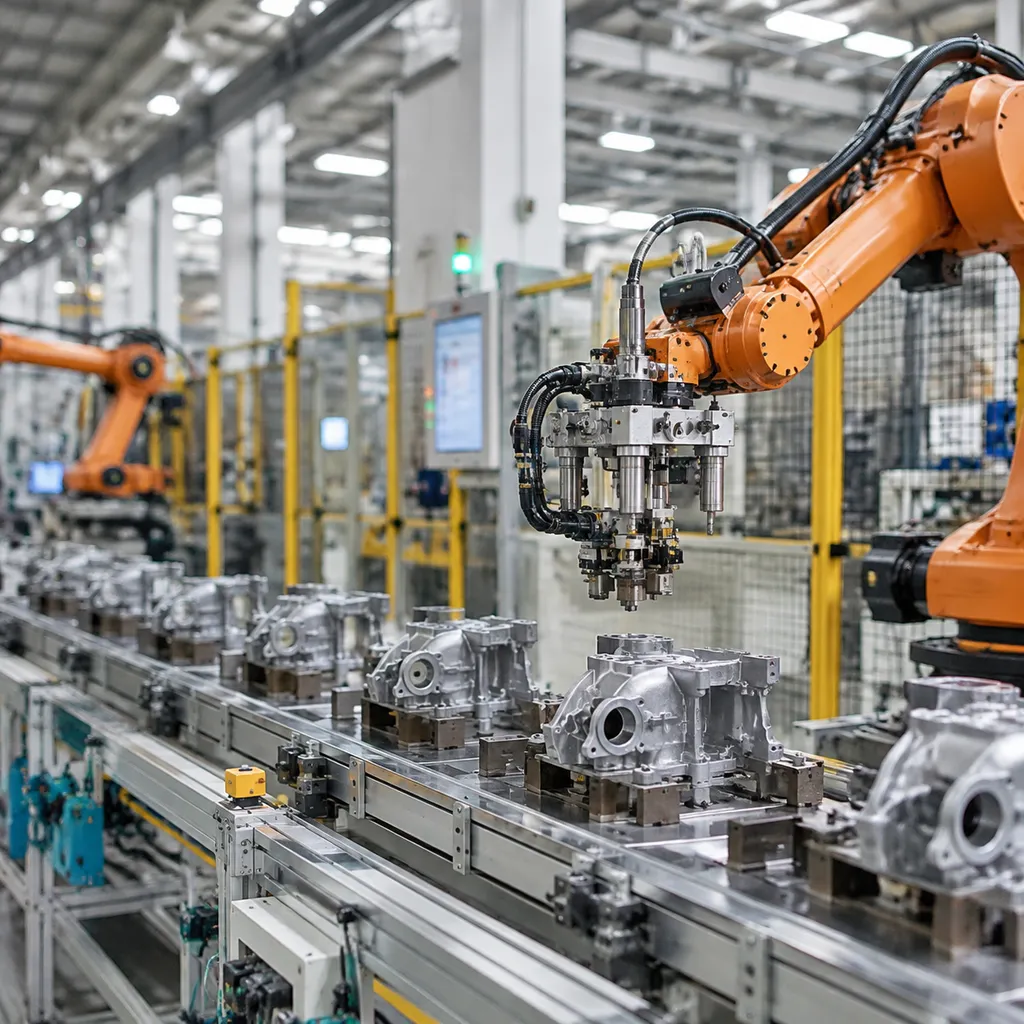
Our automated investment casting production line solutions are engineered to meet the rigorous quality requirements of high-stakes industries. We focus on delivering consistency across complex geometries, helping manufacturers maintain strict casting quality standards for reliable metal parts.
Aerospace & Defense Structural Components
We support the production of flight-critical parts, including turbine blades and structural airframe components. Automation ensures the repeatability necessary to pass stringent non-destructive testing and meet aerospace material certification requirements.
Automotive & Commercial Vehicle Powertrain Parts
High-volume production environments benefit from our robotic systems by streamlining the output of turbocharger wheels, transmission components, and engine intake manifolds. Precision is maintained even at the high cadence required by modern automotive supply chains.
Medical Equipment and Orthopedic Implants
The precision required for biocompatible implants demands absolute shell uniformity. Our automated dipping and stuccoing modules eliminate human inconsistency, ensuring that delicate orthopedic components, such as knee and hip replacements, meet exact dimensional specifications.
Power Generation and Industrial Flow-Control Valves
We provide robust solutions for casting large-scale, pressure-containing components. From complex industrial flow-control valves to heavy-duty power generation parts, our systems ensure integrity in every pour, supported by our expertise in manufacturing carbon steel casting custom industrial components.
Turnkey Implementation Methodology for Investment Casting Production Line Automation
We manage the transition to automation through a structured, five-stage framework designed to minimize downtime and ensure seamless integration with your existing foundry operations. Whether you are transitioning to aerospace investment casting for precision components or standard industrial production, our approach focuses on performance and reliability.
- Stage 1: Production Analysis & Casting Geometry Audit: We begin by evaluating your current casting parts, weight clusters, and material requirements to determine the optimal automation configuration.
- Stage 2: 3D Layout Simulation & Digital Twin Modeling: Before fabrication, we build a digital twin to simulate the robotic dipping paths and material flow, ensuring your casting manufacturing services for precision metal parts achieve maximum throughput.
- Stage 3: Precision Manufacturing, Assembly & Pre-FAT: All mechanical and electronic components are assembled and undergo a rigorous Factory Acceptance Test (FAT) at our facility to verify performance against specified cycle times.
- Stage 4: On-Site Erection, Integration & SAT: Our team handles the mechanical installation and software integration on your floor, culminating in the Site Acceptance Test (SAT) to confirm the system meets operational KPIs.
- Stage 5: Operator Training, Commissioning & Lifetime Support: We provide comprehensive training for your floor staff and establish a long-term maintenance protocol to keep your production line running at peak efficiency.
Frequently Asked Questions Regarding Investment Casting Production Line Automation
We address common operational queries to help you determine how our automatic shell coating line for investment casting fits your specific production environment.
| Question | Implementation Insight |
|---|---|
| Footprint Adaptability | Our modular robotic cells use a compact, vertical, or linear footprint design, allowing us to retrofit existing facilities. |
| Slurry Management | We utilize integrated automated mixing systems with real-time viscosity sensors and chilled cooling jackets to maintain stability across shifts. |
| Recipe Changeover | PLC-based programming enables rapid recipe selection, minimizing downtime between different wax tree cluster types. |
| Coating Uniformity | Multi-axis robots facilitate complex, programmable motion paths to ensure slurry penetration in blind cavities and intricate geometries. |
| ROI and Payback | Efficiency gains in material consumption, labor reduction, and scrap rate minimization typically drive a competitive payback period for high-volume foundries. |
Technical Operational Clarification
- Process Consistency: By removing manual labor from the dipping and sanding cycle, we ensure that every cluster receives identical coating thicknesses, directly reducing the scrap rate common in manual setups.
- Safety and Maintenance: Our diagnostic-heavy architecture monitors system health in real-time, allowing for proactive maintenance before downtime occurs.
- Scalability: You can start with a standalone robotic dipping cell and scale into a fully integrated, conveyor-linked production line as your output requirements grow.

 English
 Russian
 German