

2026年10月9日
Discover expert casting manufacturing solutions delivering precision quality durability and efficiency for diverse industrial applications

What Is Casting Manufacturing?
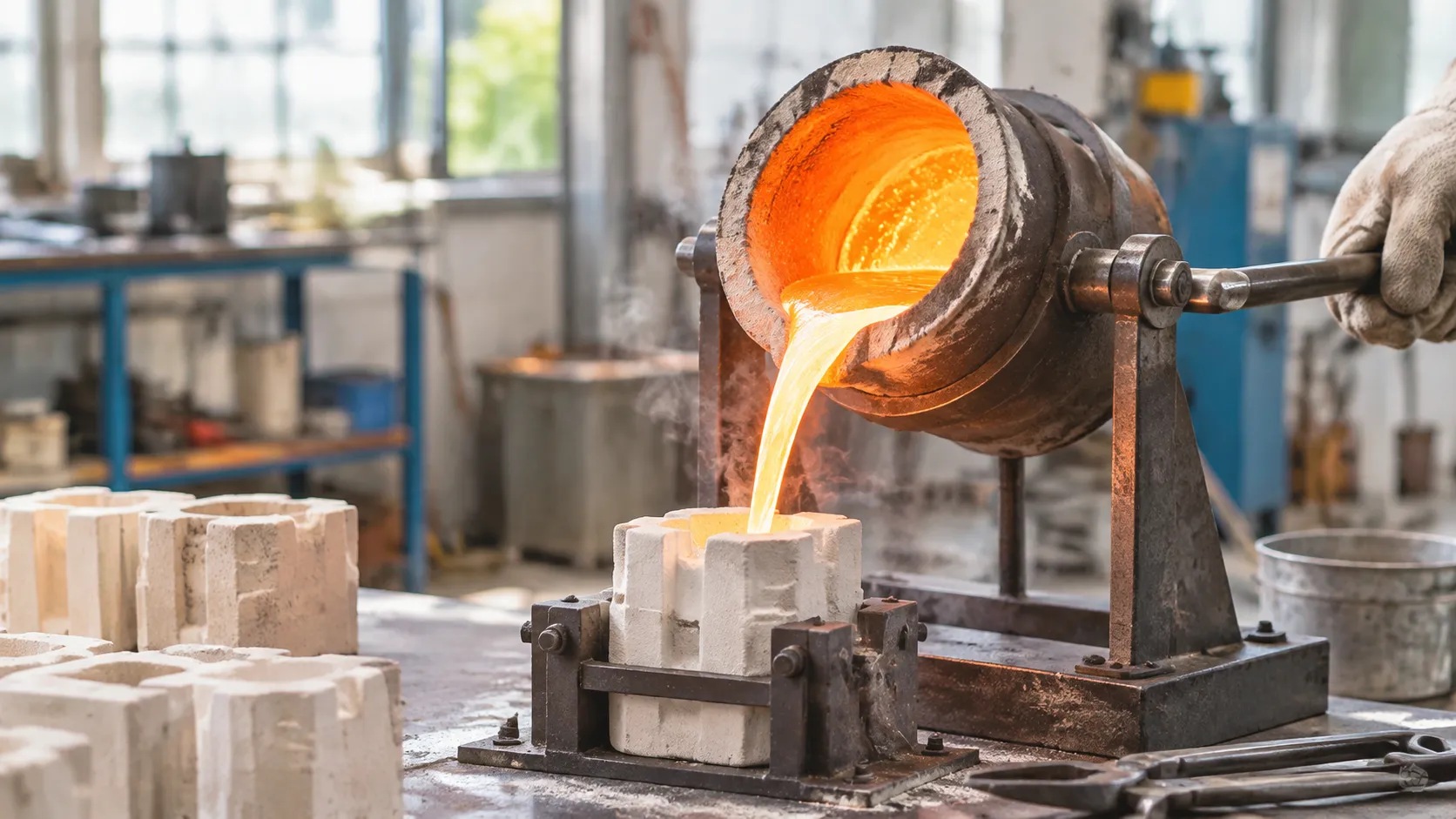
Casting manufacturing is a foundational thermal shaping process where molten metal is poured into a custom mold cavity matching the exact negative profile of a designed part. Once the liquid alloy solidifies and cools, the raw component is extracted, cleaned, and prepared for final machining or surface treatment.
Our foundry network leverages advanced thermal modeling and metallurgical control to produce high-integrity cast metal components that meet stringent industrial standards.
+------------------+ +-------------------+ +--------------------+ +---------------------+ | Mold / Die Prep | --> | Molten Pouring | --> | Solidification | --> | Shakeout & Cleaning | | Tooling & Coring | | Precise Temp Ctrl | | Controlled Cooling | | Post-Processing/CNC | +------------------+ +-------------------+ +--------------------+ +---------------------+
Core Advantages of Metal Casting
Casting remains the preferred manufacturing method for components requiring high structural integrity, complex geometries, and scalable production economics:
- Intricate Internal Cavities: Easily forms complex internal passageways, undercut features, and hollow structures using specialized internal sand or ceramic cores.
- Near-Net-Shape Efficiency: Reduces raw material waste and subsequent CNC cycle times compared to machining solid billets or forgings.
- Superior Scalability: Supports cost-effective scaling from low-volume sand-cast industrial prototypes to automated, millions-of-units high-pressure die casting runs.
- Unmatched Alloy Versatility: Readily accommodates aluminum, stainless steel, ductile iron, carbon steel, bronze, and high-temp superalloys.
Process Selection Matrix
Our engineering team analyzes your part geometry, production volume, surface finish needs, and tolerance limits to match your design with the most cost-effective casting manufacturing method.
| Casting Process | Typical Tolerances | Best Wall Thickness | Ideal Production Volume | Typical Applications |
|---|---|---|---|---|
| Sand Casting | ±0.5 mm to ±2.0 mm | ≥ 4.0 mm | Low to Medium (1 – 5,000+) | Heavy machine bases, engine blocks, valve bodies |
| Investment Casting | ±0.1 mm to ±0.3 mm | ≥ 1.5 mm | Low to High (100 – 50,000+) | Turbine blades, medical implants, aerospace brackets |
| Die Casting | ±0.05 mm to ±0.2 mm | 0.8 mm – 4.0 mm | High (5,000 to 1,000,000+) | Automotive housings, electronics enclosures, brackets |
| Permanent Mold | ±0.2 mm to ±0.5 mm | ≥ 3.0 mm | Medium to High (1,000 – 100,000+) | Pistons, fluid manifolds, suspension components |
Casting Manufacturing Processes and Capabilities
We provide a comprehensive range of metal casting processes tailored to your specific mechanical requirements, production volumes, and part geometries. By matching your design to the right casting method, our engineering team ensures optimal dimensional accuracy, structural integrity, and production cost efficiency.
Core Casting Manufacturing Methods
- Sand Casting: Ideal for large industrial equipment, heavy machinery bases, and structural frames. Sand casting supports both ferrous and non-ferrous alloys with low upfront tooling costs, making it the most economical choice for low-to-medium volume production runs and massive components weighing up to several tons.
- Precision Investment Casting: Delivers exceptional surface finish (Ra 3.2–6.3 µm) and tight dimensional tolerances for complex, thin-walled geometries. Through our dedicated investment and precision casting services, we produce near-net-shape components in stainless steel, superalloys, and carbon steel, drastically reducing secondary CNC machining needs.
- High-Pressure Die Casting (HPDC): Engineered for high-volume mass production of lightweight non-ferrous parts. HPDC achieves excellent dimensional repeatability, smooth surfaces, and uniform thin walls for automotive housings, electronic enclosures, and brackets. For comprehensive material data across these methods, refer to our aluminum alloy casting guide.
- Permanent Mold Casting (Gravity Die Casting): Utilizes reusable steel or iron molds for medium-to-high volume runs. It provides superior mechanical properties, tighter grain structures, and lower porosity compared to sand casting, making it well-suited for safety-critical structural parts.
- Centrifugal Casting: Designed specifically for symmetrical cylindrical components such as pipes, bushings, cylinder liners, and industrial rings. High rotational speeds push molten metal against the mold wall, displacing impurities to the inner bore and creating a dense, defect-free outer structure with high wear resistance.
Casting Process Selection Guide
| Casting Method | Typical Tolerances | Surface Finish (Ra) | Optimal Volume | Tooling Cost | Best For |
|---|---|---|---|---|---|
| Sand Casting | ±0.5 mm – ±2.0 mm | 12.5 – 25 µm | 1 – 1,000 pcs | Low | Heavy machine bases, large valves, pump housings |
| Investment Casting | ±0.1 mm – ±0.5 mm | 3.2 – 6.3 µm | 50 – 50,000 pcs | Medium | Complex geometries, impellers, aerospace hardware |
| Die Casting | ±0.05 mm – ±0.2 mm | 0.8 – 3.2 µm | 5,000+ pcs | High | Automotive housings, thin-walled brackets, enclosures |
| Permanent Mold | ±0.2 mm – ±0.8 mm | 3.2 – 12.5 µm | 500 – 20,000 pcs | Medium-High | Pistons, engine parts, structural automotive components |
| Centrifugal Casting | ±0.5 mm – ±1.5 mm | 6.3 – 12.5 µm | 10 – 5,000 pcs | Low-Medium | Cylinders, sleeves, pipes, heavy-duty rings |
Our metallurgists and manufacturing engineers evaluate your 2D drawings and 3D CAD files to balance tooling investment against per-unit production cost, ensuring you receive high-performance cast metal components configured exactly to your application.
Materials and Alloys for Casting Manufacturing

Selecting the right metal alloy determines the structural integrity, corrosion resistance, and total production cost of your cast metal components. We melt and pour a full spectrum of ferrous and non-ferrous alloys in-house, ensuring each melt meets strict chemical and mechanical specifications.
| Alloy Family | Common Grades | Key Performance Characteristics | Typical Applications |
|---|---|---|---|
| Aluminum Alloys | A356, A380, A383, ADC12 | Excellent strength-to-weight ratio, high thermal conductivity, pressure tightness | Automotive brackets, heat sinks, electronic enclosures |
| Stainless Steel | 304, 316, 316L, 17-4 PH, Duplex 2205 | Superior corrosion resistance, heat tolerance, hygienic cleanability | Food processing, marine hardware, chemical pump impellers |
| Carbon & Low-Alloy Steel | WCB, 1020, 1045, 4140, 8620 | High tensile strength, impact toughness, excellent weldability | Heavy machinery links, structural brackets, lifting hardware |
| Gray & Ductile Iron | Class 30, Class 40, 65-45-12, 80-55-06 | Outstanding vibration damping, high compressive strength, wear resistance | Machine tool bases, engine blocks, heavy gearboxes |
| Copper, Brass & Bronze | C83600, C93200, C95400 (Al-Bronze) | High electrical/thermal conductivity, low friction, anti-galling | Marine bushings, fluid valves, electrical switchgear |
| Specialty & Superalloys | Hastelloy, Inconel 625/718, Cobalt alloys | Extreme high-temperature strength, severe oxidation and acid resistance | Turbine nozzles, petrochemical valves, high-wear tooling |
Aluminum Casting Alloys
Aluminum remains the industry standard for lightweighting. Alloys like A356 provide exceptional ductility and strength after T6 heat treatment, making them ideal for structural frames. Die casting alloys such as A380 deliver high fluidity for casting thin-walled parts with intricate details.
Stainless Steel Casting
For sanitary, marine, and chemical applications, our foundry pours austenitic, martensitic, and duplex grades. Check our detailed guide to cast stainless steel custom casting alloys and grades to match specific grade chemistry against your corrosion and yield-strength requirements. We also offer standard CF8 (304) and CF8M (316) melts for standard industrial flow control systems.
Carbon and Low-Alloy Steels
When designs require superior load-bearing capacity and shock resistance, carbon steels (such as WCB) and alloy steels (such as 4140) provide the necessary toughness. These alloys respond reliably to post-cast heat treatments like quenching and tempering to achieve specific surface hardness and core toughness targets.
Gray Iron and Ductile Iron
Cast iron offers cost-effective mass and structural stability. Gray iron delivers optimal vibration dampening and thermal dissipation for industrial machine bases. Ductile (nodular) iron incorporates spherical graphite nodes, giving components yield strengths comparable to carbon steel with lower production costs and superior machinability.
Copper, Brass, and Bronze Alloys
Non-ferrous copper-base alloys are selected for fluid handling, bearing applications, and non-sparking environments. Aluminum bronzes provide high wear resistance against metal-on-metal friction, while high-conductivity coppers serve power generation and high-voltage transmission equipment.
Custom and Specialty Alloy Selection
For severe service environments involving extreme thermal cycling, abrasive wear, or aggressive media, our metallurgy team formulates and validates custom heats. We verify all incoming ingots, monitor melt chemistry using optical emission spectrometers (OES), and supply full Material Test Reports (MTR) with heat numbers for complete batch traceability.
Custom Casting Production Capabilities
We tailor our casting manufacturing lines to accommodate diverse production scales, geometric complexities, and project lifecycles. Whether you need a single proof-of-concept part or hundreds of thousands of cast metal components annually, our facilities are equipped to deliver consistent metallurgical and dimensional accuracy.
Rapid Prototype Casting for Fit and Functional Testing
Accelerate your product development cycle without committing to expensive hard tooling early on. For functional validation and physical stress testing, we utilize fast-turnaround methods—including 3D printed sand molds for rapid patternless precision casting and rapid investment casting patterns. This allows our engineers to test gate designs, verify alloy flow, and confirm mechanical performance before initiating series production.
Scalable Production Volumes: From Pilot Batches to Mass Production
We support production schedules of any scale: Low-Volume & Pilot Runs: Ideal for specialized machinery, custom replacement parts, and initial market entries. We leverage modular tooling and flexible pouring setups to keep initial capital expenditure low. High-Volume Mass Production: Dedicated automated molding, pouring, and robotic shakeout systems ensure fast cycle times, consistent metallurgical grain structure, and unit-cost efficiency across large production volumes.
| Production Tier | Typical Volume | Primary Methods Used | Best For |
|---|---|---|---|
| Prototyping | 1 – 50 pcs | 3D sand printing, SLA investment casting | Fit-checks, mechanical testing, design validation |
| Low-to-Medium Run | 50 – 2,000 pcs | Floor sand molding, semi-automatic investment casting | Specialized equipment, pilot series, replacement parts |
| High-Volume Production | 2,000+ pcs | Automated horizontal/vertical green sand, high-pressure die casting | Automotive, consumer goods, large industrial OEM components |
Component Size Spectrum: Heavy Castings to Precision Miniatures
Our foundry operations handle an extensive size and weight range: Heavy Industrial Castings: As an established sand casting manufacturer for custom metal parts, we pour heavy-duty machine bases, industrial pump bodies, and drivetrain housings weighing hundreds of kilograms. Miniature & Complex Components: Using automated investment casting and die casting, we manufacture thin-walled, intricate parts weighing under 50 grams with tight as-cast tolerances.
Custom OEM Casting Manufacturing from 2D and 3D CAD Files
Our engineering team builds custom casting tooling directly from your digital files: Accepted File Formats: Native CAD, STEP, IGES, Parasolid (.x_t), and fully dimensioned 2D engineering drawings (PDF/DWG/DXF). Engineering Alignment: We review all GD&T specifications, machining allowances, critical datum surfaces, and required alloy standards (ASTM, DIN, ISO, JIS) to ensure total compliance from the first sample approval to full production delivery.
Design for Casting Manufacturing (DFM)
Getting the design right before cutting tooling is the most effective way to eliminate defects, reduce cycle times, and control unit costs. Our engineering team conducts a thorough DFM review on every project to optimize geometry for the chosen casting manufacturing method, whether you are running production batches or validating designs with precise cast prototypes and engineering.
Essential Casting Design Rules
Minor design adjustments directly impact mold flow, cooling rates, and structural integrity. We work with your engineering team to implement core casting guidelines:
| Design Feature | Best Practice Rule | Manufacturing Impact |
|---|---|---|
| Wall Thickness | Maintain uniform cross-sections; use 3:1 gradual transitions | Prevents hot spots, shrinkage voids, and sink marks |
| Draft Angles | 1.0° to 3.0° for tooling release (process-dependent) | Enables clean ejection and reduces mold wear |
| Fillets & Radii | Minimum radii equal to half the nominal wall thickness | Eliminates stress concentration and prevents hot tears |
| Ribs & Gussets | Rib thickness at 40%–60% of attached wall base | Adds stiffness without adding heavy thermal mass |
| Parting Lines | Keep parting lines along a single flat plane when possible | Reduces tooling complexity and flash trimming costs |
Engineering DFM Review to Eliminate Defects
Our casting engineers run advanced mold flow and solidification simulations to predict and eliminate thermal and structural issues before metal is poured:
- Shrinkage and Porosity Prevention: We optimize gate, runner, and riser placement to ensure directional solidification toward the feeder zones.
- Warping and Distortion Control: Balanced wall transitions and thermal stress relief ensure dimensional stability during cooling.
- Internal Core Optimization: We streamline complex internal channels to avoid fragile sand cores and guarantee complete cleanout.
- Quality Standard Compliance: Every review aligns geometry with established casting quality standards for reliable metal parts.
File Requirements for Production & Tooling
To provide an accurate quote and comprehensive DFM analysis, we accept standard industry file formats:
- 3D CAD Models: STEP (.stp), IGES (.igs), Parasolid (.x_t), or native SolidWorks/Creo files for complete volume and tooling layout analysis.
- 2D Engineering Drawings: PDF, DWG, or DXF files containing critical tolerances, datum features, threading specifications, and machining allowances.
- GD&T Specifications: Clearly defined Geometric Dimensioning and Tolerancing callouts to align CMM inspection routines with your functional requirements.
Step-by-Step Casting Manufacturing Workflow
We follow a disciplined, stage-gated production workflow to take your project seamlessly from digital CAD models to finished, ready-to-assemble cast metal components. Every step is managed under strict quality controls to ensure repeatable dimensions, internal metallurgical integrity, and fast turnaround times. You can explore our detailed casting process guide to see how these steps adapt across different casting methods.
[CAD Review & DFM] ➔ [Tooling / Die Build] ➔ [Melt & Pouring] ➔ [Shakeout & Cleaning] ➔ [CNC Machining] ➔ [Final CMM & Packing]
1. Project Evaluation & Process Recommendation
Our engineers review your 3D CAD files, 2D prints, and geometric dimensioning and tolerancing (GD&T) specifications. We assess production volume, alloy properties, wall thickness variations, and functional requirements to recommend the optimal casting method—whether sand casting, investment casting, or high-pressure die casting.
2. Pattern, Die, and Tooling Development
Once the DFM analysis is approved, our tooling department fabricates the patterns, core boxes, or permanent dies. We integrate precise shrinkage allowances, thermal gating systems, and parting lines directly into the mold designs using high-speed CNC tooling centers to prevent premature tool wear and flow defects.
3. Mold Preparation, Core Setting, and Melt Temperature Control
Depending on the process, we prepare sand molds, ceramic shells, or pre-heated steel dies: Core Placement: Complex internal channels and cavities are created using high-strength sand or soluble cores positioned securely in the mold cavity. Melt Control: Alloys are melted in induction or electric resistance furnaces under protective degassing atmospheres. Optical emission spectrometry (OES) verifies chemical composition prior to tap. Temperature Monitoring: Infrared pyrometers confirm tight pouring temperature windows to prevent misruns or excess thermal oxidation.
4. Pouring, Solidification, and Automated Shakeout
Molten metal is poured using automated or operator-guided ladles to maintain consistent fill rates and laminar flow. Controlled cooling ensures uniform directional solidification, minimizing internal shrinkage voids. After cooling, parts pass through automated vibratory shakeout tables or knockout machines to separate the cast parts from sand or ceramic molds.
5. Fettling, Degating, and Rough Cleaning
As-cast parts undergo primary clearing: Degating: Risers, sprues, and runner gates are removed via hydraulic cut-off saws, plasma cutting, or automated shearing. Fettling & Grinding: Flash, parting lines, and seam burrs are ground flush to nominal profile specs. Blast Cleaning: Steel grit, aluminum oxide, or glass bead shot blasting clears residual investment slurry, oxides, and surface scale.
6. Heat Treatment, Precision CNC Machining, and Surface Finishing
To meet demanding mechanical load ratings and tight fit requirements, castings undergo integrated secondary processing: Heat Treatment: Solution annealing, T5/T6 precipitation hardening, normalizing, or stress-relieving cycles adjust tensile strength, yield, and hardness. Secondary Machining: Our multi-axis machining cells perform tight-tolerance turning, milling, drilling, and tapping through integrated precision casting and CNC machining workflows. Surface Treatments: Electrophoretic deposition (E-coat), powder coating, anodizing, or passivating are applied based on your corrosion and aesthetic targets.
7. Final Dimensional Inspection, Protective Packing, and Logistics
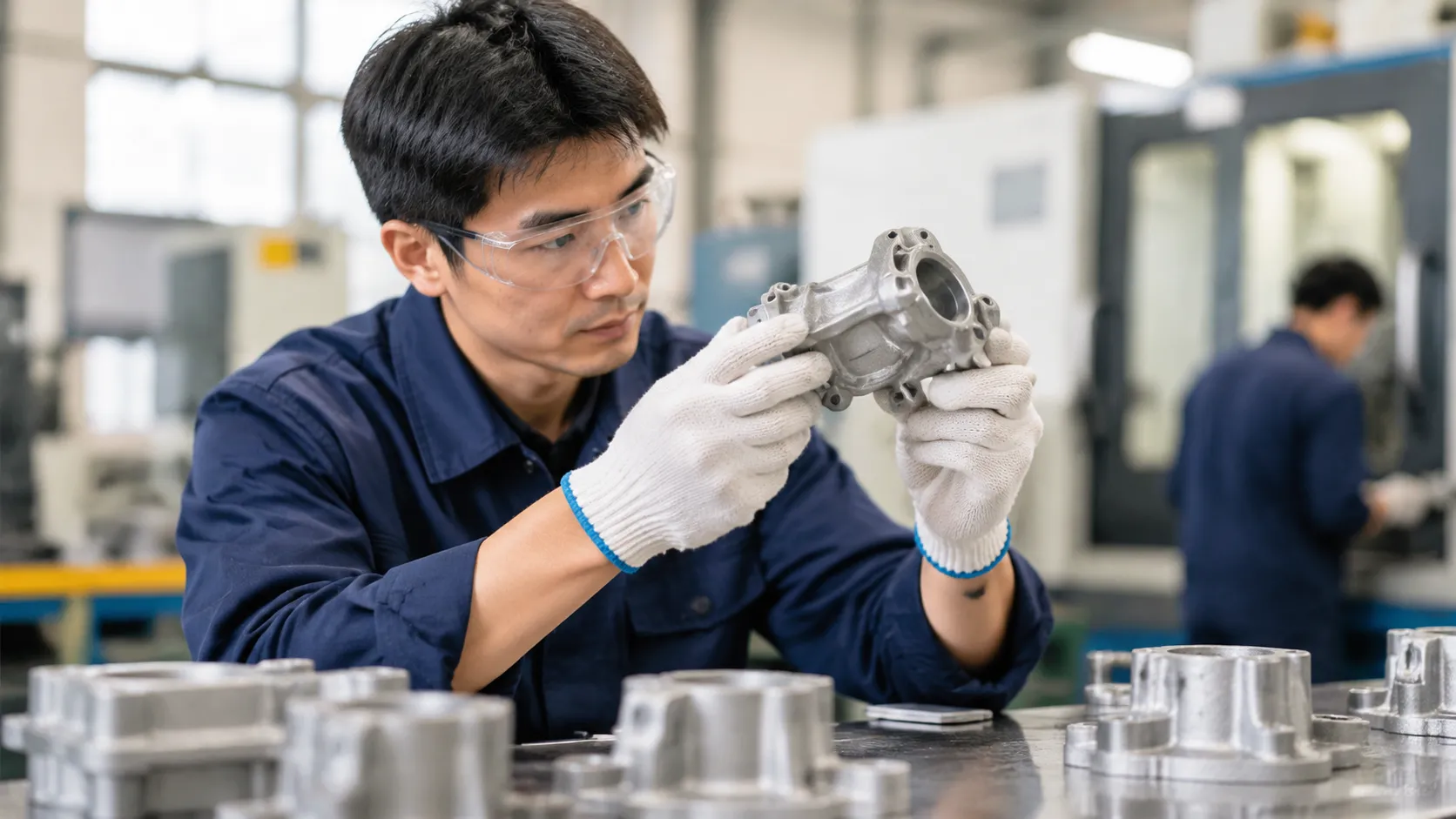
Every production batch undergoes comprehensive quality verification before dispatch: Quality Verification: Coordinate measuring machine (CMM) inspection, 3D optical scanning, and non-destructive testing (NDT) such as X-ray and liquid penetrant. Documentation: Shipments include complete Material Test Reports (MTRs), First Article Inspection (FAI) packages, and dimensional inspection records. Packaging & Logistics: Components are cleaned, treated with vapor corrosion inhibitors (VCI), bagged, and secured in custom-fitted, export-grade crates for reliable international shipping.
Secondary Machining and Surface Finishing Operations

Raw castings provide near-net shapes, but high-precision applications require secondary processing to achieve exact engineering tolerances, enhanced mechanical properties, and surface protection. Our facility handles full post-casting operations in-house to deliver ready-to-assemble cast metal components under a single quality control standard.
Precision CNC Machining Services
We integrate multi-axis CNC milling, high-speed turning, precision boring, drilling, and tapping to achieve tight tolerances where casting alone cannot reach them. By combining raw casting with precision machining, our engineers routinely achieve dimensional tolerances down to ±0.01 mm on critical mating surfaces, bearing journals, and O-ring grooves. Learn more about optimizing casting tolerances in our comprehensive sand casting and precision CNC machining guide.
| Secondary Operation | Typical Capabilities & Specifications | Common Applications |
|---|---|---|
| CNC Milling & Turning | 3-, 4-, and 5-axis machining; tolerances to ±0.01 mm | Flange faces, precision bores, mounting pads |
| Drilling & Tapping | Standard metric/imperial threads, deep-hole drilling, helicoil prep | Fastener holes, fluid ports, manifold channels |
| Surface Grinding | Surface roughness down to Ra 0.4 µm | High-wear seal faces, structural flat references |
In-House Heat Treatment Options
We tailor the microstructure and mechanical strength of raw castings using tightly controlled thermal processing cycles:
- T6 Solution & Aging: Maximizes tensile strength and hardness for aluminum alloy castings.
- Quenching and Tempering: Enhances toughness, yield strength, and impact resistance in carbon and alloy steels.
- Annealing & Normalizing: Relieves internal residual stresses, softens the matrix, and optimizes grain structure for secondary machining.
- Stress Relieving: Eliminates residual stresses caused by rapid solidification and rough machining without altering base hardness.
Industrial Surface Finishing Solutions
We offer comprehensive surface treatment lines to improve corrosion resistance, surface hardness, and cosmetic appearance:
- Shot Blasting & Sand Blasting: Cleans scale, removes parting lines, and creates a uniform matte finish across cast surfaces.
- Powder Coating & E-Coating: Provides heavy-duty, corrosion-resistant, and UV-stable polymer barriers for outdoor and industrial environments.
- Electroplating & Anodizing: Delivers zinc, nickel, or chrome plating for steel/iron castings, alongside Type II and Type III hardcoat anodizing for aluminum parts.
- Passivation & Chemical Conversion: Prevents surface oxidation on stainless steel and non-ferrous cast components.
Value-Added Sub-Assembly and Pressure Testing
To streamline your supply chain, our production team provides full turnkey post-processing:
- Hardware & Threaded Inserts: Automated press-fitting of dowel pins, bushings, bearings, and threaded inserts.
- Pressure Leak Testing: 100% submerged pneumatic and hydrostatic leak testing to ensure zero porosity leaks in fluid and gas manifolds.
- Custom Sub-Assembly: Full mechanical assembly, hardware kitting, and protective crating for immediate line installation.
Quality Control, Inspection Standards, and Defect Prevention

Consistent quality in casting manufacturing relies on tight process control, rigorous multi-stage inspection, and complete metallurgical verification. We monitor every melt, mold, and finished part to deliver cast components that meet strict engineering prints, mechanical requirements, and zero-defect targets.
Dimensional and Geometric Inspection
To guarantee that raw and machined castings match your exact CAD geometry and GD&T specifications, our quality lab uses advanced metrology equipment:
- Coordinate Measuring Machines (CMM): High-precision tactile probing to inspect critical datums, hole positions, true position tolerances, and tight machining interfaces.
- 3D Optical & Laser Scanning: Full-field surface scanning to capture complex freeform contours, comparing the physical casting directly against the nominal 3D CAD model via color-deviation heat maps.
- Dedicated Go/No-Go Gauges: Custom fixtures, thread gauges, and plug gauges for fast, repeatable verification during high-volume production runs.
Non-Destructive Testing (NDT)
We deploy comprehensive porosity inspection NDT methods to identify internal voids, surface cracks, and structural flaws without damaging the component:
| NDT Inspection Method | Target Defects Identified | Best Suited Applications |
|---|---|---|
| X-Ray / Digital Radiography | Internal gas porosity, shrinkage voids, inclusions | Pressure-retaining bodies, safety-critical aerospace/auto parts |
| Ultrasonic Testing (UT) | Deep internal fissures, wall thickness variations | Heavy-section industrial castings, thick alloy blocks |
| Dye Penetrant Testing (PT) | Surface-breaking micro-cracks, pinholes, laps | Precision stainless steel and aluminum investment castings |
| Magnetic Particle Testing (MT) | Subsurface and surface cracks in ferrous metals | Ductile iron, carbon steel, and forged/cast structural components |
| Hydrostatic / Air Leak Testing | Through-wall leaks, micro-porosity channels | Pump housings, valve manifolds, fluid-handling enclosures |
Systematic Root-Cause Defect Prevention
Eliminating defects begins in the engineering phase before metal ever enters the mold. We target the primary causes of casting failure through proactive process controls:
- Gas & Shrinkage Porosity: Prevented through optimized runner-and-riser design, vacuum degassing of molten alloys, and mold-flow solidification simulation to ensure directional cooling.
- Cold Shuts & Misruns: Controlled by maintaining precise pouring temperatures, automated pouring speeds, and optimized wall-thickness transitions.
- Slag and Sand Inclusions: Eliminated through ceramic foam filtration systems, controlled-atmosphere melting, and durable mold coatings.
To verify composition before and after pouring, our engineers analyze every batch against chemical criteria detailed in our casting alloy properties and material selection guide.
Quality Documentation and Compliance
Every production batch is fully traceable from raw ingot to final packaging. We provide comprehensive quality data packages to support your incoming inspection and regulatory audits:
- Material Test Reports (MTR / Mill Certs): Verified chemical composition via optical emission spectrometry (OES) and mechanical test results (tensile, yield, elongation, and hardness).
- First Article Inspection (FAI): Complete dimensional reports adhering to ISO 9001, AS9102, or automotive PPAP Level 3 standards.
- NDT & Pressure Test Certifications: Formal sign-offs from certified Level II / Level III NDT technicians for radiographic, penetrant, or hydrostatic leak tests.
- Surface Roughness & Coating Reports: Stylus profilometer surface measurements ($Ra$) alongside dry-film thickness (DFT) certifications for plated, e-coated, or painted surfaces.
Industries and Applications Served in Casting Manufacturing
We deliver high-integrity cast metal components engineered to meet rigorous performance, mechanical, and regulatory standards across diverse global industries. Our versatile casting manufacturing lines support everything from high-volume automotive runs to heavy-duty custom machinery parts.
Automotive & Transportation Components
We manufacture critical structural and powertrain components engineered for fatigue resistance, weight reduction, and tight tolerances: Suspension & Chassis: Control arms, steering knuckles, subframes, and shock absorber brackets. Powertrain & Drivetrain: Engine mounts, transmission housings, differential cases, and flywheel covers. Braking Systems: Caliper bodies, brake drums, and mounting brackets.
Industrial Machinery & Equipment
Our heavy-duty industrial casting parts provide essential structural rigidity, wear resistance, and vibration damping for demanding factory environments: Structural Frames & Bases: Machine tool beds, vibration-damping gray iron bases, and press platens. Power Transmission: Industrial gearboxes, bearing housings, planetary carriers, and motor frames. Material Handling: Crane pulleys, conveyor sprockets, and heavy-duty wear shoes.
Pumps, Valves & Fluid Handling
Pressure containment and fluid flow efficiency demand sound metallurgy and smooth internal surfaces. Understanding the advantage of investment casting over green sand casting allows us to produce complex fluid passages with zero leak paths: Pump Components: Closed and open impellers, volute casings, backplates, and suction covers. Valves & Actuators: Gate, ball, and butterfly valve bodies, bonnets, discs, and high-pressure manifolds. Sanitary & Chemical Fittings: High-grade stainless steel fluid connectors, mixing nozzles, and strainers.
Energy, Marine, and Heavy Construction
We cast rugged components designed to endure high mechanical loads, abrasive media, and corrosive marine conditions: Off-Highway & Construction: Excavator bucket teeth, track links, hydraulic cylinder clevises, and counterweights. Marine & Subsea: Bronze and stainless propeller brackets, rudder stocks, deck hardware, and seawater valve housings. Renewable & Traditional Energy: Wind turbine rotor hubs, generator end shields, turbine housings, and downhole drilling tools.
Casting Manufacturing Cost Factors and Savings Strategies
Controlling project expenses requires a clear understanding of what drives expenses from initial design through final finishing. We help engineering and procurement teams identify cost-heavy features early to optimize both initial capital expenditure and per-piece manufacturing rates.
Key Cost Drivers in Metal Casting
- Tooling and Mold Complexity: Multi-cavity molds, complex side-actions, hydraulic core-pulls, and tight-tolerance tooling require intricate EDM machining and hardened tool steels, directly increasing upfront costs.
- Alloy Selection and Melt Loss: Standard commercial grades like A380 aluminum, ductile iron, and standard carbon steels provide the lowest raw material expense. Specialty nickel-based alloys, stainless steels, and cobalt alloys carry higher raw material costs and melt loss percentages.
- Machining Stock and Post-Processing: Excessive machining allowances force longer CNC cycle times and accelerate cutting tool wear. Tighter as-cast tolerances significantly reduce downstream machining hours.
- Non-Destructive Testing (NDT) Requirements: 100% X-ray, ultrasonic, or dye-penetrant inspection standards add labor and cycle time compared to standard batch sampling.
| Cost Driver | Primary Impact Area | Optimization Strategy |
|---|---|---|
| Tooling Design | Upfront Capital (CapEx) | Simplify parting lines, eliminate unnecessary undercuts |
| Alloy Choice | Unit Price (OpEx) | Standardize on commercial alloy grades where feasible |
| Machining Stock | Secondary Cycle Times | Utilize near-net-shape casting to minimize stock allowances |
| Inspection Rigor | Operational Expense | Apply strict NDT only to mission-critical stress sections |
Practical Tips to Lower Tooling Investment and Unit Costs
- Optimize Draft Angles and Radii: Incorporate generous draft angles (1° to 3°) and uniform corner radii to minimize mold wear and ensure fast, clean ejection.
- Minimize Undercuts and Complex Cores: Redesign component features to eliminate complex internal cores and sliding side mechanisms in the mold.
- Standardize Wall Sections: Uniform wall thickness prevents hot spots, sink marks, and porosity, drastically reducing scrap rates during quality control.
- Consolidate Multi-Piece Assemblies: Combine welded or fastened sub-assemblies into a single cast component to remove secondary hardware, assembly labor, and inspection steps.
Balancing Initial Mold Investment Against Long-Term Piece Price
Choosing the right manufacturing approach depends on lifetime production volumes. High-pressure die casting carries a higher initial tooling investment but delivers the lowest per-unit cost and fastest cycle times for mass production. Conversely, tooling for sand casting requires minimal upfront capital, making it ideal for low-to-medium runs, large components, or rapid prototyping. Review our detailed die casting vs sand casting cost, volume, and tolerance guide to align your volume requirements with the right manufacturing process and tooling budget.
Order Volumes, Lead Times, and RFQ Process for Casting Manufacturing

We streamline production schedules and order fulfillment to match your supply chain demands. Whether you need rapid prototypes to validate a new assembly or high-volume recurring deliveries, our manufacturing infrastructure supports dynamic project scopes with reliable turnaround times.
Flexible Order Quantities for Prototypes and Mass Production
We accommodate varied production volumes without compromising quality or cost efficiency:
- Prototype Batches (1 to 50 pcs): Rapid tooling, 3D printed sand molds, or direct pattern printing for fast fit checks, testing, and functional validation.
- Low-to-Medium Runs (50 to 1,000 pcs): Cost-effective match plates or soft tooling tailored for specialized machinery, pre-production runs, and bridge manufacturing.
- High-Volume Mass Production (1,000 to 100,000+ pcs): Automated multi-cavity dies and permanent metal tooling designed for continuous, high-speed output with maximum part-to-part consistency.
Standard Production Lead Times
We maintain transparent timelines across every stage of the casting manufacturing cycle:
| Project Phase | Typical Lead Time | Key Deliverables |
|---|---|---|
| Tooling & Pattern Making | 2 to 4 Weeks | Pattern fabrication, mold flow simulation, core box production |
| First Article Samples (FAI) | 1 to 2 Weeks | Initial test pours, CMM inspection reports, material certs (MTR) |
| Full Production Runs | 3 to 6 Weeks | Batch casting, secondary CNC machining, surface finishing |
| Expedited Production | Available on Request | Priority tooling build and accelerated machining slots |
Note: Lead times vary depending on alloy choice, part complexity, heat treatment specs, and required secondary operations.
Step-by-Step Guide to Submitting an RFQ
Getting an accurate quote and DFM feedback is straightforward. Follow these steps to submit your project requirements to our engineering team:
- Upload CAD Models and Drawings: Send your 3D models (.STEP, .IGES, .X_T) along with 2D drawings (.PDF, .DWG) indicating critical dimensions, GD&T tolerances, and datum references.
- Specify Material and Standards: Define the alloy grade (e.g., A380, ductile iron 65-45-12, 316 stainless steel) and testing requirements. If your project demands high-spec corrosion resistance, explore our specialized cast stainless steel casting services to align on alloy composition and material testing.
- Define Secondary Operations: Indicate required heat treatments, CNC machining features, surface finishes (shot blast, anodizing, powder coating), or pressure-leak testing.
- State Quantities and Schedule: Provide your target sample volume, initial production batch size, and estimated annual usage (EAU) to help us configure the most economical tooling strategy.
- Receive Comprehensive Quote & DFM Review: Our casting engineers deliver a complete cost breakdown alongside a manufacturability analysis within 24 to 48 hours.
Frequently Asked Questions About Casting Manufacturing
What is the difference between casting, forging, and CNC machining?
Each process balances geometric complexity, tooling cost, and mechanical strength differently depending on production volume.
| Manufacturing Process | Best For | Structural Integrity | Tooling & Setup Cost | Material Waste |
|---|---|---|---|---|
| Casting Manufacturing | Complex internal geometries, hollow shapes, net shapes | High (uniform isotropic properties) | Moderate to high (tooling dependent) | Very low (sprues and runners are recycled) |
| Forging | High-impact, fatigue-critical structural parts | Maximum (directional grain flow) | High (heavy die sets and presses) | Moderate (flash trimming) |
| CNC Machining | Tight tolerances, low volumes, simple-to-medium shapes | Base material strength | Low (minimal upfront tooling) | High (subtractive raw stock removal) |
Which casting method provides the tightest dimensional tolerance?
High-pressure die casting and precision investment casting deliver the tightest dimensional controls in modern foundry production:
- High-Pressure Die Casting: Achieves standard tolerances of ±0.05 mm to ±0.1 mm for non-ferrous alloys like aluminum, zinc, and magnesium.
- Precision Investment Casting: Delivers ±0.1 mm to ±0.2 mm across stainless steels, alloy steels, and superalloys, minimizing post-cast machining. Evaluating sand casting vs. investment casting key differences helps determine whether your target tolerance warrants investment tooling or if secondary machining on a sand casting is more cost-effective.
- Permanent Mold Casting: Holds consistent tolerances around ±0.25 mm for repeatable, medium-to-high volume non-ferrous components.
Can cast metal components undergo precision CNC machining?
Yes. We design cast metal components near-net-shape with specific machining allowances (typically 1.5 mm to 3 mm) on critical features. Our in-house machine shop performs secondary CNC milling, turning, drilling, boring, and tapping on critical datum faces, bearing journals, and O-ring sealing grooves to meet tight assembly tolerances down to ±0.005 mm.
What metals and custom alloys can be cast?
Our foundry pours a comprehensive range of standard and custom engineered alloys:
- Aluminum Alloys: A380, A356, ADC12, AL6061 (lightweight structural housings and thermal heatsinks).
- Stainless Steels: 304, 316, 316L, 17-4PH, duplex stainless (corrosion resistance and sanitary food/chemical hardware).
- Carbon & Low-Alloy Steels: WCB, 4140, 8620 (heavy wear, structural frames, and load-bearing links).
- Cast Irons: Gray iron (Class 30/35 for vibration damping) and ductile iron (65-45-12, 80-55-06 for high tensile strength).
- Copper & Bronze Alloys: C83600, C95800 aluminum bronze, brass (marine hardware, bushings, and fluid handling).
Reviewing what is investment casting process benefits and tolerances provides additional technical depth on matching complex geometries with specialty high-temperature alloys.
How do we prevent and detect internal porosity defects in castings?
We eliminate defects through proactive mold simulation and rigorous non-destructive testing (NDT):
- Upfront Mold Flow Simulation: Our engineers optimize gating, riser placement, and venting locations in CAD before cutting tooling to prevent air entrapment and shrinkage voids.
- Melt Quality Control: Rotary degassing and spectrographic chemical analysis ensure clean melt chemistry prior to pouring.
- In-Line Porosity Inspection NDT: We verify internal part integrity through real-time industrial X-ray inspection, ultrasonic testing (UT), and hydrostatic pressure leak testing for pressurized fluid bodies.
What engineering information is required to receive a formal quote?
To provide an accurate production quote and tooling estimate within 24 to 48 hours, our engineering team requires:
- 3D CAD Model: STEP, STP, or IGES format for volume, weight, and mold parting analysis.
- 2D Production Drawing: PDF format indicating critical dimensions, GD&T tolerances, thread callouts, and surface finish (Ra) requirements.
- Material Specification: Specific alloy grade (e.g., A356-T6, ASTM A216 WCB, 316 SS) or operational performance parameters.
- Estimated Annual Volume (EAV): Prototype quantities, initial pilot run sizes, and expected yearly production demand to select the most economical casting method.
- Secondary Operations: Required heat treatments, CNC machining operations, surface plating/coating, or specialized NDT quality certifications.
 English
 Russian
 German