
2026年9月24日
Precision carbon steel casting with durable strength custom shapes and reliable performance for industrial applications

Carbon Steel Casting Capabilities and Specifications
We provide end-to-end carbon steel casting solutions engineered to meet demanding structural, mechanical, and pressure-containment requirements. Our production lines integrate silica sol investment casting, water glass casting, and resin sand casting to balance surface fidelity, dimensional precision, and overall production cost.
Manufacturing Range and Technical Parameters
| Parameter | Investment Casting (Silica Sol / Water Glass) | Sand Casting (Resin Sand) | Secondary CNC Machining |
|---|---|---|---|
| Unit Weight Range | 0.05 kg – 80 kg | 10 kg – 1,500+ kg | Fully customizable |
| Linear Tolerances | ISO 8062 CT4 – CT6 | ISO 8062 CT8 – CT10 | Down to ±0.01 mm |
| Surface Roughness | Ra 3.2 µm – Ra 6.3 µm | Ra 12.5 µm – Ra 25 µm | Down to Ra 0.8 µm |
| Production Scale | Rapid pilot lots to mass production | Medium to high-volume runs | High-precision batch runs |
Production Flexibility and Volume Scalability
- Extensive Weight Envelope: We cast micro-components weighing as little as 0.05 kg up to heavy-duty industrial castings exceeding 1,500 kg.
- Optimized Casting Methods: High-detail, tight-tolerance components utilize our lost wax silica sol or water glass processes; large, heavy-section components are cast using robust resin sand lines.
- Superior Surface Integrity: Achieve clean, defect-free as-cast surfaces starting at Ra 3.2 µm, with secondary CNC milling, turning, and grinding delivering fine finishes down to Ra 0.8 µm.
- Adaptive Production Capacity: Scalable setups support rapid prototyping, pre-production trial batches, and consistent high-volume serial runs for global supply chains.
Choosing the Right Carbon Steel Casting Process
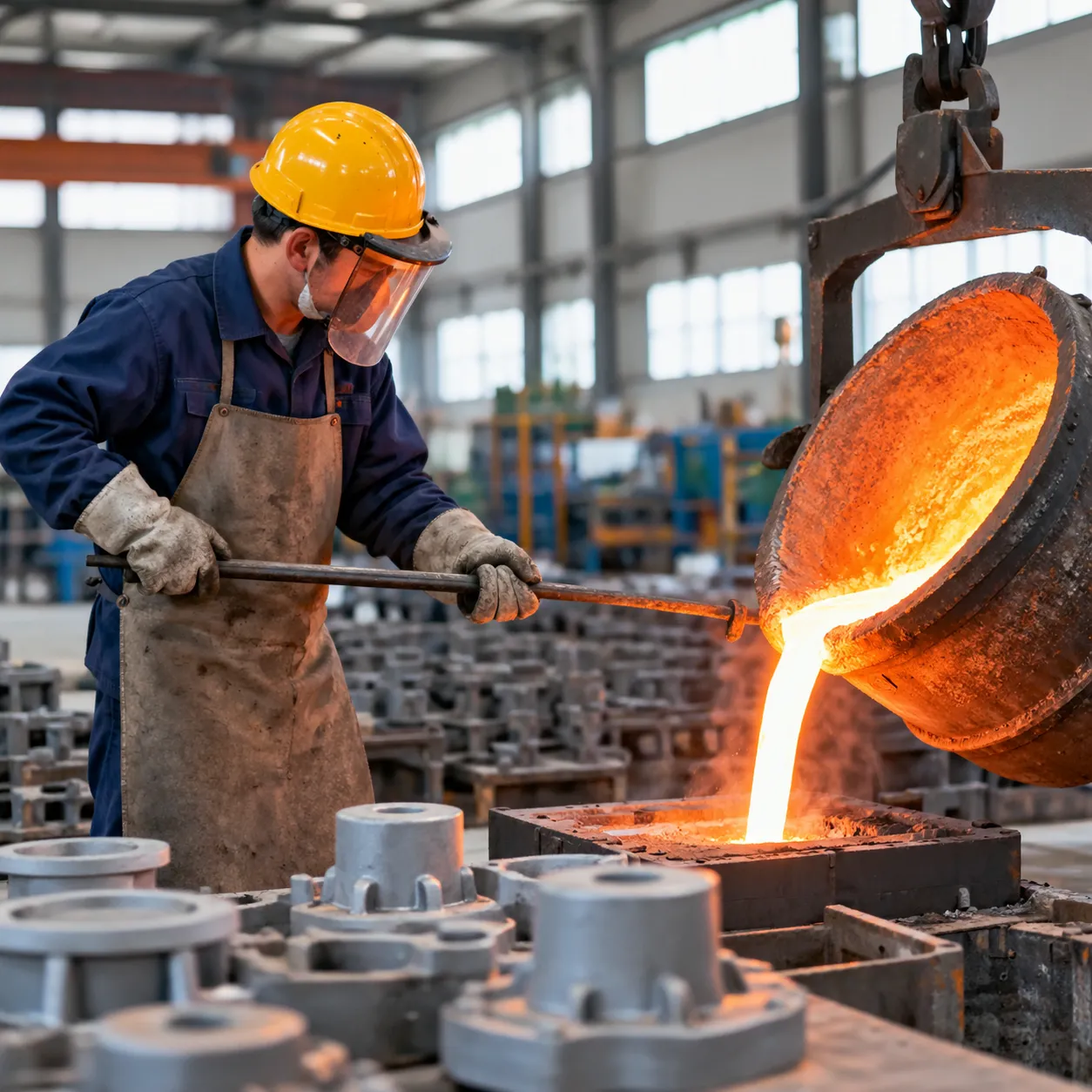
Selecting the optimal production method comes down to part geometry, required dimensional tolerances, wall thickness, and order volumes. We configure your manufacturing plan using either precision lost wax casting or resin sand casting to balance unit cost and performance.
Precision Investment Casting for Complex Shapes and Tight Tolerances
When designs demand intricate geometries, thin walls, and fine as-cast finishes, our investment and precision casting services deliver near-net-shape accuracy. Tolerances: Meets ISO 8062 CT4 to CT6 standard linear accuracy. Surface Roughness: Achieves as-cast finishes between Ra 3.2 µm and Ra 6.3 µm, eliminating secondary surface operations. Best Applications: Valve bodies, fluid handling components, thin-wall brackets, and complex mechanical linkages. Wall Thickness: Capable of pouring cross-sections down to 2.5 mm reliably.
Industrial Sand Casting for Heavy Structural Components
For large components and thick-walled structural frames, partnering with an experienced sand casting manufacturer provides cost efficiency and structural strength. Tolerances: Conforms to ISO 8062 CT8 to CT10 standards. Unit Weight: Handles heavy single-piece pours from 10 kg up to 1,500+ kg. Best Applications: Heavy equipment housings, mining bucket parts, pump casings, and heavy machine bases. Tooling Economy: Lower initial pattern tooling investment, suited for small-to-medium production runs.
Process Selection Criteria
| Factor | Carbon Steel Investment Casting | Carbon Steel Sand Casting |
|---|---|---|
| Typical Weight Range | 0.05 kg – 50 kg | 10 kg – 1,500+ kg |
| Linear Tolerance | ISO 8062 CT4 – CT6 | ISO 8062 CT8 – CT10 |
| Min. Wall Thickness | 2.5 mm | 6.0 mm |
| As-Cast Surface (Ra) | 3.2 – 6.3 µm | 12.5 – 25.0 µm |
| Machining Allowance | 1.0 – 2.0 mm | 3.0 – 6.0 mm |
| Target Production Volume | Medium to high volume | Low to medium volume / Large parts |
Carbon Steel Material Grades and International Standards
Selecting the correct alloy is critical to achieving the mechanical performance, weldability, and wear characteristics your application demands. We pour a wide spectrum of standard and custom carbon steel casting formulations under ASTM, EN/DIN, ISO, GB, and JIS standards.
Low Carbon Steel (ASTM A216 WCB/WCC, AISI 1020)
- Key Characteristics: Carbon content below 0.25%. Exceptional ductility, high impact toughness, and effortless weldability.
- Best Used For: Fluid handling parts, pressure vessels, valve bodies, and structural weldments requiring reliable performance under low to medium stress.
Medium Carbon Steel (AISI 1045, ZG270-500)
- Key Characteristics: Carbon content between 0.25% and 0.55%. Offers a solid balance of tensile strength, machinability, and toughness. Responsive to through-hardening and surface hardening.
- Best Used For: Heavy-duty mechanical components, gear blanks, levers, brackets, and automotive hubs. When selecting alloys for structural loads, you can compare these metrics against stainless steel strength grades and comparisons to evaluate yield behavior.
High Carbon Steel (AISI 1060, AISI 1070)
- Key Characteristics: Carbon content exceeding 0.55%. High surface hardness and superior abrasion resistance after quenching and tempering, with lower ductility.
- Best Used For: Wear plates, cutting edges, track components, and high-friction industrial tooling.
Mechanical and Chemical Performance Benchmarks
The table below outlines standard mechanical baselines for our most common carbon steel casting grades:
| Material Grade | Equivalent Standards (EN / GB / JIS) | Carbon Content (C %) | Tensile Strength (MPa) | Yield Strength (MPa) | Elongation (A %) | Impact Energy (Charpy-V / J) |
|---|---|---|---|---|---|---|
| ASTM A216 WCB | 1.0619 / ZG230-450 / SCPH2 | 0.20 – 0.30% | ≥ 485 | ≥ 250 | ≥ 22 | ≥ 30 |
| ASTM A216 WCC | 1.0625 / ZG270-500 / SCPH11 | ≤ 0.25% | 485 – 655 | ≥ 275 | ≥ 22 | ≥ 35 |
| AISI 1020 | 1.0402 / 20# / S20C | 0.18 – 0.23% | ≥ 410 | ≥ 245 | ≥ 25 | ≥ 40 |
| AISI 1045 | 1.0503 / 45# / S45C | 0.43 – 0.50% | ≥ 600 | ≥ 355 | ≥ 16 | ≥ 25 |
| ZG270-500 | 1.0446 / GS-52 / SC480 | 0.30 – 0.40% | ≥ 500 | ≥ 270 | ≥ 18 | ≥ 22 |
Every melt heat is tested with on-site optical emission spectrometers and mechanical testing rigs to guarantee full adherence to your chemical and physical property specifications.
In-House CNC Precision Machining and Heat Treatment
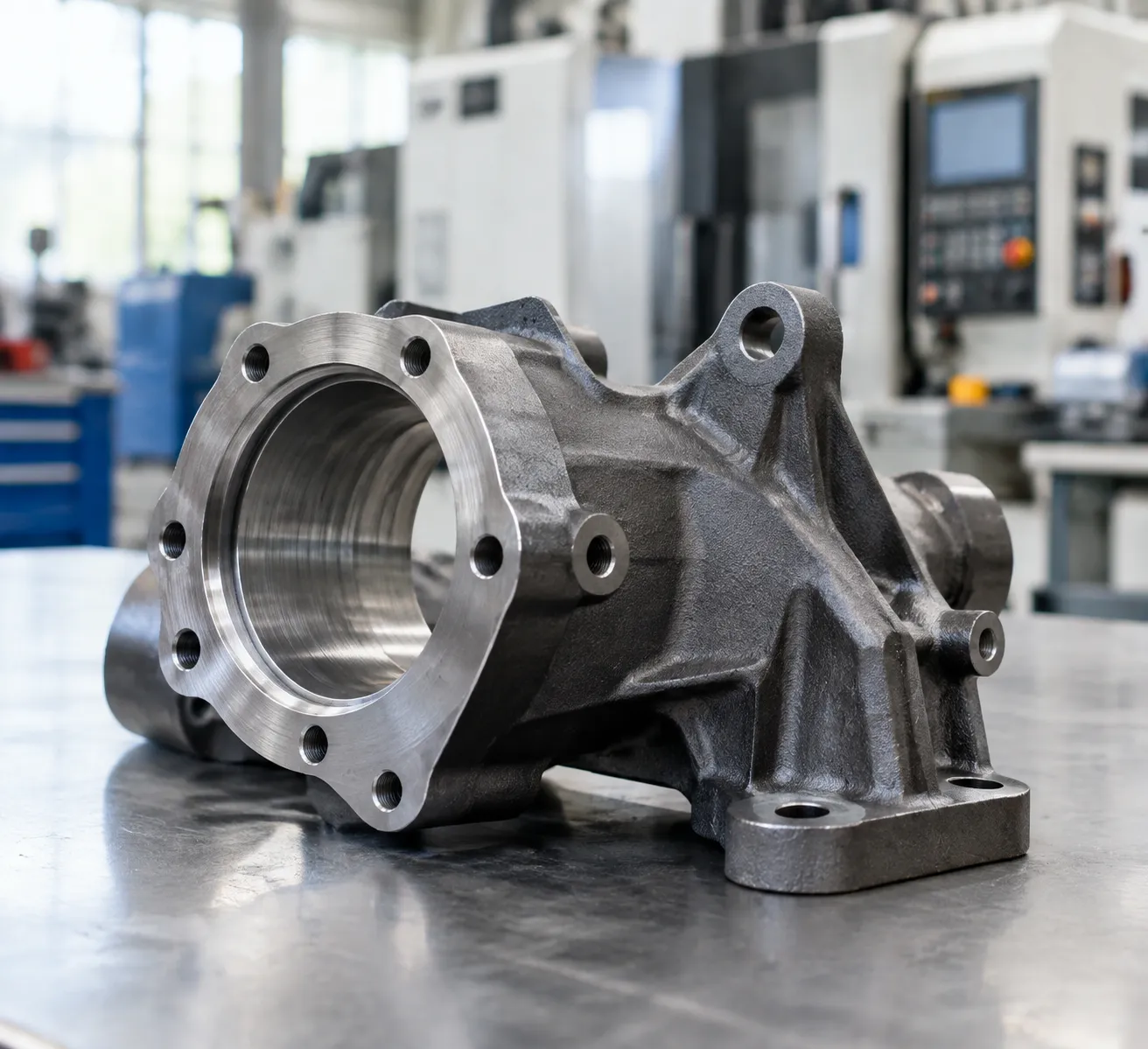
We deliver fully finished, assembly-ready components directly from our foundry floor. By integrating advanced secondary machining and metallurgical conditioning with our precision casting and CNC machining workflows, we eliminate multi-vendor handoffs, shorten lead times, and guarantee dimensional accuracy across every batch of carbon steel casting products.
Multi-Axis CNC Machining Capabilities
As-cast blanks rarely meet strict interface requirements on their own. We machine critical mating faces, threads, and internal geometries using high-precision CNC equipment:
- Equipment Fleet: 3-axis, 4-axis, and 5-axis CNC machining centers, high-speed CNC lathes, horizontal boring mills, and automated tapping units.
- Machining Operations: High-precision facing, turning, contour milling, deep-hole drilling, reaming, tapping, and cylindrical grinding.
- Precision Tolerances: Linear and positional tolerances held down to ±0.01 mm on critical bearing journals, seal grooves, and mounting faces.
- Surface Roughness: As-cast surfaces smoothed down to Ra 0.8 µm – Ra 1.6 µm on key machined surfaces.
Thermal Processing and Surface Finishing Matrix
We optimize mechanical properties and surface durability to match your exact working environment through certified in-house treatments:
| Processing Category | Method / Treatment | Targeted Engineering Benefit |
|---|---|---|
| Heat Treatment | Normalizing & Annealing | Refines grain structure, eliminates internal casting stress, and improves machinability. |
| Heat Treatment | Quenching & Tempering (Q&T) | Balances yield strength, core toughness, and dynamic impact resistance. |
| Heat Treatment | Case Hardening / Carburizing | Maximizes surface hardness (up to 58–62 HRC) while preserving ductile core properties. |
| Surface Finishing | Steel Shot Blasting | Removes foundry scale and delivers an even, clean texture ready for paint or coating. |
| Surface Finishing | Zinc Plating & Passivation | Provides standard sacrificial corrosion resistance for outdoor or wet exposure. |
| Surface Finishing | Black Oxide & Phosphate Coating | Enhances anti-galling performance, reduces light reflection, and holds lubricating oils. |
| Surface Finishing | Anti-Rust Oil & Primer Painting | Protects tight-tolerance CNC machined carbon steel castings throughout sea transit and storage. |
Quality Assurance, Inspection, and Testing Protocols

To guarantee structural integrity and total compliance with your engineering specifications, every carbon steel casting undergoes systematic quality control at each production phase. We utilize advanced in-house inspection equipment to verify dimensional accuracy, internal sound quality, and physical properties before shipment.
Dimensional Validation and Optical Inspection
We verify complex geometries and tight tolerance features directly against your 3D CAD models: Coordinate Measuring Machines (CMM): High-precision probing for critical geometric dimensioning and tolerancing (GD&T). 3D Optical Laser Scanning: Full-part surface profile mapping and deviation analysis to verify metal investment casting process tolerances and materials. Custom Go/No-Go Gauges: Dedicated fixed tooling for fast, repeatable checks on high-volume production runs.
Chemical Composition and Mechanical Testing
We verify every melt heat to ensure full compliance with specified alloy standards: Spectrometric Chemical Analysis: Optical emission spectrometers analyze each batch to confirm exact carbon, manganese, silicon, and trace element levels. Tensile and Yield Testing: Universal testing machines evaluate yield strength, ultimate tensile strength, and elongation percentage. Impact Testing: Sub-zero and ambient Charpy V-notch tests to verify toughness in high-stress operating environments. Hardness Verification: In-house Brinell (HBW) and Rockwell (HRC) testing across as-cast and heat-treated surfaces.
Non-Destructive Testing (NDT) Capabilities
For mission-critical components, valve bodies, and high-load structural parts, we offer comprehensive NDT inspections: Magnetic Particle Inspection (MPI): Identifies surface and near-surface cracks in ferromagnetic carbon steel parts. Dye Penetrant Testing (PT): Detects surface discontinuities, microporosity, and hairline fractures. Ultrasonic Testing (UT): Evaluates internal soundness, identifying subsurface voids, inclusions, and wall thickness variations. Radiographic Testing (RT / X-ray): Provides full visual verification of internal casting density and structural integrity.
Traceability, Documentation, and Certification
Our quality workflows provide end-to-end traceability for every production lot: EN 10204 3.1 Material Test Reports (MTR): Standard documentation detailing chemical analysis, mechanical performance data, and heat treatment logs. PPAP Level 3 Packages: Complete Production Part Approval Process packages, including control plans, FMEA, dimensional results, and material certifications for OEM clients.
Industrial Applications for Custom Carbon Steel Castings
We produce cast carbon steel parts built to handle severe impact, mechanical fatigue, and high operating pressures across global industries. When standard fabrications fail under load, our carbon steel casting solutions provide the structural integrity and wear resistance required for critical operations.
High-Pressure Fluid Control and Energy
Our foundry manufactures pressure-retaining components that meet strict international pressure vessel standards: Valve Components: High-pressure valve bodies, bonnets, gates, and plugs cast in ASTM A216 WCB. Flow Fittings: Flanges, manifold blocks, and fluid control connectors designed to prevent leakage under cyclic pressure.
Mining and Heavy Construction Equipment
For earthmoving and aggregate handling, we supply components engineered for severe abrasion: Ground Engaging Tools (G.E.T.): Heavy-duty bucket teeth, adapters, and side cutters. Structural Hardware: Track links, track shoes, pivot pins, and high-load mounting brackets. Understanding the difference between forging and casting explained helps our engineers optimize these components for complex shapes without sacrificing strength.
Commercial Automotive and Heavy Transport
We manufacture safety-critical chassis and suspension parts requiring tight dimensional accuracy: Suspension Nodes: Heavy-duty control arms, spring brackets, and axle perches. Drivetrain & Steering: Steering knuckle joints, differential housings, and hub assemblies.
Pumps, Power Transmission, and Agriculture
Our facility delivers ready-to-assemble OEM carbon steel components for industrial power transfer and farming machinery: Fluid Handling: Impellers, pump casings, volutes, and wear plates. Power Transmission: High-torque gear blanks, sprockets, and coupling hubs. Agricultural Machinery: Tillage points, hitch assemblies, and disc arm brackets.
Turnkey Manufacturing and Engineering Advantages
As a dedicated custom steel casting manufacturer, we eliminate supply chain fragmentation by managing every production stage in-house. From initial engineering analysis to final delivery, our integrated workflow ensures consistent quality, reduced lead times, and lower overall project costs for critical carbon steel casting programs.
Upfront DFM and Defect Prevention
Before cutting tooling, our engineering team performs thorough Design for Manufacturability (DFM) reviews to identify potential production risks early. Solidification & Gating Simulation: We optimize gating, parting lines, and riser placement to prevent shrinkage porosity, cold shuts, and hot tearing. Geometry Optimization: We advise on uniform wall transitions, draft angles, and corner radii to enhance structural integrity. Rapid Validation: We support precise cast prototypes and engineering evaluations to verify fit and function prior to mass production tooling.
Single-Source Production Control
We maintain full operational control from pattern making to final assembly-ready OEM carbon steel components: In-House Tooling Fabrication: High-accuracy aluminum and steel molds built for long-run repeatability. Integrated Secondary Operations: Seamless transition from foundry pouring to precision CNC turning, milling, and specialized heat treatment without third-party transit delays. Centralized Accountability: One quality management system oversees the entire manufacturing lifecycle, simplifying your vendor management.
Anti-Rust Protection and Global Logistics
To guarantee that components arrive clean, rust-free, and ready for your production line, we enforce rigorous export preservation standards: Corrosion Protection: Application of neutral anti-rust oils, VCI (Vapor Corrosion Inhibitor) packaging, and desiccant packs tailored to sea and air freight conditions. Certified Export Packaging: Heavy-duty, ISPM 15-compliant treated wooden crates and reinforced palletizing designed to prevent transit damage. Logistics Coordination: Comprehensive global shipping support, including full documentation, customs clearance assistance, and scheduled container deliveries.
Step-by-Step Sourcing Workflow and RFQ Submission
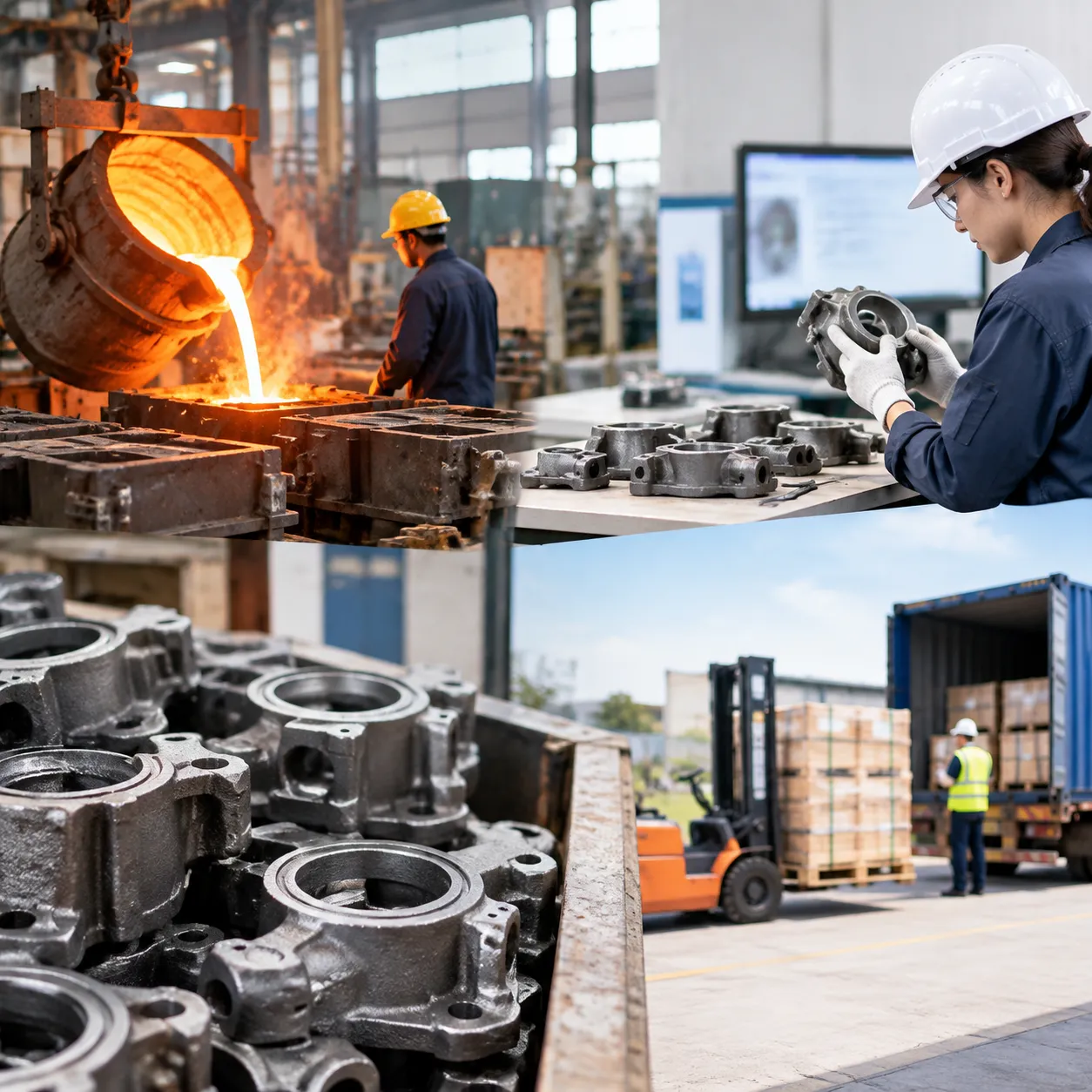
Sourcing custom carbon steel casting parts shouldn't involve guesswork or endless back-and-forth. We provide a transparent, engineering-led manufacturing workflow that turns your part concepts into production-ready components with minimal lead times.
1. Submitting 2D/3D Engineering CAD Drawings
To initiate the quoting process, submit your technical drawing packages through our secure inquiry portal: Accepted 3D CAD formats: STEP, IGES, X_T, or native SolidWorks files for volumetric analysis and gating simulation. Accepted 2D drawing formats: PDF, DWG, or DXF containing critical dimensional tolerances, surface finish specifications, and datum references. Project parameters: Specify target alloy grade (e.g., ASTM A216 WCB, AISI 1020, AISI 1045), expected annual order volume, heat treatment criteria, and required non-destructive testing (NDT).
2. Rapid Engineering Review and Quotation (24–48 Hours)
Our foundry engineers review your design for manufacturability (DFM) before finalizing the commercial proposal: Tooling and unit pricing: Transparent itemization of pattern tooling, machining setup, per-unit casting cost, and surface treatment. DFM recommendations: Feedback on draft angles, parting line placements, wall thickness consistency, and core considerations to eliminate porosity and lower unit costs. Project schedule: Defined timeline covering tooling fabrication, prototype sampling, and production delivery. You can also evaluate related alloy requirements via our cast stainless steel casting services, grades, and RFQ portal if your application demands elevated corrosion resistance.
3. Tooling Development, Sampling, and FAI Approval
Once the quotation and tooling designs are approved, we move directly into prototype validation: Tooling fabrication: Precision CNC-machined metal tooling for lost wax patterns or durable patterns for sand casting. Sample casting: Pouring initial sample batches using the specified carbon steel melt chemistry. First Article Inspection (FAI): We provide a comprehensive FAI package, including full CMM dimensional measurement reports, spectrometer chemical analysis, tensile testing data, and initial surface roughness measurements. Production only proceeds upon your written FAI approval.
4. Serial Manufacturing, Quality Documentation, and Delivery
After sample sign-off, your project transitions into controlled mass production: Batch consistency: Strict monitoring of molten steel degassing, pouring temperatures, cooling cycles, and CNC machining operations. Quality documentation: Every production shipment includes EN 10204 3.1 material test reports (MTR), heat treatment charts, dimensional inspection logs, and NDT certificates. Export-grade packaging: Parts are cleaned, treated with anti-rust oil or VCI protective bags, and secured in heavy-duty wooden crates designed for international sea or air freight.
Frequently Asked Questions About Carbon Steel Casting
What dimensional tolerances can be achieved with carbon steel investment casting?
For precision lost wax carbon steel casting, we routinely achieve ISO 8062-3 CT4 to CT6 as-cast linear tolerances (typically within ±0.1 mm to ±0.5 mm depending on overall part geometry and nominal size). For mating faces, bearing bores, and threaded holes requiring tighter fits, our multi-axis CNC machining centers hold critical features down to ±0.01 mm.
How do I decide between investment casting and sand casting for my project?
The choice comes down to geometry, unit weight, volume, and surface finish requirements: Choose Investment Casting: Best for complex internal channels, thin walls down to 2.5 mm, parts weighing under 50 kg, and requirements for smooth as-cast finishes (Ra 3.2 µm) that minimize secondary machining. Choose Sand Casting: Best for heavy, structural, or thick-walled components from 20 kg up to 1,500+ kg, where lower upfront tooling cost is prioritized over fine as-cast surface texture. For applications requiring corrosion resistance alongside heavy section capability, we also support specialized stainless steel sand casting services.
What NDT inspection methods are recommended for critical pressure components?
For high-stress and fluid-handling parts like ASTM A216 WCB valve bodies, bonnets, and pump casings, we implement rigorous Non-Destructive Testing (NDT) workflows: Radiographic Testing (RT) & Ultrasonic Testing (UT): Detects subsurface voids, internal shrinkage porosity, and inclusions. Magnetic Particle Inspection (MPI): Identifies surface and near-surface cracks in ferromagnetic carbon steel grades. Liquid Penetrant Testing (PT): Validates surface integrity on critical machined transitions and weld preps. Hydrostatic Pressure Testing: Confirms leak-free integrity under working and proof pressures prior to shipment.
What is the standard lead time for tooling, prototyping, and mass production?
- Tooling & First Article Samples (FAI): Typically 3 to 4 weeks, covering mold engineering, pattern fabrication, trial pouring, heat treatment, and full CMM inspection reports.
- Serial Mass Production: Typically 4 to 6 weeks after sample sign-off, depending on order volume, secondary machining complexity, and surface treatment requirements. Expedited schedules are available for time-critical OEM supply runs.

 English
 Russian
 German