
2026年11月10日
Robotic material handling for foundries improves casting efficiency safety and precision with reliable automated solutions for demanding production en
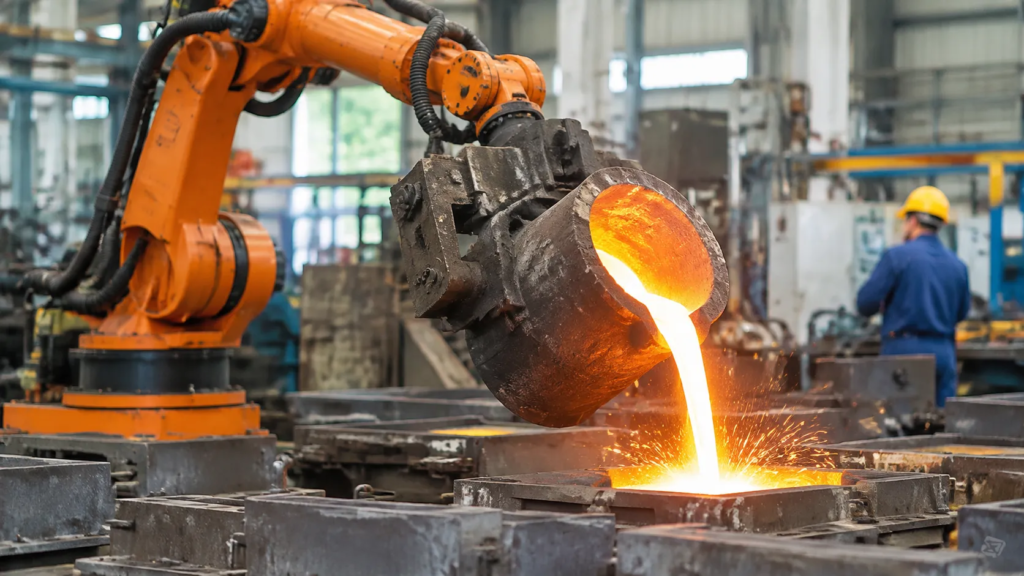
Overcoming Extreme Foundry Hazards with Robotic Material Handling for Foundries
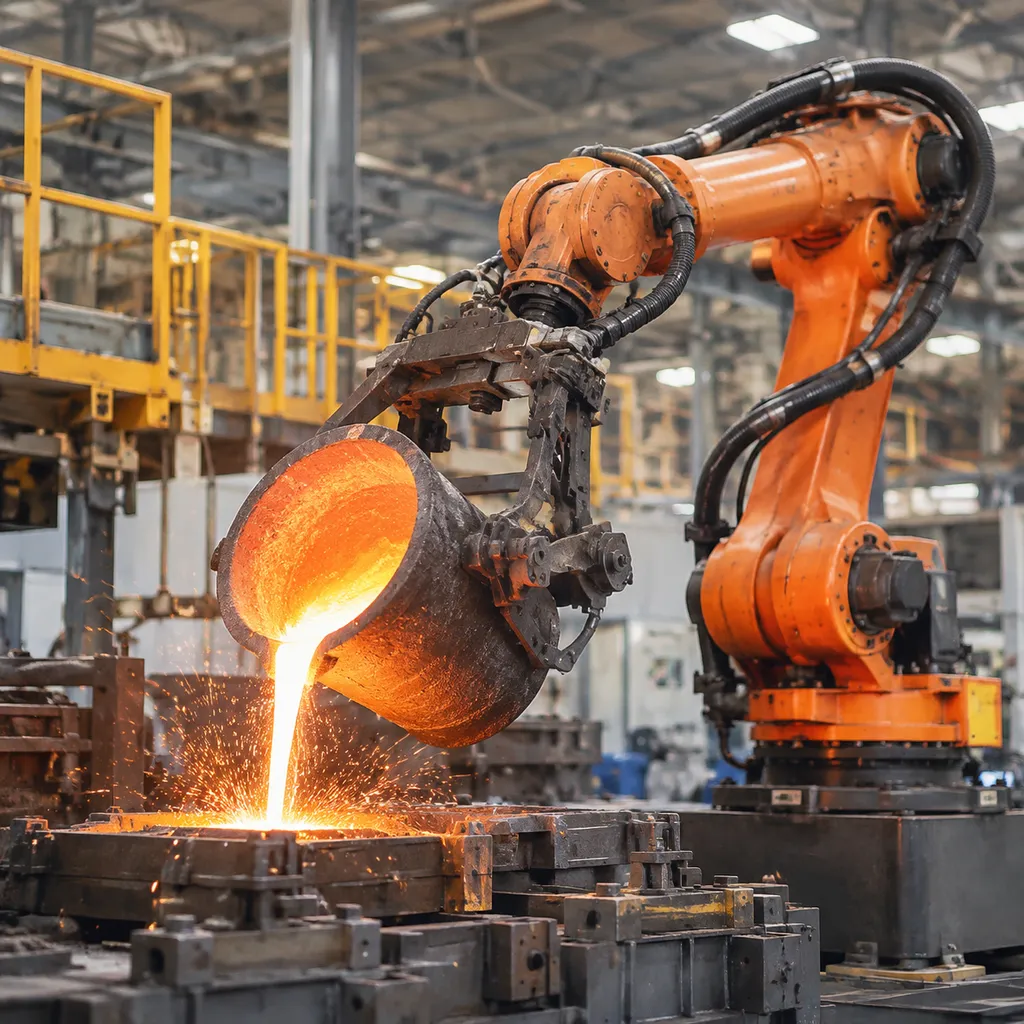
Foundry operations are inherently defined by the "3D" challenges: dull, dirty, and dangerous environments. We provide specialized robotic material handling for foundries to mitigate these risks by replacing manual labor in high-hazard zones. Our solutions are engineered to withstand the extreme stressors of the casting floor, ensuring that your facility remains productive without compromising worker safety.
We address the most demanding aspects of metal casting through robust mechanical design:
- Thermal Protection: Advanced shielding and cooling systems protect robotic arms from extreme radiant heat and constant thermal flux.
- Contaminant Sealing: Integrated enclosures prevent abrasive sand, dust, and particulate matter from infiltrating sensitive joints and electronics.
- Safety Engineering: We eliminate direct human exposure to molten splash hazards and high-pressure environments.
- Ergonomic Optimization: By automating repetitive, high-strain material transport, we prevent chronic workplace injuries associated with heavy-lifting tasks.
Our integration approach replaces manual fatigue with consistent, machine-led precision, transforming hazardous casting cells into high-performance, automated workflows.
Core Robotic Material Handling Applications for Metal Casting
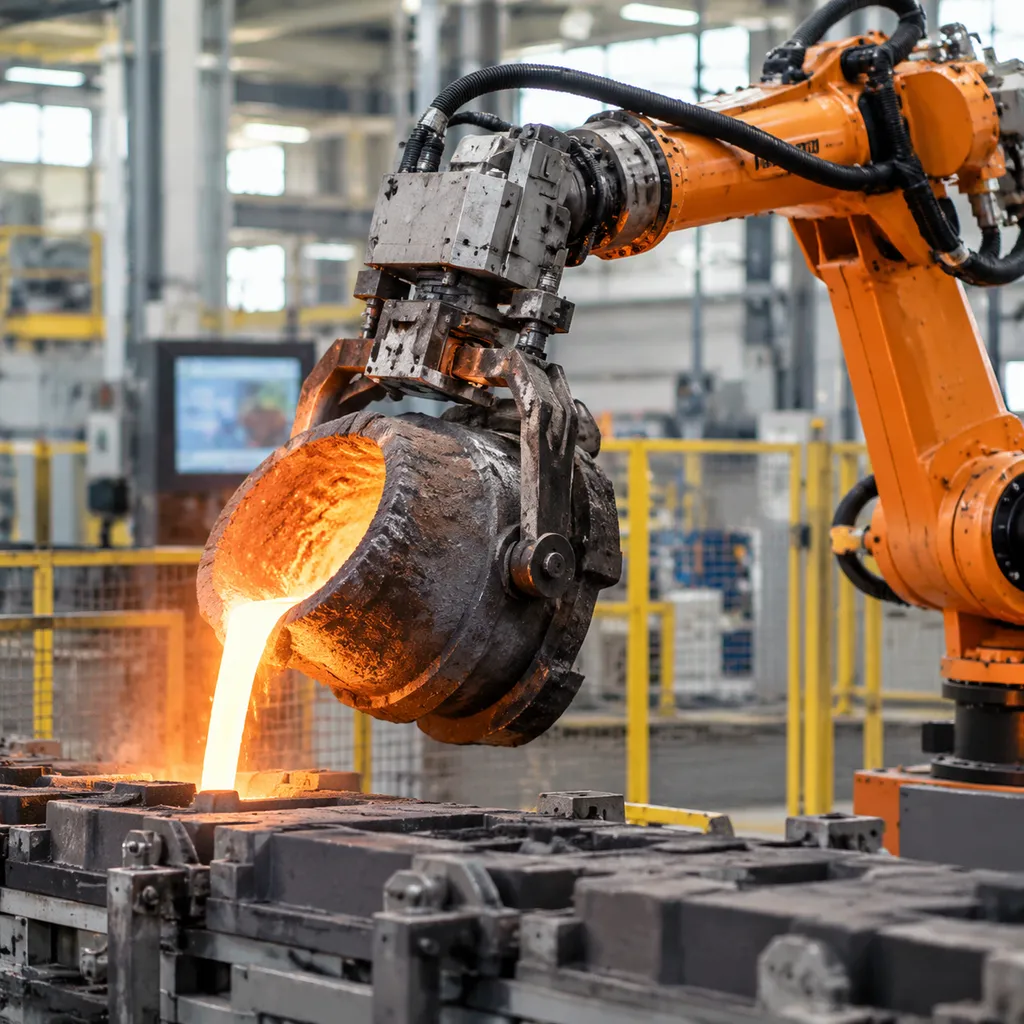
We implement robotic systems to address the most demanding stages of the metal casting lifecycle. By integrating specialized automation, we ensure high-precision results in environments where manual intervention is both dangerous and inefficient.
- Delicate Sand Core and Mold Handling: We utilize precision-controlled robotics for the transport and assembly of fragile cores and molds, ensuring structural integrity during the sand mold casting process.
- Furnace Charging and Ladle Tending: Automated systems manage the consistency of furnace charging and melt pouring, removing workers from proximity to molten metal and heat.
- Casting Extraction and Shakeout: Our robots are engineered to withstand the intense thermal environment during extraction from casting cells and subsequent shakeout, streamlining the workflow for high-volume production.
- Fettling, Degating, and Grinding: We deploy robots for consistent secondary operations, including the removal of gates and risers, as well as surface grinding. This automation provides the uniformity required for custom metal parts that meet strict quality standards.
Heavy-Duty Engineering and Thermal Durability Standards
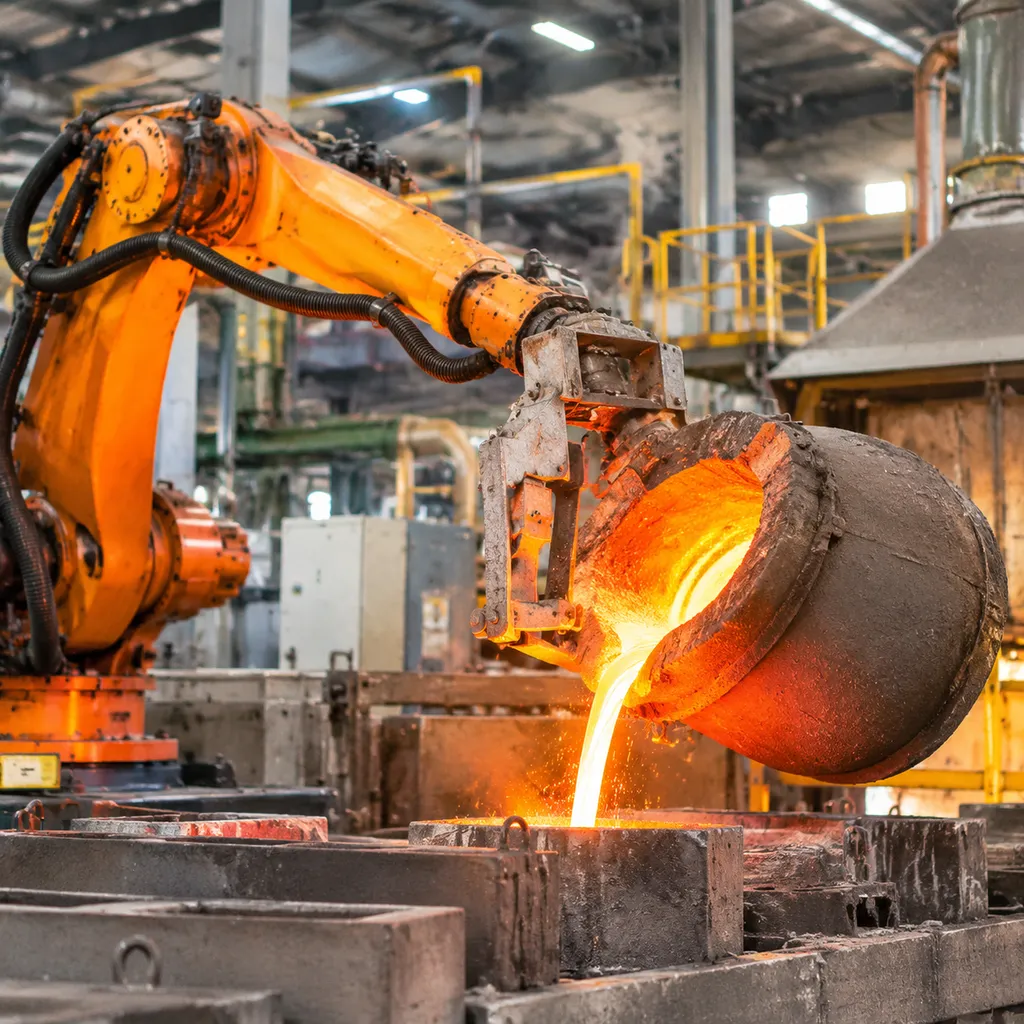
Foundry floors destroy standard automation. Between airborne particulate, abrasive sand, and radiant heat exceeding several hundred degrees, robotic material handling for foundries demands purpose-built construction. We build our foundry casting extraction robots and transfer systems to withstand continuous thermal cycling and abrasive environments without missing a beat.
IP67 and IP69K Sealed Enclosures with Protective Thermal Jackets
Every joint, motor, and electrical line requires multi-layer defense against the foundry environment. We engineer our IP67 rated foundry robots with pressurized internal cavities, specialized epoxy coatings, and severe-duty seals to lock out fine silica sand and metallic dust.
- High-grade sealing: Full IP67 wrist protection as standard, with optional IP69K ingress protection against high-pressure washdown and aggressive chemical sprays.
- Positive-pressure purging: Continuous low-pressure air purge prevents airborne contaminants from migrating into mechanical gearboxes and axis housings.
- Multi-layer thermal jackets: Custom-tailored heat-resistant aluminized coats deflect ambient radiant heat and protect mechanical joints during prolonged exposure to red-hot castings.
- Internalized routing: All power cables, air hoses, and sensor lines run internally through the robot arm to prevent snagging and burn damage from stray slag or molten metal splash.
Custom End-of-Arm Tooling for Hot, Irregular Castings
Raw castings are hot, heavy, and lack uniform gripping surfaces. Off-the-shelf grippers simply fail under these conditions. We design and build heavy-duty end-of-arm tooling for foundries to securely clamp raw gates, risers, and parting lines.
| Tooling Feature | Technical Specification | Operational Advantage |
|---|---|---|
| Pneumatic / Mechanical Grippers | Heat-treated alloy steel jaws with mechanical lock | Prevents part drops during sudden air loss |
| Thermal Isolation Mounts | Ceramic and insulated mounting plates | Blocks heat conduction from the casting to the robot wrist |
| Internal Water / Air Cooling | Integrated closed-loop cooling channels | Extends seal and gripper life during high-cycle handling |
| Adaptive Compliant Fixturing | Floating pins and spring-loaded centering guides | Accommodates dimensional casting variances and draft angles |
3D Vision Guidance for Bin Picking and Real-Time Defect Inspection
Handling unsorted castings out of shakeout bins or cooling conveyors requires intelligent recognition. We integrate ruggedized industrial 3D vision systems that identify, locate, and orient unmachined components in fractions of a second.
Our camera setups use structured-light sensors to penetrate dusty air and shifting ambient lighting. The system matches point-cloud data to CAD geometry, directing the robot to pick parts at the optimal grip point regardless of how they settle in the tote.
During the pick-and-place transfer, integrated optical sensors scan critical part surfaces to verify that gates, risers, and parting lines meet core casting quality standards for reliable metal parts. The robot immediately flags and sorts out defective, incomplete, or flash-heavy castings before they reach secondary CNC machining or robotic fettling cells, protecting downstream machinery from costly tool crashes.
Operational Gains and Measurable Shop-Floor Benefits
Deploying robotic material handling for foundries directly eliminates the core bottlenecks of metal casting operations: cycle time variance, part damage, and severe safety hazards. By integrating dedicated casting cell automation, we help foundries lock in predictable throughput, protect margins, and maintain reliable multi-shift productivity.
Maximizing OEE and Stabilizing Cycle Times Across Multi-Shift Runs
Manual casting transfers inevitably suffer from thermal shifts, pacing lags, and operator fatigue. Our industrial robotic material handling systems run 24/7 at fixed cycle rates, eliminating bottlenecks around mold lines, blast cabinets, and shakeout stations.
- Elimination of Starvation: Robots keep downstream trimming, shot blasting, and machining cells constantly fed without idle gaps.
- Thermal Consistency: Casting extraction occurs at exact, repeatable intervals, preventing cool-down defects and uneven metallurgical properties.
- Continuous Multi-Shift Output: Robotic cells sustain identical cycle speeds across first, second, and third shifts without performance drop-offs. When managing high-volume, high-tolerance lines like our investment and precision casting services for metal parts, maintaining strict cycle stability is vital to part integrity.
Reducing Scrap Rates Through Repeatable Part Transfer and Placement
Green sand molds and hot, freshly cast components are extremely vulnerable to shock, drop impacts, and improper clamping pressures. Automation standardizes every touchpoint:
- Controlled Gripping Force: Servo-driven and pneumatically cushioned grippers apply exact holding torque, preventing core crush and surface cracking.
- Precise Die and Fixture Placement: Parts enter trimming presses, quench tanks, and degating tables in accurate alignment every cycle, eliminating tooling jams and mis-cuts.
- Zero Drop Damage: Automated extraction and transfer drastically minimize mechanical handling damage between shakeout and final inspection.
Lowering Lost-Time Accidents by Removing Labor from Hazardous Zones
Extreme radiant heat, molten splatter, airborne silica dust, and heavy lifting create continuous safety and compliance liabilities. Foundry automation systems isolate personnel from these high-risk areas:
- Eliminating Heavy Ergonomic Strain: High-payload robots handle heavy gates, risers, and rough castings that typically cause repetitive stress injuries.
- Isolating Thermal Hazards: Operators move out of direct splash zones and furnace perimeters into air-conditioned, safety-interlocked control booths.
- Safer Workforce Allocation: Plant personnel transition from hazardous, manual manipulation to cell supervision, programming, and quality assurance.
Performance Impact: Manual vs. Robotic Material Handling
| Performance Metric | Manual Foundry Handling | Robotic Material Handling | Measurable Benefit |
|---|---|---|---|
| Cycle Time Variance | Fluctuates by 15–30% across shifts | Locked to engineered takt times | Maximized overall equipment effectiveness (OEE) |
| Handling-Induced Scrap | Recurring drops, cracks, and misalignments | Near-zero handling defects | Reduced remelt cycles and material loss |
| Workplace Safety Risks | Elevated risk of burns, strains, and dust exposure | Complete physical isolation of danger zones | Lower lost-time incidents and liability costs |
| Equipment Utilization | Pauses during shift changes and breaks | Continuous 24/7 production capability | Higher output from existing floor space |
Turnkey Robotic Cell Integration Workflow for Foundries
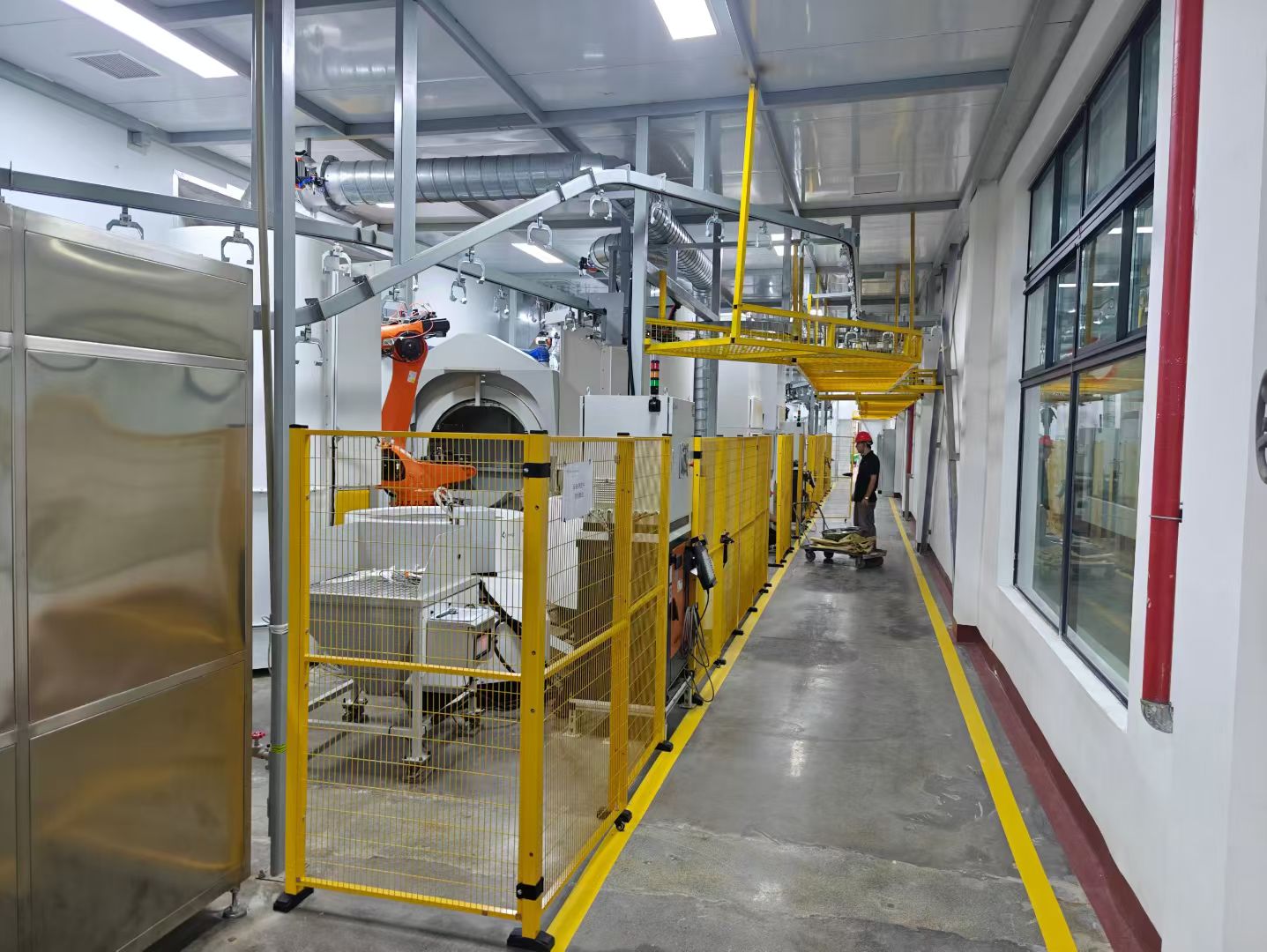
We manage the entire lifecycle of your robotic material handling for foundries project, ensuring a seamless transition from concept to active production. Our turnkey approach prioritizes reliability and performance in the toughest casting environments.
- Digital Simulation and Validation: Before we cut any metal, we use advanced 3D simulation to map your casting workflow. We validate reach envelopes, cycle times, and collision avoidance to ensure the robot performs exactly as planned within your existing layout.
- Bespoke EOAT Fabrication: We design and manufacture custom mechanical grippers and end-of-arm tooling tailored to your specific casting geometry. Each solution undergoes rigorous proof testing to ensure it maintains a secure hold on hot, irregular parts throughout the handling process.
- On-Site Integration and Commissioning: Our team handles the full installation, including safety fencing, PLC programming, and electrical interlocks. We prioritize custom automated assembly systems to ensure that every robotic cell integrates perfectly with your upstream and downstream foundry processes.
- Comprehensive Crew Training: We provide hands-on training for your plant operators and maintenance staff. This covers routine cell operation, basic troubleshooting, and safety protocols, ensuring your team is fully equipped to maintain high OEE standards.
Technical Specifications and Robot Configuration Guide
We engineer every robotic material handling cell to match specific casting weights, mold envelopes, and floor space constraints. Proper sizing prevents motor burnout, thermal degradation, and structural deflection under heavy operational cycles.
Payload Capacity and Reach Selection for Foundry Layouts
Selecting the right robot requires balancing maximum mechanical reach against gross tool payload. Total payload must account for the casting, gates and runners, plus the custom end-of-arm tooling (EOAT).
- Reach envelopes: Sized from 1.4 m to over 3.5 m to clear furnace lips, die-casting tie bars, and shakeout conveyors.
- Payload margins: We calculate a minimum 25% safety overhead above dynamic loading to withstand rapid deceleration forces during transport.
- Alloy mass considerations: Because density varies widely between pour types, consult our casting alloy properties and material selection guide to accurately estimate finished casting weights and runner systems before finalizing your payload class.
| Configuration Tier | Nominal Payload | Working Reach | Typical Foundry Application |
|---|---|---|---|
| Light Duty | 20 kg – 50 kg | 1,400 mm – 1,800 mm | Shell mold handling, core setting, precision degating |
| Medium Duty | 70 kg – 250 kg | 2,000 mm – 2,700 mm | Ladle tending, casting extraction, fettling manipulation |
| Heavy Duty | 300 kg – 600 kg | 2,500 mm – 3,200 mm | Large flask handling, heavy shakeout, multi-cavity extraction |
| Ultra-Heavy Duty | 700 kg – 1,200+ kg | Up to 3,500 mm | Direct furnace charging, monolithic mold positioning |
Ambient Operating Limits and Secondary Cooling Configurations
Standard factory robots fail quickly when exposed to foundry heat. We configure our robotic material handling systems with multi-tiered thermal management:
- Ambient tolerance: Engineered for standard operation between 0°C and 45°C (32°F to 113°F), extendable to continuous 60°C (140°F) ambient ceilings.
- Positive-pressure air purge: Keeps fine silica sand and airborne metallic dust out of gearboxes, cable harnesses, and motor cavities.
- Active secondary cooling: Closed-loop vortex coolers, chilled-air jackets, or water-cooled mounting plates protect the wrist and primary axes during close-proximity ladle tending and furnace unloading.
- Radiant heat shielding: Heavy-duty aluminized fabric covers deflect flash temperatures exceeding 1,000°C (1,832°F) near molten baths.
Axis Repeatability Ratings Under Continuous Maximum Load
Heavy castings exert substantial torque on robot gearboxes. Maintaining consistent placement into grinding fixtures, quench tanks, and core machines requires high rigidity:
- Positional repeatability: Maintained within ±0.05 mm to ±0.2 mm, even when running at 100% duty cycles under full payload.
- High-torque drivetrains: Reinforced double-supported bearings and high-rigidity cycloidal reducers eliminate axis backlash during rapid directional changes.
- Thermal drift compensation: Integrated encoder software accounts for mechanical expansion caused by ambient temperature swings across 24/7 operating shifts.
Frequently Asked Questions About Foundry Material Handling Robots
We field many inquiries regarding the integration of automated systems into challenging production environments. Below are the answers to common questions about deploying robotic material handling for foundries:
- How do robotic arms withstand molten metal heat and ambient foundry dust? Our robots utilize specialized thermal shielding, pressurized enclosures, and IP67/IP69K-rated seals. These components prevent abrasive silica dust and metallic particles from entering sensitive gearboxes and electronics, while heat-reflective covers protect against intense radiant temperatures.
- What payload capacities are standard for hot casting extraction? Payload requirements vary by application, but we typically configure systems ranging from 50kg to over 500kg. The choice depends on the casting weight, the mass of the end-of-arm tooling, and the required dynamic movement speed during extraction.
- Can robotic grippers handle delicate green sand cores without damage? Yes. We design custom grippers with pressure-sensitive control and compliant padding. These tools ensure the safe, precise placement of fragile sand cores and molds, maintaining structural integrity throughout the transport cycle.
- What is the expected ROI timeline for a foundry automation cell? While project scopes vary, most foundries see a return on investment within 12 to 24 months. Gains are driven by reduced labor overhead, decreased scrap rates, improved OEE, and the ability to maintain consistent production speeds that manual labor cannot sustain over multi-shift operations.
 English
 Russian
 German