
2026年11月18日
Explore medical investment casting for titanium and stainless steel precision components with CNC machining surface finishing and traceability
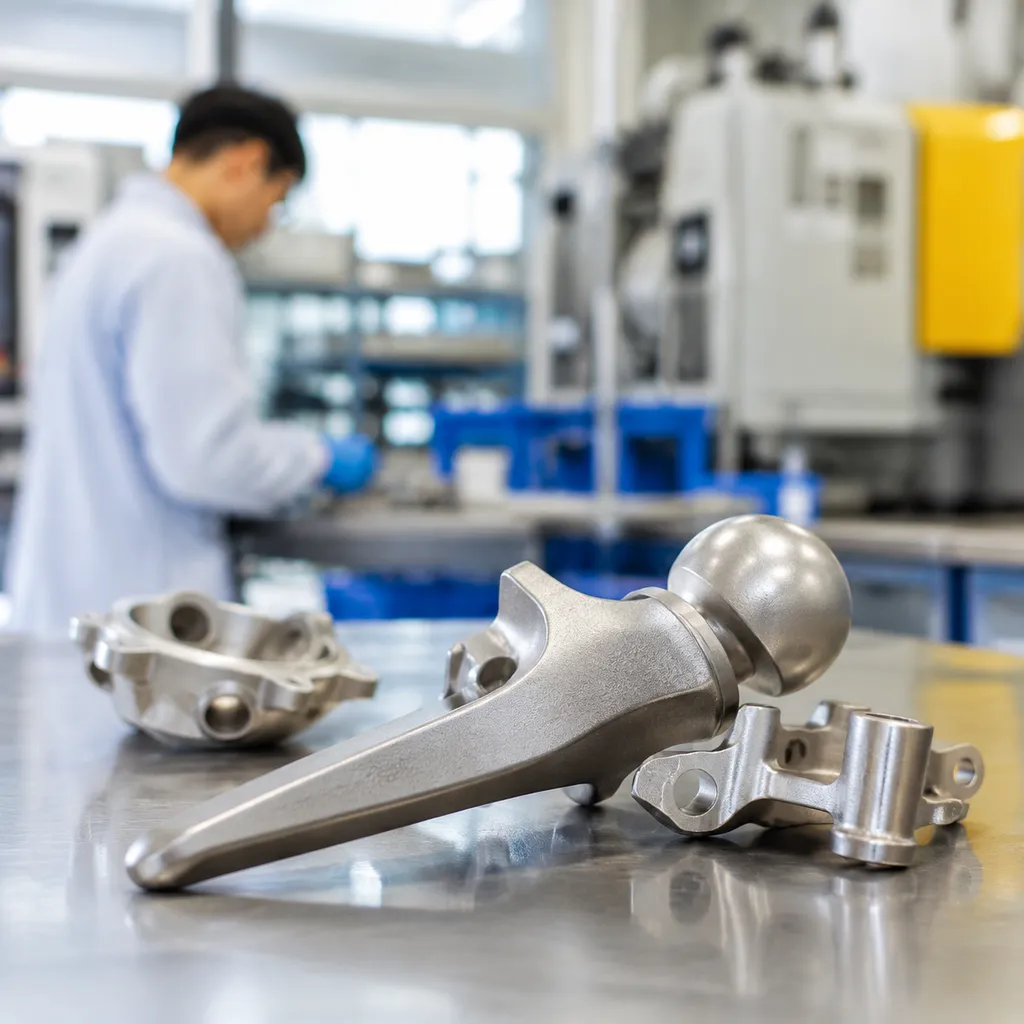
Medical Investment Casting: For Complex Precision Components
Medical investment casting delivers net-shape and near-net-shape manufacturing for critical healthcare assemblies and instruments. When medical devices demand complex internal passages, organic contours, and tight geometric tolerances, precision casting offers an efficient manufacturing path that subtractive methods cannot match alone.
By combining the lost-wax technique with high-grade silica sol ceramic molding, we produce medical investment casting and precision components that meet strict performance, structural, and cosmetic standards.
Key Capabilities and Advantages
- Intricate Geometries: Accurately replicate thin walls, internal channels, and complex contours without extensive secondary hog-out machining.
- Superior Surface Integrity: The silica sol investment process yields refined as-cast surface finishes, reducing post-processing time and enhancing downstream passivation or electropolishing.
- Material Versatility: Cast biocompatible and corrosion-resistant alloys, including medical-grade stainless steels, cobalt-chrome alloys, and titanium.
- Near-Net-Shape Efficiency: Significantly minimize raw material waste on high-cost medical alloys while streamlining downstream precision CNC operations.
- Consistent Repeatability: Stable wax injection and controlled dewaxing cycles deliver dimensional stability across low-, mid-, and high-volume production batches.
Through integrated engineering control—from tooling design to precision casting and final secondary finishing—we provide end-to-end component reliability for the global medical device sector.
Applications for Medical Investment Casting and Precision Components
Medical manufacturing leaves zero room for structural failure. When parts feature organic contours, thin cross-sections, or tough specialty alloys, machining everything from solid bar stock becomes wasteful and slow. We rely on medical investment casting and precision components processing to deliver near-net-shape parts that sharply reduce material loss while meeting critical tolerances.
Here is where precision casting delivers the highest value across the medical sector:
- Surgical Instrumentation: Handles, articulated jaws, forceps, and retractor linkages require ergonomic curved surfaces that are costly to machine from solid blocks. Casting captures intricate surface detail in one setup.
- Orthopedic Implants and Guides: From knee and hip trial components to surgical cutting blocks, silica sol investment casting delivers anatomical shapes with uniform density and clean surface finishes.
- Implantable Component Substrates: Complex geometries cast from surgical-grade stainless steel or cobalt-chrome alloys reduce downstream multi-axis milling cycles down to critical mating faces and tap holes.
- Diagnostic and Device Enclosures: Fluid-handling manifolds, sensor brackets, and optical housings benefit from integrated mounting points, thin-wall passages, and consolidated multi-part assemblies.
To achieve clean metallurgy in these demanding applications, our shell prep relies on an energy-saving burnout furnace for silica sol shells to eliminate all wax residues, paired with controlled pours via a dedicated 150 to 200 kg melting furnace for investment casting. This workflow guarantees dense, pore-free components ready for final CNC finishing and pass-through quality inspection.
Material Selection: Based on the Component and Operating Environment
Choosing the right alloy for medical investment casting and precision components depends on mechanical load, biocompatibility, sterilization methods, and corrosion exposure. We evaluate how the part functions in the clinic or field before recommending a specific alloy pouring process.
| Material Category | Common Grades | Primary Strengths | Typical Applications |
|---|---|---|---|
| Titanium Alloys | Ti-6Al-4V (Grade 5), Ti-6Al-4V ELI (Grade 23) | High strength-to-weight ratio, superior biocompatibility, low modulus | Orthopedic implants, bone fixation devices, prosthetic structures |
| Austenitic Stainless Steel | 316L, 304 | High general corrosion resistance, ductile, non-magnetic | Surgical handles, diagnostic housings, endoscopic hardware |
| Martensitic / PH Stainless Steel | 17-4 PH, 420, 440C | Exceptional hardness, wear resistance, high yield strength | Cutting tools, surgical clamps, bone drill guides, forceps |
Key Factors for Titanium Alloy Selection
Titanium is the benchmark for direct-contact implants and weight-sensitive surgical assemblies. When selecting titanium for medical casting:
- Biocompatibility and Osseointegration: Grade 5 ELI offers low interstitial elements, reducing the risk of tissue reaction in long-term implantable hardware.
- Fatigue Strength: Titanium handles cyclic loading effectively, making it suitable for structural joint components and plates.
- Vacuum Processing Requirements: Molten titanium reacts aggressively with atmospheric oxygen. We cast titanium using dedicated vacuum skull melting and specialized shell systems to prevent surface contamination (alpha case formation).
Key Factors for Stainless Steel Selection
Stainless steels provide reliable mechanical performance, machinability, and cost efficiency across surgical instruments and medical equipment hardware.
- Corrosion Resistance under Autoclave Cycles: Surgical devices undergo repeated steam, chemical, or radiation sterilization. Using our 300 series stainless steel guide helps identify when 316L is necessary for harsh fluid exposure versus standard 304 for general instrument structures.
- Edge Retention and Hardness: For cutting edges, articulation points, and high-wear jaws, precipitation-hardening grades deliver the required rigidity. We routinely utilize 17-4 PH investment casting to achieve high tensile strength and wear resistance through straightforward post-cast heat treatments.
- Secondary Machining and Surface Polishing: Martensitic and austenitic grades yield uniform surface finishes during electropolishing, ensuring passive oxide layers that resist pitting in hospital environments.
Design and Process Review Before Quotation

Before finalizing any quote for medical investment casting and precision components, we run a rigorous upfront engineering and manufacturability review. This phase identifies potential production risks, eliminates unnecessary tooling expenses, and ensures that the casting process aligns with the final functional requirements of the medical assembly.
1. Structural and Wax Pattern Feasibility
We evaluate the part geometry to confirm reliable mold filling, uniform cooling, and pattern integrity:
- Wall Thickness Transitions: Abrupt changes between thick and thin sections are adjusted to prevent shrinkage porosity, sink marks, or internal stress.
- Draft Angles and Undercuts: Core pulls and parting lines are established to ensure clean pattern release without distortion.
- Rapid Prototyping: For complex or low-volume runs, utilizing 3d-printed wax patterns for rapid investment casting validates structural gating and dimensional accuracy before hard tooling is cut.
- Gate Placement: Feed gates are strategically positioned in non-critical areas to simplify gate grinding and maintain component integrity.
2. Datum and Machining Strategy
Balancing net-shape casting with secondary machining delivers both precision and cost efficiency:
- Datum Alignment: We establish shared datum planes between the raw casting and subsequent CNC machining fixtures to avoid tolerance stack-ups.
- Machining Allowances: Stock allowances are kept to an optimal minimum to reduce cycle times while ensuring a clean surface cut without tool deflection.
- Clamping Rigidity: Complex, organic medical shapes are assessed for secure workholding to prevent vibration or deformation during tight-tolerance milling or turning.
3. Surface Finish and Edge Requirements
Medical hardware requires precise edge conditions and defect-free external profiles:
- As-Cast Roughness vs. Post-Finishing: Target finishes are reviewed early to select the right ceramic shell slurry system and determine whether secondary electropolishing, passivation, or bead blasting is necessary.
- Parting Line and Gate Dressing: Strict limits are placed on parting flash and witness marks to ensure flush blending with the surrounding profile.
- Edge Treatments: Critical edges, radii, and transitions are evaluated to eliminate micro-burrs and prevent stress concentrations on working surfaces.
4. Inspection and Traceability
A compliant manufacturing run requires an agreed-upon quality verification roadmap:
- Dimensional Verification: Critical-to-quality (CTQ) dimensions are mapped to CMM routines, optical scanning, or custom functional go/no-go gauges.
- Non-Destructive Testing (NDT): Radiographic (X-ray) and liquid penetrant inspections (FPI) are planned based on structural criticality.
- Material Lot Traceability: Every production batch is paired with chemical composition analysis, mechanical test reports, and process documentation from wax injection through final packaging.
Process Control and Equipment Stability in Medical Investment Casting

Repeatability in medical investment casting and precision components comes down to tight control over every physical and thermal variable. Medical hardware leaves zero margin for porosity, dimensional drift, or surface inclusions. We manage stability by standardizing each stage of the precision casting workflow with dedicated automation and strict monitoring.
1. Pattern Fabrication and Dimensional Consistency
A casting is only as accurate as its pattern. Temperature-controlled wax injection presses ensure consistent volumetric shrinkage, while tooling temperature sensors prevent pattern distortion. When evaluating production methods, comparing 3D printed wax vs injected wax for casting helps determine the right balance between tooling-free prototyping and high-volume pattern repeatability.
2. Automated Shell Coating and Slurry Management
Ceramic shell integrity directly impacts surface finish and metallostatic pressure resistance. We control the ceramic mold build using: Robotic Dipping Arms: Maintain consistent angle, speed, and drainage to prevent slurry pooling and uneven shell thickness. Controlled Drying Rooms: Constant relative humidity (RH) and ambient temperature prevent premature shell cracking during multi-dip drying cycles. Slurry Viscosity Monitoring: Continuous agitation and scheduled cup tests keep refractories evenly suspended.
3. Dewaxing and Thermal Shell Firing
Rapid autoclave dewaxing removes the wax core without thermal expansion cracking the green ceramic shell. Pre-pour burnout furnaces eliminate residual carbon residues and pre-heat the molds to reduce thermal shock during metal pouring.
4. Melting, Pouring, and Foundry Automation
Clean metallurgy protects mechanical integrity. Controlled atmosphere or vacuum-assisted induction melting prevents gas absorption and slag entrapment in reactive alloys. Integrating foundry automation into ladle positioning and pour rates ensures smooth, non-turbulent mold filling across every production run.
Sourcing Checklist for Medical Components
Sourcing parts for high-stakes medical equipment requires zero compromise on quality and consistency. When procuring custom components through medical investment casting, evaluating suppliers against clear technical and regulatory standards prevents production bottlenecks and guarantees compliance.
Use this practical sourcing checklist during vendor evaluation:
- Material Verification & Traceability
- Verified melt origin, heat numbers, and raw material certificates (MTRs) for every batch.
- Direct alloy suitability for the operating environment, whether utilizing cobalt-chrome, titanium, or assessing alloy performance such as 416 vs 316 stainless steel for corrosion resistance and strength.
- Strict prohibition of contaminated scrap during wax injection and alloy melting.
- Tooling and Casting Tolerances
- Tooling design capable of producing stable wax patterns with minimal shrinkage variation.
- As-cast linear tolerances aligned with precision casting standards (e.g., ISO 8062 CT4–CT6).
- Robust shell-building controls to prevent surface inclusions, gas porosity, and wall-thickness deviations.
- Secondary CNC Machining & Datum Alignment
- Integrated multi-axis CNC capability to hold tight tolerances on critical mating surfaces, threads, and bores.
- Standardized fixturing datums established directly on the raw casting drawings.
- Quality Assurance and Non-Destructive Testing (NDT)
- In-house or certified third-party testing, including CMM dimensional inspection, X-ray (radiographic testing), and dye penetrant inspection.
- Documented surface roughness (Ra) verification straight from the mold and post-finishing.
- Complete lot tracking from primary pour to secondary finishing and passivation.
Investment Casting vs. CNC Machining for Medical Precision Components

Choosing between medical investment casting and precision components produced purely through subtractive CNC machining comes down to geometric complexity, material loss, and production volume.
Both methods deliver high reliability, but their strengths differ significantly when handling medical-grade alloys:
| Feature | Medical Investment Casting | Pure CNC Machining |
|---|---|---|
| Material Efficiency | High; near-net shape minimizes scrap on costly alloys (titanium, CoCr, 316L) | Lower; extensive chip removal leads to significant raw material waste |
| Geometric Complexity | Superior for organic curves, contours, and complex internal passages | Limited by cutting tool access and multi-axis reach |
| Tooling & Setup | Upfront tooling investment (wax injection dies), low unit cost at volume | Minimal initial tooling, but higher machining cycle time per unit |
| Dimensional Control | Near-net tolerances; critical fits require finish machining | Extremely tight tolerances directly off the machine |
The Hybrid Advantage
For most complex surgical tools and medical hardware, the most cost-effective path is a hybrid workflow. We utilize precision casting to form the intricate, near-net body, followed by CNC secondary machining strictly on critical locating datums, sealing faces, and tapped threads. Understanding the trade-offs in investment casting vs CNC machining cost and accuracy ensures your medical components maintain high dimensional compliance while optimizing overall production spend.
How to Prepare an RFQ for Medical Investment Casting and Precision Components
Getting an accurate quote and a fast turnaround starts with a clean request for quotation package. When dealing with medical investment casting and precision components, ambiguous prints cause delays and unexpected cost adjustments.
To help us evaluate your project efficiently, include the following details in your initial submission:
- Complete 2D and 3D Engineering Files: Provide 3D CAD models (STEP or IGES format) alongside 2D dimensional drawings (PDF) specifying linear tolerances, geometric dimensioning and tolerancing (GD&T), datum schemes, and critical-to-function features.
- Alloy Grade and Standards: Specify the exact material grade—such as 316L, 17-4PH, CoCrMo, or Ti-6Al-4V—and any mandatory medical or ASTM standards for melt, chemistry, and mechanical properties.
- Cast vs. Machined Conditions: Clearly distinguish between as-cast surfaces and secondary CNC machining zones, including required surface roughness (Ra) values.
- Quality Assurance and NDT Criteria: Detail all non-destructive testing requirements, such as radiographic inspection (X-ray), fluorescent penetrant inspection (FPI), or coordinate measuring machine (CMM) reports.
- Production Volume and Batching: State your prototype needs, initial production run, and estimated annual usage (EAU) to help us configure the right tooling strategy. Reviewing our precision casting RFQ checklist for accurate quotes ensures all technical and commercial factors are covered upfront.
- Finishing and Packaging: Clarify downstream processes such as passivation, electropolishing, laser marking, and cleanroom packaging specifications.
Providing these details upfront allows our engineering team to review moldability, plan secondary operations, and return an accurate, competitive quote without delays.
Frequently Asked Questions
Is Investment Casting Suitable for Medical Devices?
Yes. Medical investment casting is one of the most reliable methods for producing complex, net-shape metal parts. It allows for intricate geometries, thin walls, and fine surface finishes that are difficult or cost-prohibitive to achieve with standard fabrication alone. The silica sol process provides the high structural integrity, density, and consistency required for surgical tools, implant components, and diagnostic hardware.
What Materials Are Commonly Used in Medical Investment Casting?
We pour a range of medical-grade alloys engineered for biocompatibility, wear resistance, and mechanical strength:
- Stainless Steels: 316L and 17-4PH for surgical instruments and structural hardware.
- Cobalt-Chrome Alloys (CoCrMo): Preferred for high-wear applications, including orthopedic joint components.
- Titanium Alloys: Selected for high strength-to-weight ratios and corrosion resistance.
Can Medical Castings Undergo CNC Machining and Surface Finishing?
Yes. While precision casting delivers near-net shapes with tight as-cast tolerances, critical mating faces, precision holes, and threaded features often require secondary operations. Through our integrated one-stop service, we provide precision CNC secondary machining, passivation, polishing, and custom surface treatments to supply completely finished medical investment casting and precision components ready for cleanroom assembly.
What Documents Are Required for a Medical Casting RFQ?
To provide an accurate technical assessment and quotation, please include:
- 3D CAD Models: STEP or IGES files for geometry evaluation and mold flow planning.
- 2D Drawings: PDF formats clearly showing dimensional tolerances, datum targets, and surface roughness requirements.
- Material Specifications: Designated alloy grade and any specific heat-treatment criteria.
- Quality & Testing Scope: Inspection requirements, such as CMM reports, non-destructive testing (NDT), or chemical analysis.
- Production Volume: Initial prototype quantities and projected annual volumes.
Does Vastpe Provide Medical Device Certifications?
Vastpe provides complete manufacturing traceability and quality verification documentation for every production batch. We support your validation process by supplying material test reports (MTR), chemical composition analyses, mechanical test results, CMM dimensional verification reports, and non-destructive testing records tailored to your project requirements.
Related Vastpe Resources

To support your sourcing evaluations for medical investment casting and precision components, we provide dedicated technical overviews detailing our casting methodologies, production controls, and process capabilities:
- Foundry Engineering and Controls: Discover how our wax injection, shell building, and precision casting workflows maintain dimensional repeatability across challenging production runs by reviewing our technical advantages.
- Process Selection Guide: Evaluate alloy performance, structural complexity, and cost tradeoffs by reviewing the key advantages and disadvantages of lost wax casting for complex metal components.
Discuss Your Medical Investment Casting and Precision Components with Vastpe
When developing critical healthcare hardware, early collaboration ensures your designs translate smoothly from CAD models into defect-free cast parts. At Vastpe, we evaluate your technical drawings, functional geometries, and material grades to optimize manufacturability, minimize secondary tooling costs, and safeguard part integrity across every production run.
Whether your project requires surgical-grade stainless alloys or specialized alloy steel investment casting capabilities, our engineering team works directly with your procurement and design specifications:
- Direct Engineering Review: In-depth DFM (Design for Manufacturability) analysis on wall thickness, parting lines, gate placement, and draft angles to prevent shrinkage and porosity.
- Tight Tolerancing & CNC Secondary Operations: Precision post-cast machining plans aligned with your critical datum structures and print tolerances.
- Surface Finishing & Metallurgy: Full alignment on specified surface roughness (Ra), passivated finishes, and material certifications before tooling commences.
- Traceable Documentation: Comprehensive inspection protocols, material test reports (MTR), and dimensional verification configured for medical-grade supply chains.
Send your 3D CAD files (STEP/IGES) and 2D engineering drawings to the Vastpe engineering team to initiate your comprehensive design review and quote evaluation for high-reliability medical casting projects.


 English
 Russian
 German