
2026年11月9日
Explore the investment casting shell building process including slurry dipping stucco layers drying dewaxing materials and quality controls
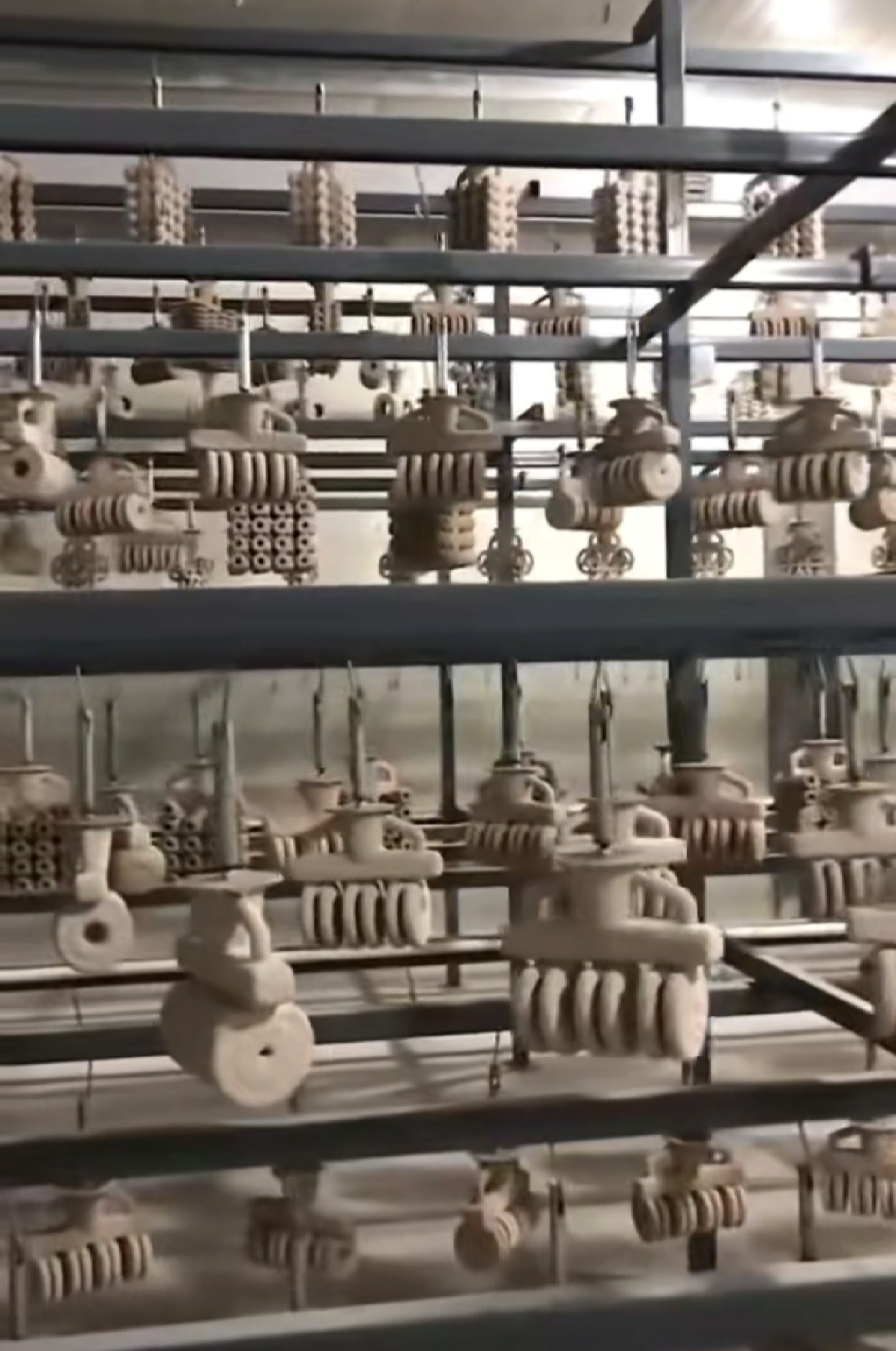
Automated Shell Building System Overview
Modern precision foundries cannot afford scrap caused by manual dipping inconsistencies, slurry drainage defects, or unmonitored drying cycles. We design automated ceramic shell production lines that replace manual operator variability with rigid, programmable process control across the entire investment casting shell building process.
Operational Principle of Recipe-Driven Dipping and Drying
Our automated shelling architecture operates on deterministic, recipe-controlled cycles. Each wax tree assembly follows a pre-programmed sequence stored in the central controller:
- Manipulated Immersion: Multi-axis articulation controls approach angles, dip depth, and dwell time to eliminate trapped air bubbles in complex pattern pockets.
- Compound Drainage Motion: Continuous, programmable dual-axis rotation during withdrawal prevents slurry pooling, bridging, and uneven run-down along knife edges.
- Synchronized Stuccoing: Immediate transfer to fluidized beds or rainfall sanders ensures uniform refractory grain adhesion while the wet slurry film remains active.
- Automated Environmental Interlocks: Workpieces transfer into climate-regulated drying zones, progressing to subsequent coats only when preset weight-loss or moisture-depletion parameters are validated.
Primary Industrial Capabilities and Payload Limits
We build our robotic investment casting shelling systems to handle varied structural demands, from small medical cluster assemblies to heavy, monolithic turbine housings:
| Parameter | Standard Cell Specification | Heavy-Duty Cell Specification |
|---|---|---|
| Max Cluster Payload | Up to 150 kg (330 lbs) | Up to 500 kg (1,100 lbs) |
| Working Envelope Diameter | 1,200 mm | 2,200 mm |
| Maximum Cluster Height | 1,500 mm | 2,500 mm |
| Axis Motion Precision | ±0.05 mm repeatability | ±0.10 mm repeatability |
| Dip Cycle Throughput | 20–35 clusters per hour | 10–18 clusters per hour |
Colloidal Silica and Ethyl Silicate Binder Compatibility
Our wet-processing stations adapt directly to your chosen refractory chemistry without cross-contamination or chemical degradation:
- Water-Based Colloidal Silica Systems: Optimized for high-integrity molds requiring maximum green strength and environmental compliance. Our cells integrate high-volume laminar airflow management to accelerate gelation without skin-cracking.
- Solvent-Based Ethyl Silicate Systems: Fully compliant with explosion-proof (ATEX/Class I, Div 1) ratings. Systems incorporate automated ammonia vapor gelling integration, sealed exhaust extraction, and solvent-resistant seals throughout the slurry dipping tanks and transmission lines.
Core Machinery and Equipment Specifications
We build our investment casting shell building process equipment to eliminate human variance, prevent shell lifting, and maintain precise mold thickness across high-volume production runs. Every cell integrates heavy-duty motion units, automated slurry stabilization, and adaptive sanding systems.
Multi-Axis Robotic Dipping Arms with Compound Rotation
Our industrial articulated robots handle heavy wax assemblies through repeatable dipping trajectories. Compound roll-and-pitch axis movements eliminate air entrapment in blind holes and ensure uniform slurry coverage across complex airfoil vanes or deep core cavities. Payload capacity: 50 kg to 500 kg cluster weights. Motion control: 6-axis articulation with programmable drain angles and continuous rotational axis. Repeatability: ±0.05 mm positioning accuracy to protect fragile wax sprues from tank collisions.
Slurry Mixing and Conditioning Tanks
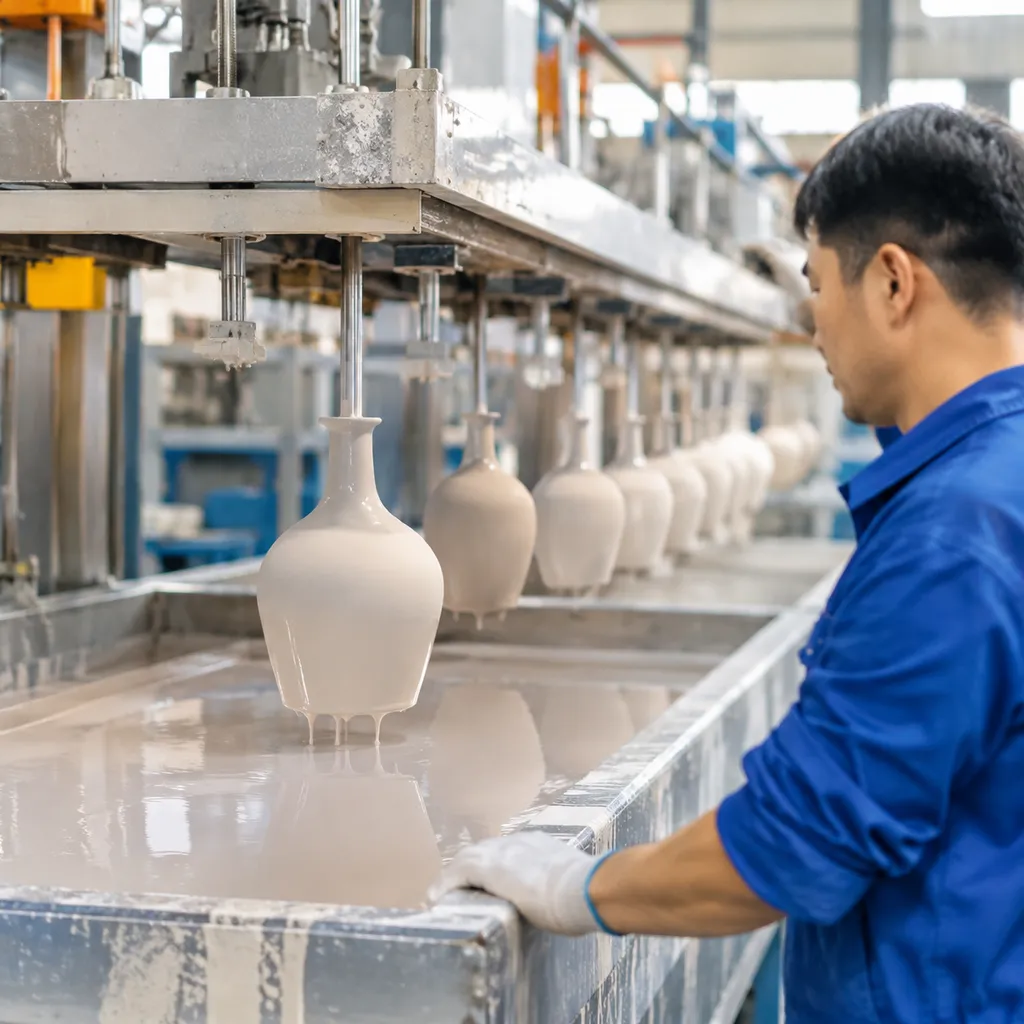
Stable slurry rheology directly dictates primary surface quality and shell permeability. We equip our stainless steel dipping tanks with low-shear variable-speed impellers, rotating tank walls, and temperature-jacketed reservoirs to prevent binder degradation. Viscosity control: Integrated monitoring paired with automated liquid addition. Tank styles: Rotating cylindrical slurry tanks with static baffle scrapers to prevent dead zones. Binder support: Compatible with water-based colloidal silica and ethyl silicate formulations.
| Equipment Unit | Operational Role | Key Mechanism / Capability |
|---|---|---|
| Multi-Axis Robot Arm | Pattern dipping & draining | 6-axis manipulation, continuous cluster rotation |
| Slurry Dipping Tank | Primary & backup coating | Rotating basin, water-jacketed temperature control |
| Rainfall Sander | Primary & detail stuccoing | Curtain-fall deposition with adjustable flow rates |
| Fluidized Sand Bed | Backup coat stuccoing | Low-pressure air diffusion with porous tile bases |
| Drying Environmental Chamber | Inter-coat drying | Closed-loop temperature, airflow, and RH management |
Fluidized Beds and Rainfall Sanders for Stuccoing
Mechanical integrity requires uniform refractory sand adhesion without impacting delicate wax features. Our cell setups integrate our sand coating machine with adjustable sand flow alongside pneumatic fluidized beds. This enables precise control over stucco deposition rates across both primary zircon mesh and coarse backup fused silica grains, preventing localized thinning or sand clustering.
Climate-Controlled Shell Drying Conveyors and Chambers
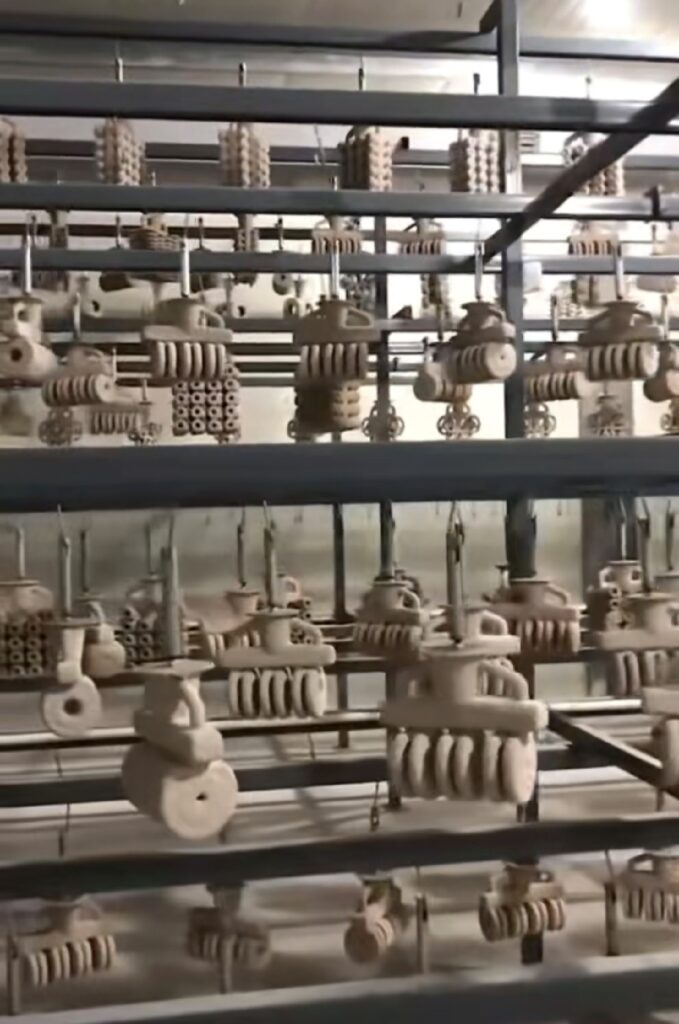
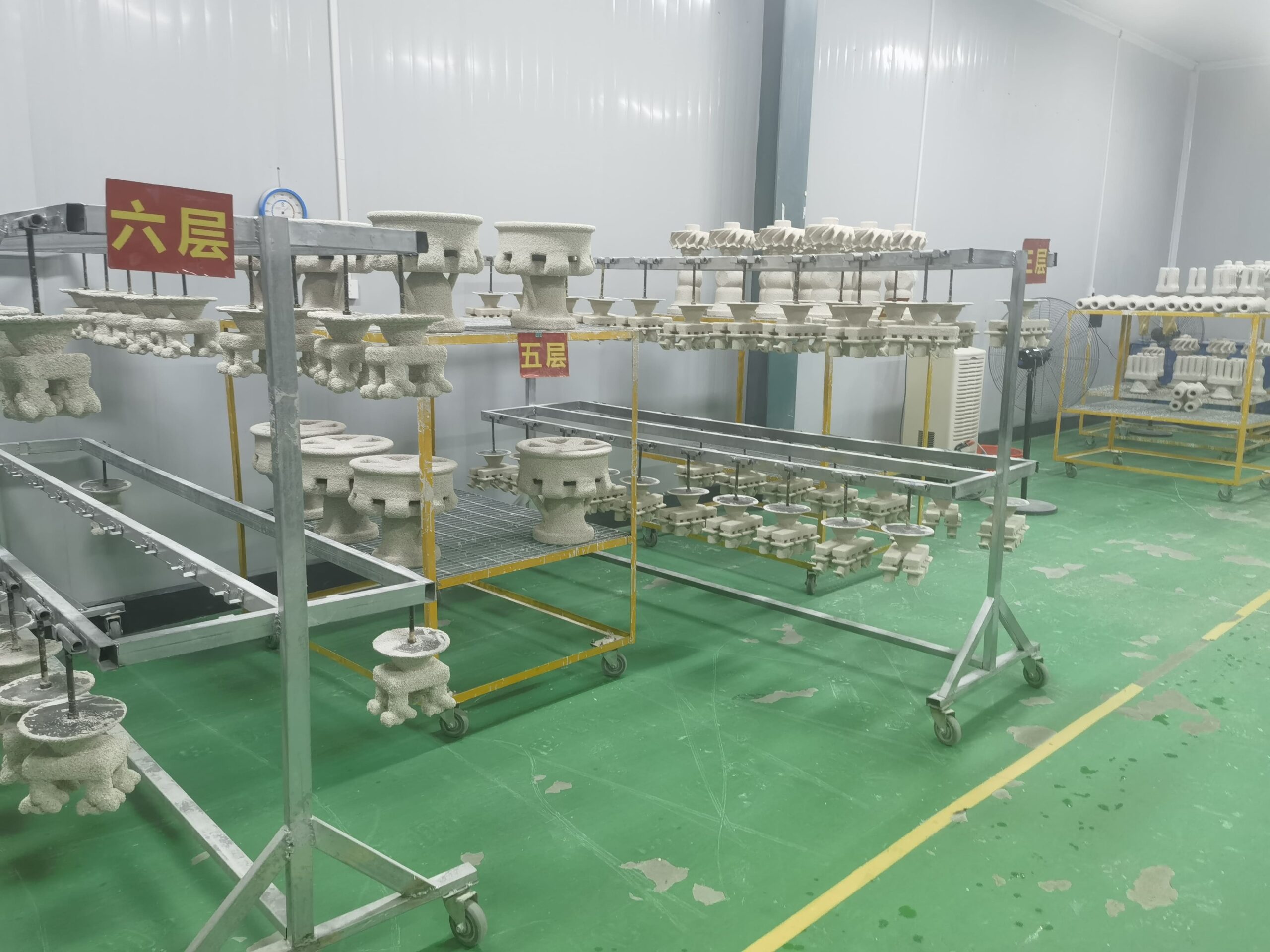
Uncontrolled drying rates lead directly to shell cracking, delamination, and green strength failure during dewaxing. Our continuous drying tunnels and multi-tier indexing conveyors maintain dedicated climate zones for progressive coats: Air velocity management: Directed laminar nozzle arrays delivering 2 to 5 m/s air speed directly over cluster profiles. Atmospheric control: Humidity held strictly within 30% to 70% RH, with temperature regulated to ±1°C. Conveyor integration: Overhead power-and-free monorails or rotary carousels that feed shells continuously back to the robotic dipping envelope once drying sensors confirm cure targets.
Investment Casting Shell Building Process Steps
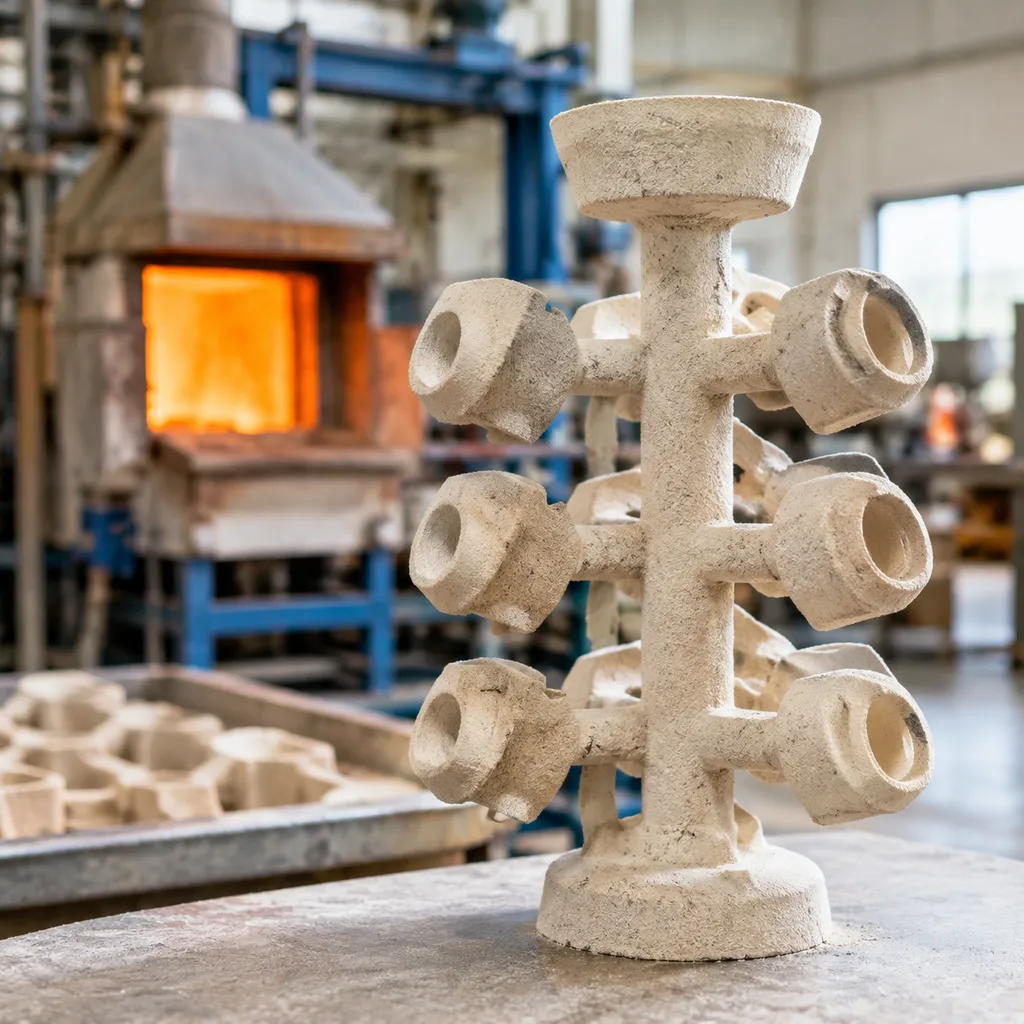
Mastering the investment casting shell building process demands strict mechanical repeatability at every dipping, sanding, and drying stage. We configure our shell lines to follow a rigid four-stage sequence that transforms assembled wax trees into robust, thermally stable ceramic molds capable of handling the pressures of molten metal.
Wax Cluster Degreasing and Surface Conditioning
Slurry will not adhere uniformly to wax patterns contaminated with silicone release agents, machining oils, or shop dust.
- Solvent Wash: We submerge assembled wax trees in an ultrasonic cleaning or mild solvent bath to strip oily residue without etching the wax surface.
- Wetting Agent Etch: The assembly passes through an aqueous conditioning rinse containing surfactant wetting agents. This lowers surface tension, ensuring the initial ceramic slurry coats deep crevices, core passages, and sharp fillets without bubble entrapment or dry spots.
- Forced Air Dry: Low-pressure, clean air knives blow off excess moisture prior to the first dip.
Primary Face Coat Slurry and Fine Stucco Application
The face coat directly governs final casting surface finish and part detail fidelity. Managing this step correctly on an automatic shell coating line for investment casting prevents metal penetration and surface veining.
- Slurry Dipping: We manipulate the cluster through compound rotational axes inside a viscosity-controlled primary slurry tank, typically using colloidal silica binder paired with fine zircon flour (325 mesh).
- Drain and De-bubble: The robot reorients the pattern tree to shed excess liquid, clearing drain channels and preventing slurry pools.
- Fine Stuccoing: Before the wet binder flashes, a rainfall sander coats the wet cluster with ultra-fine refractory sand (such as 80/120 mesh zircon). This forms a dense, smooth barrier against liquid alloy erosion.
Intermediate and Backup Structural Coat Layering
After targeted drying cycles, we build the shell wall to withstand thermal expansion during autoclave dewaxing and the hydrostatic head pressure during pouring.
- Transition Coats: One or two intermediate dips bridge the expansion gap between the fine zircon face and the coarser structural layers.
- Backup Layering: We repeat multiple backup dips using higher-solids fused silica or aluminosilicate slurries, followed immediately by coarse stuccoing (such as 30/50 mesh fused silica) in fluidized beds.
- Controlled Inter-Coat Drying: Each dip cycles through precise temperature, relative humidity, and airflow zones to optimize green strength and avoid premature shell cracking. Explore our complete guide on the ceramic shell investment casting process and benefits to understand drying dynamics in detail.
Final Seal Coat Dipping to Prevent Ceramic Spalling
The process concludes with a non-stuccoed protective wash.
- Slurry-Only Immersion: We dip the fully layered cluster into a low-viscosity backup slurry without applying any sand afterward.
- Grain Lockdown: This liquid seal encapsulates the outermost coarse sand grains, completely locking down loose particles.
- Defect Elimination: Sealing prevents refractory spalling during transport, stops ceramic inclusions from washing into the mold cavity during metal pouring, and provides a smooth outer skin for autoclave handling.
Shell Defect Prevention and Green Strength Optimization
Controlling shell stability during the investment casting shell building process directly impacts final casting yields. Manual dipping often introduces inconsistent drainage angles, patchy stucco coverage, and unpredictable drying times that cause scrap down the line. We engineer automated shelling systems to eliminate process drift, optimize green strength, and protect mold integrity from initial dip to pour.
Eliminating Slurry Run-Down, Lifting, and Shell Cracking
Ceramic shell failures trace back to poor slurry drainage, air entrapment, and non-uniform layer thickness. We tackle these root causes through rigid mechanical parameters:
- Compound Drainage Motion: Programmable multi-axis rotation drains excess slurry evenly from deep pockets, blind holes, and complex cores, preventing slurry pooling and run-down lines.
- Controlled Dip Speeds: Calibrated dipping cycles eliminate trapped air pockets and slurry foaming around delicate pattern details, stopping coat lifting before stuccoing.
- Balanced Thermal Expansion: Regulated refractory sand-to-slurry ratios establish uniform wall thickness across the entire wax assembly, preventing the uneven stress that triggers drying cracks.
Autoclave Dewaxing Durability and Thermal Shock Resistance
The ceramic shell must survive rapid steam pressurization and the thermal expansion of melting wax without delaminating. Achieving the proper dewaxing green strength optimization ensures zero spalling during autoclave cycles:
- Interlocking Refractory Matrix: Precise application via fluidized bed and rainfall sanders ensures complete stucco encapsulation within the binder layer, giving the green shell high mechanical peel resistance.
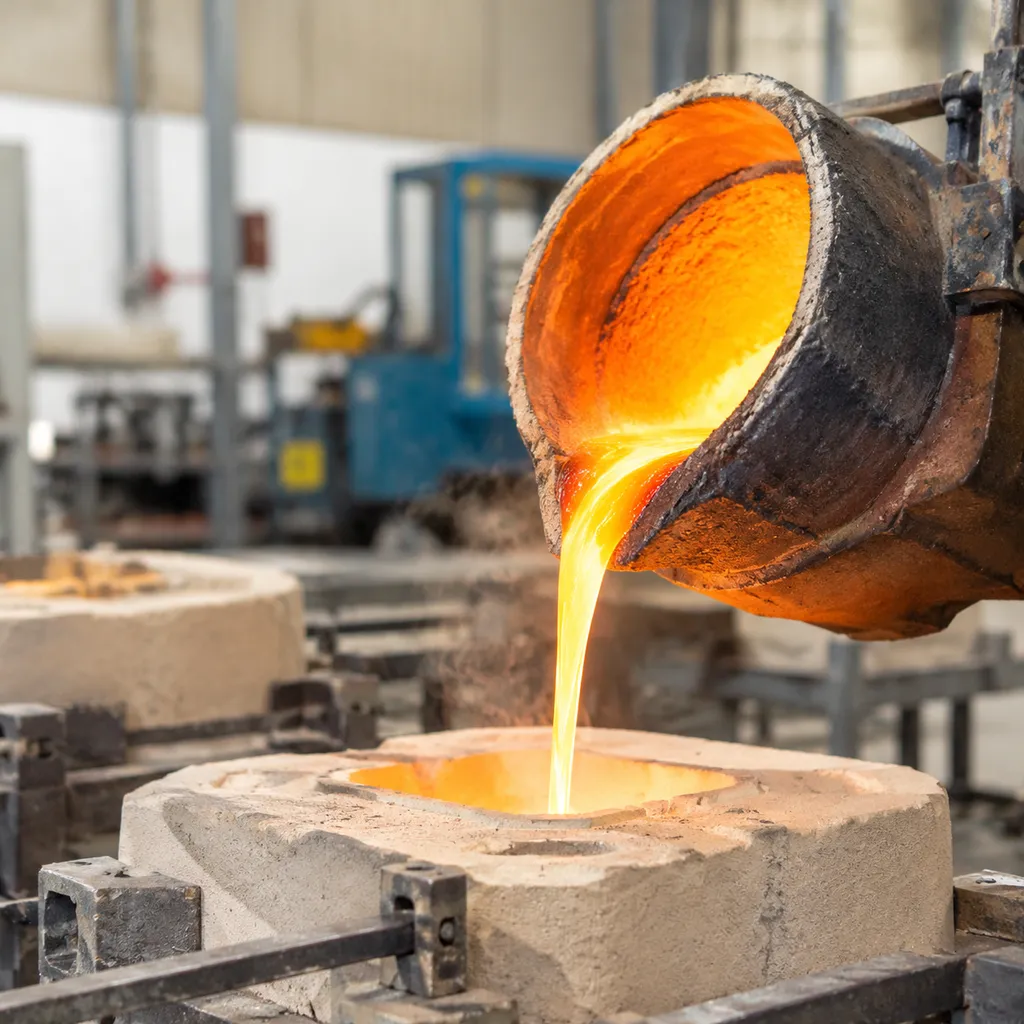
- Thermal Shock Resistance: Regulated ceramic density allows the fired shell to withstand molten metal pours at extreme temperatures without thermal spalling. Achieving this structural stability highlights the primary advantage of investment casting over green sand casting when producing complex, net-shape geometries.
- Controlled Drying Permeability: Optimized inter-coat drying profiles preserve micro-porosity, allowing expanding steam and wax pressure to vent safely during the critical first seconds of dewaxing.
Reducing Ceramic Slurry Waste and Manual Labor Costs
Manual dipping ties up skilled labor and drives high material scrap. Our automated dipping and stuccoing cells cut operating overhead across the floor:
| Process Metric | Manual Shell Building | Automated Shell Building System |
|---|---|---|
| Slurry Waste | High runoff, edge buildup, manual tank skimming losses | Minimal drag-out loss through recipe-controlled spin-off cycles |
| Labor Allocation | 2–3 dedicated operators per dipping line | Single-operator oversight for full cell management |
| Coat Consistency | Operator-dependent variability (±20% shell weight) | Repeatable thickness within ±3% batch-over-batch |
| Rework & Scrap | High incidence of dewax cracks and core inclusions | Near-zero shell breakdown during autoclave cycles |
Technical Specifications and Operating Parameters
In our design of automated shell building systems, we focus on establishing precise mechanical control to ensure the integrity of the investment casting shell building process. We engineer our machinery to handle varying cluster weights and dimensions, ensuring that every mold layer is applied with consistent velocity and angle. Proper shell formation is a critical prerequisite for successful processing in a dewaxing autoclave, as structural density directly impacts the shell's ability to withstand thermal expansion without cracking.
Key Operating Parameters for Shell Building Cells
| Parameter | Operational Focus |
|---|---|
| Cluster Payload | Engineered capacity for max wax weight and ceramic slurry loading. |
| Dimensional Envelope | Customizable dipping depth and swing radius for large-scale casting clusters. |
| Slurry Rheology | Automated viscosity monitoring and pH adjustment for consistent face coat application. |
| Drive Mechanics | Variable speed drive ratings for controlled, vibration-free dipping cycles. |
| Pneumatic Control | Regulated air consumption for fluidized bed stuccoing and rainfall sander efficiency. |
| Throughput | Cycle time optimization based on number of coats and drying intervals. |
We integrate Variable Speed Drives (VFDs) into our dipping arms to allow for smooth acceleration and deceleration, which prevents slurry run-down and ensures uniform thickness across complex part geometries. Our systems manage sander air consumption and dust collection cycles, providing a clean environment while maintaining consistent stucco rain density. By standardizing these variables, we help foundries achieve repeatable quality and reduce the ceramic slurry waste often associated with manual processing.
PLC Control Architecture and Process Monitoring
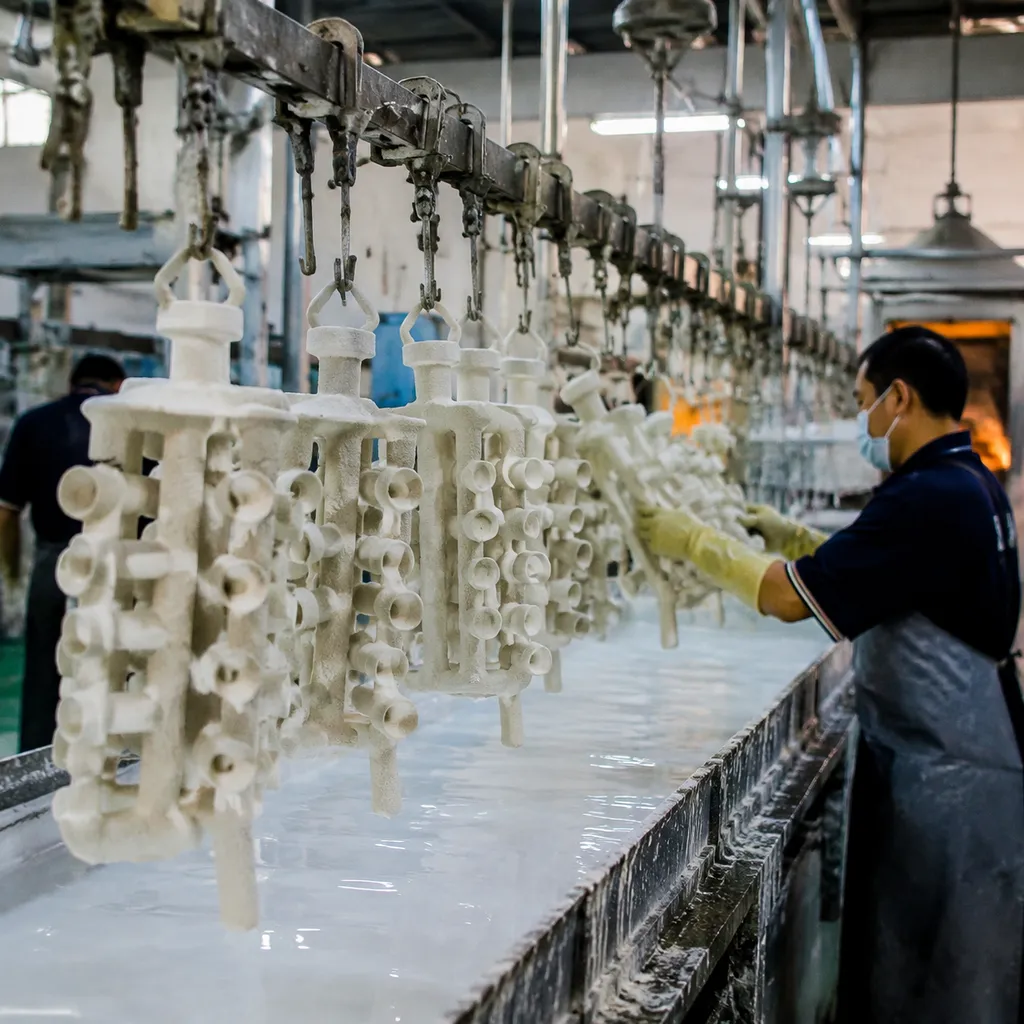
We integrate robust PLC control systems into our investment casting shell building process to ensure repeatability and precision. Our architecture centers on intuitive touchscreen HMI interfaces, allowing operators to manage complex recipes, monitor cycle status, and run diagnostics without navigating convoluted menus. By centralizing control, we eliminate manual variables that often lead to inconsistency in high-stakes environments.
Real-Time Process Tracking
Efficiency relies on data, which is why our systems provide continuous monitoring of the essential environmental and chemical variables: Slurry Rheology: Automated tracking of viscosity, temperature, and pH levels to maintain optimal coating thickness. Environmental Controls: Real-time logging of drying room airflow, humidity, and ambient temperature to guarantee standardized hardening. Diagnostic Alerts: Instant notification of system deviations to prevent mechanical downtime or slurry degradation.
Quality Compliance and Traceability
In sectors like aerospace and medical manufacturing, documentation is as critical as the casting itself. We implement rigorous quality compliance logging that archives every process parameter for every shell produced. This digital trail ensures that manufacturers can verify the integrity of casting quality standards for reliable metal parts and meet stringent audit requirements for high-performance components. By digitizing the shell building workflow, we provide the transparency necessary for total production control.
Industrial Applications and Casting Alloy Suitability
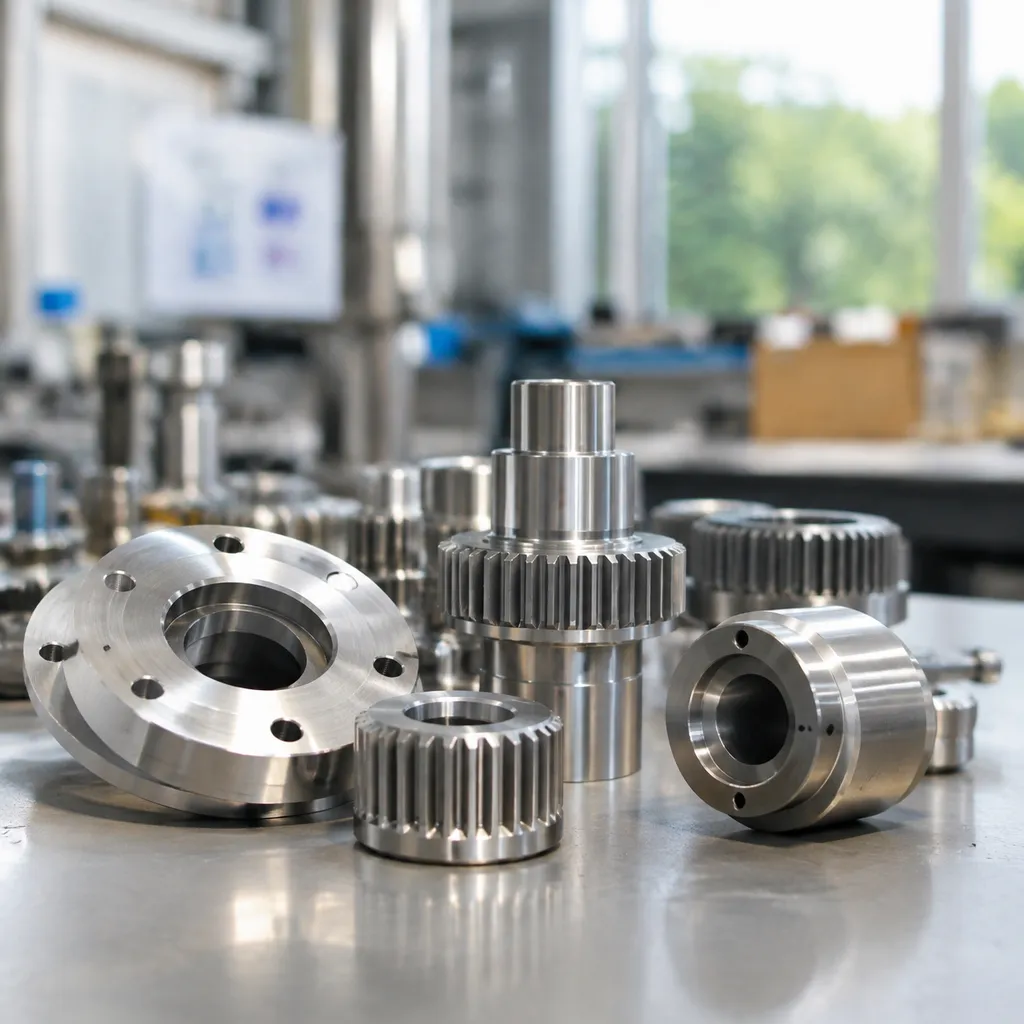
Our automated shell building systems are engineered to meet the stringent metallurgical requirements of high-performance sectors. By maintaining precise ceramic shell integrity, we ensure consistent casting results across diverse industrial applications:
- Aerospace & Defense: We support the production of turbine blades and complex hot-section components where thermal resistance and creep strength are non-negotiable. Our process is optimized for precision aerospace casting components and solutions that demand extreme dimensional accuracy.
- Medical Technology: Our systems accommodate the casting of orthopedic implants using specialized cobalt-chrome and titanium alloys, ensuring biocompatibility and intricate geometric detail.
- Automotive Performance: We facilitate the high-volume manufacturing of turbocharger wheels and exhaust hardware, where casting consistency directly impacts component longevity under high thermal stress.
- Industrial Infrastructure: Our shelling process provides the structural robustness required for heavy-duty, high-pressure industrial valves and pump impellers, ensuring reliable operation in demanding environments.
By integrating rigorous process controls, our equipment ensures that high-integrity alloys are cast with the surface finish and mechanical properties required by global engineering standards.
System Configurations for Investment Casting Shell Building Process
We design foundry layouts to maximize floor space and throughput, tailoring the configuration to your specific production volume and facility constraints. Our systems are built to scale, ensuring that your automated shell coating line with robotic precision integrates seamlessly into your existing operations.
Optimized Layout Options
- Compact Circular Cells: Ideal for smaller foundries, these cells utilize a central robot to handle dipping and stuccoing tasks in a confined, high-efficiency footprint.
- In-line Continuous Conveyor Systems: Best suited for high-volume production, these layouts move clusters through dedicated drying tunnels to maintain consistent cycle times and environmental control.
- Modular Expansion: We build systems that grow with your business, allowing for the addition of extra dip stations or drying modules without requiring a total system overhaul.
- Dual-Robot Integration: By utilizing robot integrators for custom investment casting cells, we enable simultaneous processing, doubling capacity for complex geometries that require multiple slurry types or extended drying intervals.
Quality Assurance, Testing, and Commissioning for Shell Systems
We ensure every automated cell integrates directly into your foundry workflow without unexpected downtime. Commissioning an automated investment casting shell building process demands rigorous hardware validation, slurry balancing, and structured team handoffs.
Factory Acceptance Testing and Site Commissioning Protocols
Before any system ships, we run exhaustive validation trials at our facility using your part geometry profiles:
- Dry Cycle Simulation: Full multi-axis motion profile verification, payload stress checks, and mechanical envelope clearance testing.
- Wet Slurry Testing: Real-load slurry tank dipping and stuccoing runs to confirm kinematic stability and uniform coat thickness.
- Site Acceptance Testing (SAT): On-site installation, utility hookups, sensor recalibration, and synchronization with existing drying lines.
- Production Validation: Live casting runs to verify shell integrity through dewaxing and pouring, consistent with advanced investment and precision casting services for metal parts.
Slurry Rheology Consulting and Parameter Optimization
Automated dipping depends entirely on chemical stability. Our process engineers work with your metallurgical team to eliminate shell failure at the root:
| Process Parameter | Target Control Band | Foundry Impact |
|---|---|---|
| Zahn Cup Viscosity | ±0.5 to 1.0 second variance | Prevents primary coat lifting and uneven backup walls |
| Slurry Temperature | 20°C to 22°C (±1°C) | Stabilizes binder evaporation rates and pot life |
| Solids Content / pH | Continuous titration checks | Prevents premature binder gelation and slurry waste |
| Airflow & RH | Zoned dry chamber control | Eliminates green shell cracking during autoclave dewaxing |
Operator Maintenance Training and Spare Parts Support
We provide hands-on training to get your operators and maintenance techs fully self-sufficient from day one:
- HMI & Recipe Programming: Teaching operators how to fine-tune dip angles, drain rotations, and sander dwell times.
- Preventive Maintenance Schedules: Daily, weekly, and monthly protocols for seal checks, gearbox lubrication, and tank drive servicing.
- Consumable & Critical Spare Kits: Pre-packaged spares including motor drives, rotary couplings, level sensors, and seal kits to guarantee zero line stoppages.
Frequently Asked Questions About Shell Building Systems
How many coats are typically required for lost wax ceramic shells?
Most standard industrial parts need between 5 and 9 coats to achieve sufficient green strength and thermal shock resistance during dewaxing and pouring. The exact coat count depends directly on the casting size, alloy pour temperature, and static metallostatic head pressure:
- Lightweight / Small Parts: 4 to 6 coats (1 primary, 3 to 4 backups, 1 seal coat).
- Medium to Large Castings: 7 to 9 coats (1 to 2 primaries, 5 to 6 structural backups, 1 seal coat).
- Heavy Structural Pours: 9+ coats reinforced with coarser refractory stucco grids.
Understanding the structural buildup requirements is essential when evaluating the advantages and disadvantages of lost wax casting for high-stress manufacturing runs.
What is the ideal drying room temperature and relative humidity?
Precise drying room climate control prevents premature lifting, cracking, or under-dried layers that fail during dewaxing. We engineer drying rooms around strict operating windows:
- Primary Coat: 20°C to 22°C (68°F to 72°F) at 50% to 60% relative humidity (RH) with gentle laminar airflow under 0.5 m/s to prevent wax pattern thermal distortion.
- Backup Coats: 21°C to 25°C (70°F to 77°F) at 40% to 50% RH with turbulent air circulation (1.5 to 2.5 m/s) to accelerate water evaporation without blistering the binder.
- Final Seal Coat: Dried down to under 35% RH to eliminate residual moisture before loading into the steam autoclave.
How does automated dipping improve mold yield over manual shelling?
Automated robotic dipping eliminates the human variability that drives shell-related scrap. In the investment casting shell building process, our automated cells deliver predictable consistency across three critical parameters:
- Uniform Shell Thickness: Multi-axis articulated robots maintain precise manipulation angles and rotation speeds, eliminating heavy slurry drainage rims and thin corner washouts.
- Consistent Slurry Wetting: Controlled entry and withdrawal speeds eliminate trapped air bubbles against the wax face coat, drastically reducing surface inclusion defects.
- Measurable Scrap Reduction: Foundries switching from manual dipping to automated cells consistently report a 15% to 25% reduction in overall casting scrap.
Can the system handle both water-based and solvent-based binders?
Yes. Our dipping tanks and slurry handling stations accommodate both water-based colloidal silica and alcohol-based ethyl silicate binders. When running solvent-based systems, we outfit the cell with explosion-proof (ATEX / Class I, Div 1) drive motors, sealed electrical enclosures, vapor extraction ducting, and anti-static pneumatic components to maintain complete operational safety.
 English
 Russian
 German