
2026年10月2日
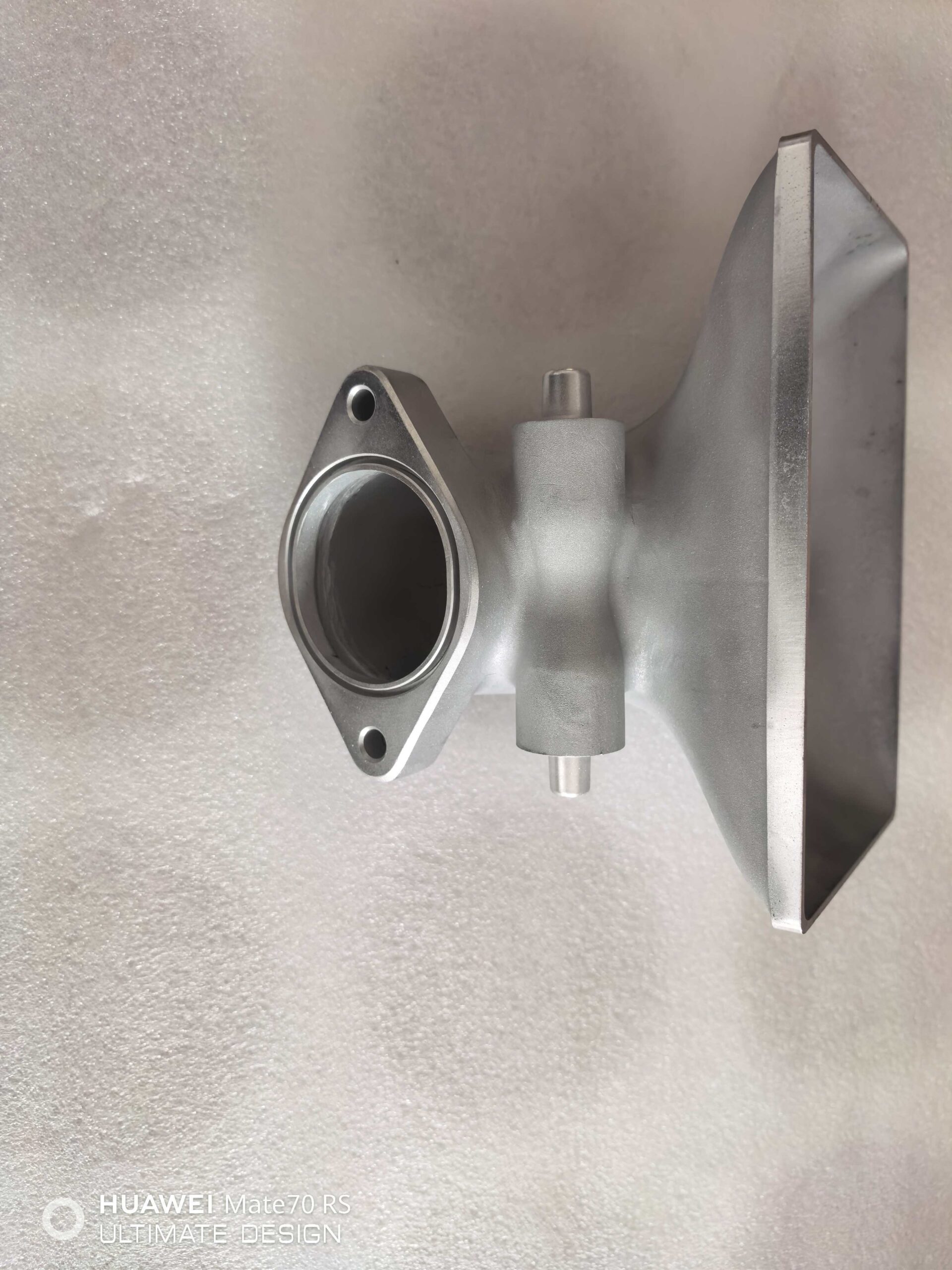
Foundry aluminum casting delivers lightweight durable precision parts with excellent strength corrosion resistance and custom manufacturing solutions
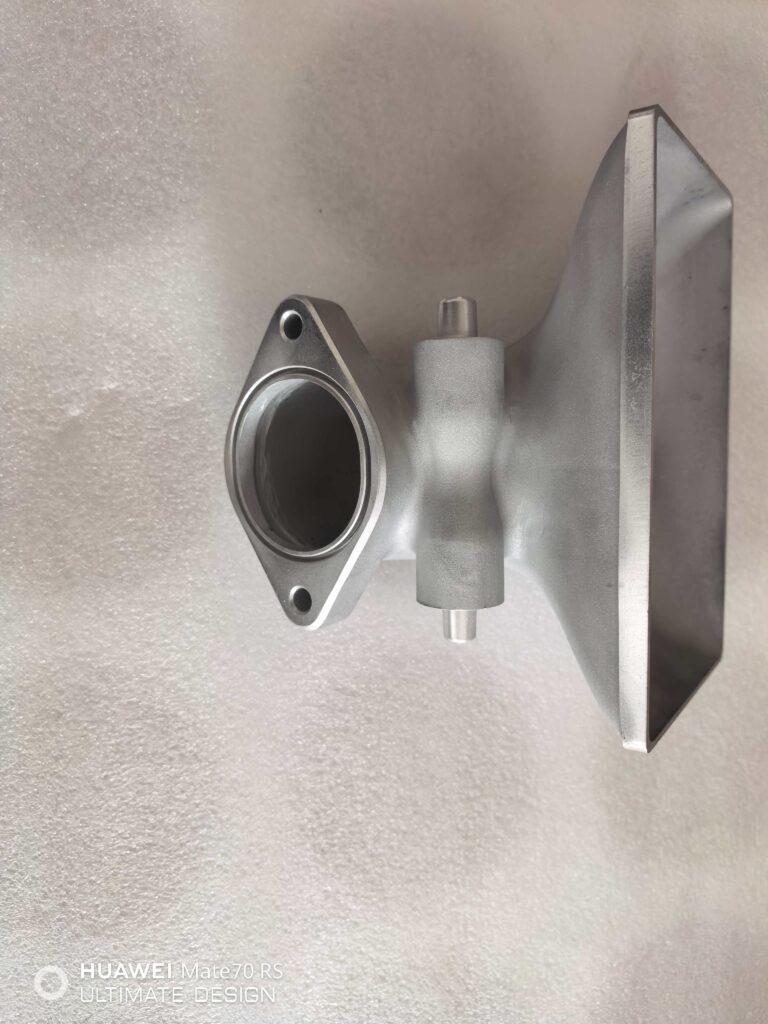
Core Aluminum Casting Methods in the Foundry
Choosing the right casting method dictates your upfront tooling investment, mechanical strength, and final unit cost. In our foundry aluminum casting operations, we match your annual volume, mechanical load specs, and geometric complexity to the optimal production method to eliminate porosity, reduce scrap, and avoid costly over-engineering.
+---------------------------+-----------------------+---------------------+-------------------------+ | Process | Typical Volume (p/yr) | Tolerance Class | Best Suited For | +---------------------------+-----------------------+---------------------+-------------------------+ | Sand Casting | 10 – 5,000 | ±0.030" – ±0.060" | Heavy structural bodies | | High-Pressure Die Casting | 10,000 – 100,000+ | ±0.002" – ±0.010" | High-volume thin walls | | Permanent Mold Casting | 1,000 – 50,000 | ±0.015" – ±0.030" | Pressure-tight parts | | Investment Casting | 100 – 10,000 | ±0.005" – ±0.015" | Complex internal paths | +---------------------------+-----------------------+---------------------+-------------------------+
Sand Casting for Heavy Structural and Low-Volume Parts
Aluminum sand casting delivers the fastest route from CAD to physical part with minimal tooling capital. We pack chemically bonded green sand or no-bake resin sand around precision wood, resin, or aluminum patterns to create robust molds for large-scale parts.
- Low Upfront Capital: Ideal for pilot runs, prototyping, and low-volume production where expensive hard tooling is not economically justified.
- Massive Part Capacity: Accommodates large-footprint castings weighing from 5 lbs up to 2,000+ lbs.
- Rapid Geometry Modifications: Pattern changes are fast and cost-effective, streamlining product iterations before committing to high-volume production.
High-Pressure Die Casting for High-Volume Precision Components
High-pressure die casting (HPDC) injects molten aluminum into hardened tool-steel dies under extreme hydraulic pressure (often exceeding 10,000 psi). This process fills complex cavities in fractions of a second, producing near-net-shape components with smooth surface finishes.
- Lowest Unit Cost at Scale: Rapid cycle times make HPDC the most cost-effective method for high-volume custom aluminum foundry parts.
- Thin-Wall Capabilities: Readily casts wall sections as thin as 1.5 mm while maintaining structural integrity.
- Minimal Secondary Machining: Casts precise bolt holes, locating pins, and intricate cooling fins directly into the part.
Permanent Mold Gravity Casting for Dense, Leak-Tight Parts
Permanent mold gravity casting utilizes reusable cast iron or steel molds, relying purely on gravity to draw molten aluminum smoothly into the mold cavity. The non-turbulent fill significantly reduces air entrapment and gas porosity.
- Superior Mechanical Properties: Chilling rates from the steel mold generate a fine metallurgical grain structure, delivering higher yield and tensile strength.
- Pressure-Tight Integrity: The dense microstructure makes gravity-cast parts ideal for hydraulic systems, fluid manifolds, and pneumatic valves that must pass 100% leak tests.
- Heat-Treatable Substrates: Unlike standard die castings, permanent mold components can undergo full T6 solution and aging treatments without blistering.
Investment Casting for Complex Thin-Wall Geometries
When a component demands zero draft angles, intricate internal undercuts, or tight contours that tooling cannot pull, our investment casting line provides the solution. We inject wax into precision dies, build a ceramic shell around the pattern assembly, melt out the wax, and pour the molten alloy into the remaining cavity.
- Extreme Geometric Freedom: Captures complex internal channels, cross-drilled passages, and sharp edge definitions.
- Near-Mirror Surface Finishes: Delivers as-cast surface roughness down to 125 RMS, reducing the need for post-cast polishing.
- Near-Zero Material Waste: Drastically cuts down CNC roughing cycles by delivering net-shape features straight from the shell.
Selecting the Right Foundry Aluminum Casting Alloy
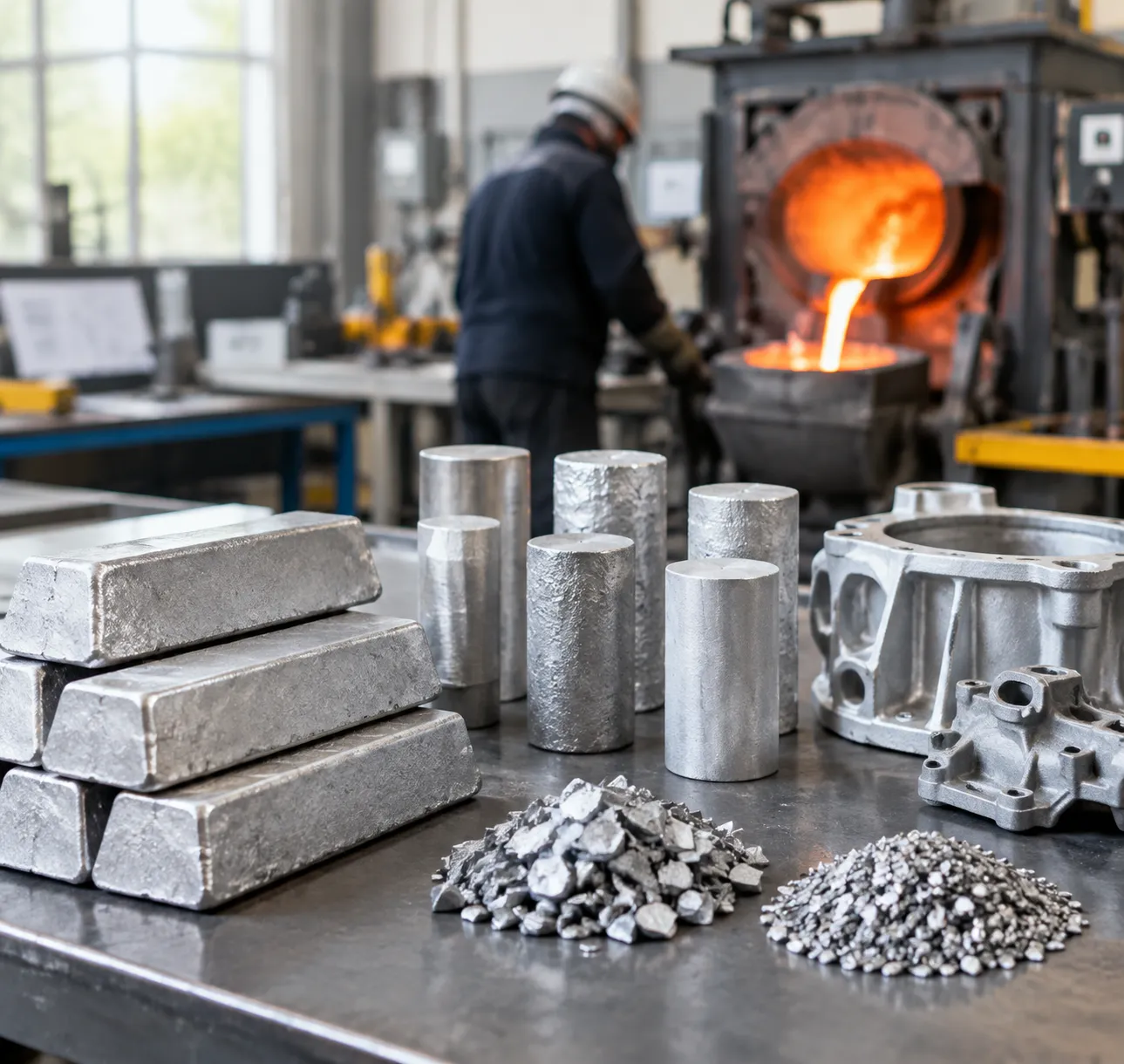
Choosing the right alloy determines how well a part fills the mold, handles mechanical stress, and resists environmental wear. In our foundry, we match raw alloy chemistry directly to your part geometry, required tolerances, and structural load. If you are comparing processes, explore our aluminum alloy casting guide for die, sand, and investment to see how alloy chemistry aligns with specific tooling methods.
A356 Alloy: High Strength and Impact Resistance with T6 Temper
A356 aluminum alloy is our primary choice for structural components that must endure heavy mechanical loads and cyclic stress. Core Strengths: Exceptional elongation, high yield strength, and excellent weldability. Heat Treatment: Standardly combined with a T6 heat treatment (solution heat-treat followed by artificial aging) to reach peak mechanical strength and impact resistance. Typical Uses: Automotive control arms, suspension knuckles, heavy-duty pump bodies, and high-integrity structural brackets.
A380 Alloy: Superior Fluidity and Dimensional Stability for Die Casting
A380 die casting alloy represents the vast majority of our high-volume production output due to its optimal balance of cost, castability, and mechanical properties. Core Strengths: Outstanding fluidity at elevated temperatures, excellent pressure tightness, and stable dimensional control across long production runs. Machining Performance: Contains targeted silicon and copper levels, making it straightforward to machine while maintaining high tool life. Typical Uses: Engine brackets, electrical enclosures, transmission cases, and power tool housings.
A383 and A413 Alloys: Thin Walls and Pressure-Tight Sealing
When standard alloys fall short on mold filling or leak prevention, we turn to specialized high-silicon formulations: A383 (ADC12 equivalent): Acts as a direct upgrade to A380 when casting complex, thin-walled parts. It offers superior hot-crack resistance and fills tight die cavities with minimal injection pressure. A413 Alloy: A near-eutectic silicon alloy providing maximum fluid flow and exceptional leak-tight density. We use A413 primarily for pneumatic cylinders, fluid manifolds, and marine valve bodies that require 100% leak-proof reliability under pressure.
Foundry Aluminum Casting Alloy Comparison Chart
| Alloy Grade | Primary Casting Method | Yield Strength (MPa) | Machinability | Corrosion Resistance | Pressure Tightness |
|---|---|---|---|---|---|
| A356-T6 | Sand / Gravity Permanent Mold | 165 – 205 | Very Good | Excellent | High |
| A380 | High-Pressure Die Casting (HPDC) | 160 – 190 | Good | Moderate | Very Good |
| A383 | High-Pressure Die Casting (HPDC) | 150 – 175 | Good | Good | Excellent |
| A413 | HPDC / Gravity Die Casting | 130 – 150 | Fair | Excellent | Superior |
Step-by-Step Foundry Aluminum Casting Process
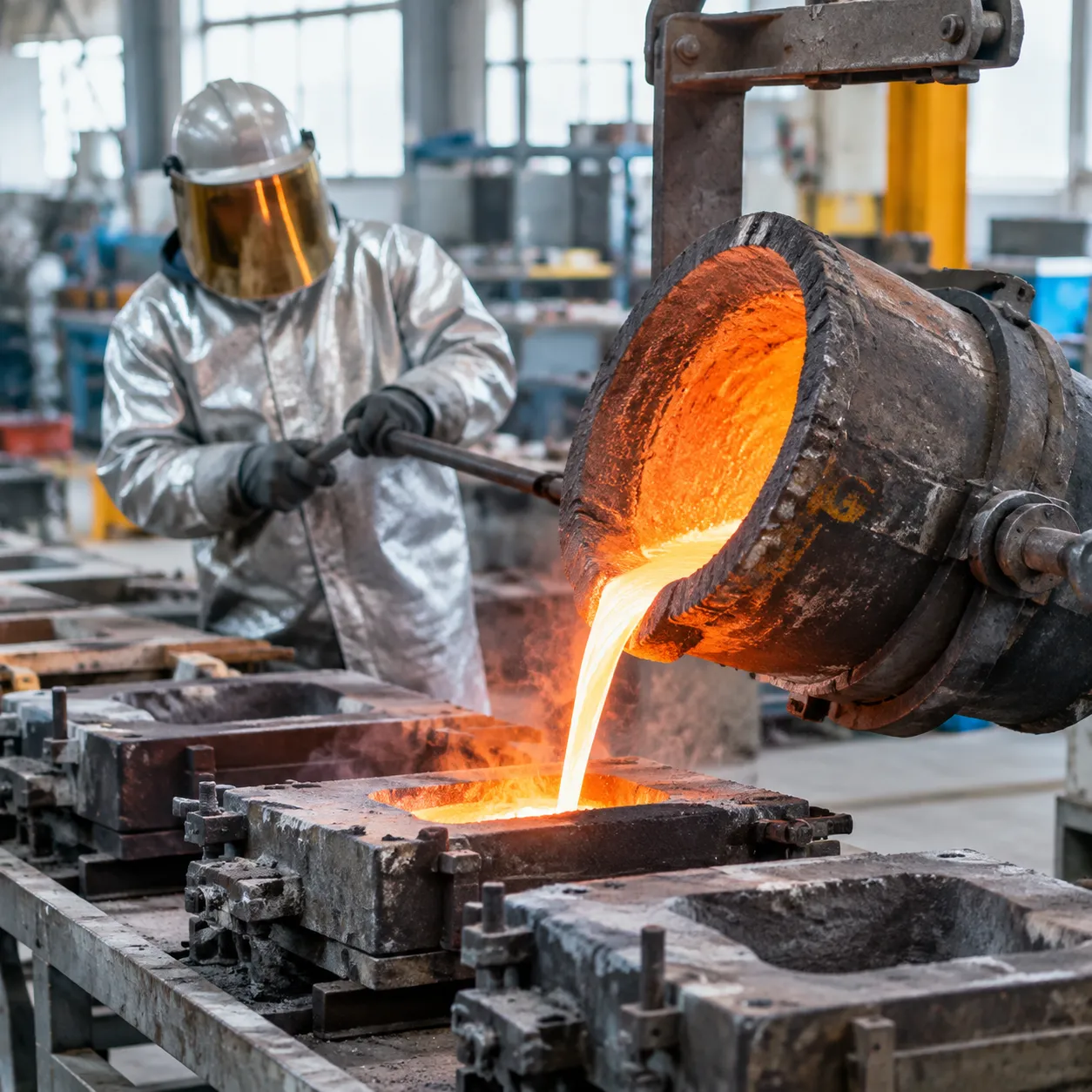
Delivering sound, defect-free parts requires strict process discipline at every stage of the melt and mold cycle. In our foundry aluminum casting operations, we eliminate porosity and dimensional variation by standardizing four core manufacturing phases. For a broader overview of production paths, explore our casting process guide.
3D CAD Tooling and Pattern Development
Every cast component begins with digital tooling engineering optimized for fluid dynamics and thermal behavior:
- Shrinkage and Draft Scaling: We apply alloy-specific contraction rates (typically 1.1% to 1.3% for standard aluminum alloys) and precise draft angles directly into the 3D model.
- Tool Fabrication: We machine high-durability tool steel dies for high-pressure casting or craft durable aluminum and urethane patterns for sand casting.
- Rapid Prototyping: For short production runs or urgent validation, we deploy 3D printed sand molds to skip hard tooling entirely and slash development lead times.
Degassing and Fluxing Molten Aluminum to Remove Impurities
Molten aluminum acts like a sponge for hydrogen gas and atmospheric oxygen, which lead to internal gas porosity and oxide inclusions if left untreated:
- Rotary Degassing: We inject inert argon or nitrogen gas through a submerged rotating impeller. The micro-bubbles lift dissolved hydrogen out of the bath.
- Fluxing and Drossing: Environmentally safe chemical fluxing agents bind with non-metallic oxides, floating them to the surface where our operators skim the dross clear.
- Melt Quality Verification: We use Reduced Pressure Testing (RPT) and spectrometer sampling to confirm chemical composition and ensure density before the melt moves to the pouring floor.
Pouring, Gating Design, and Controlled Thermal Solidification
Smooth metal transfer and thermal management prevent turbulence-induced air entrapment and voids:
- Engineered Gating Systems: Choke areas, runners, and filters regulate metal velocity, creating laminar flow into the mold cavity.
- Directional Solidification: We place strategic risers, feeders, and internal chill blocks to ensure thin sections freeze first while heavy sections draw feed metal continuously, guaranteeing shrinkage defect prevention.
- Precise Temperature Monitoring: Digital pyrometers regulate pouring temperatures within tight process windows (typically 680°C to 740°C depending on wall thickness) to avoid misruns and cold shuts.
Part Shakeout, Degating, and Trim Press Flash Removal
Once the metal cools below critical transformation temperatures, the cast parts undergo mechanical breakdown and cleaning:
- Mold Shakeout: Sand-cast parts run through vibratory knockout tables to cleanly separate molding media from the casting envelope, while automated extractors remove parts from permanent dies.
- Degating and Riser Cut-Off: Bandsaws, circular cutoff wheels, or hydraulic breakout stations remove gates, runners, and feeder heads.
- Flash Trimming: Dedicated hydraulic trim press dies sheer away parting line flash in a single stroke, leaving clean net profiles ready for heat treatment and CNC machining.
Heat Treatment and Secondary Finishing in Foundry Aluminum Casting
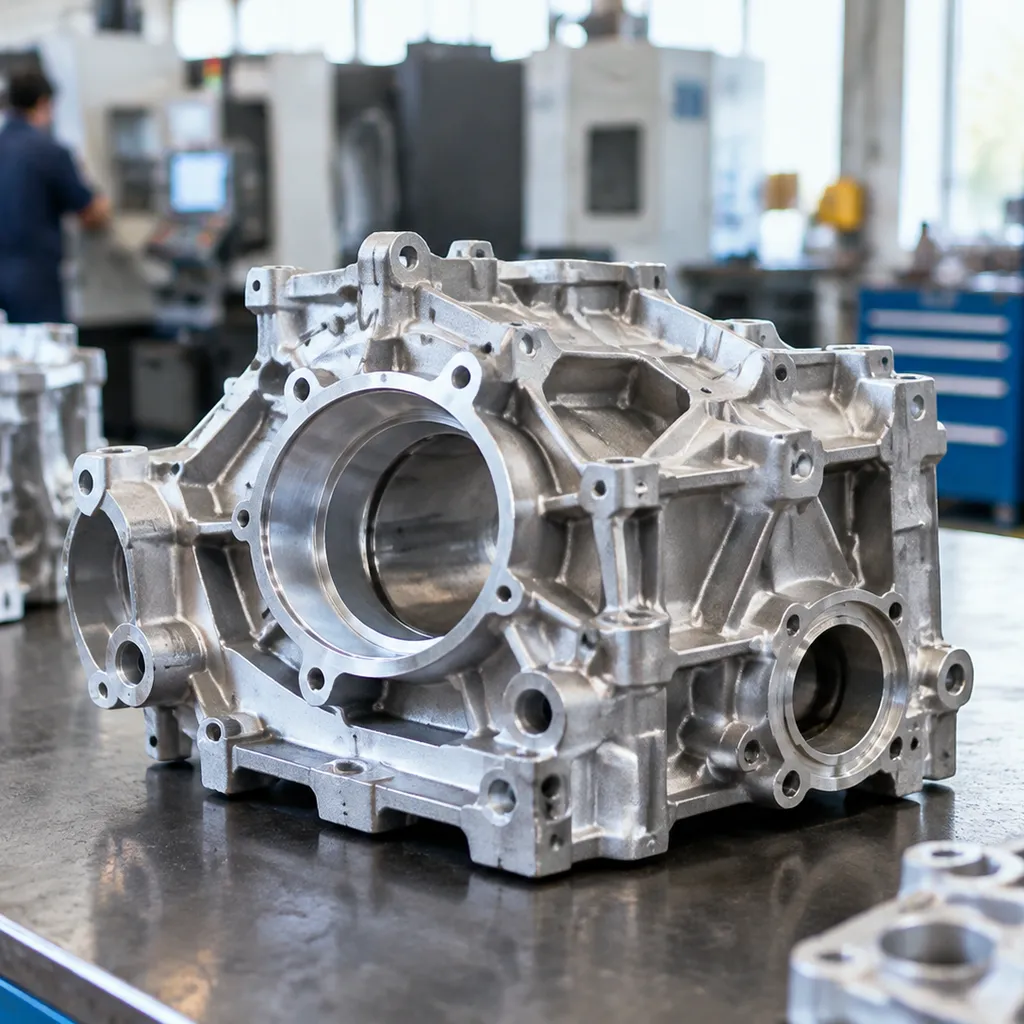
Raw castings rarely ship straight from the mold to the assembly line. To meet demanding mechanical specifications and tight geometric tolerances, we run post-cast thermal treatments, machining, and surface finishes entirely in-house.
T4, T5, and T6 Heat Treatment Cycles
Thermal processing alters the internal microstructure of cast aluminum to dramatically increase mechanical strength, hardness, and fatigue resistance.
- T4 Treatment (Solution Heat Treated & Naturally Aged): Increases ductility, elongation, and impact resistance. Best for structural parts subjected to dynamic shock loads.
- T5 Treatment (Artificially Aged Only): Air or water-quenched immediately after casting, then furnace-aged. Delivers dimensional stability and moderate hardness without the distortion risks of high-temp solution baths.
- T6 Heat Treatment (Solution Treated & Artificially Aged): Our standard cycle for heavy-duty alloys like A356. Boosts yield strength by up to 100% and optimizes hardness for high-load brackets, suspension knuckles, and pressure-tight housings.
| Temper Condition | Solution Treatment | Quench Step | Artificial Aging | Primary Benefit |
|---|---|---|---|---|
| T4 | Yes (~535°C) | Rapid Water Quench | No (Room Temp) | High ductility & impact toughness |
| T5 | No | Air/Mist Quench | Yes (~150°C–180°C) | Low distortion, improved machinability |
| T6 | Yes (~535°C) | Rapid Water Quench | Yes (~155°C–165°C) | Maximum tensile and yield strength |
Precision CNC Machining for Tight Tolerances
While our foundry processes yield near-net shapes, critical mating interfaces require sub-millimeter precision. We integrate dedicated fixturing and multi-axis milling to turn raw castings into finished components.
- Seal & Gasket Faces: Milling flat gasket surfaces to strict flatness specs (within 0.02 mm) to prevent hydraulic or oil leaks.
- Bearing Bores & Bushings: Precision boring and reaming to hold tight diameter tolerances (+/- 0.005 mm) and fine surface finishes.
- Drilling & Tapping: Automated multi-spindle drilling and thread tapping with hardened steel inserts (Heli-Coil) for high-stress fasteners.
- Datum Alignment: Establishing reliable machining datums directly off cast target points to maintain absolute feature-to-feature true position.
Combining our in-house foundry with multi-axis precision casting and CNC machining eliminates handoff delays, maintains single-source quality control, and cuts total component lead times.
Surface Preparation and Protective Coatings
We tailor post-cast surface finishing to enhance wear resistance, prevent environmental corrosion, and deliver specific cosmetic textures.
- Shot Blasting & Vibratory Tumbling: Uses stainless steel media or ceramic beads to remove flash, smooth rough parting lines, and yield a clean, uniform satin finish.
- Anodizing (Type II & Type III Hardcoat): Electrochemically grows an aluminum oxide layer directly on the part. Hardcoat anodizing provides extreme scratch resistance and electrical insulation for industrial housings.
- Powder Coating & E-Coating: Applies an electrostatic polymer layer baked for maximum UV and chemical resistance. Ideal for automotive brackets, valve covers, and outdoor marine hardware.
- Chemical Conversion (Chromate/Alodine): Creates a thin, conductive passivation layer that prevents oxidation while serving as an ideal bonding primer for secondary paint.
Foundry Quality Control and Defect Prevention in Aluminum Casting
Every critical cast component depends on internal soundness, exact metallurgy, and tight dimensional consistency. In our aluminum casting foundry, we eliminate defects before production begins and verify every production run using comprehensive in-line inspection systems.
Eliminating Gas Porosity and Shrinkage Defects Through Flow Simulation
Gas entrapment and localized shrinkage are primary causes of structural failure in aluminum cast components. We prevent these defects during the tooling design phase using advanced mold-filling and thermal solidification simulations:
- Virtual Flow Analysis: We map fluid velocity to prevent turbulent flow, air entrapment, and oxide skin formation during mold filling.
- Thermal Gradient Optimization: Simulation identifies hot spots where shrinkage cavities form, allowing our engineering team to position risers, chills, and gating systems for proper directional solidification.
- Venting and Vacuum Placement: In high-pressure die casting and permanent mold processes, we place overflow wells and vacuum chill vents at precise locations where gas naturally collects.
Real-Time X-Ray Inspection and Dye Penetrant Testing (NDT)
Subsurface integrity is critical for pressure-tight housings, structural brackets, and fluid-handling parts. We validate internal soundness using standardized non-destructive testing (NDT) methods:
- Radiographic X-Ray Inspection: Real-time digital X-ray scans identify internal gas porosity, shrinkage voids, and foreign inclusions in high-stress structural sections without damaging the part.
- Liquid Dye Penetrant Testing (PT): Fluorescent dye testing exposes micro-surface cracks, cold shuts, and parting-line defects on critical sealing faces and high-load radii.
- Pressure Decay Testing: We perform pneumatic and hydrostatic leak tests on cast housings to guarantee leak-free performance under operating pressures.
Spectrometer Chemical Analysis and CMM Dimensional Verification
Reliable foundry aluminum casting requires strict control over both chemistry and geometry:
| Inspection Method | Equipment Used | Target Verification | Quality Standard / Output |
|---|---|---|---|
| Melt Chemistry | Optical Emission Spectrometer (OES) | Silicon, magnesium, iron, and copper ratios in the melt | ASTM alloy compliance certificate per batch |
| Internal Soundness | Digital Industrial X-Ray | Subsurface void size, density, and location | ASTM E155 reference radiograph levels |
| Precision Dimensions | Automated 3D CMM & Laser Scanners | GD&T callouts, hole positions, datum planes, and profile tolerances | Full First Article Inspection (FAI) & CPK reports |
| Mechanical Properties | Universal Tensile & Hardness Testers | Yield strength, ultimate tensile strength (UTS), and elongation | Hardness mapping (HB/HRB) and heat-treat lot reports |
Our coordinate measuring machines (CMM) check raw castings and fully machined parts directly against your 3D CAD model, ensuring tight-tolerance bearing bores and mounting surfaces align properly on your assembly line.
Design for Manufacturability (DFM) and Cost Factors in Foundry Aluminum Casting
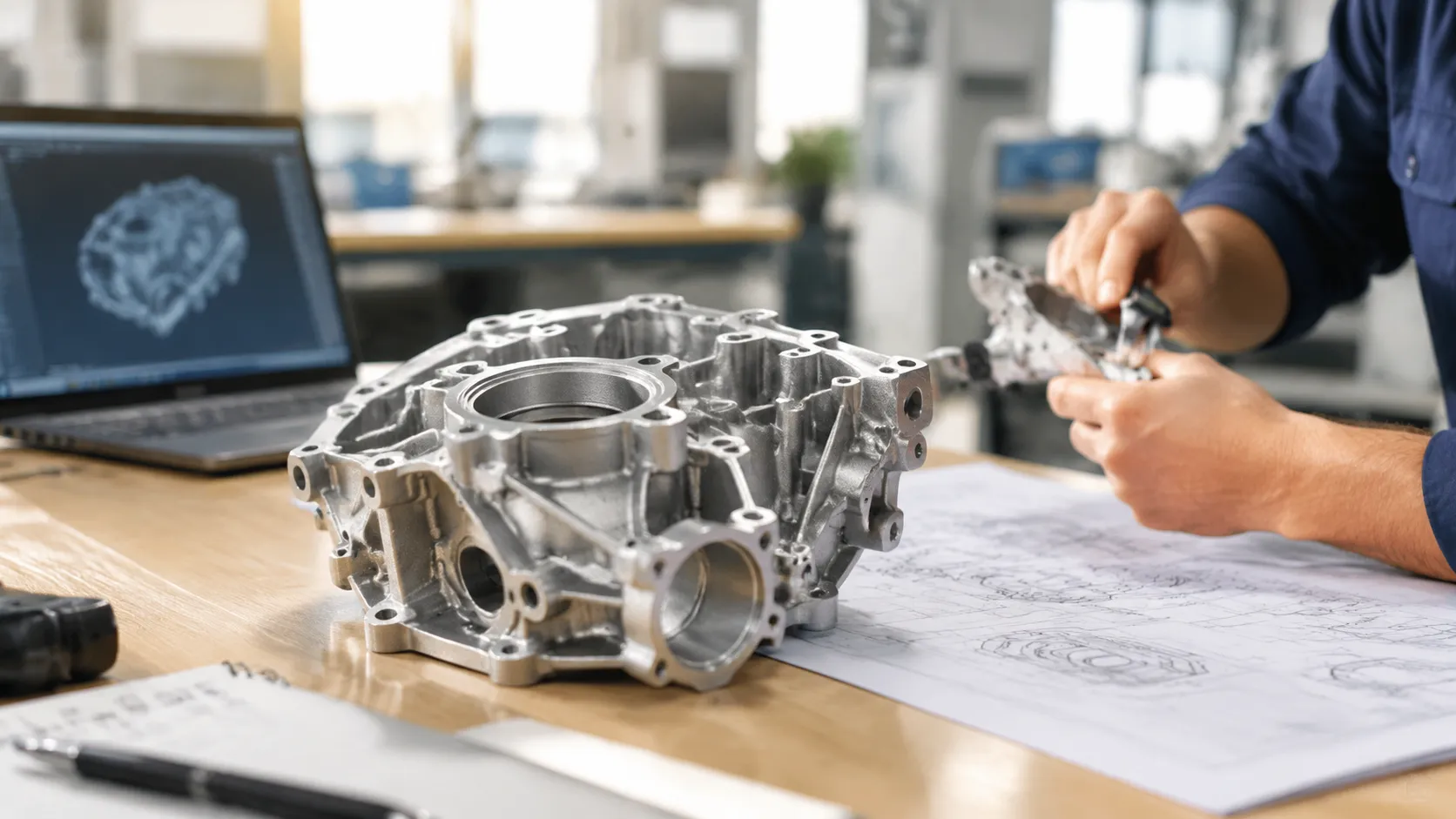
Smart component design directly controls manufacturing costs, scrap rates, and production speeds. When we review custom parts during upfront DFM analysis, our foundry focuses on geometry adjustments that simplify mold release, optimize metal flow, and minimize post-machining work.
Wall Thickness and Draft Angle Guidelines
Uniform wall thickness is critical to prevent thermal hot spots, sink marks, and internal shrinkage. When wall variations are necessary, our engineering team designs gradual transitions with generous fillets rather than sharp steps.
Proper draft angles allow cast parts to eject smoothly from tooling without dragging or surface tearing:
- Sand Casting: Minimum 1.0° to 3.0° draft to cleanly pull patterns from compacted sand molds.
- Permanent Mold Casting: 1.0° to 2.0° draft on outside walls; 2.0° to 3.0° on internal cores to accommodate metal contraction.
- High-Pressure Die Casting: 0.5° to 1.5° for outer walls; internal cores require at least 1.0° to 2.0° to prevent die sticking under high tonnage.
- Corner Radii: Avoid sharp 90° corners. We maintain internal corner radii equal to at least 1x nominal wall thickness to reduce stress concentrations and turbulence during mold fill.
| Process Type | Min. Wall Thickness | Typical Draft Angle | Machining Allowance |
|---|---|---|---|
| Sand Casting | 4.0 mm – 5.0 mm | 1.5° – 3.0° | 2.5 mm – 4.0 mm |
| Permanent Mold | 3.0 mm – 4.0 mm | 1.0° – 2.0° | 1.5 mm – 2.5 mm |
| Die Casting | 1.5 mm – 2.5 mm | 0.5° – 1.5° | 0.5 mm – 1.0 mm |
Tooling Costs vs. Unit Price Trade-offs
Production volume determines the most economical casting method. Tooling represents an upfront capital expenditure, while cycle time and labor drive recurring unit costs:
- Low Volume (1 to 500 units): Sand casting uses cost-effective wood, urethane, or soft aluminum patterns. Upfront tooling costs remain minimal, making it the practical choice for prototypes and small batches despite higher per-unit finishing labor.
- Mid Volume (500 to 5,000 units): Gravity permanent mold tooling machined from tool steel offers a balanced middle ground—moderate tooling costs with lower unit pricing and tighter structural density.
- High Volume (5,000+ units): Hardened H13 steel die casting mold tooling requires significant upfront capital. However, fast cycle times and near-net-shape tolerances yield the lowest piece price. Evaluating our die casting vs investment casting cost guide helps pinpoint the volume break-even threshold for complex designs.
Raw Material Yields and Scrap Recycling Efficiency
Molten metal utilization impacts the final part quote. The total weight poured into a mold includes the functional component plus gates, runners, overflows, and risers:
- Optimized Gating Ratios: We use computer-aided flow simulations to design lean gating systems that feed sound metal with minimal excess runner volume, driving metal yield above 65% to 75% per shot.
- Closed-Loop In-House Remelt: Clean aluminum trimmings, sprues, and dry machining chips are recovered, re-melted, degassed, and spectrographically verified. This closed-loop scrap recycling keeps raw material waste low and directly stabilizes production costs for custom aluminum foundry parts.
Key Industrial Applications for Foundry Aluminum Casting
We engineer custom aluminum castings for sectors where weight reduction, thermal management, and structural integrity are non-negotiable. By matching the right casting method and alloy to each operating environment, our foundry delivers durable, end-use components across major global industries.
Automotive Powertrain, Brackets, and EV Battery Enclosures
Modern vehicle manufacturing demands maximum strength with minimum mass. Our foundry aluminum casting processes provide high structural stiffness and thermal dissipation for critical automotive components:
- Electric Vehicle (EV) Systems: Thin-wall battery trays, inverter housings, and motor end-shields requiring EMI shielding and integrated cooling channels.
- Powertrain & Chassis: Engine brackets, transmission cases, engine blocks, and suspension knuckles designed to absorb dynamic road vibration.
- Safety & Structural Nodes: Shock towers and subframe crossmembers produced with high elongation alloys to meet crash-test crashworthiness standards.
Industrial Pump Housings, Fluid Valves, and Motor Frames
Industrial fluid systems and heavy machinery require leak-tight castings capable of handling continuous pressure, cavitation, and corrosive media. Working as a dedicated sand casting manufacturer for custom metal parts, our team casts robust components designed for long service life:
- Fluid Handling: High-pressure pump bodies, hydraulic manifolds, and valve bodies verified through hydrostatic pressure testing.
- Drives & Actuation: Heavy-duty motor frames and gearbox housings featuring cast-in cooling fins for efficient heat dissipation.
- Compressor Components: Dense, pressure-tight scroll housings and cylinder heads free of subsurface gas porosity.
Aerospace Structural Fittings and Electrical Enclosures
For aerospace, defense, and high-spec electronics, failure is not an option. We deliver precision-cast aluminum parts with tight metallurgical consistency:
- Avionics & Radar Enclosures: Lightweight, hermetically sealed chassis and ruggedized junction boxes that protect sensitive electronics from vibration and moisture.
- Structural Mounts & Brackets: High-integrity cargo brackets, ducting hardware, and flight-control hinge fittings cast from premium A356-T6 alloy.
- Thermal Sinks: Complex heat exchangers and cold plates with thin-wall geometries engineered for optimal airflow and passive cooling.
Frequently Asked Questions About Foundry Aluminum Casting
What is the strongest aluminum casting alloy?
For high-stress structural parts, A206 and A356-T6 are the top choices:
- A206-T71: Offers extreme tensile strength (up to 450 MPa) and exceptional fracture toughness. It is ideal for aerospace brackets and high-impact structural nodes, though it requires precise cooling controls during pouring.
- A356-T6: The industry standard for high-strength cast parts. It delivers tensile strengths around 260–310 MPa with excellent ductility, high corrosion resistance, and predictable thermal solidification behavior.
How do foundries prevent porosity in critical cast parts?
Gas porosity and shrinkage voids can ruin mechanical properties and pressure integrity. We prevent casting porosity through strict melt controls and advanced process engineering:
- Rotary Argon Degassing: Purges dissolved hydrogen gas from the molten bath before pouring to eliminate gas porosity.
- Flow & Solidification Simulation: Custom gating and feeder designs ensure progressive directional solidification, feeding liquid metal into heavy sections until fully solidified.
- Vacuum-Assisted Casting: Used in die casting to evacuate air from the die cavity before alloy injection.
- Non-Destructive Testing: We verify internal integrity using real-time radiographic X-ray casting inspection and dye penetrant testing on critical structural zones.
What is the difference between aluminum sand casting and die casting?
The choice between sand casting and high-pressure die casting (HPDC) depends primarily on part size, structural requirements, and production volume.
| Feature | Aluminum Sand Casting | High-Pressure Die Casting (HPDC) |
|---|---|---|
| Tooling Cost | Low to moderate (wood, resin, or aluminum patterns) | High (hardened tool steel dies) |
| Production Volume | Low to medium runs (1 to 5,000 pcs/year) | High volume (10,000+ pcs/year) |
| Tolerance Range | ±0.5 mm to ±1.5 mm (requires CNC finishing) | ±0.05 mm to ±0.2 mm (net-shape capability) |
| Wall Thickness | Typically ≥4.0 mm | Thin walls down to 1.5 mm |
| Common Alloys | A356, 319, AlMag 535 | A380, A383, A413 |
| Best For | Heavy pump housings, engine blocks, large frames | High-volume brackets, thin enclosures, housings |
For tight-tolerance geometries that fall between these two methods, specialized aluminum investment casting provides complex, thin-walled precision without heavy tooling investments.
What are standard tooling lead times and minimum order quantities (MOQs)?
Lead times and order volumes reflect the tooling complexity and casting method:
- Rapid Prototyping & Sand Patterns: 2 to 4 weeks for pattern build and first-article samples. MOQs can be as low as 1 to 10 pieces for custom developmental runs.
- Permanent Mold & Die Casting Tooling: 6 to 10 weeks for hardened steel dies, flow validation, and CMM dimensional inspection reports. Production MOQs typically start at 500 to 1,000 pieces to offset setup and machine changeover costs.
For dedicated OEM production schedules, our aluminum foundry services for precision castings handle complete DFM optimization, tool design, heat treatment, and precision CNC machining under a single quality management system.
 English
  Russian
  German