
2026年8月27日
Custom ductile iron castings with nodular graphite high tensile strength and impact resistance for automotive machinery and infrastructure
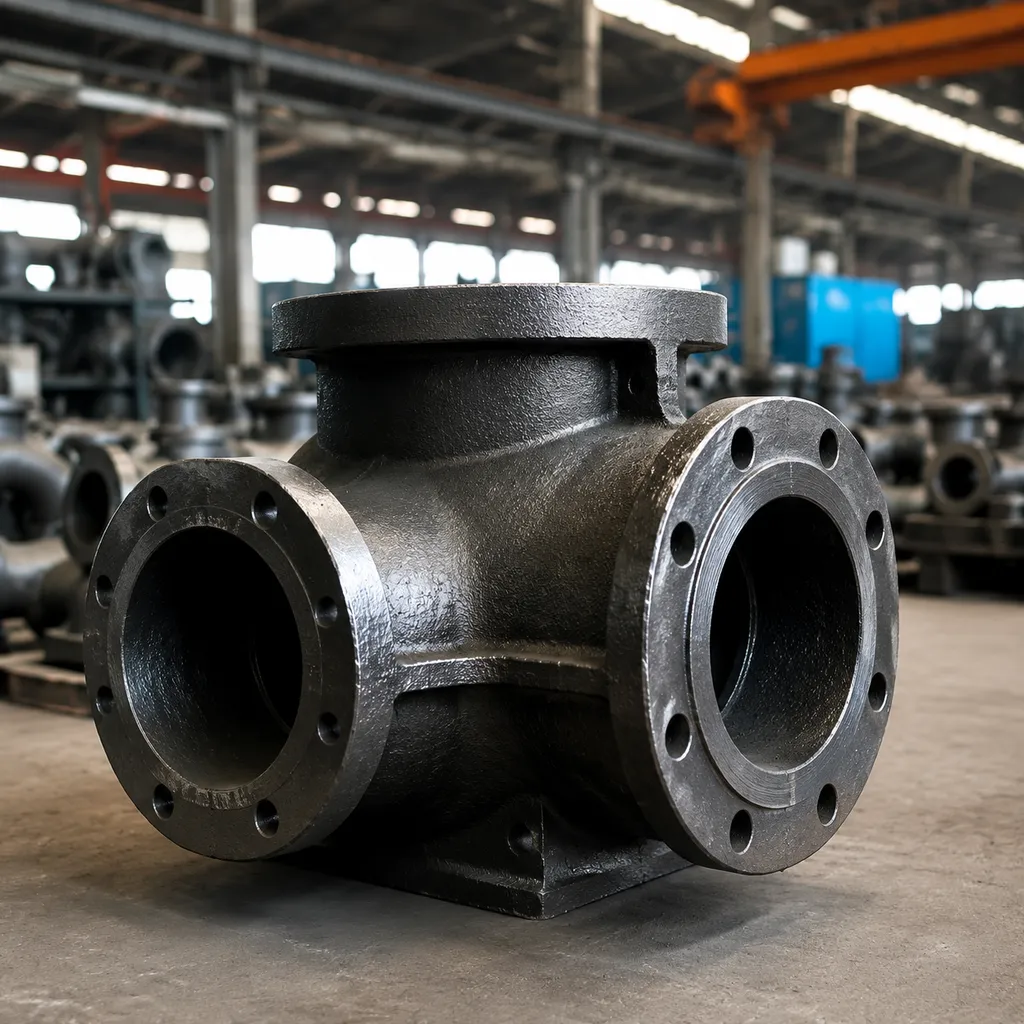
Material Science & Structural Advantage
Standard gray iron components often fail under severe shock or dynamic loads because internal graphite flakes act as sharp stress concentrators. Through precise inoculations, our ductile iron cast process transforms these internal flakes into smooth, spherical nodules—fundamentally changing how the alloy responds to severe mechanical stress.
Nodular Graphite Microstructure
- Stress Reduction: Spherical graphite nodules eliminate the sharp interior edges found in gray iron flakes, preventing stress concentration points.
- Crack Resistance: The continuous matrix surrounding the spheroids prevents micro-crack propagation under heavy thermal and physical strain.
- Matrix Control: Tailored heat treatments allow us to fine-tune the pearlite-ferrite matrix ratio, balancing high hardness with extreme toughness.
Mechanical Superiority of SG Iron
Our spheroidal graphite iron (SG iron) provides mechanical properties that rival carbon steel forgings while retaining the cost-effective manufacturability of cast iron:
- High Yield Strength: Yield strength exceeds standard gray iron by over 100%, enabling thinner, lighter wall designs without sacrificing structural safety.
- Superior Ductility: Plastic deformation capabilities reaching up to 18% elongation prevent catastrophic brittle failure.
- Vibration Damping: Absorbs operational noise and mechanical shock significantly better than cast carbon steel, extending component lifespan.
- Impact Resistance: Retains superior Charpy impact values in low-temperature and high-vibration applications.
Performance Comparison Matrix
| Performance Metric | Ductile Iron (SG Iron) | Gray Iron | Cast Carbon Steel |
|---|---|---|---|
| Tensile Strength | 400 - 800 MPa | 150 - 350 MPa | 450 - 700 MPa |
| Yield Strength | 250 - 600 MPa | Negligible | 230 - 450 MPa |
| Elongation | 3% - 18% | < 0.8% | 15% - 25% |
| Machinability | Excellent | Superior | Moderate |
| Vibration Damping | High | Very High | Low |
| Relative Unit Cost | Moderate | Low | High |
ASTM A536 Ductile Iron Cast Grades
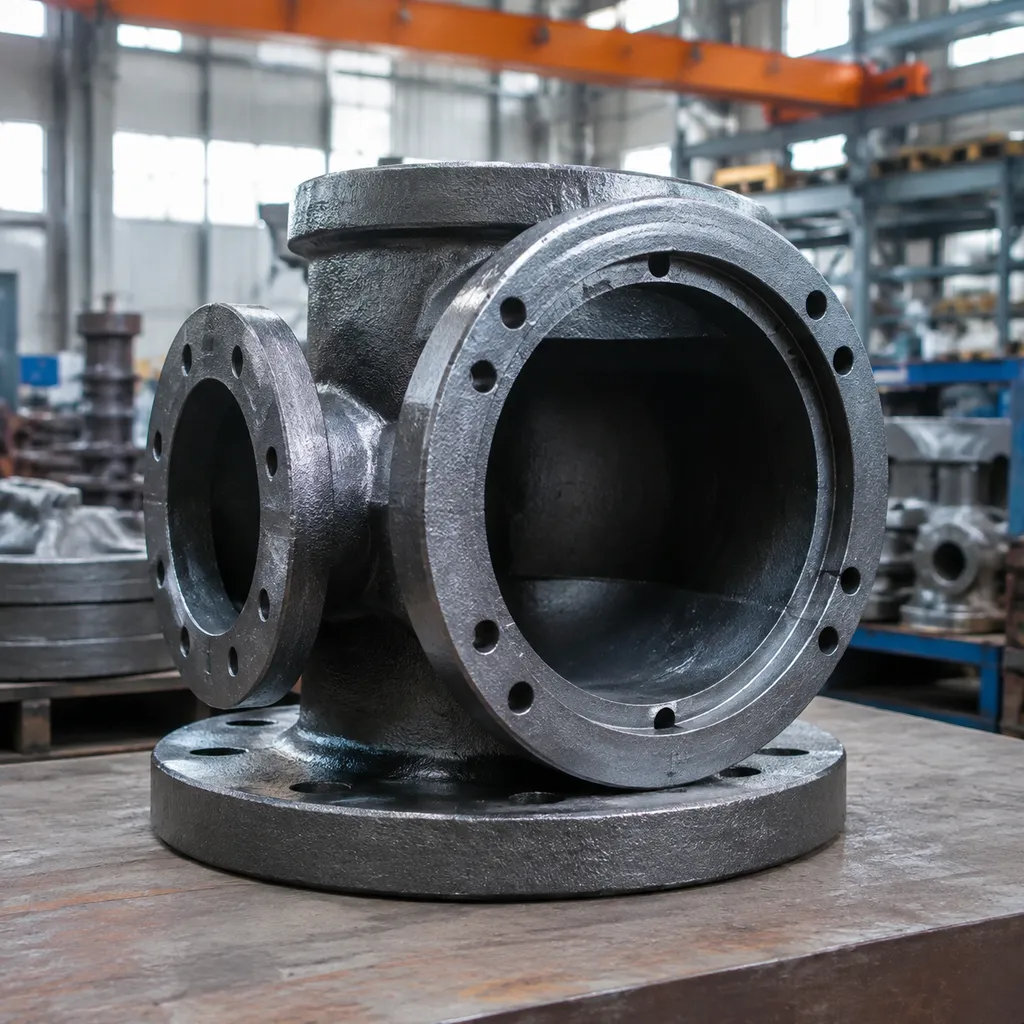
At Vastpcc, we engineer standard ASTM A536 grades tailored for precise mechanical loads, ensuring every ductile iron cast component matches exact structural requirements.
- Grade 65-45-12: High-ductility grade providing superior impact resistance and high elongation (12% minimum). Ideal for pressure-containing components and shock-loaded applications.
- Grade 80-55-06: Mid-range grade delivering a balanced combination of high yield strength, wear resistance, and reliable machinability.
- Grade 100-70-03: High-strength cast ductile iron grade featuring optimal hardness and fatigue endurance for heavy-duty structural equipment.
Austempered Ductile Iron (ADI)
When components face extreme mechanical stress without room for added weight, we produce Austempered Ductile Iron (ADI). Through precise thermal processing of spheroidal graphite iron, ADI achieves roughly double the tensile strength of standard ductile grades while retaining high impact toughness. This makes ADI an exceptional, lightweight alternative to expensive steel forgings and fabricated parts.
Chemical Composition Matrix
We control melt chemistry using spectrometer analysis and controlled inoculants to secure exact microstructural properties.
| Element | Range (%) | Primary Influence |
|---|---|---|
| Carbon (C) | 3.50 – 3.80 | Ensures graphite nodule formation and fluidity |
| Silicon (Si) | 2.20 – 2.80 | Promotes graphitization and matrix strength |
| Manganese (Mn) | 0.20 – 0.50 | Increases pearlite ratio and tensile performance |
| Magnesium (Mg) | 0.03 – 0.06 | Key inoculant that converts graphite into spherical nodules |
Advanced Foundry Capabilities for Ductile Iron Cast Components
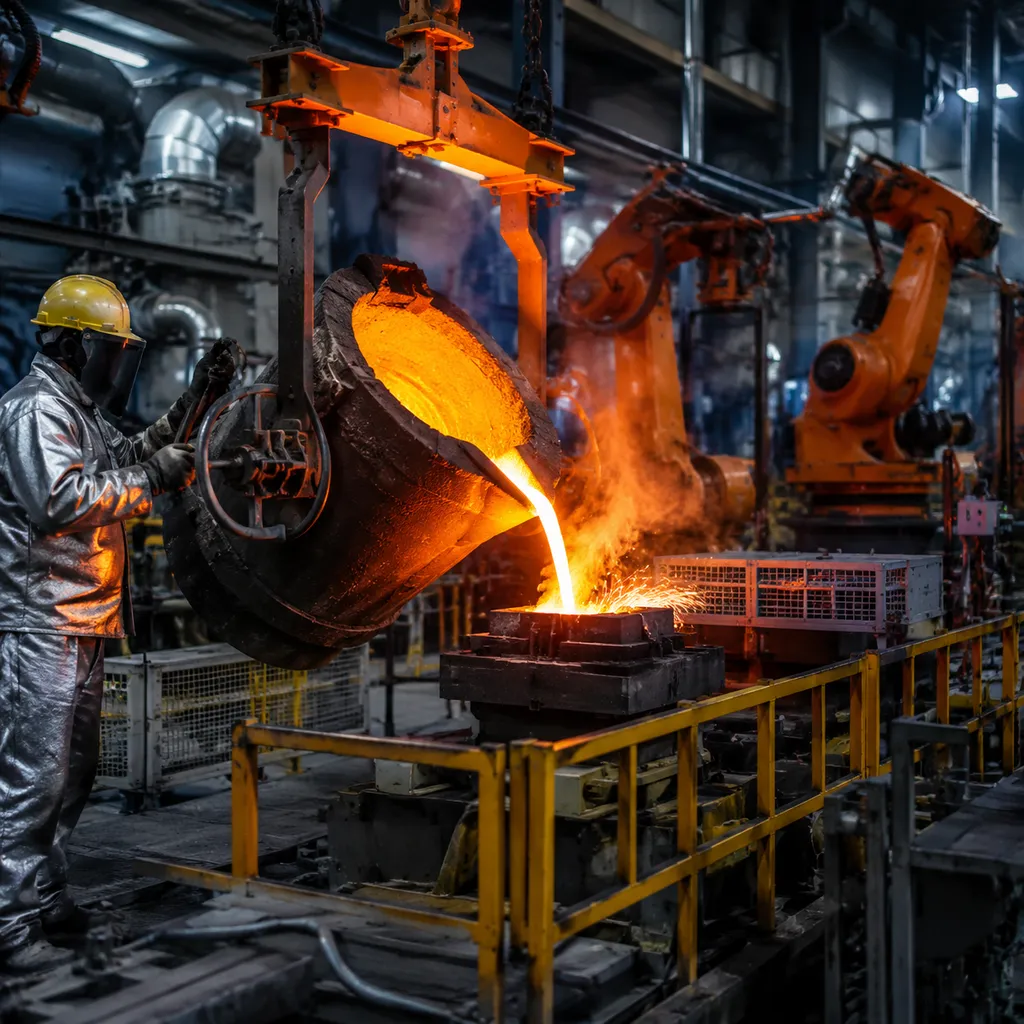
We leverage flexible manufacturing processes to deliver high-integrity ductile iron cast components tailored to demanding structural standards. By integrating specialized green sand casting process options with silica sol investment casting and automated dewaxing autoclaves, we optimize material yield and structural stability.
| Process Option | Core Advantage | Primary Application |
|---|---|---|
| Silica Sol Investment Casting | High dimensional precision & smooth finish | Intricate shapes, thin walls |
| Green & Resin Sand Casting | Cost-effective for large-scale production | Heavy machinery components, pump bodies |
| Automated Shell Coating | Uniform shell thickness, low defects | Mass-production ductile iron casting |
Robotic Process Control & Tight Tooling
Our automated production lines eliminate manual variation and enforce strict process repeatability:
- Micron-Level Tooling Alignment: Robotic positioning maintains tooling alignment within 5 µm, virtually eliminating wall thickness variations.
- Controlled Metal Pouring: Automated ladle operations keep pouring temperatures uniform, securing consistent nodular structures throughout every casting ductile iron cycle.
In-House OEM Ductile Iron Machining
To deliver drop-in, tight-tolerance finished parts, we combine complete sand mold casting and CNC machining under one roof. Our OEM ductile iron machining capabilities include:
- Precision Turning & Milling: Multi-axis CNC centers execute complex geometry machining to exact customer prints.
- Drilling & Tapping: Automated multi-spindle drilling and precision thread tapping for hydraulic ports and structural mountings.
Surface Treatment & Corrosion Protection
- Shot Blasting: Cleans surface scale and prepares raw castings for secondary coatings.
- E-Coating & Epoxy Coating: Creates continuous, corrosion-resistant barriers against harsh chemical and outdoor exposure.
- Zinc Plating & Anti-Rust Treatment: Prevents oxidation during global logistics and inventory storage.
Quality Assurance & Inspection for Ductile Iron Cast Parts
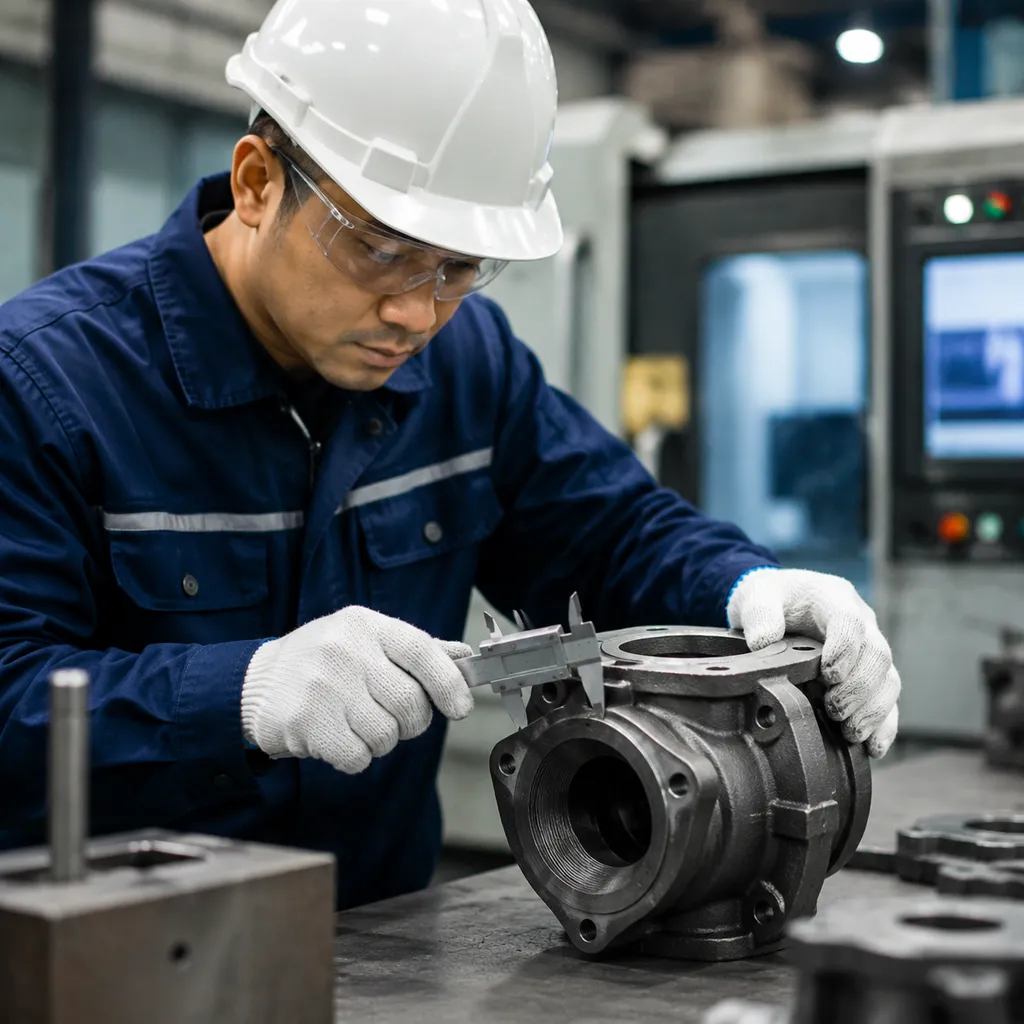
We enforce zero-defect quality control across every ductile iron cast batch that leaves our foundry floor. Our multi-stage auditing process verifies chemical chemistry, microstructural integrity, and exact dimensional precision before any part hits assembly lines.
Metallurgical & Microstructural Control
We test the liquid melt and solid samples to guarantee core mechanical properties: Spectrometric Analysis: Real-time chemical analysis monitors Carbon (C), Silicon (Si), Manganese (Mn), and residual elements prior to pouring. Nodularity Testing: Microstructural analysis guarantees a minimum target of >85% graphite nodularity to ensure maximum strength and toughness in our spheroidal graphite iron castings.
Non-Destructive Testing (NDT)
We deploy advanced NDT protocols to detect internal voids, subsurface defects, and microscopic surface cracks without damaging finished components: Ultrasonic Testing (UT): Audits internal soundness and locates subsurface inclusions or shrinkage porosity. Magnetic Particle Inspection (MPI): Identifies near-surface planar defects on ferrous surfaces. Radiographic Testing (RT): High-energy X-ray verification for critical stress areas and variable wall sections. Dye Penetrant Inspection (DPI): Highlights fine surface discontinuities on complex machined geometries.
Mechanical & Dimensional Verification
Our testing lab validates structural capacity against international engineering specs: Tensile & Hardness Testing: Destructive tensile testing verifies yield strength, tensile limits, and Brinell hardness (HBW) values. Charpy Impact Testing: Evaluates energy absorption and notch toughness under high-impact conditions. CMM Dimensional Auditing: Coordinate Measuring Machines inspect critical feature tolerances against native CAD files. When deploying automated lines or integrating custom automated assembly systems with precision vision inspection, we maintain tight, repeatable tolerances across high-volume production runs.
Traceability & Certification
We back every order with full raw-material-to-shipment documentation: Mill Test Reports (MTR): Material certificates supplied per EN 10204 3.1 standards, detailing exact melt chemistry and heat-lot test results. ISO 9001 Compliance: Full process control and lot traceability to meet strict OEM quality management requirements.
Target Applications & Case Studies for Ductile Iron Castings
We manufacture high-precision ductile iron cast components for demanding industrial applications where structural integrity, fatigue strength, and pressure tightness are vital.
Key Industry Applications
| Industry Sector | Core Applications | Key Performance Driver |
|---|---|---|
| Automotive & Commercial Vehicles | Steering knuckles, brake calipers, control arms, differential cases | High fatigue resistance and impact absorption under dynamic road loads. |
| Fluid Handling & Valves | High-pressure valve bodies, butterfly valve discs, pipe flanges, centrifugal pump casings | Superior pressure-tight integrity and burst strength under cyclic hydraulic pressure. |
| Heavy Machinery & Mining | Transmission housings, hydraulic manifolds, track shoes, bracket arms | Outstanding vibration damping, high wear resistance, and high yield strength. |
Case Study: Weldment-to-Casting Conversion
A commercial machinery client approached us to re-engineer a multi-piece fabricated steel bracket arm that suffered from joint fatigue risks and excessive assembly costs. By converting the component into a single-piece ductile iron casting, we optimized the geometry to reinforce high-stress zones while eliminating redundant material.
- Weight Reduction: Achieved a 25% weight reduction by eliminating heavy weld seams and optimizing wall thickness.
- Cost Savings: Delivered a 30% cost savings in unit manufacturing by cutting down manual fabrication, assembly, and testing steps.
- Performance Boost: Achieved superior fatigue endurance and stress distribution across the entire structure, matching performance parameters outlined in our forging and casting comparison.
Our engineered cast ductile iron solutions give equipment builders a direct path to lighten structural weight while boosting structural durability and profitability.
Vastpcc OEM/ODM Ductile Iron Cast Workflow
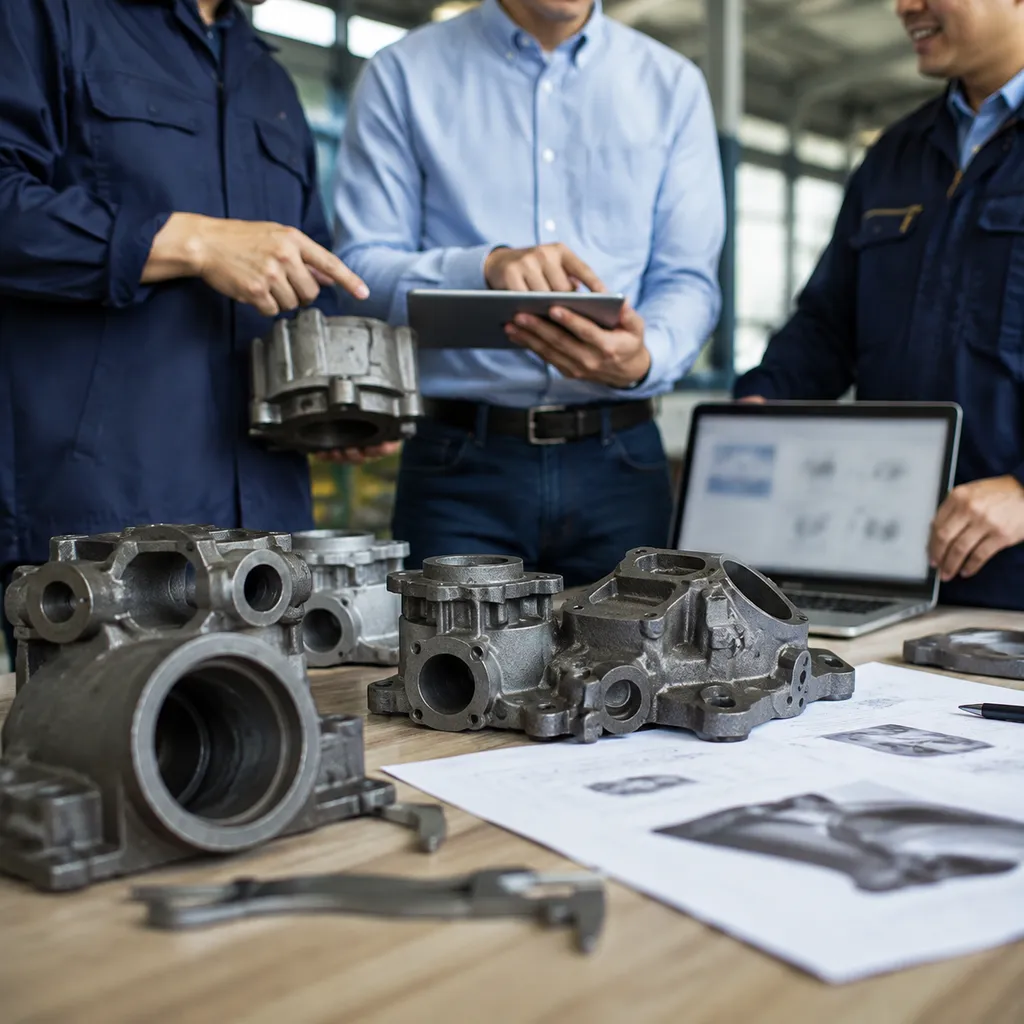
We streamline custom manufacturing from raw concept to finished components. As a dedicated custom ductile iron foundry, our 5-phase OEM/ODM workflow guarantees structural integrity, tight tolerances, and scalable production for every ductile iron cast part we produce.
5-Step Sourcing & Manufacturing Process
| Phase | Stage | Technical Execution |
|---|---|---|
| Phase 1 | Design for Manufacturability (DFM) | Comprehensive engineering review evaluating wall thickness uniformity, draft angles, and parting line placement to eliminate shrinkage and stress points. |
| Phase 2 | Tooling & Prototyping | 3D pattern development and mold production using precise cast prototypes to validate part geometry prior to mass tooling. |
| Phase 3 | Sample Sign-Off | First Article Inspection (FAI) report delivery, backed by full CMM dimensional auditing, spectro-chemical analysis, and tensile test data. |
| Phase 4 | Automated Mass Production | Continuous nodularization control, automated mold pouring, and robotic handling for consistent, high-volume cast ductile iron output. |
| Phase 5 | Global Logistics & Delivery | Specialized VCI anti-rust treatment, heavy-duty export packaging, and flexible door-to-door international logistics. |
Core Production Standards
- Tooling Accuracy: Tooling and pattern designs account for exact solidification shrinkage rates tailored to spheroidal graphite iron grades.
- Precision Finishing: In-house OEM ductile iron machining provides exact tolerances on critical sealing surfaces, mounting bores, and tapped threads.
- Corrosion Protection: Finished components receive custom anti-rust oil, E-coating, or specialized surface treatments before export wrapping to ensure arrive-safe condition across global shipping routes.
Technical FAQ: Ductile Iron Cast Solutions
What is the primary mechanical difference between ductile iron and gray iron?
The key distinction lies in the graphite microstructure and fracture toughness. Cast ductile iron features spherical graphite nodules, whereas gray iron contains sharp flake graphite. This structural difference drastically alters physical performance:
- Tensile & Yield Strength: Ductile iron achieves up to twice the yield strength of gray iron.
- Ductility & Elongation: Ductile iron provides 2% to 20% elongation before failure, compared to virtually 0% in gray iron.
- Impact Resistance: Spherical nodules stop microscopic crack growth under shock loads, making a ductile iron cast component far more resilient in dynamic stress applications.
What dimensional tolerances can Vastpcc achieve on cast ductile iron parts?
Tolerances depend on the casting process chosen for your geometric requirements:
| Process Type | ISO 8062 Tolerance Class | Typical Dimensional Accuracy |
|---|---|---|
| Ductile Iron Investment Casting | CT4 – CT6 | ±0.15 mm to ±0.3 mm |
| Precision Shell Mold Casting | CT6 – CT8 | ±0.3 mm to ±0.5 mm |
| Resin Sand Casting | CT7 – CT9 | ±0.5 mm to ±1.0 mm |
| In-House Precision CNC Machining | N/A | Up to ±0.005 mm |
Can Vastpcc customize chemical compositions for high-temperature or corrosive environments?
Yes. We tailor chemical formulations to meet specialized operational environments. By introducing precise ratios of Silicon (Si), Molybdenum (Mo), and Nickel (Ni), we produce high-alloyed ductile iron casting variants such as:
- SiMo Ductile Iron: Formulated for high-temperature exhaust manifolds and turbocharger housings operating up to 820°C.
- Ni-Resist Nodular Iron: Formulated with high nickel content for elevated corrosion resistance in marine pumps, valves, and chemical processing equipment.
What are the typical lead times for tooling prototypes versus mass production runs?
We optimize production schedules to streamline your supply chain:
- Tooling & Prototyping Phase: 15 to 25 calendar days. Includes 3D pattern development, mold construction, trial pouring, and First Article Inspection (FAI) dimensional reporting.
- Mass Production Runs: 20 to 35 calendar days following FAI sign-off, supported by our scalable foundry capabilities as a custom sand casting manufacturer.
 English
  Russian
  German