
2026年9月12日
Compare sand casting vs investment casting including processes costs materials precision surface finish and ideal applications for informed manufactur
Understanding Sand Casting: Process, Capabilities, and Limitations
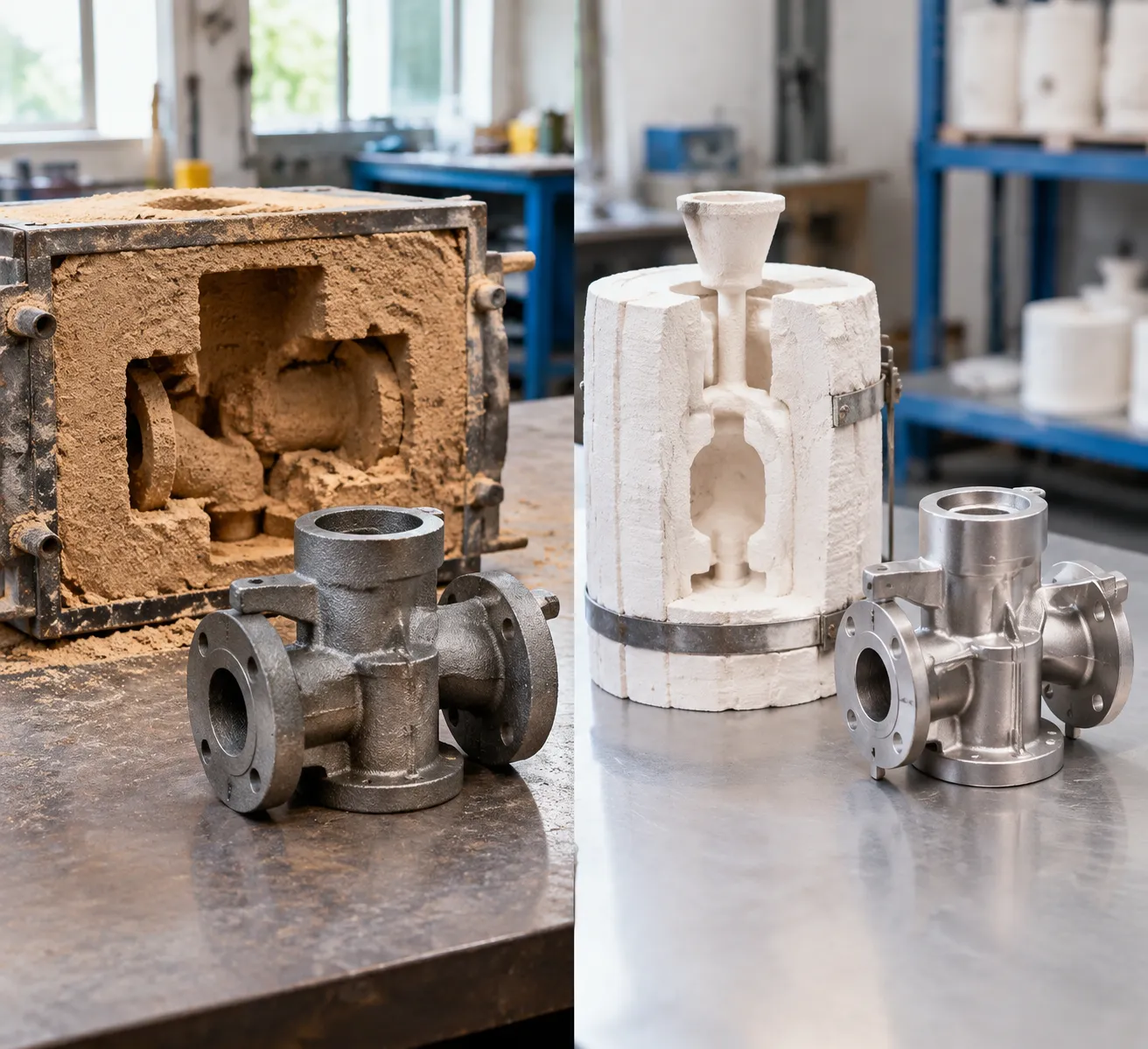
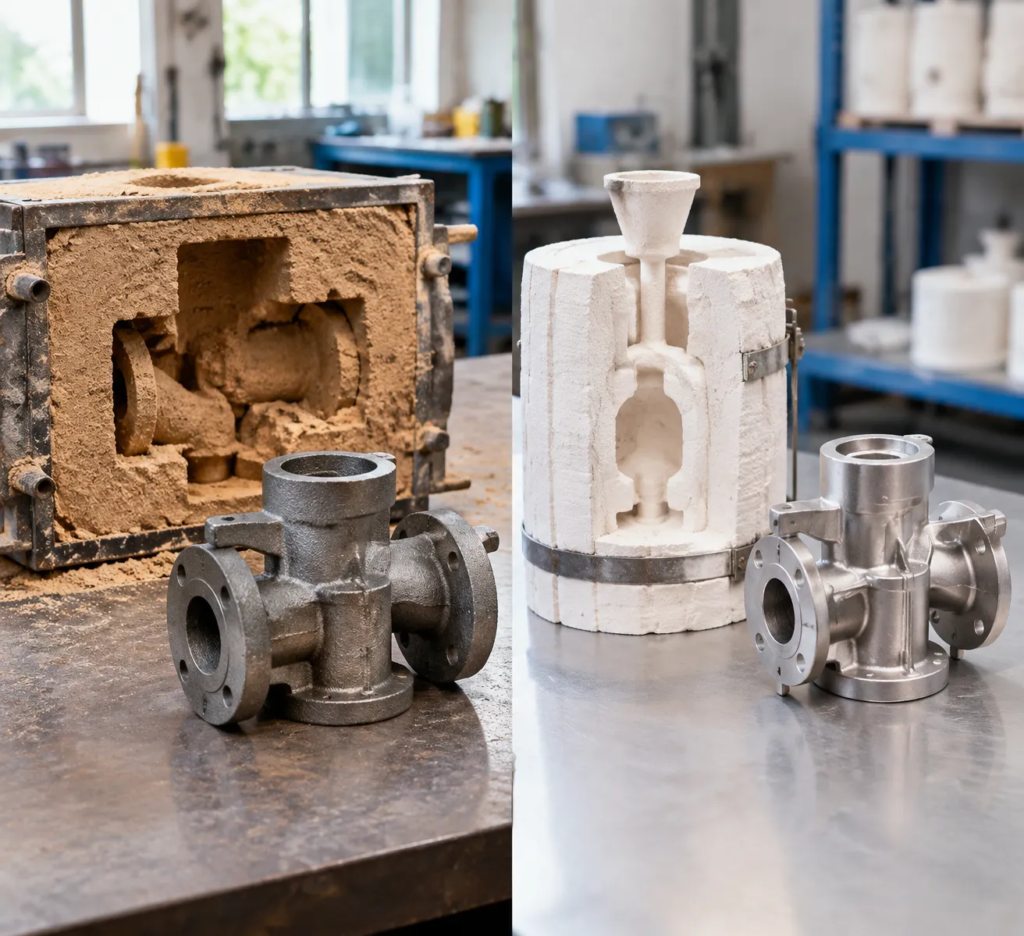
Sand casting remains one of the most versatile and cost-effective manufacturing methods for producing robust metal components. At our foundry, we leverage this traditional yet highly refined process to produce parts ranging from small brackets to massive industrial machinery bases.
Pattern Creation and Sand Mold Compaction
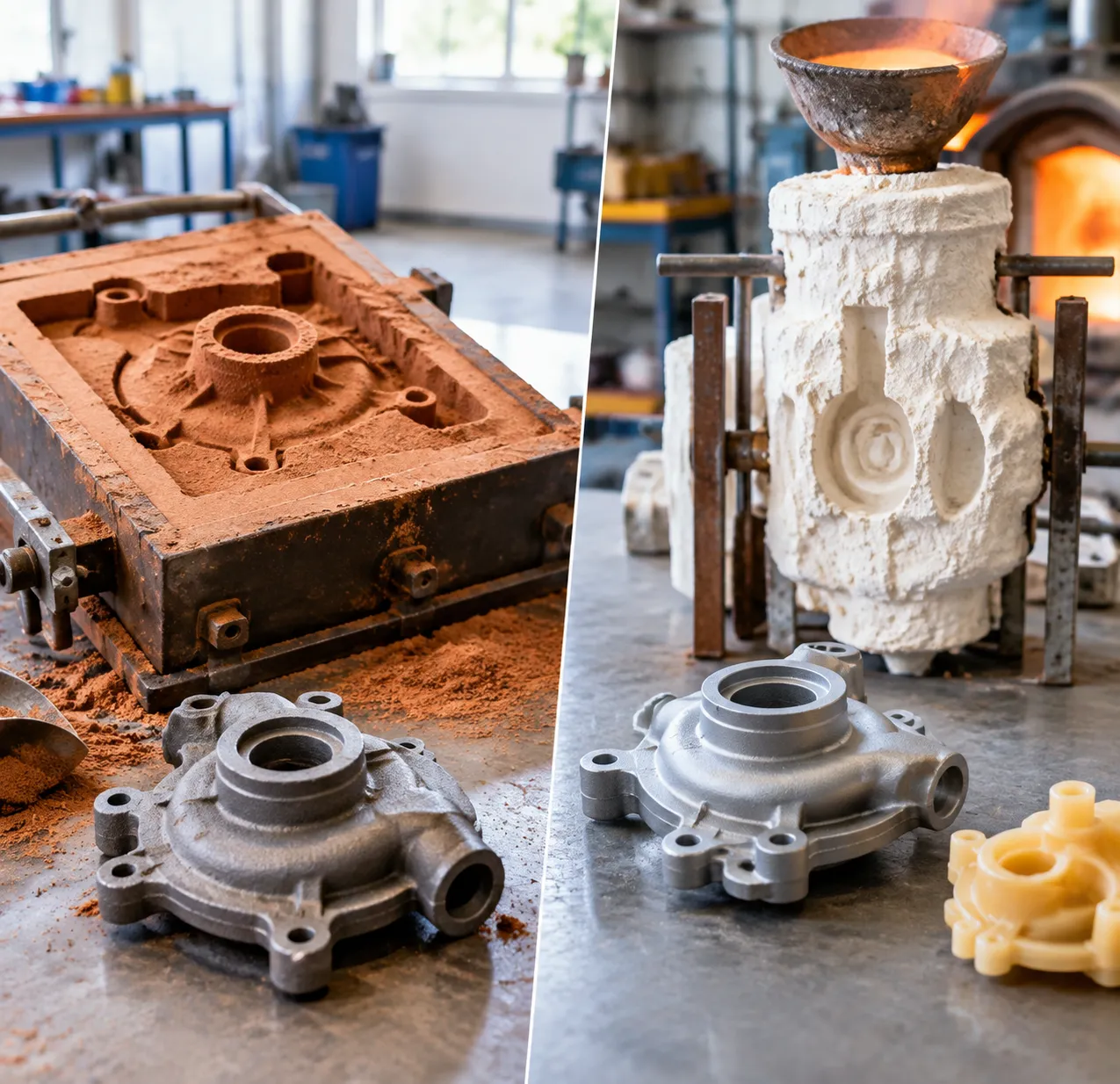
The process begins with creating a physical pattern made of wood, resin, or aluminum, representing the final part geometry with calculated shrinkage allowances:
- Green Sand Molding: A mixture of silica sand, bentonite clay, and moisture is compacted around the pattern. It is the most economical choice for high-volume, standard-tolerance production.
- Resin Sand (No-Bake) Molding: Sand mixed with chemical binders hardens at room temperature, delivering superior mold rigidity, sharper detail definition, and improved dimensional stability for complex, heavy castings.
Molten Metal Pouring, Cooling Cycle, and Shakeout
- Mold Assembly: The cope (top half) and drag (bottom half) are aligned with gating and riser systems to control metal flow and prevent shrinkage defects.
- Pouring: Molten metal is poured into the mold cavity under gravity.
- Cooling & Solidification: Controlled thermal dissipation ensures structural integrity across thick wall sections.
- Shakeout & Cleaning: The sand mold is mechanically vibrated and destroyed to release the casting, followed by shot blasting and gating removal.
Key Advantages
- Low Tooling Costs: Pattern tooling is significantly cheaper to fabricate and modify than high-precision steel dies.
- Massive Part Capacity: Handles components from under 1 kg up to several tons.
- Broad Material Versatility: Highly compatible with gray iron, ductile iron, carbon steel, bronze, and aluminum alloys.
- Rapid Turnaround: Shorter initial setup times allow for faster initial sample delivery.
Inherent Limitations
- Coarser Surface Texture: Typical as-cast surface roughness ranges between Ra 6.3 µm and 12.5 µm (or higher in coarse green sand), necessitating post-process grinding or shot peening.
- Wider Dimensional Tolerances: Standard linear tolerances generally fall between ±0.5 mm and ±1.5 mm, requiring extra machining allowances on critical mating faces.
- Draft Angle Constraints: Requires standard draft angles (typically 1° to 3°) to allow clean pattern extraction without damaging mold walls.
Understanding Investment Casting: The Lost-Wax Precision Method
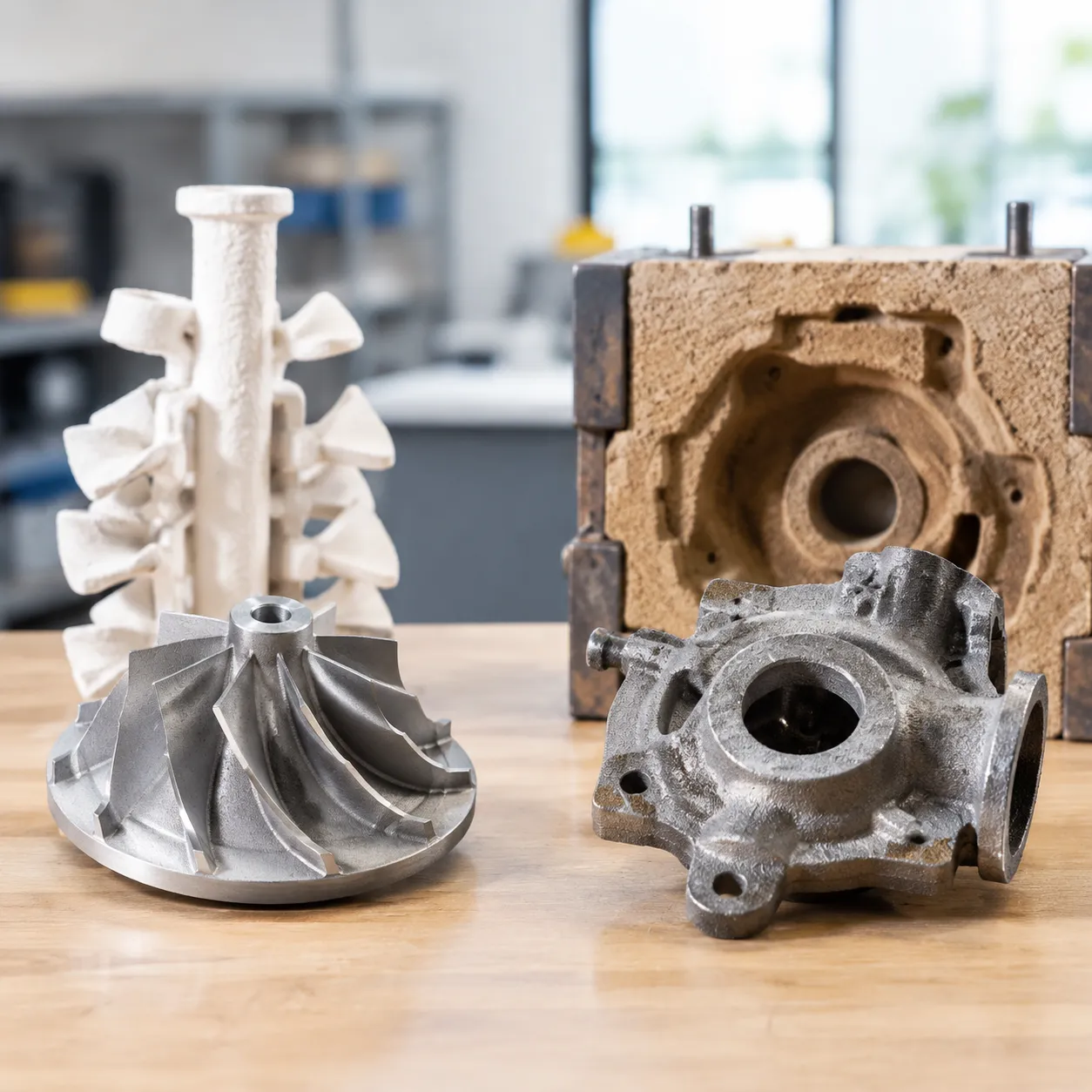
When our clients need tight tolerances and complex details that standard sand molds cannot match, we turn to the lost-wax investment casting process. This precision manufacturing technique produces net-shape or near-net-shape metal parts, significantly cutting down or completely eliminating secondary CNC machining.
Step-by-Step Investment Casting Process
- Wax Pattern Injection: We inject specialized wax into precision metal dies to create exact replicas of the target component. Multiple wax patterns are then assembled onto a central wax sprue to create a production "runner tree."
- Ceramic Shell Building: The assembly is repeatedly dipped into high-grade refractory ceramic slurry and coated with fine ceramic stucco. Each layer dries before the next is applied, building a durable, heat-resistant shell.
- Dewaxing and Shell Burnout: We place the ceramic molds into an autoclave to melt out the wax (hence "lost wax"). The hollow shell is then fired at high temperatures to burn out any residual wax and sinter the ceramic structure.
- Molten Metal Pouring: Liquid metal is poured into the preheated ceramic mold under precise thermal controls.
- Ceramic Knockout and Finishing: Once solidified and cooled, the ceramic shell is mechanically knocked off or vibrated away. Parts are cut from the tree, ground at the gates, and inspected.
Our specialized investment and precision casting services for metal parts ensure consistent metallurgical integrity throughout every production cycle.
Key Advantages
- Intricate Geometries: Capable of producing thin walls down to 1.5 mm, fine lettering, blind holes, and complex undercuts.
- Superior Surface Finish: As-cast surface roughness averages Ra 1.6 to 3.2 µm, delivering a clean, smooth appearance straight out of the mold.
- High Precision: Maintains strict dimensional tolerances (CT4–CT6), minimizing the need for expensive post-machining.
- Alloy Versatility: Ideal for high-melting-point alloys, stainless steel, and nickel- or cobalt-based superalloys.
Inherent Limitations
- Higher Tooling Investment: Metal injection dies require higher initial upfront capital compared to sand casting patterns.
- Extended Setup Lead Times: Multi-layer ceramic shell dipping, drying, and dewaxing cycles require longer processing times.
- Size and Weight Constraints: Best suited for parts ranging from a few grams up to approximately 50–100 kg; larger or multi-ton components are typically not cost-effective.
Evaluating these trade-offs early helps optimize budgets. For a deeper breakdown of structural trade-offs, review the advantages and disadvantages of lost wax casting before locking in your final part design.
Sand Casting vs Investment Casting: Core Technical Comparison
When choosing between these two metal casting methods, technical tolerances, surface quality, and geometric limits dictate your downstream production costs. Here is how both processes perform side by side in our production facility:
| Technical Parameter | Investment Casting (Lost Wax) | Sand Casting |
|---|---|---|
| ISO Dimensional Tolerance | CT4 – CT6 (typically ±0.1 mm to ±0.3 mm) | CT10 – CT13 (typically ±0.5 mm to ±1.5 mm) |
| Surface Roughness ($Ra$) | Ra 1.6 – 3.2 µm (smooth, satin finish) | Ra 12.5 – 25 µm (granular, coarse texture) |
| Minimum Wall Thickness | 1.0 mm – 1.5 mm | 3.0 mm – 5.0 mm |
| Draft Angle Requirement | 0° to 0.5° (often zero draft required) | 1° to 3° (mandatory for pattern pull) |
| Weight Capacity | Under 10 g up to ~100 kg | < 1 kg up to several tons |
| Secondary Machining Needed | Minimal (critical mating faces only) | Extensive (milling, turning, grinding) |
Dimensional Tolerances: CT Grades
Investment casting consistently hits ISO tolerance grades CT4 to CT6, giving you near-net-shape components straight from the ceramic mold. Sand casting operates within CT10 to CT13, which requires our team to add heavier machining allowances (typically 2 mm to 4 mm per side) to clean up functional surfaces.
Surface Roughness: $Ra$ Comparison
- Sand Casting (Ra 12.5–25 µm): Molten metal takes on the coarse texture of the sand particles, leaving visible grain and heavy parting lines that require abrasive grinding.
- Investment Casting (Ra 1.6–3.2 µm): The smooth liquid ceramic slurry creates a fine-grained surface that easily accepts polishing, plating, or immediate end-use assembly. Review our detailed investment casting vs sand casting process comparison to see how surface finish impacts secondary finishing budgets.
Geometric Complexity and Wall Thickness
- Complex Features: Investment casting uses disposable wax assemblies to form complex undercuts, deep blind holes, thin cooling fins, and sharp embossed lettering without traditional tooling pull restrictions.
- Structural Limitations: Sand casting requires rigid pattern extraction from compacted sand. This demands generous draft angles, larger corner radiuses, and thicker wall sections (typically 3 mm or more) to prevent mold collapse and incomplete mold filling.
Part Size and Weight Capacities
- Micro to Medium Precision: Investment casting shines for small, intricate metal components ranging from tiny surgical brackets to 50 kg turbine bodies.
- Heavy Industrial Scale: Sand casting has no practical upper limit. We utilize sand tooling to cast massive pump housings, machine beds, and heavy counterweights weighing hundreds or thousands of kilograms where investment shells are physically and economically impractical. For deeper alloy considerations, explore our aluminum alloy casting guide for die, sand, and investment.
Material Compatibility and Alloy Suitability
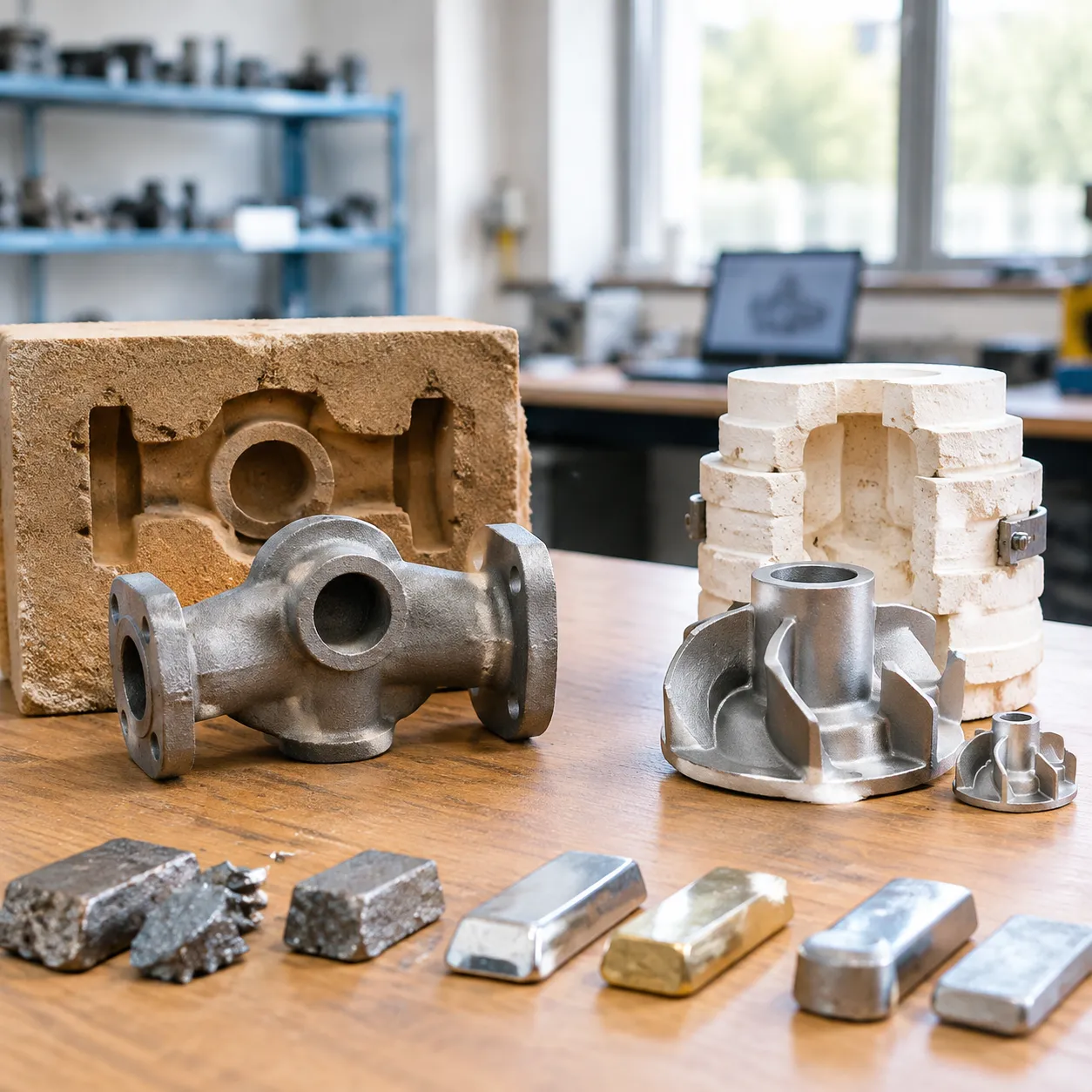
Choosing between sand casting vs investment casting often comes down to the metal you need to pour. While both methods handle a wide range of ferrous and non-ferrous alloys, each process excels with specific material grades and cooling dynamics.
Cast Iron, Ductile Iron, and Heavy Carbon Steels
Sand casting remains the industry benchmark for high-mass ferrous metals. We routinely use it for components poured from: Gray Iron & Ductile Iron: Excellent fluidity in sand molds, offering high damping capacity and wear resistance for heavy structures. Low & Medium Carbon Steels: Cost-effective for large structural components where standard machining allowances are acceptable. Heavy Alloy Steels: High-temperature resistance for industrial equipment. When specialized corrosion resistance is needed at high volumes, our team relies on stainless steel sand casting services to balance raw material scale with performance.
High-Performance Alloys and Stainless Steels
Investment casting delivers superior results with high-melting-point, hard-to-machine alloys. Because ceramic shells withstand extreme pouring temperatures without degrading, this method is ideal for: Austenitic, Ferritic, and Duplex Stainless Steels: Delivers clean, oxidation-free surfaces. Review our detailed cast stainless steel custom alloys and grades to match specific corrosion resistance targets. Nickel-Based Superalloys (Inconel, Hastelloy): Essential for extreme heat and high-stress environments. Cobalt Alloys & Titanium: Precision-poured for wear parts, medical components, and aerospace hardware where secondary machining is cost-prohibitive.
Aluminum, Brass, and Bronze Across Both Processes
Non-ferrous alloys adapt well to both techniques, but your production goals dictate the choice: Sand Casting: Best for large aluminum housings, bronze marine hardware, and low-cost prototypes. Investment Casting: Best for thin-walled aluminum electronics enclosures, decorative brass fittings, and intricate bronze hardware requiring fine detail.
Metallurgical Integrity, Grain Structure, and Defect Rates
| Quality Factor | Sand Casting | Investment Casting |
|---|---|---|
| Cooling Rate | Slower, resulting in coarser grain structure | Controlled, producing finer, more uniform grain structures |
| Porosity Risks | Higher risk of gas porosity and sand inclusions | Lower risk; vacuum pouring options further reduce gas entrapment |
| Defect Rate & Rework | Moderate; requires surface grinding and weld blending | Very low as-cast defect rate with minimal scrap |
| Mechanical Strength | Reliable bulk strength; lower fatigue limits | High tensile strength and superior fatigue resistance |
Cost Analysis and Production Economics: Sand Casting vs Investment Casting

Evaluating the true financial footprint in sand casting vs investment casting requires looking beyond the raw piece price. We analyze the complete Total Cost of Ownership (TCO), balancing upfront tooling, production run volumes, secondary CNC operations, and delivery schedules.
Initial Tooling and Pattern Tooling Cost Differences
- Sand Casting Tooling: Utilizes wood, polyurethane resin, or machined aluminum patterns. Tooling costs are substantially lower, making it ideal for prototypes, short runs, and heavy industrial castings without huge upfront capital expenditure.
- Investment Casting Tooling: Demands precision-machined metal injection dies (typically hardened tool steel or aluminum) to mold wax patterns. The initial capital investment is higher, but these durable dies yield hundreds of thousands of identical wax parts over their operational lifespan.
| Cost & Economic Factor | Sand Casting | Investment Casting |
|---|---|---|
| Initial Tooling Cost | Low to Moderate | Moderate to High |
| Low-Volume Cost (<100 pcs) | Highly Economical | Higher per-piece amortization |
| High-Volume Cost (>5,000 pcs) | Moderate unit savings | Lowest net cost for complex geometries |
| Secondary CNC Machining Needed | Heavy (high stock removal) | Minimal (near-net-shape) |
| Tooling Fabrication Lead Time | 2 to 4 Weeks | 4 to 8 Weeks |
| Production Cycle Time | Fast turnaround per batch | Multi-step process, longer cycle |
Per-Piece Cost Across Production Volumes
For low-volume runs and prototyping, sand casting holds an economic edge due to lower pattern startup costs. However, as production scales into medium and mass volumes, the precision of investment casting dramatically narrows the cost gap by reducing cycle times per piece and saving costly raw alloy scrap.
Secondary Operations: Impact of Post-Machining and Finishing
Raw casting cost is only part of the equation. Sand cast parts typically carry generous machining allowances (3 mm to 6 mm) that demand multi-axis CNC milling, turning, and parting-line grinding. Investment castings emerge as near-net shapes with allowances under 0.5 mm to 1 mm, often requiring only light gate grinding and tapping.
When evaluating overall project costs, investment casting frequently saves money by eliminating multi-stage CNC fixturing and tool wear. Review our practical sand mold casting guide to see how machining allowances directly dictate downstream finishing budgets.
Lead Time Comparison: Rapid Prototyping to Full Production
- Rapid Prototyping: 3D-printed sand molds or direct-printed wax/resin patterns can deliver first-article prototypes in 1 to 2 weeks for either process without hard tooling.
- Hard Tooling Setup: Sand casting patterns typically take 2 to 4 weeks to construct and sample, whereas multi-cavity wax dies for lost-wax casting require 4 to 8 weeks for CNC cut, polish, and dimensional validation.
- Production Lead Times: Once tooling is approved, sand casting provides faster melt-to-ship turnaround, while investment casting requires steady staging through slurry dipping, drying, dewaxing, and ceramic knockout phases.
Industry Applications and Common Use Cases
Choosing between sand casting vs investment casting comes down to structural scale versus geometric precision. We help engineering teams match their component demands with the most economical manufacturing route across key global industries.
Heavy-Duty Sand Casting Applications
Sand casting handles the heaviest workloads where massive structural integrity and lower upfront tooling dominate project requirements:
- Automotive and Heavy Transport: Engine cylinder blocks, transmission cases, brake rotors, and heavy-duty suspension arms.
- Fluid and Pressure Systems: High-volume valve bodies, heavy centrifugal pump housings, and municipal pipe fittings.
- Agriculture and Mining: Heavy tractor frame brackets, plow shares, excavator teeth, and track shoes built from durable cast iron or ductile iron.
- Industrial Infrastructure: Bearing housings, massive machine tool bases, and crane counterweights weighing hundreds of kilograms or multiple tons.
Precision Investment Casting Applications
When parts require complex contours, razor-thin cross sections, and fine as-cast finishes, investment casting is our go-to solution:
- Aerospace and Defense: High-performance turbine blades, fuel system bodies, brackets, and specialized titanium investment casting for aerospace and medical parts.
- Medical Technology: Surgical instrument handles, orthopedic implants, robotic joint linkages, and dental tools.
- Firearms and Tactical Gear: Triggers, receivers, hammer assemblies, and sight mounts requiring tight drop-in fits.
- High-End Commercial Hardware: Marine stainless steel rigging, decorative architectural fittings, and precision valve trim.
Case Study: Upgrading from Sand Casting to Investment Casting
A fluid handling client originally produced a 316 stainless steel multi-port valve body via sand casting. The rough as-cast surface and dimensional drift required over 45 minutes of multi-axis CNC milling per unit, along with manual port grinding to clear flow-path turbulence.
| Operational Metric | Previous Sand Casting | Converted Investment Casting | Result |
|---|---|---|---|
| Initial Tooling Cost | Lower (wood/resin pattern) | Moderate (machined wax die) | Tooling amortized across 2,000 units |
| As-Cast Surface (Ra) | 12.5 µm | 2.8 µm | Flow restriction eliminated as-cast |
| CNC Machining Time | 45 minutes per part | 12 minutes per part | 73% cycle time reduction |
| Scrap Rate from Porosity | 6.8% | Under 0.5% | Dramatic consistency boost |
| Total Net Part Cost | Baseline | 32% total unit cost savings | Net savings achieved at volume |
By shifting to lost-wax investment casting, we integrated mounting tabs directly into the wax model and cast the fluid channels to near-net shape. The upfront investment in precision tooling was fully recovered within the first quarter solely through CNC cycle-time and scrap reductions.
Decision Framework: Choosing the Right Casting Process for Your Project
Choosing between sand casting vs investment casting comes down to balancing upfront tooling costs against downstream machining expenses. We guide engineering teams through this decision daily to ensure the lowest total cost of ownership (TCO) without compromising part performance.
Key Evaluation Checklist
Before issuing an RFQ or freezing your CAD model, evaluate your component against these four core production criteria:
| Evaluation Parameter | Sand Casting Fit | Investment Casting Fit |
|---|---|---|
| Part Complexity | Simple to moderate shapes, uniform cross-sections, draft required | Complex geometries, internal channels, undercuts, thin walls |
| Required Ra Finish | As-cast roughness of Ra 6.3–12.5 µm is acceptable | Smooth finish of Ra 1.6–3.2 µm required out of the mold |
| Tolerance Needs | Loose tolerances (typically ±0.5 mm to ±1.5 mm) | Precision tolerances (typically ±0.1 mm to ±0.3 mm) |
| Annual Volume | Cost-effective for low, medium, and high runs of heavy parts | Best ROI on medium-to-high runs that offset tooling costs |
| Tooling Budget | Lower initial upfront pattern expenditure | Higher upfront metal die investment required |
When to Choose Sand Casting for Maximum ROI
Sand casting delivers the fastest return on investment when raw mass and low tooling expenditures matter more than near-net-shape tolerances. We recommend sand casting when:
- Massive component dimensions: Your part exceeds 50 kg or requires heavy sections, such as engine blocks, large pump housings, and industrial valve bodies.
- Low upfront capital budgets: You need low-cost patterns (wood, resin, or aluminum) for low-volume runs or early functional testing.
- Standard materials dominate: The project specifies ductile iron, gray iron, or heavy carbon steels where dimensional allowances can be handled by standard post-machining.
- Generous tolerances are viable: Downstream mating surfaces are minimal and easily milled on standard CNC equipment.
When to Invest in Precision Lost-Wax Casting
Investing in precision lost-wax tooling pays off by eliminating secondary CNC machining, tool wear, and scrap rates. You should choose our high-quality investment casting parts for precision manufacturing when:
- Near-net shapes are mandatory: You need razor-thin walls (down to 1.5 mm), intricate internal cavities, blind holes, or cast-in lettering.
- Fine surface texture is required: The part demands an as-cast finish of Ra 1.6–3.2 µm for fluid handling, aesthetic hardware, or sanitary applications.
- High-value alloys are specified: Your design uses stainless steel, aerospace aluminum, or nickel-based superalloys where raw material waste from heavy machining is costly.
- Labor and machining drive up costs: The cost of cutting away excess machining stock exceeds the amortization cost of an injection die over your annual volume. If your project demands lightweight structural components, reviewing our aluminum investment casting guide for precision parts helps identify critical savings in tolerance stack-ups.
Design for Manufacturing (DFM) Tips to Optimize Casting Costs
Regardless of the casting method, small design tweaks significantly reduce scrap rates and tooling lead times:
- Maintain uniform wall thickness: Avoid abrupt transitions between thick and thin sections to prevent shrinkage cavities and hot tears during metal solidification.
- Add generous radii and fillets: Sharp internal corners act as stress concentrators and cause mold erosion; incorporate radii of at least 1.5 mm to 3 mm.
- Design sensible draft angles: Sand casting requires 1° to 3° draft for clean pattern removal. While investment casting wax patterns pull with minimal draft, adding 0.5° still extends metal die life.
- Isolate precision features for secondary machining: Cast non-critical features net-shape, and leave standard 1.0–2.0 mm machining allowances exclusively on critical mating faces and bearing bores.
Frequently Asked Questions (FAQs)
Is investment casting stronger than sand casting?
Base mechanical properties depend primarily on the chosen alloy, but investment casting consistently delivers better structural integrity. Because ceramic molds are preheated before pouring, the molten metal cools evenly, significantly reducing internal porosity, gas inclusions, and micro-shrinkage. For high-stress applications requiring superior fatigue strength and pressure tightness, lost-wax casting typically outperforms traditional sand-cast alternatives.
Why is investment casting more expensive than sand casting?
Investment casting involves a labor-intensive, multi-step process including wax injection, repetitive ceramic dipping, prolonged drying, and dewaxing before metal is poured. Additionally, fabricating CNC-machined aluminum or steel wax dies requires a higher upfront tooling investment than standard sand patterns. However, near-net-shape output and minimal downstream machining often balance the total production cost for complex geometries.
What is the minimum wall thickness achievable in investment vs. sand casting?
- Investment casting: Reliably achieves wall thicknesses down to 1.0 mm – 1.5 mm due to preheated ceramic molds that prevent premature metal freezing.
- Sand casting: Generally requires a minimum wall thickness of 3.0 mm – 5.0 mm to ensure complete mold filling and prevent cold shuts.
Can sand casting replace investment casting if we add secondary CNC machining?
Sand casting can replace investment casting only if the geometry is accessible to standard cutting tools and the production volume justifies the extra spindle time. For parts with deep undercuts, fine lettering, complex internal channels, or thin ribs, CNC machining cannot easily replicate as-cast features. In such cases, secondary machining costs quickly exceed the tooling savings of choosing sand casting over lost-wax casting.
How do tooling lead times compare between sand casting patterns and wax injection dies?
Sand casting patterns made from wood, resin, or aluminum typically take 1 to 3 weeks to build and test. In contrast, precision tooling built for an industrial wax injection machine for investment casting generally requires 3 to 6 weeks for design, CNC milling, and sample validation. While investment casting dies take longer to produce, they provide exceptional dimensional repeatability over hundreds of thousands of production cycles.
 English
  Russian
  German