
2026年11月11日
Explore investment casting cost factors including materials tooling complexity tolerances volume and finishing with practical DFM savings tips
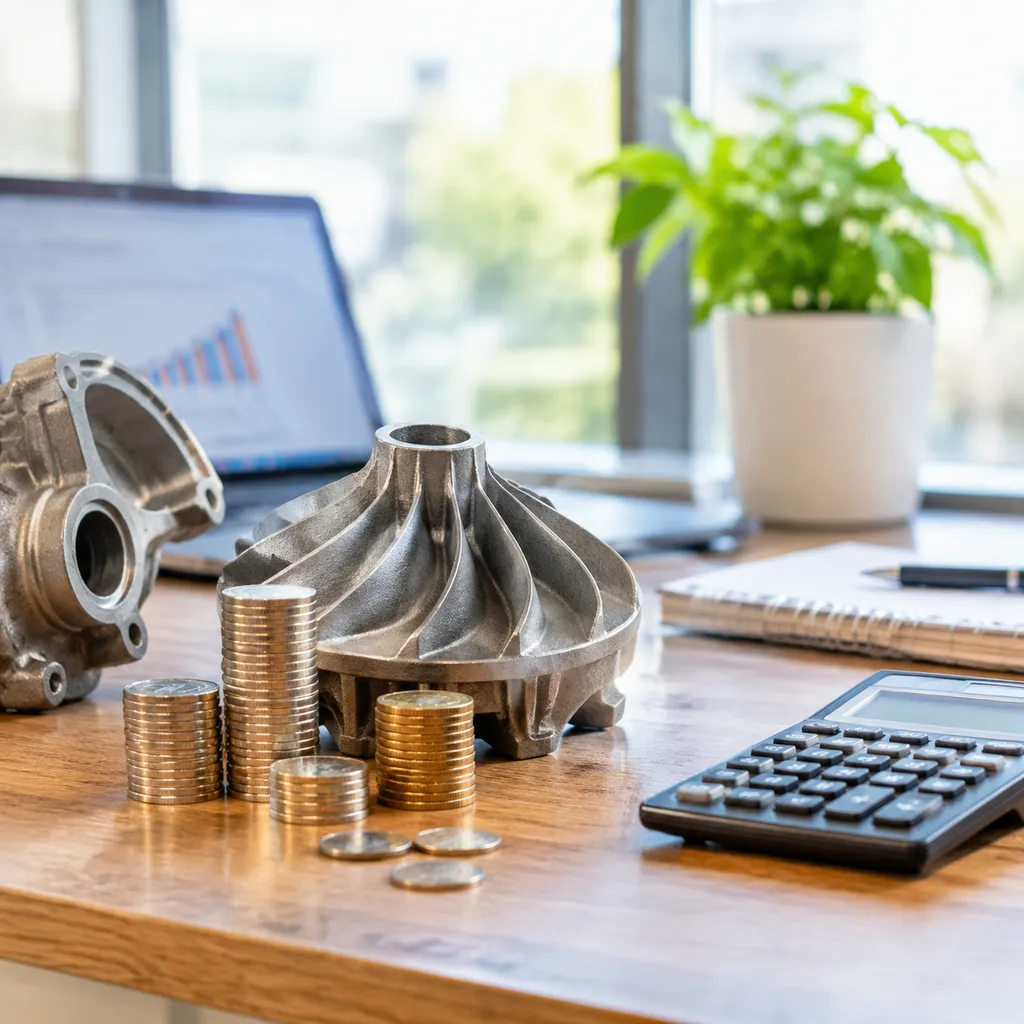
Investment Casting Cost Factors: What Determines the Price?
Navigating investment casting cost factors requires more than a simple price check per unit. To achieve the best value for your precision components, you must evaluate the total landed cost—a figure that encompasses everything from initial tooling investment and material selection to logistics and post-processing requirements.
At Vastpe, we specialize in high-quality lost-wax investment casting designed to balance engineering precision with cost efficiency. We understand that every project has unique constraints, and transparency is our priority. Whether you are scaling from a prototype to full production or seeking to optimize an existing design, we provide the technical insights necessary to manage expenses without compromising on quality or performance. Understanding the variables that influence your quote is the first step toward a successful and sustainable manufacturing partnership.
Investment Casting Cost at a Glance
When evaluating investment casting cost, it is essential to understand the trade-offs between different manufacturing methods. Reviewing our die casting vs. investment casting cost and material guide provides necessary context for choosing the right process to align with your specific budget and project requirements. Several variables interact to determine your final investment casting pricing, and clarity on these drivers is the first step toward effective cost management.
The following table outlines the primary factors that influence your precision casting cost and how they impact the bottom line:
| Cost Driver | Impact on Investment Casting Cost | Optimization Strategy |
|---|---|---|
| Tooling & Patterns | High upfront investment for mold creation. | Increase annual volume to amortize costs. |
| Production Volume | Per-part cost decreases as batch size grows. | Consolidate orders for larger, consistent runs. |
| Alloy Selection | Material grade affects raw cost and processing time. | Select standard, readily available alloys. |
| Design Complexity | Intricate designs increase scrap risk and labor. | Implement DFM to simplify complex geometries. |
| Tolerance/Finish | Tight tolerances require more machining and inspection. | Limit critical tolerances to essential features. |
| Secondary Ops | Heat treatment and extra machining add labor costs. | Minimize post-casting requirements where possible. |
Understanding these factors allows you to make informed decisions early in the design phase, ensuring your lost-wax casting cost remains competitive while maintaining high quality and performance standards.
What Is Included in an Investment Casting Quote?
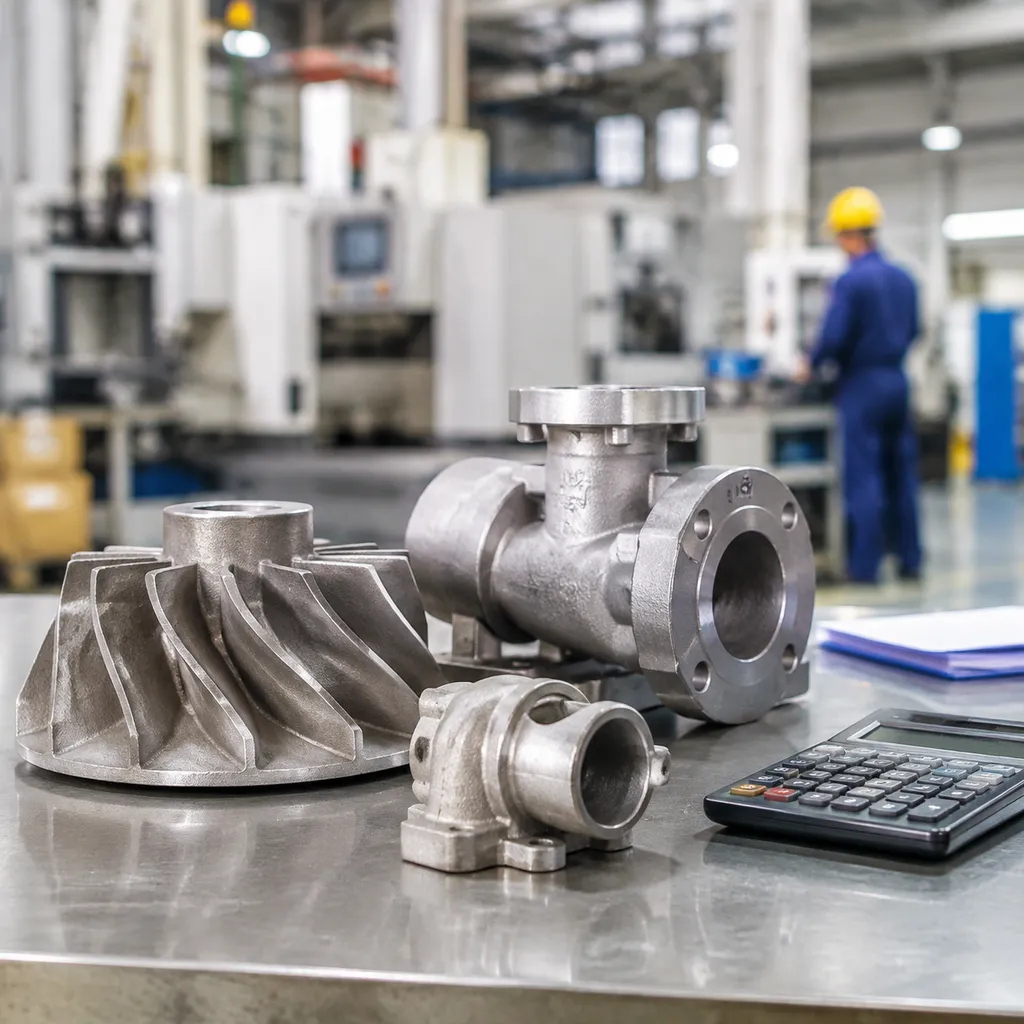
When we calculate your investment casting cost, we provide a transparent, itemized breakdown so you see exactly where every dollar goes. An accurate quote prevents surprise expenses down the road by clearly dividing one-time upfront tooling from recurring unit production expenses.
Breakdown of Typical Quote Components
A comprehensive lost-wax casting cost assessment covers several core elements:
- Tooling and Mold Costs (NRE): This is a one-time non-recurring engineering charge for designing and cutting the aluminum wax-injection die. It accounts for mold complexity, cavity count, and core pulls.
- Unit Piece Price: The ongoing investment casting price per part, which encompasses the base alloy weight, wax pattern injection, ceramic shell building, pouring, and cut-off labor.
- Secondary Operations: Machining tight-tolerance features, thread tapping, heat treating (such as annealing or precipitation hardening), and surface finishing (e.g., passivating, anodizing, or painting).
- Quality Control and Testing: Dimensional verification via CMM, non-destructive testing (NDT like X-ray or dye penetrant), chemical composition analysis, and mechanical test certifications.
- Packaging and Delivery: Corrosion-inhibiting bags, custom dunnage, protective boxing, and freight terms.
| Cost Element | Type | What It Covers |
|---|---|---|
| Tooling & Dies | One-time (NRE) | Wax injection tooling, fixtures, custom gages |
| Casting Production | Recurring | Raw alloy, shell materials, labor, melt energy |
| Post-Processing | Recurring | Heat treatment, surface finish, precision CNC machining |
| Quality & Inspection | Variable | CMM reports, NDT, material test reports (MTRs) |
Verifying the Scope of Work
The biggest trap in evaluating investment casting pricing is comparing quotes with mismatched scopes. A low-ball estimate often leaves out machining, non-destructive testing, or critical surface finishing, delivering only raw, "as-cast" parts that require costly third-party processing later.
Before committing, verify whether your quote includes finish machining, specific tolerance guarantees, and quality documentation. Referencing our precision casting RFQ checklist for accurate quotes ensures all drawing notes, tolerances, and inspection criteria are locked in from day one. Clearly defined scopes prevent production delays and keep your total landed cost on budget.
Main Factors That Affect Investment Casting Cost
Several variables determine the final price of an investment casting project. We evaluate your design to balance production efficiency with cost-effectiveness. The following table summarizes the primary cost drivers we assess during the quoting phase.
Key Cost Drivers Overview
| Cost Factor | Impact on Price | Key Consideration |
|---|---|---|
| Tooling & Patterns | High (Upfront) | Mold complexity and life expectancy |
| Order Quantity | High (Per Unit) | Amortization of setup costs |
| Geometry & Design | High | Affects yield and scrap risk |
| Tolerances | Moderate to High | Precision requirements dictate QC time |
| Alloy Selection | Moderate | Raw material market volatility |
| Secondary Ops | High | Machining, heat treat, and finishing |
Detailed Breakdown of Cost Factors
- Tooling and Pattern Equipment: The investment casting tooling cost is typically your largest initial expense. A complex mold with moving slides or cores increases the price compared to simple, single-cavity designs.
- Order Quantity and Production Volume: Your annual volume significantly impacts the unit price. We amortize tooling costs over the total run quantity; higher volumes result in a lower cost per part.
- Geometry and Design Complexity: Intricate designs with thin walls or complex transitions increase the likelihood of casting defects. To keep costs down, we recommend designing for manufacturing by standardizing wall thicknesses and minimizing undercuts where possible.
- Dimensional Tolerances and Inspection: Achieving extremely tight tolerances requires more rigorous inspection and potentially secondary operations. Clarifying your requirements early allows us to optimize the casting process and avoid unnecessary testing costs.
- Materials and Alloy Selection: Raw material costs fluctuate based on the metal grade. Specialized alloys often require more sophisticated melting and pouring procedures, which can influence pricing.
- Secondary Operations and Finishing: While investment casting is known for "near-net-shape" accuracy, specific surface finish or post-casting machining requirements add labor and processing time. We offer comprehensive precision casting services that include secondary processing to ensure your parts are production-ready.
- Quality Control and Logistics: Stringent documentation, non-destructive testing, custom packaging, and expedited lead times all factor into the final landed cost. We work with you to define exactly what your project needs to ensure transparency from the start.
How Design Choices Can Reduce Investment Casting Cost
Optimizing your part geometry is the most effective way to manage investment casting pricing. By applying Design for Manufacturing (DFM) strategies early, you can significantly lower production overhead and improve part quality.
Key approaches to reduce costs include:
- Standardize Wall Thickness: Aim for uniform wall sections throughout the part. Abrupt transitions in thickness can cause uneven cooling, increasing the risk of defects. Integrating 3D printed wax patterns for rapid investment casting can help validate these designs before moving to full-scale production.
- Simplify Geometry: Remove unnecessary undercuts, sharp corners, and deep pockets. Complex shapes require more intricate tooling and longer processing times.
- Relax Tolerances: Only specify tight dimensional tolerances where they are strictly necessary for functionality. Excessively strict requirements drive up inspection costs and scrap rates.
- Consolidate Assemblies: If your design features multiple components that could be cast as a single piece, take advantage of this to eliminate secondary assembly and welding costs.
- Draft Angles: Incorporate adequate draft angles to ensure the pattern can be removed from the mold easily, which reduces wear on tooling and prevents surface damage.
By prioritizing these DFM strategies, we help you achieve a more efficient manufacturing run that balances precision with cost-effectiveness.
How Production Volume Changes the Cost per Part
In investment casting, understanding the distinction between fixed setup costs and recurring manufacturing costs is essential for accurate budget planning. Your total investment is directly influenced by the scale of your order, as production volume dictates how effectively you can amortize one-time expenses.
Fixed Costs versus Recurring Manufacturing Costs
- Fixed Costs (Tooling and Setup): These are one-time capital investments required before production begins. They include the creation of wax injection molds (dies), custom jigs, fixtures, and any specific process documentation required for quality assurance. Regardless of whether you order 500 units or 50,000, these expenses remain constant.
- Variable Costs (Unit Price): These cover recurring expenses like raw material alloys, labor, energy consumption, and secondary finishing processes. While these remain relatively stable, higher production volumes can lead to minor efficiencies in material purchasing and process optimization.
The Amortization Effect
When you increase your investment casting production volume, the upfront tooling expense is spread across a larger number of units, which significantly lowers the investment casting price per part.
- Low Volume (Small Batches): The cost per unit is higher because the tooling cost is amortized over fewer parts. For smaller runs, we often look for ways to simplify tooling or utilize modular die designs to keep entry costs manageable.
- High Volume (Mass Production): The cost per unit decreases as the tooling cost becomes a smaller, often negligible, fraction of the total price.
For example, if a mold costs $5,000 to produce, the tooling impact is $10 per part on a 500-unit order, but drops to just $1 per part on a 5,000-unit order. We always recommend reviewing your annual usage requirements versus a one-time bulk order. Balancing inventory holding costs against the per-unit savings gained from longer, continuous production runs is a critical step in optimizing your total investment casting cost.
Investment Casting vs. Other Manufacturing Methods

Choosing the right production process is a balancing act between initial investment and long-term part performance. At Vastpe, we evaluate how investment casting stacks up against other common methods to ensure you get the best value for your project.
Comparative Analysis: Casting and Machining
- CNC Machining: While CNC excels at rapid prototyping and extremely high precision, it often involves significant material waste, especially for complex geometries. Investment casting allows for near-net-shape production, which drastically reduces material costs and machining time for intricate designs. For a clearer view of process differences, refer to our investment casting vs. die casting vs. sand casting analysis.
- Sand Casting: Sand casting is typically more economical for very large, heavy parts or low-complexity components. However, it cannot match the dimensional accuracy or superior surface finish provided by the investment casting process. The high upfront cost of investment casting is often offset by the reduction in secondary machining required to achieve final tolerances.
- Forging: Forged parts offer exceptional grain structure and mechanical strength for high-stress applications. However, forging is often limited by design complexity and higher tooling costs for intricate shapes. Investment casting provides greater design freedom, allowing for complex internal channels and fine details that are difficult or impossible to forge.
Summary Comparison Table
| Feature | Investment Casting | CNC Machining | Sand Casting | Forging |
|---|---|---|---|---|
| Design Complexity | High | Moderate | Low | Low |
| Material Waste | Low | High | Moderate | Low |
| Surface Finish | Excellent | Excellent | Rough | Good |
| Tooling Cost | Moderate/High | Low | Low | High |
| Ideal Volume | Medium to High | Low to High | Low to High | High |
By weighing your specific geometry requirements and production volume against these variables, we help you determine whether the precision and repeatability of investment casting justify the initial tooling investment compared to the material-heavy approach of machining or the aesthetic limitations of sand casting.
Information Needed for an Accurate Vastpe Quote
Getting an accurate investment casting price starts with providing clear, comprehensive technical data. When you submit your project to Vastpe, the completeness of your documentation directly impacts the precision of our estimate and the speed of our initial feasibility review. Missing information often forces us to make assumptions, which can result in unnecessary contingency costs or delays in your production timeline.
To ensure you receive the most competitive and accurate quote, please include the following technical documentation in your request:
| Document/Requirement | Details to Include |
|---|---|
| 3D CAD Models | STEP, IGES, or Parasolid files for geometry and volume analysis. |
| 2D Technical Drawings | PDF or DWG files detailing critical dimensions, tolerances, and notes. |
| Material Specifications | Exact alloy grade (e.g., Stainless Steel, Carbon Steel, Superalloys). |
| Production Volume | Annual estimated usage and specific order lot sizes for cost amortization. |
| Surface & Finish | Required surface roughness (Ra) and cosmetic standards. |
| Secondary Processes | Requirements for machining, heat treatment, plating, or assembly. |
| Testing & Quality | Specific needs for NDT, pressure testing, or material certifications. |
If you are dealing with complex geometries, let us know if you are considering 3D printed wax patterns versus traditional hard tooling, as this significantly impacts your initial investment casting tooling cost and prototype lead times. Providing this information upfront allows us to conduct a thorough design-for-manufacturing (DFM) review and identify potential cost-saving opportunities before we lock in your production plan.
Vastpe Investment Casting Services

We engineer precision lost-wax casting solutions built to keep overall production costs predictable while meeting tight mechanical specifications. From initial tooling design through final secondary machining, our foundry delivers fully finished metal components directly to your production line.
Core Capabilities and Process Limits
- Tolerances: Standard linear tolerances conform to ISO 8062-3 (CT4–CT6 grades), eliminating unnecessary cleanup machining.
- Surface Finish: Standard as-cast surface roughness averages Ra 3.2 to 6.3 µm, suitable for direct assembly in many industrial applications.
- Part Sizing: Components ranging from a few grams up to 80 kg, with wall sections down to 1.5 mm depending on part geometry and alloy flow characteristics.
- Secondary Processing: Complete in-house CNC milling, turning, precision grinding, heat treatment (annealing, quenching, tempering), and surface finishing.
Material Selection
We pour a comprehensive range of ferrous and non-ferrous alloys tailored to specific operating environments:
- Stainless Steels: Extensive cast stainless steel casting services covering austenitic (304, 316), martensitic (410, 420), and precipitation-hardening alloys like 17-4 PH.
- Carbon & Low-Alloy Steels: WCB, 1020, 1045, 4140, and 8620 for wear resistance and high tensile applications.
- High-Temperature Alloys: Cobalt- and nickel-based superalloys engineered for extreme thermal and corrosive conditions.
- Aluminum Alloys: Lightweight, high-strength grades for structural and aerospace hardware.
Quality Standards and Verification
Every casting run aligns with documented casting quality standards to prevent defects and protect your downstream budget:
- Chemical Verification: Optical emission spectrometry (OES) analysis per heat lot.
- Dimensional Layout: Automated Coordinate Measuring Machine (CMM) inspection and 3D optical scanning.
- Non-Destructive Testing (NDT): Liquid penetrant testing (PT), magnetic particle inspection (MPI), and radiographic inspection (RT).
- Mechanical Property Testing: Tensile strength, yield strength, elongation, and Rockwell/Brinell hardness verification.
Request a Cost Review or Quote

Getting an accurate investment casting price per part starts with a detailed evaluation of your project requirements. At Vastpe, I prioritize transparency and efficiency, ensuring you receive a comprehensive quote that reflects your specific technical needs. To begin your design review, please submit your CAD files, material specifications, and anticipated annual production volume.
My team conducts a thorough feasibility analysis to identify potential savings through optimized design for manufacturing. We review your prints to balance structural integrity with cost-effective production techniques. Whether you are inquiring about cobalt-based casting for heat and wear resistance or high-performance stainless steel components, I provide direct feedback on how your geometry impacts the overall lost-wax casting cost.
What to include in your inquiry: 3D CAD models (STEP or IGES preferred) 2D prints with clear dimensional tolerances and surface finish requirements Material grade or alloy specifications Expected batch sizes and annual usage projections Post-processing requirements, such as heat treatment or machining
Once received, we analyze the tooling investment and unit production expenses to give you a clear, honest breakdown. My goal is to ensure your project is both technically sound and commercially viable from the start. Reach out today to initiate a professional assessment of your manufacturing needs.
Frequently Asked Questions Regarding Investment Casting
We often receive technical inquiries from engineers and procurement managers looking to optimize their production. Below are the answers to the most common questions concerning investment casting cost factors and process capabilities.
How does tooling cost impact my project?
Tooling costs cover the creation of the master pattern and the mold used to produce wax replicas. While this is a significant upfront investment, it is a one-time charge for the life of the mold. For higher production volumes, the tooling cost is amortized across more units, substantially reducing the price per part. We recommend reviewing our mold and cast guide to better understand how different tooling methods align with your production goals.
What are the standard tolerances for precision casting?
Investment casting is known for excellent dimensional accuracy, typically achieving tolerances within ±0.005 inches per inch. However, tighter tolerances may require additional secondary machining, which adds to the total investment casting cost. If your design requires extreme precision, we evaluate the geometry to see if it can be achieved "as-cast" or if it necessitates post-process CNC machining.
How does material selection influence pricing?
The choice of alloy is a primary driver of raw material costs. Common alloys like stainless steel or carbon steel are generally more cost-effective due to availability and processing ease. Specialized alloys that require vacuum melting or have complex heat treatment requirements will naturally increase the price per part. We encourage clients to consult with our team early to balance material performance needs with budgetary constraints.
Can design changes reduce costs?
Yes, Design for Manufacturing (DFM) is the most effective way to lower expenses. Strategies include: Standardizing wall thicknesses: Prevents cooling issues and reduces scrap rates. Simplifying geometry: Reduces the complexity of the wax injection mold. Optimizing draft angles: Ensures easier pattern removal from the mold. Consolidating parts: Combining multiple components into one casting eliminates assembly and welding costs.
What is the typical lead time for production?
Lead times vary based on the complexity of the part and the necessity of new tooling. Generally, the initial process involves mold creation and sample approval, followed by mass production. By providing clear technical documentation—including 3D models and precise material specifications—we can provide an accurate project timeline during the quoting stage.
 English
 Russian
 German