
2026年11月16日
Learn where to start with investment casting production line automation including wax injection shell coating dewaxing robotics and phased integration

Strategic Goals of Investment Casting Automation
Transitioning to investment casting automation is not merely about replacing manual labor—it is an operational overhaul designed to secure repeatability, eliminate process bottlenecks, and protect profit margins. For precision casting foundries serving demanding markets like aerospace, defense, and automotive, introducing automated systems achieves four non-negotiable operational benchmarks:
- Zero-Variance Process Repeatability: Manual dipping, wax handling, and mold manipulation introduce human variability. Robotic automation standardizes slurry penetration, shell build thickness, and drying cycle times, delivering absolute structural consistency across every mold.
- Drastic Scrap and Rework Reduction: In precision casting, shell failures and dimensional deviations directly erode the bottom line. Automated handling eliminates shell drop incidents, uneven shell walls, and inclusions, systematically driving scrap rates down to industry-leading minimums.
- Mitigation of Labor Bottlenecks and EHS Risks: Foundry floors feature repetitive strain, silica dust exposure, and extreme thermal conditions. Automating heavy-payload tasks removes personnel from hazardous zones, cuts workplace injuries, and insulates operations from severe skilled-labor shortages.
- Predictable Throughput and Optimized OEE: Automated cells eliminate shift-change delays and pacing drops. By running synchronized recipes around the clock, facilities achieve dependable cycle times, reliable delivery schedules, and maximized Overall Equipment Effectiveness (OEE).
Step 1: First, organise the production line, then select the equipment
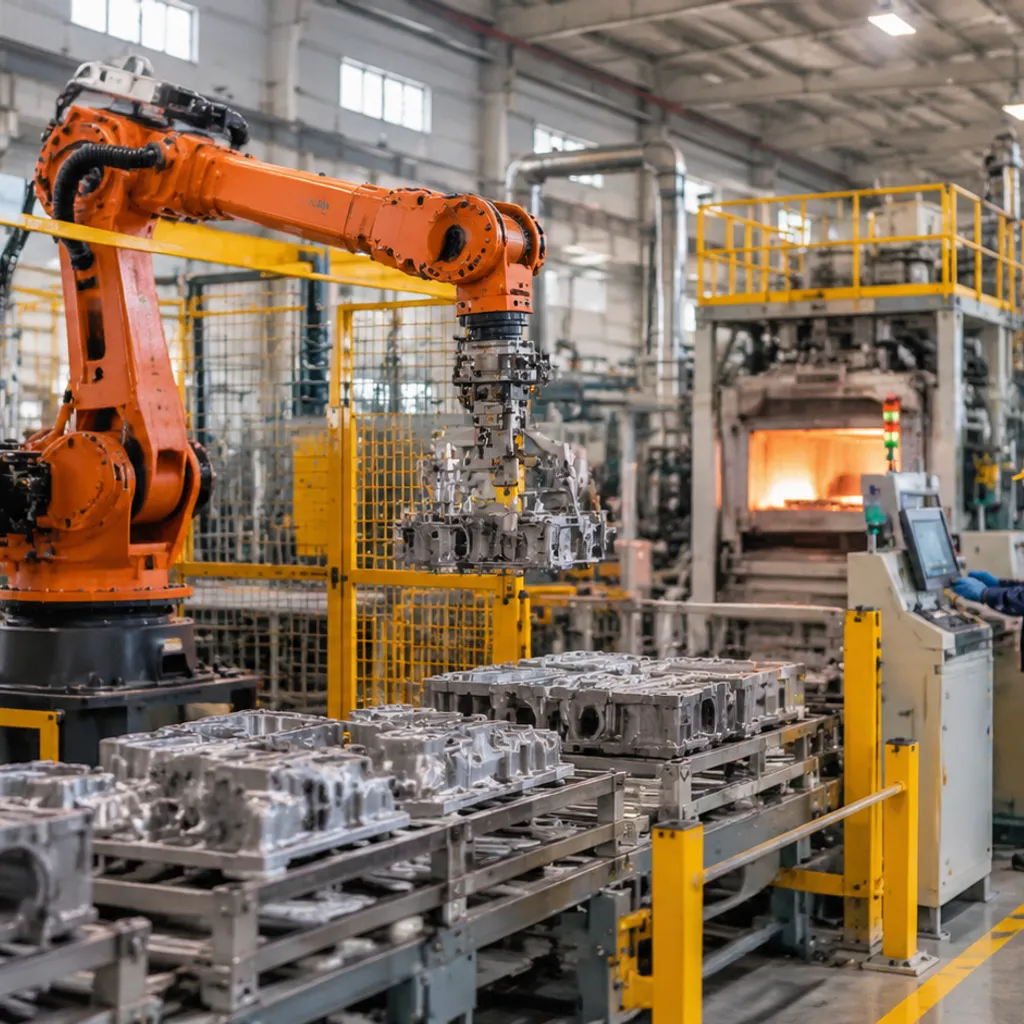
When considering investment casting production line automation, the most common mistake is purchasing robots directly. Automation is far more than simply stacking hardware; its core is optimizing production workflows through technology. If your production processes are disorganized and parameters unstable, introducing automated equipment will only mechanize these flaws, resulting in lower rather than higher efficiency.
I recommend setting aside the blind pursuit of equipment and starting with a full review of the production line. The first step must be an in-depth analysis of every process node:
Identify process bottlenecks: Pinpoint stages that cause downtime due to heavy manual labor, harsh working conditions (high temperature, dust), or inconsistent human operation. These are usually the priority starting points for automation retrofits.
Standardize production workflows: Before integrating equipment, ensure high-level standardization for molds, wax injection and sintering processes. For example, adopting the energy-saving https://vastpe.com/1200c-energy-saving-burnout-furnace-for-silica-sol-shells/ to stabilize shell sintering is a prerequisite for automated equipment to deliver its full potential.
Redesign material flow routes: Automated production relies on continuous operation. Re-evaluate plant layout to cut redundant handling and waiting time between workstations. This often delivers more noticeable cost savings than investing in expensive robots.
Once you properly streamline workstation handovers and production logic, you will clearly see which links require high-precision automated intervention and which only need simple tooling improvements. Only when the production line logic is well-organized can equipment selection be targeted and purposeful.
Rank Workstations by Automation Readiness
Not every station in a precision casting foundry delivers an immediate return on automation. We classify workstations into three tiers to prevent expensive implementation bottlenecks:
- Tier 1: High Readiness, Quick ROI. Repetitive, physically demanding tasks with stable parameters and standardized cycle times. These deliver immediate quality consistency.
- Tier 2: Moderate Readiness, Medium Complexity. Operations involving part variance that require vision systems or flexible tooling, such as automated pouring or gate grinding.
- Tier 3: Complex Automation, High Dexterity. High-mix manual tree assembly, deep-cavity visual inspection, and intricate rework. Keep these manual until your plant floor data infrastructure matures.
Common Starting Points for Upgrades
When mapping out investment casting automation, the smartest path starts with stations that eliminate ergonomic hazards and scrap-inducing human variance:
- Automated Shell Coating (Dipping and Sanding): Shell building is the most proven entry point. Multi-axis foundry robots carry heavy wax clusters through slurries and fluidized sand beds with precise dipping angles, rotational control, and draining speeds. This consistency prevents slurry buildup, ensures uniform wall thickness, and virtually eliminates shell breakouts during dewaxing.
- Wax Injection and Pattern Handling: Standardizing pattern extraction and runner assembly stabilizes downstream dimensional accuracy. For complex or low-volume runs, pairing automated cells with 3D printed wax patterns for rapid investment casting eliminates traditional mold-change bottlenecks and keeps assembly cells moving without tooling delays.
- Robotic Cut-Off and Degating: Manual abrasive sawing carries significant safety risks and uneven cut depth. Robotic cutting cells equipped with force-torque sensors calculate precise cut-off margins along the gate, reducing scrap and slashing post-cast grinding time.
Step 2.A Practical Comparison Table for Selecting Your First Project
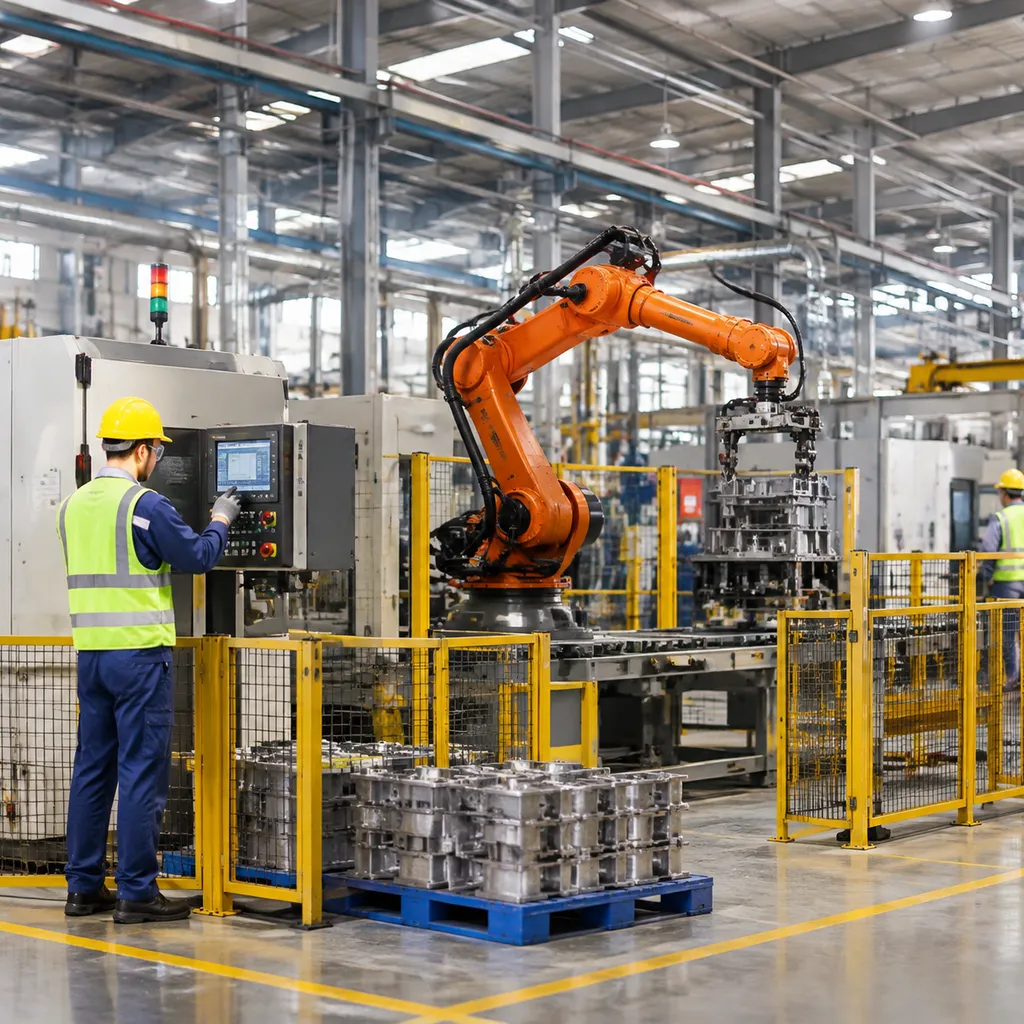
When launching an investment casting automation project, choosing the right starting point is critical. To help you intuitively assess the ROI of different automation solutions, I have compiled this practical comparison table. It focuses on several high-frequency retrofitting workstations commonly seen in precision casting processes.
表格
| Automated Workstation | Retrofit Difficulty | Payback Period | Main Value Improvements | Key Technical Thresholds |
|---|---|---|---|---|
| Wax Injection | Medium | Short (12–18 months) | Improved consistency, reduced rework | Precise temperature control and pressure compensation |
| Shelling Robot | High | Medium (24–36 months) | Stable shell quality, lower labor dependence | Slurry viscosity and drying curve control |
| Dewaxing & Burnout | High | Medium-long (36 months+) | Enhanced safety, energy conservation and emission reduction | Environmental data integration and logic interlock |
| Grinding and Cleaning | Medium-High | Medium (24–30 months) | Better working environment, higher efficiency | Force control sensors and vision guidance |
Selection Recommendations Please follow the principles below when reviewing the table above:
Prioritize pain points: If your yield fluctuates due to mold consistency issues when switching between 3D printed wax patterns and injection wax patterns, the wax injection process should be your first choice. Assess flexibility requirements: For high-mix, low-volume production such as 416 stainless steel precision castings, flexible automation for grinding and cleaning workstations is often more practical than a fully automated production line. Control risk boundaries: On your first automation attempt, avoid complex processes requiring high-level multi-station coordination. Pilot with independent units featuring mature technology and quantifiable data.
By comparing the input costs and expected returns of different workstations, you can allocate your limited automation budget more scientifically. This ensures your first project can be successfully implemented while accumulating valuable experience for subsequent full-line integration.
Step 3: Define Clear Integration Boundaries

Automating an investment casting production line fails most often at the handoff points. When we bring automation onto the foundry floor, our first priority is establishing strict operational boundaries between existing machinery, the new robotic cell, and our plant crew. Without a clear scope, integration stalls, finger-pointing starts, and commissioning drags on for months.
To keep your precision casting line build predictable, lock down these four integration boundaries before signing off on equipment:
- Mechanical Interfaces: Pin down exact physical handoff zones. This covers gripper clearance, fixture nests, payload limits, and parts alignment before the robot takes control. If you produce high-stress parts like 4340 steel casting components, ensure structural clamping tools prevent surface damage and dimensional distortion during high-speed transfers.
- Electrical & Safety Signals: Standardize the safety envelope. Define how the automation cell talks to upstream wax presses or downstream drying conveyors through hardwired safety relays, light curtains, and unified E-stop circuits.
- PLC and Handshake Logic: Map out digital I/O protocols. Both sides must agree on simple, robust handshake signals (Cell Ready, Part Clamped, Cycle Start, Fault Active) instead of overly complex communication layers that confuse floor technicians.
- Data and Recipe Management: Decide where the process parameters live. Whether recipes are stored on the robot controller or pushed down from your factory MES, the handoff for part tracking, dip times, and slurry coats must be unambiguous.
Defining these limits protects your investment casting automation timeline and holds vendors accountable for real performance.
Step 4: Design for Product Fluctuations and Quick Changeovers
In investment casting, batch sizes swing and part geometries change constantly. If your system cannot handle mix-and-match production, automation becomes a bottleneck rather than an asset. When designing automated cells for investment casting automation, flexibility must come before raw cycle speed.
A rigid setup might pump out one pattern quickly, but high-mix foundries require hardware and programming that adapt to rapid tooling changes without hours of downtime.
- Standardized Quick-Change Tooling: Use mechanical zero-point clamping systems for end-of-arm tooling (EOAT). Grippers handling fragile wax assemblies or heavy ceramic shells should switch out in under two minutes without manual recalibration.
- Recipe-Driven Programming: Store pre-set dipping sequences, wax injection parameters, and drying times in your central PLC. Operators should select part numbers from an HMI screen to immediately run verified motion paths.
- Vision-Guided Part Recognition: Instead of rigid mechanical nests, install machine vision at loading and gating stations. Vision systems detect part orientation on the fly, compensating for slight dimensional variances typical in raw castings.
- Modular End-Effectors: Build compliance into your grippers. Pneumatic soft grippers or vacuum arrays accommodate minor part shrinkages and delicate wax pattern edges without causing surface damage.
We prioritize agility across our own advanced factory floor by building modular cells that handle short runs, aerospace-grade tolerances, and commercial volumes with equal efficiency. Designing for variation on day one keeps your precision casting lines running continuously, regardless of order sizes.
Step 5: Plan the Data System and Acceptance Criteria
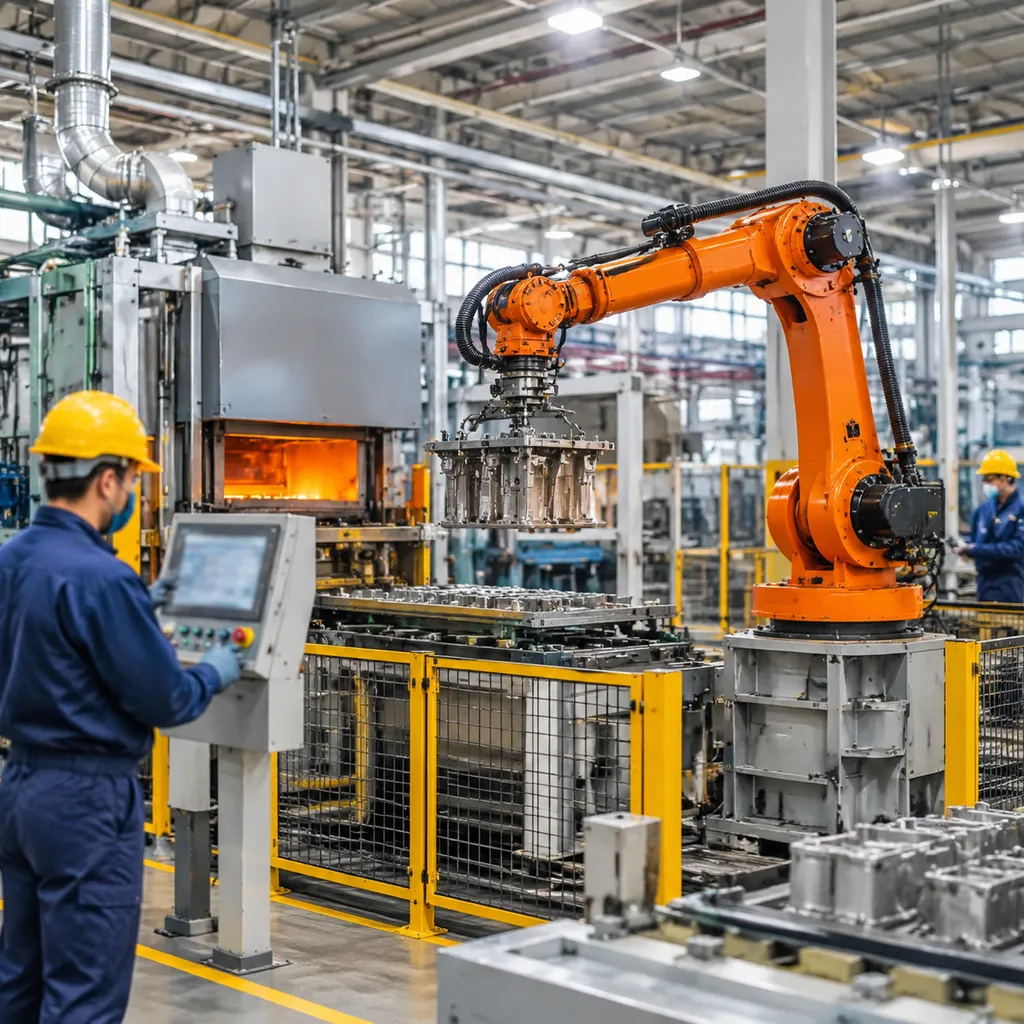
Automating an investment casting production line without a clear data strategy creates an expensive black box. Hardware executes the work, but structured data ensures process repeatability and root-cause visibility. When we deploy foundry automation, we design the digital architecture and the acceptance milestones alongside the mechanical layout.
Critical Data Architecture Requirements
Precision casting relies on tight process windows. We tie every automated cell directly into the plant-wide MES or SCADA system using standard protocols like OPC UA and MQTT, capturing critical parameters in real time:
- Wax Pattern Injection: Wax temperature, injection pressure, dwell time, and die clamp force.
- Robotic Shell Coating: Slurry viscosity, sand rainfall density, dipping speeds, and drying room humidity/airflow cycles.
- Dewaxing & Pouring: Autoclave pressure ramp rates, preheat kiln temperatures, and metal pour rates.
- Traceability: Barcode or RFID tracking per tree to correlate scrap rates with specific process deviations.
Leveraging our technical advantages in precision manufacturing, we prioritize open communication standards over closed vendor architectures. This prevents isolated data islands and gives full traceability from wax pattern to finished casting.
Measurable Factory & Site Acceptance Criteria
Never sign off on an automation project based solely on "it runs." We establish rigid, quantifiable Factory Acceptance Testing (FAT) and Site Acceptance Testing (SAT) metrics before system build begins:
- OEE and Availability: The automated cell must achieve at least 92% operational availability over a continuous 72-hour trial run under normal production conditions.
- Takt Time & Repeatability: The system must meet specified cycle times at 100% load with a dimensional repeatability capability of $C_{pk} \ge 1.67$.
- Defect Ceilings: Scrap rates directly attributable to machine handling (such as wax breakage, shell spalling, or cut-off gouging) must not exceed agreed-upon thresholds—typically under 0.5%.
- Fast Changeover Times: Tooling and recipe changeovers must execute within a verified time window without requiring code-level robot reprogramming.
Phased Implementation Roadmap for Investment Casting Automation
When tackling investment casting production line automation, I always advise clients to avoid the "all or nothing" trap. Scaling up is more sustainable when you follow a clear, phased roadmap designed to manage risk and capital expenditure.
Phase 1: Foundation & Low-Hanging Fruit
Focus on automating high-frequency, repetitive, and low-complexity tasks. Pilot Projects: Begin with aerospace investment casting for precision components that have stable demand. Wax Room Optimization: Implement automated wax injection cells to improve dimensional consistency. Data Baselines: Install sensors to capture baseline cycle times and defect rates before introducing more complex machinery.
Phase 2: Integrated Workstations
Once the pilot cells stabilize, link these individual processes to create semi-autonomous islands. Shell Room Integration: Connect shell coating and dipping stations to ensure uniform coating thickness and drying times. Material Handling: Deploy basic robotic transfer arms to bridge the gap between wax pattern assembly and dipping. Process Monitoring: Shift from manual spot checks to real-time process monitoring to identify bottlenecks early.
Phase 3: Full-Scale System Connectivity
The final phase focuses on total plant orchestration where the foundry automation ecosystem works in unison. Centralized Control: Link all production stages—from wax prep to final inspection—into a unified manufacturing execution system (MES). Adaptive Scheduling: Use data insights to dynamically adjust production schedules based on current throughput and real-time equipment health. Continuous Improvement: Leverage the historical performance data generated across the line to refine precision casting parameters automatically.
By breaking the transition into these manageable stages, you minimize operational disruption while steadily building toward a fully connected, high-efficiency production facility.
FAQ
What is the first step in investment casting automation? The first step is not purchasing equipment, but conducting a thorough on-site review. You need to analyze the existing production workflow and identify stages with the highest labor consumption, greatest process variability, or significant safety risks. By reviewing the processes outlined at https://vastpe.com/aluminum-investment-casting-guide-for-precision-parts/, you can accurately pinpoint your starting point for retrofitting and ensure subsequent investment directly boosts output efficiency.
Should a foundry automate the entire production line at one time? Not at all. For most foundries, phased implementation is more reliable than full-line deployment. We recommend starting with local, high-frequency tasks and adopting a “from point to full line” strategy to build experience and verify system compatibility. This approach effectively reduces financial risk and allows frontline operators to gradually adapt to digital production.
Which workstations are suitable for automation? Generally, workstations with repetitive operations, harsh working conditions, and strict precision requirements are ideal for investment casting automation. Examples include wax injection, shell coating, and subsequent dewaxing. Robotic operation in these processes can greatly reduce scrap rates caused by human error and stabilize product quality.
What is the difference between a robot integrator and a robot supplier? This is a common source of confusion for many customers. A robot supplier provides standard hardware units, while an integrator acts as your system architect. The integrator integrates robots, end-of-arm tooling, sensors and control software into your production workflow. For complex processes such as investment casting, selecting an integrator with deep industry expertise is far more critical than simply buying hardware.
 English
 Russian
 German