
2026年10月10日
Precision aerospace casting for lightweight durable components with complex designs reliable performance and strict quality standards
What is Aerospace Casting?
Aerospace casting is an ultra-precision manufacturing process engineered to produce complex, mission-critical components for commercial aviation, defense aircraft, space exploration vehicles, and propulsion systems. By pouring molten high-performance alloys into specialized molds—predominantly using advanced aerospace investment casting and precision lost wax casting techniques—we deliver near-net-shape geometries that standard subtractive machining cannot achieve economically.
In aerospace and space applications, these castings form the backbone of flight-critical assemblies, ranging from high-pressure jet engine precision casting components to mission-ready aircraft structural castings.
Aerospace Castings vs. Commercial Industrial Castings
Aerospace component manufacturing demands rigorous process controls far beyond standard commercial foundry practices.
| Performance Metric | Standard Commercial Casting | Precision Aerospace Casting |
|---|---|---|
| Defect Tolerance | Moderate non-structural porosity permitted | Zero-defect standard for mission-critical zones |
| Material Grades | Standard carbon steel, cast iron, basic aluminum | Advanced nickel superalloys, titanium, specialty steels |
| Quality Control & Testing | Visual, basic dimensional, random batch checks | 100% NDT (Radiographic X-ray, FPI), full heat traceability |
| Process Control | Standard atmospheric melting and pouring | Vacuum induction melting (VIM) and controlled solidification |
| Compliance Standards | ISO 9001, general industrial norms | AS9100, NADCAP accreditation, strict OEM flight specs |
Critical Requirements for Aerospace Components
Every cast part must endure severe operational environments without structural degradation:
- Maximum Strength-to-Weight Ratio: Critical lightweighting reduces fuel consumption and expands payload capacity without sacrificing structural integrity.
- Extreme Thermal & Creep Resistance: Turbine and propulsion castings withstand continuous operational temperatures exceeding 1,000°C under severe aerodynamic stress.
- Zero-Defect Quality Baseline: Complete elimination of internal micro-shrinkage, gas porosity, and surface micro-cracks ensures long-term fatigue life and flight safety.
Primary Aerospace Casting Methods
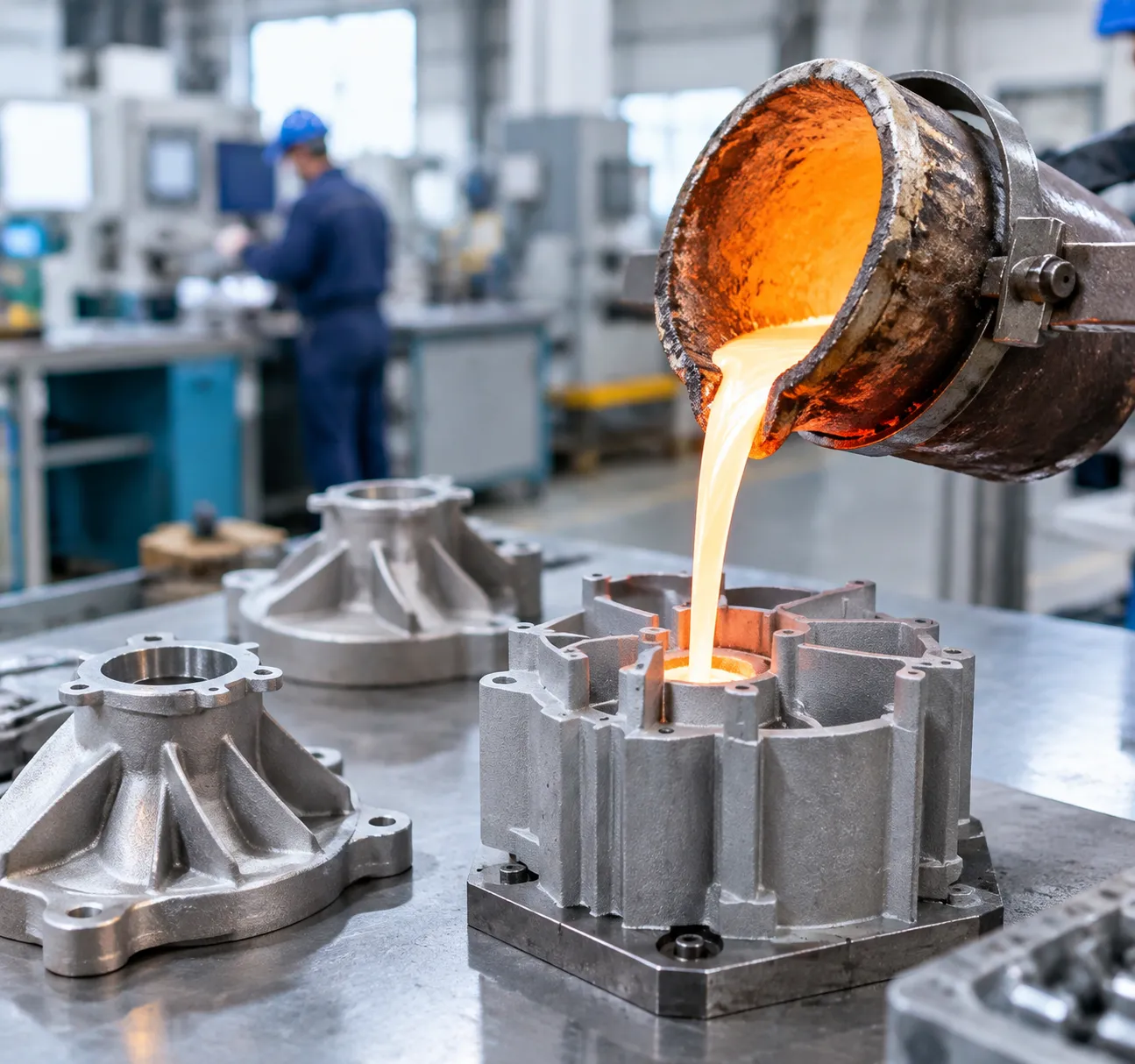
Choosing the right casting technique determines the mechanical integrity, weight efficiency, and thermal limits of flight-critical parts. We rely on distinct, high-precision casting processes tailored to specific aerospace operating environments.
Aerospace Investment Casting (Lost Wax Process)
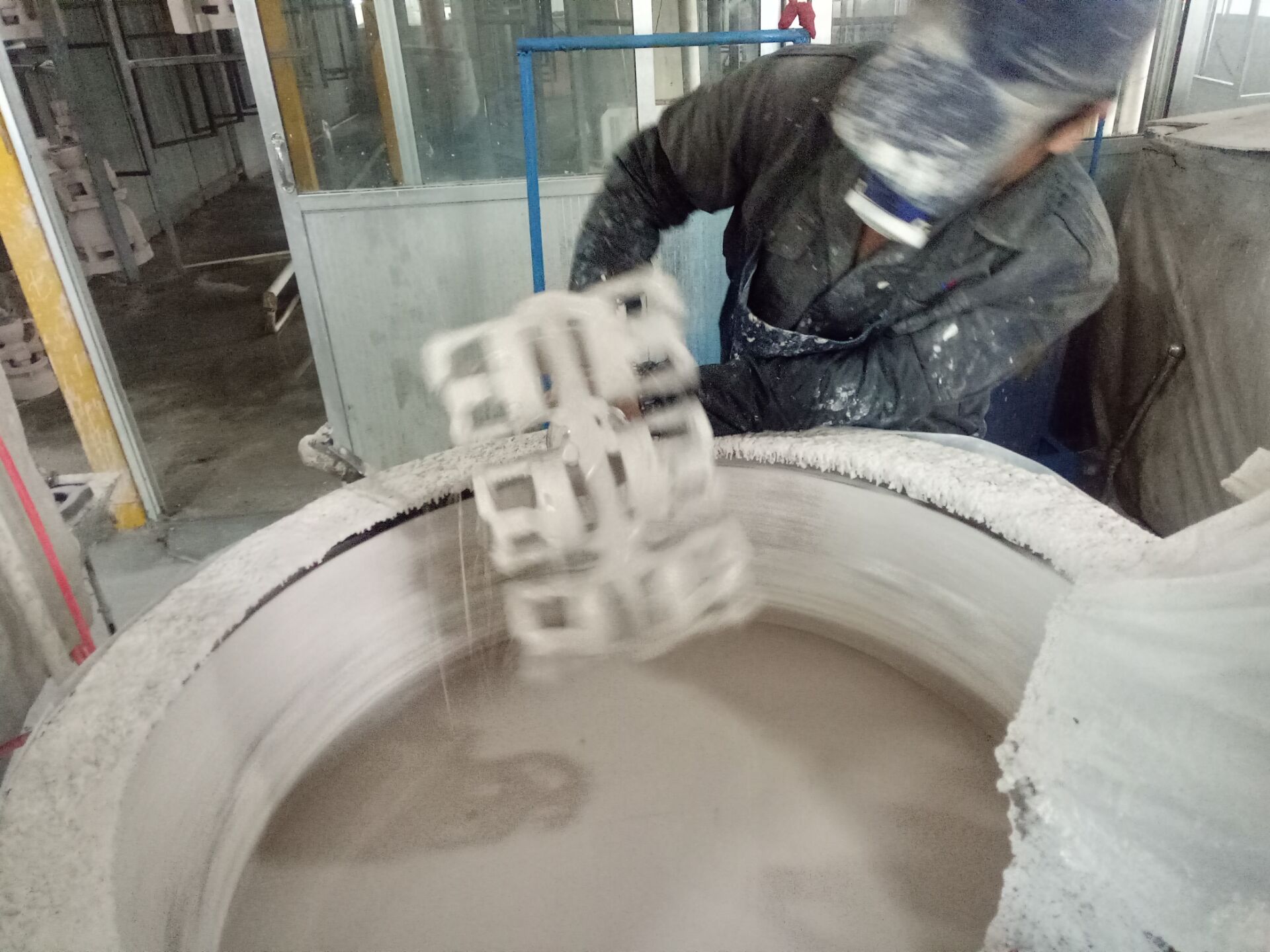
For complex geometries and thin-walled profiles, precision lost wax casting is the industry standard. It yields exceptional surface finishes, tight dimensional tolerances, and near-net-shape components that minimize secondary machining. We utilize this method extensively for structural housings, brackets, and specialized titanium investment casting for aerospace hardware.
Directional Solidification and Single-Crystal Casting
Hot-section engine parts operate under extreme mechanical stress and thermal loads. By controlling grain growth during cooling: Directional Solidification (DS): Aligns grain boundaries parallel to primary stress axes to boost thermal fatigue resistance. Single-Crystal (SX) Casting: Completely eliminates grain boundaries, maximizing creep strength and oxidation resistance for modern high-pressure turbine blades and vanes.
Precision Sand Casting for Large Airframes
When manufacturing large structural airframe components, precision aerospace sand casting offers a cost-effective route without compromising structural soundness. Advanced chemically bonded sand molds deliver high dimensional stability for large bulkheads, wing spars, and heavy-duty gearboxes.
Vacuum Die Casting for High-Integrity Components
Standard die casting risks gas entrapment, but pulling a vacuum during the shot cycle eliminates porosity. This makes vacuum die casting ideal for high-integrity aluminum structural parts, thin-wall avionics enclosures, and bracket assemblies. You can explore how these processes compare in our comprehensive aluminum alloy casting guide for die, sand, and investment solutions.
High-Performance Alloys Used in Aerospace Castings
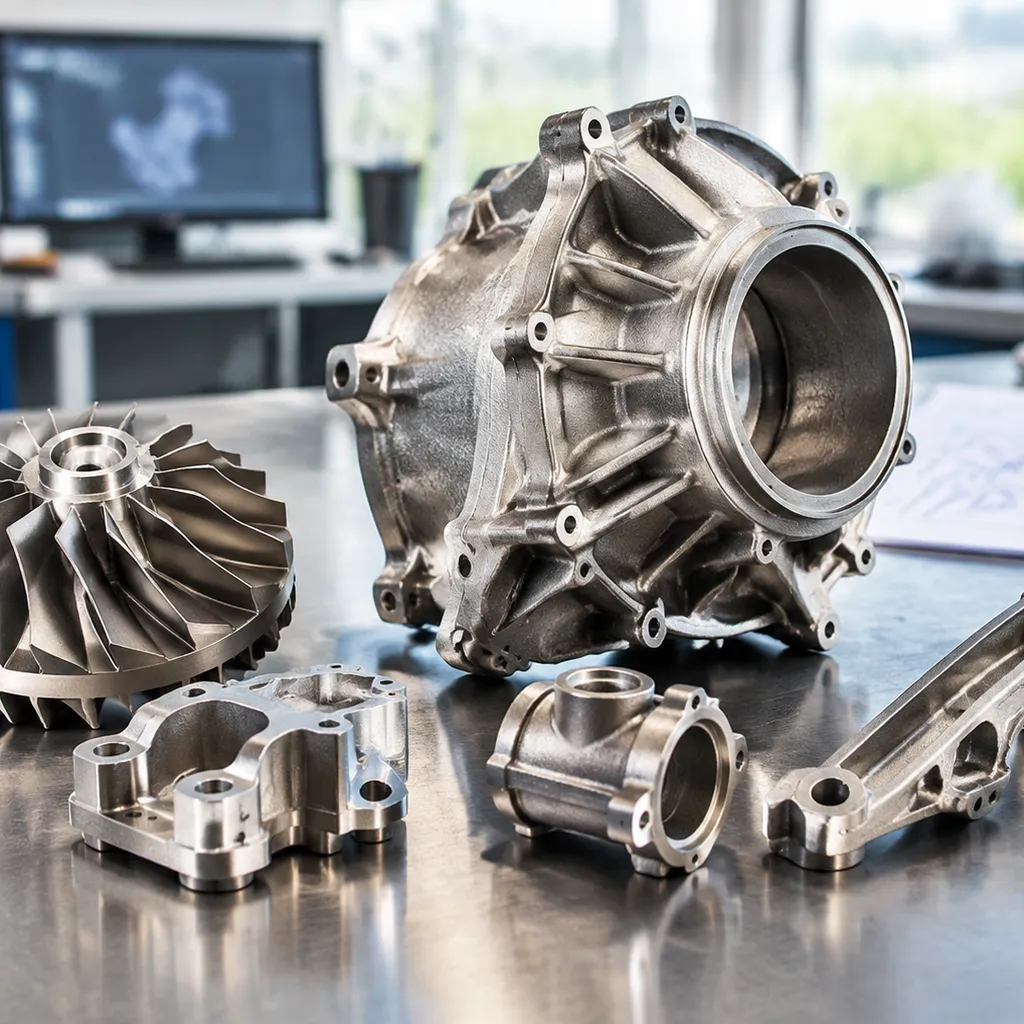
Selecting the correct alloy is the foundation of every critical aerospace casting project. We melt and pour a targeted range of flight-grade materials engineered to withstand extreme mechanical loads, thermal fatigue, and corrosive flight environments.
Titanium Alloys (Ti-6Al-4V, Ti 6-2-4-2)
- Key Benefits: Unmatched strength-to-weight ratio, exceptional fracture toughness, and superior resistance to atmospheric and galvanic corrosion.
- Primary Uses: Airframe structural brackets, engine fan frames, compressor cases, and hydraulic system housings.
Nickel-Based Superalloys (Inconel 718, Inconel 625, Rene 41)
- Key Benefits: High creep-rupture strength at operating temperatures exceeding 1,000°C, combined with excellent oxidation resistance.
- Primary Uses: Hot-section turbine cases, exhaust nozzles, combustion liners, and high-pressure fuel manifolds. We cast specialized nickel-based alloy for high strength and corrosion resistance to maintain structural integrity under continuous thermal cycling.
High-Grade Aluminum Alloys (A356, A357, 200/700-Series)
- Key Benefits: Low density, high thermal conductivity, and excellent fluidity for thin-walled geometry.
- Primary Uses: Avionics enclosures, environmental control system (ECS) ducting, gearbox housings, and non-structural airframe brackets.
Cobalt and Specialized Stainless Steel Alloys
- Key Benefits: High resistance to galling, wear, and thermal shock in aggressive operating conditions.
- Primary Uses: Fuel control bushings, bearing supports, and turbine guide vanes. Utilizing precision cobalt-based casting for heat, wear, and corrosion resistance ensures extended service life for components subjected to metal-to-metal friction.
| Alloy Family | Typical Aerospace Grades | Key Performance Attribute | Common Casting Applications |
|---|---|---|---|
| Titanium | Ti-6Al-4V, Ti-6-2-4-2 | Superior strength-to-weight & corrosion resistance | Structural airframe nodes, pylon mounts |
| Nickel Superalloys | Inconel 718, Inconel 625 | High-temperature creep & oxidation resistance | Turbine housings, exhaust ducts |
| Aluminum | A356-T6, A357 | Ultra-lightweight & high thermal transfer | Electronic chassis, intake manifolds |
| Cobalt Alloys | CoCr alloys, Stellite grades | High-temperature wear & galling resistance | Valve seats, stator guide vanes |
| Stainless Steel | 17-4PH, 15-5PH, 316L | High tensile strength & moderate heat tolerance | Actuator components, cargo fittings |
Critical Components Produced via Aerospace Casting
We cast high-integrity, mission-critical flight hardware designed to withstand extreme thermal cycles, aerodynamic pressures, and structural loads. Utilizing advanced investment and precision casting services, we manufacture near-net-shape components that meet strict aviation safety margins.
Gas Turbine & Jet Engine Components
Jet engine precision casting requires superior metallurgical integrity and internal cooling passages. We produce: Turbine blades and stator vanes: Engineered to resist creep and thermal fatigue in high-pressure engine sections. Combustion chamber hardware: Thin-wall rings, liners, and swirlers capable of sustaining continuous high-combustion temperatures. Impellers and diffusers: Aerodynamically optimized rotors delivering high-compression airflow.
Airframe Structural Parts
Our aircraft structural castings replace multi-piece fabrications, significantly cutting structural weight without sacrificing load capacity: Wing brackets and spar fittings: High-strength structural nodes supporting aerodynamic loads. Door hinges and latch mechanisms: Precision-cast assemblies offering fatigue resistance over thousands of flight cycles. Canopy and window frames: Thin-wall precision castings built with tight geometric tolerances for seamless hull integration.
Rocket Propulsion & Space Systems
For launch vehicles and satellite propulsion modules, aerospace casting provides void-free pressure containment: Turbopump housings: High-pressure casings that handle cryogenic propellants and rapid pressure spikes. Injector bodies and manifolds: Intricate fluid-routing geometries designed for uniform fuel-oxidizer mixing. Rocket nozzles and thrust chambers: High-temperature alloy castings resistant to thermal shock during ignition.
Landing Gear & Hydraulic Systems
Landing hardware must absorb heavy dynamic touchdown shocks. We cast heavy-duty, defect-free fluid and structural housings: Brake housings and torque tubes: High-strength enclosures built for extreme friction heat dissipation. Actuator bodies and cylinders: Pressure-tight hydraulic casings resisting fluid erosion and fatigue. Steering links and trunnions: Heavy-load structural links transferring ground steering and braking forces to the airframe.
Aerospace Quality Standards and Non-Destructive Testing (NDT)
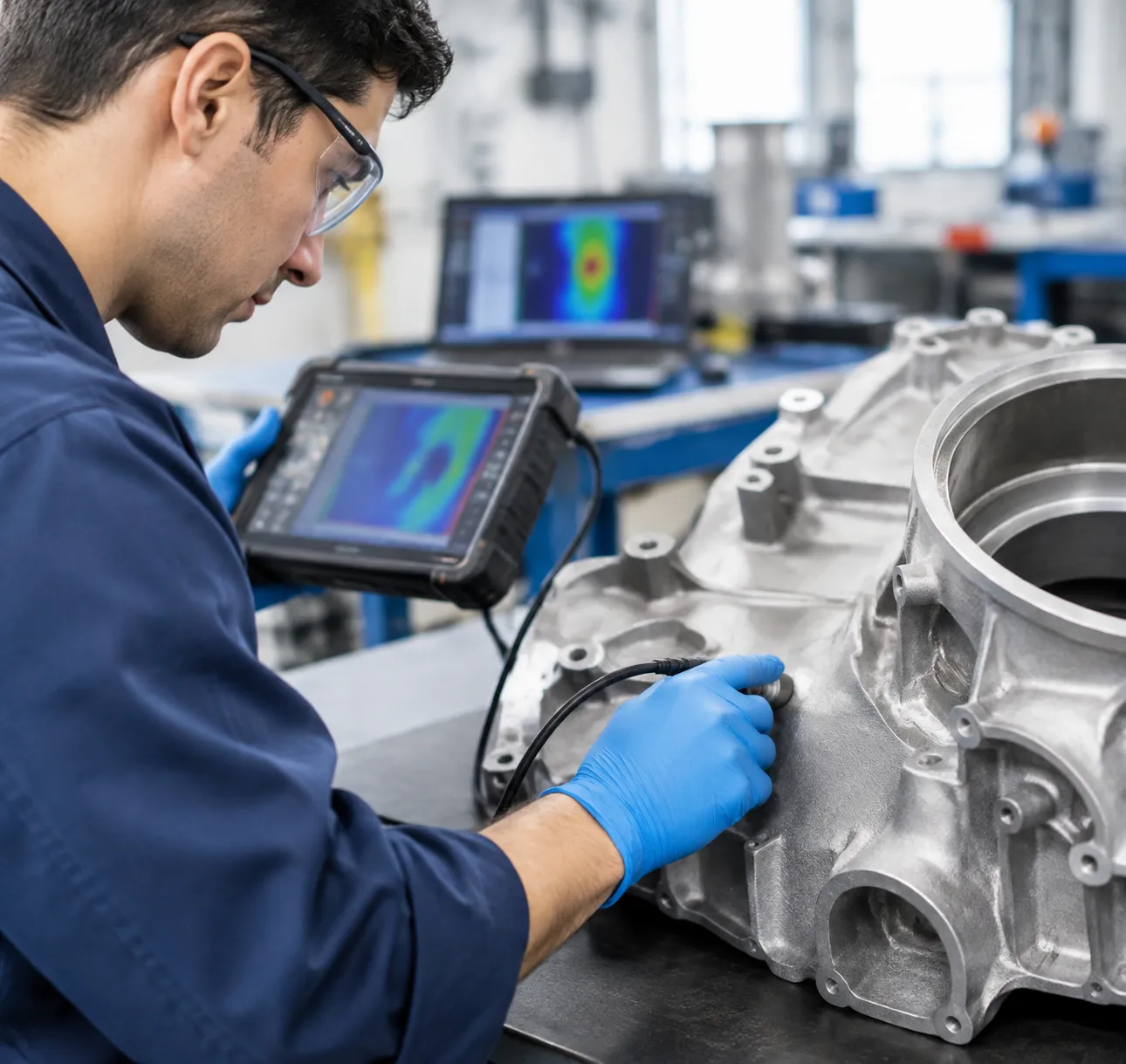
In critical flight applications, an undetected micro-flaw can lead to catastrophic failure. We apply rigorous quality management and comprehensive non-destructive testing (NDT) to ensure every aerospace casting meets zero-defect standards before entering service.
Mandatory Quality Certifications
Our aerospace casting manufacturing operations run strictly under globally recognized quality and special-process frameworks:
- AS9100 & ISO 9001: Full quality management standard controlling every phase of production, traceability, and risk mitigation.
- NADCAP Accreditation: Third-party validation covering special processes, including heat treatment, chemical processing, and NDT operations.
Core NDT & Inspection Methods
We utilize advanced non-destructive testing to verify both the internal soundness and external surface integrity of every component:
- Digital Radiography (X-Ray) & Industrial CT Scanning: High-resolution volumetric imaging reveals subsurface voids, gas porosity, and micro-shrinkage deep within dense geometries.
- Fluorescent Penetrant Inspection (FPI): Level 3 and Level 4 high-sensitivity penetrants reveal hairline surface fractures, hot tears, and linear indications under ultraviolet light.
- Coordinate Measuring Machines (CMM) & 3D Blue Light Scanning: High-speed dimensional verification ensures tight adherence to complex geometric dimensioning and tolerancing (GD&T) profiles.
- Metallurgical & Grain Structure Analysis: Optical emission spectrometry (OES) and microstructural evaluations confirm alloy composition and grain boundaries, especially crucial when pouring high-temperature grades supported by specialized nickel casting services for Inconel and superalloys.
Aerospace Casting Inspection Matrix
| Inspection Type | Test Method | Defect Target / Purpose |
|---|---|---|
| Subsurface Evaluation | High-Energy X-Ray / CT | Internal voids, inclusions, core shift |
| Surface Integrity | High-Sensitivity FPI | Surface micro-cracks, porosity, cold laps |
| Geometry Verification | Multi-Axis CMM & Laser Scan | True position, profile tolerances, wall thickness |
| Material Verification | Spectrometry & Tensile Testing | Alloy chemistry, tensile/yield strength, grain size |
Key Benefits of Aerospace Castings vs. Billet Machining
When manufacturing mission-critical flight hardware, choosing between precision casting and CNC billet machining comes down to cost, geometry, and material utilization. In our operations, we rely on aerospace casting to overcome the design and economic bottlenecks typical of traditional subtractive machining.
Material Efficiency and Near-Net-Shape Production
Subtractive machining from solid forged billets frequently results in "buy-to-fly" ratios as high as 10:1 or even 20:1, turning expensive flight-grade alloys into scrap chips. Our near-net-shape casting processes cut raw material waste drastically:
- Minimal Material Loss: Pours molten metal directly into final part geometries, reducing scrap rates on high-cost titanium and nickel alloys.
- Lower Tooling Wear: Less post-cast CNC material removal means longer cutting tool life and faster cycle times.
- Optimized Material Selection: Check our casting alloy properties and material selection guide to evaluate how alloy yield rates impact total production costs.
Complex Internal Geometries and Part Consolidation
Machining cannot reach internal hollows, curved passageways, or complex cooling circuits without splitting components into multiple pieces. With aerospace investment casting, we produce intricate geometries seamlessly:
- Internal Cooling Passages: We cast serpentine cooling channels and thin-wall profiles directly into turbine components without secondary drilling.
- Assembly Consolidation: Multi-piece welded or bolted structures merge into a single-piece casting, eliminating leak paths, assembly labor, and fastener weight.
- Design Freedom: We cast organic contours and varying cross-sections that 5-axis CNC cutters simply cannot access.
Aerospace Casting vs. Billet Machining Comparison
| Performance Metric | Aerospace Precision Casting | 5-Axis Billet Machining |
|---|---|---|
| Buy-to-Fly Ratio | Typically 1.1:1 to 1.3:1 (High efficiency) | 5:1 to 20:1+ (High scrap rate) |
| Internal Coring & Channels | Excellent (Soluble/ceramic cores) | Extremely limited / Requires multi-part joining |
| Part Consolidation | High (Converts multi-part weldments to single piece) | Low (Requires assembly of multiple sub-components) |
| Lead Time at Scale | Faster cycle times per part once tooled | Linear cycle times (Scales poorly at high volume) |
| Alloy Flexibility | High (Supports custom cast stainless steel and superalloys) | Limited to commercially available billet stock |
Fatigue Life and Structural Integrity Under Flight Stress
Engineered aerospace castings deliver isotropic mechanical properties throughout the entire component. Without the directional grain weaknesses often created by aggressive cross-grain machining, cast components maintain balanced fatigue resistance and structural reliability under thermal expansion, high vibration, and severe aerodynamic loads.
How to Choose an Aerospace Casting Manufacturer
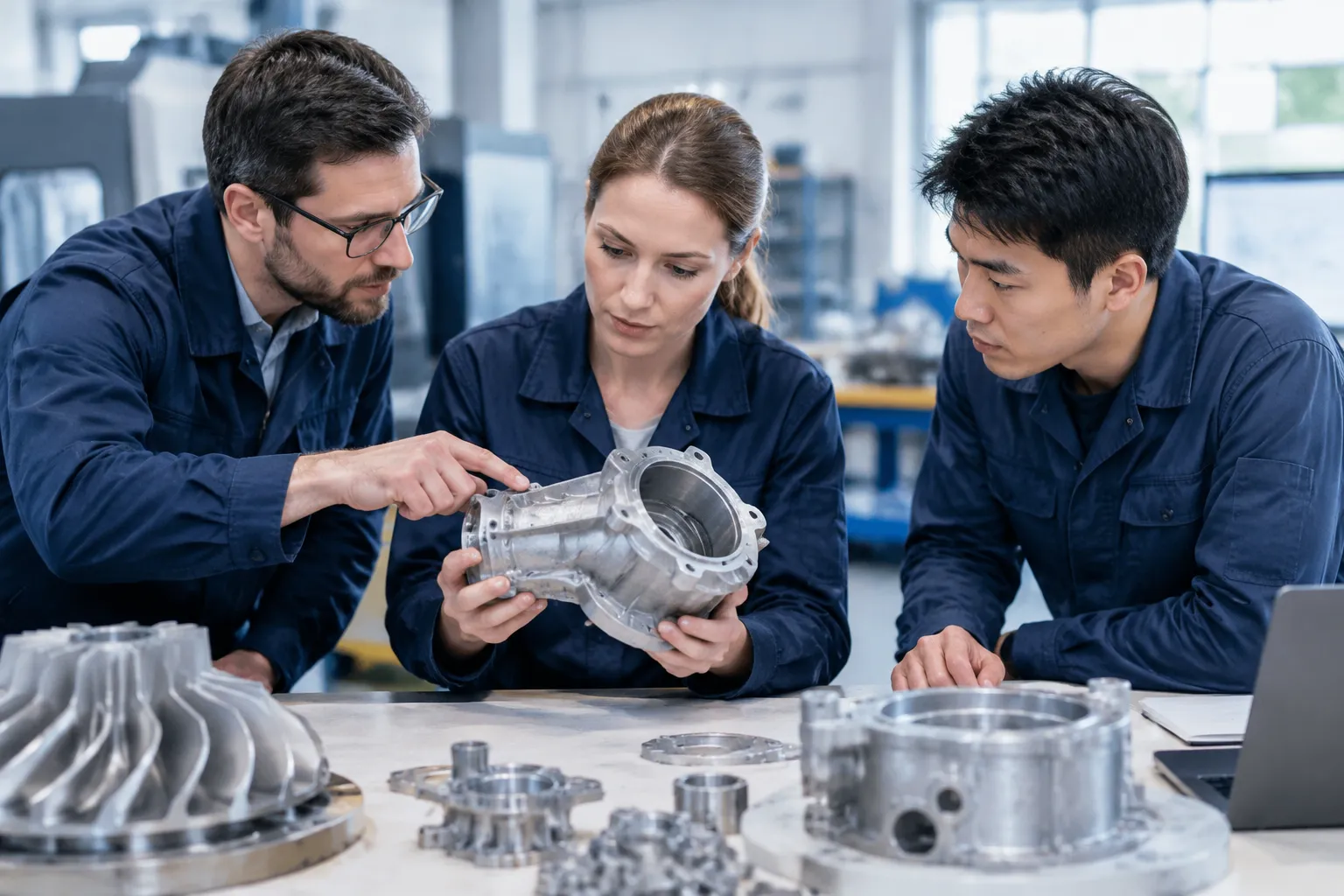
Selecting the right aerospace casting manufacturer is a critical supply-chain decision where material integrity, process repeatability, and rigorous compliance are non-negotiable. When evaluating potential foundry partners for flight-critical hardware, we recommend focusing on four core pillars:
1. Certifications and OEM Approvals
An established aerospace casting supplier must maintain an active AS9100 certified foundry quality management system alongside ISO 9001. Furthermore, ensure they hold NADCAP accredited casting special process approvals for: Non-destructive testing (NDT: Radiographic and Fluorescent Penetrant Inspection) Heat treating and metallurgical laboratory evaluation Chemical processing and specialized surface finishing
2. Melting and Pouring Capabilities
High-performance flight components require advanced melt controls. Verify whether the foundry operates Vacuum Induction Melting (VIM) or inert gas-shielded environments to cast reactive titanium and nickel-based superalloys without atmospheric contamination, inclusions, or gas porosity.
3. Tooling Design and Rapid Prototyping
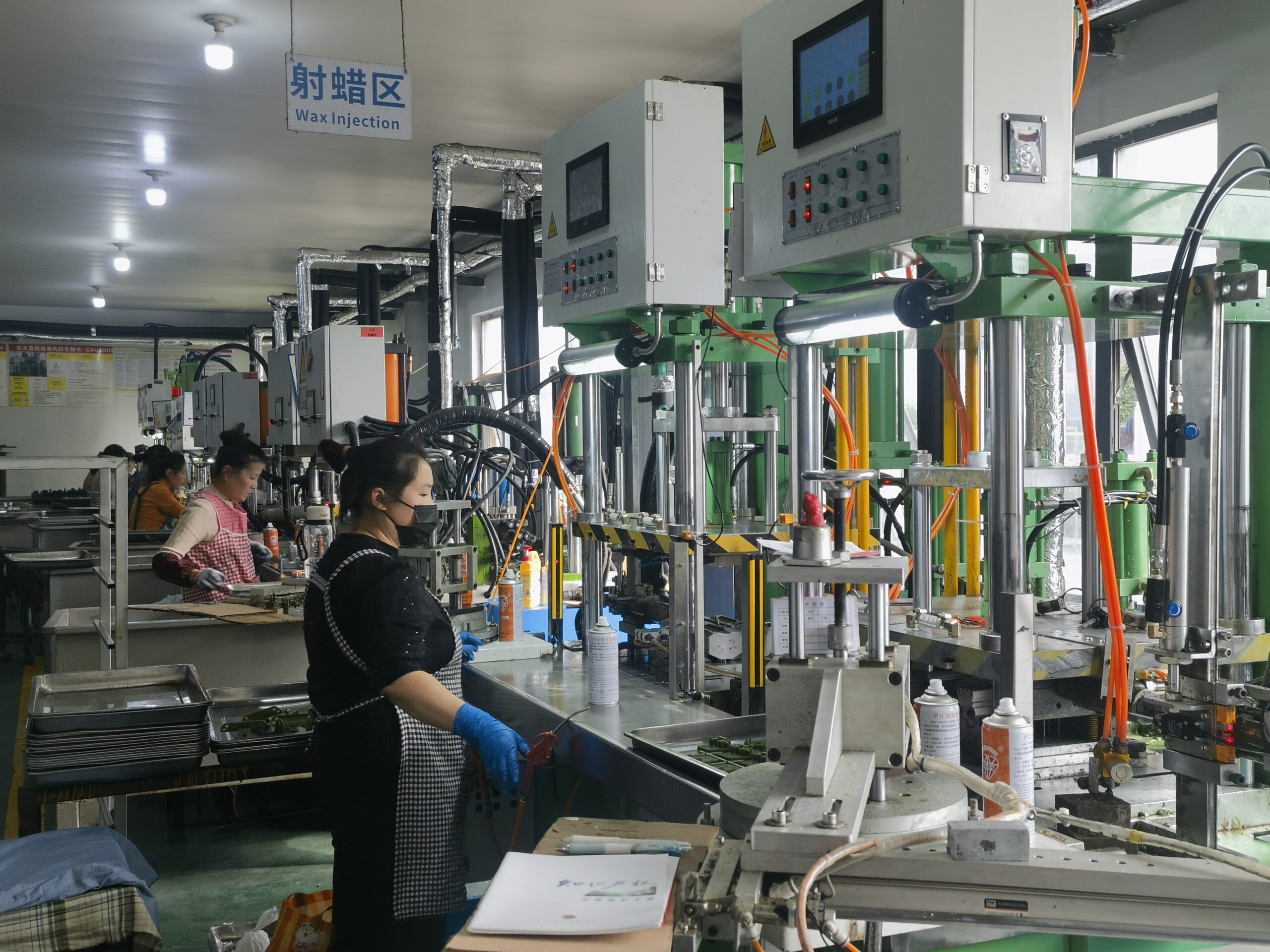
A dependable foundry should provide comprehensive in-house tooling design, solidification modeling, and rapid pattern generation. Leveraging 3D printed wax or resin patterns cuts development lead times from months to weeks. Evaluating their mastery of the metal investment casting process, tolerances, and materials helps ensure your designs transition smoothly from prototyping to full-scale production.
4. End-to-End Traceability and Documentation
Full supply chain visibility is mandatory. Your manufacturing partner must supply complete Material Test Reports (MTRs), chemical melt analyses, mechanical test coupons, and serialized dimensional inspection reports for every single production batch.
| Evaluation Factor | Critical Specification | Operational Impact |
|---|---|---|
| Accreditation | AS9100 Rev D, NADCAP (NDT / Heat Treat) | Ensures compliance with strict civil and defense aviation standards. |
| Melt Controls | Vacuum melting (VIM), controlled atmosphere | Prevents oxidation and micro-shrinkage in high-temp superalloys. |
| Prototyping | In-house mold shop & 3D printed patterns | Accelerates initial sampling and reduces re-tooling expenses. |
| Traceability | Lot-level serialization, CMM, and NDT reports | Provides complete accountability from raw ingot to final delivery. |
Frequently Asked Questions About Aerospace Casting
What is the most common casting process used in the aerospace industry?
Investment casting (precision lost wax casting) is the primary method used across the industry. We rely on aerospace investment casting because it yields exceptional surface finishes, intricate internal cooling channels, and thin-wall capabilities required for turbine components, structural brackets, and fuel systems.
How does aerospace casting compare to 5-axis CNC billet machining in cost and lead time?
While CNC machining from solid billet is practical for low-count prototypes, it generates massive material waste—often exceeding an 8:1 buy-to-fly ratio when cutting expensive titanium or nickel superalloys. When evaluating precision casting and CNC machining, near-net-shape casting drastically lowers per-part material costs, consolidates multi-piece assemblies, and scales cost-effectively for production runs.
| Comparison Factor | Precision Aerospace Casting | 5-Axis CNC Billet Machining |
|---|---|---|
| Material Waste | Low (near-net shape reduces scrap) | High (significant scrap on complex geometries) |
| Geometry Capability | Intricate internal passages & thin walls | Limited by tool reach and axis angles |
| Tooling Investment | Upfront pattern/die tooling required | Minimal upfront tooling |
| Unit Cost at Scale | Highly economical for mid-to-high volume | High per-unit machine hour costs |
What are the standard dimensional tolerances for precision aerospace investment castings?
General linear tolerances for precision investment casting typically conform to ±0.005 inches per inch (or ISO 8062-3 DCTG 4 to DCTG 6 standards). For critical interface surfaces, bearing journals, and sealing faces, we cast stock material allowances for secondary high-precision CNC machining to achieve micro-inch tolerances.
How do foundries prevent gas porosity and micro-shrinkage in superalloy castings?
We eliminate defects using targeted metallurgical controls and modern processing techniques: Vacuum Induction Melting (VIM): Prevents alloy oxidation and gas entrapment during melting and pouring. Thermal Modeling & Mold Simulation: Optimizes gating and runner design to control directional solidification and eliminate hot spots. Hot Isostatic Pressing (HIP): Applies high temperature and inert gas pressure post-cast to collapse and heal internal microporosity, ensuring 100% density.
Can 3D printing replace traditional tooling for low-volume aerospace casting patterns?
Yes. We utilize 3D printed wax and specialized PMMA patterns for rapid prototyping, engine development trials, and low-volume legacy component replacements. This additive manufacturing approach bypasses hard aluminum tooling costs, reduces initial development lead times from months to days, and maintains the dimensional accuracy required for non-destructive testing (NDT) compliance.
 English
 Russian
 German