
2026年10月12日
Precision aerospace casting for lightweight durable components with high strength corrosion resistance and reliable performance in demanding flight ap
Core Aerospace Casting Processes We Use
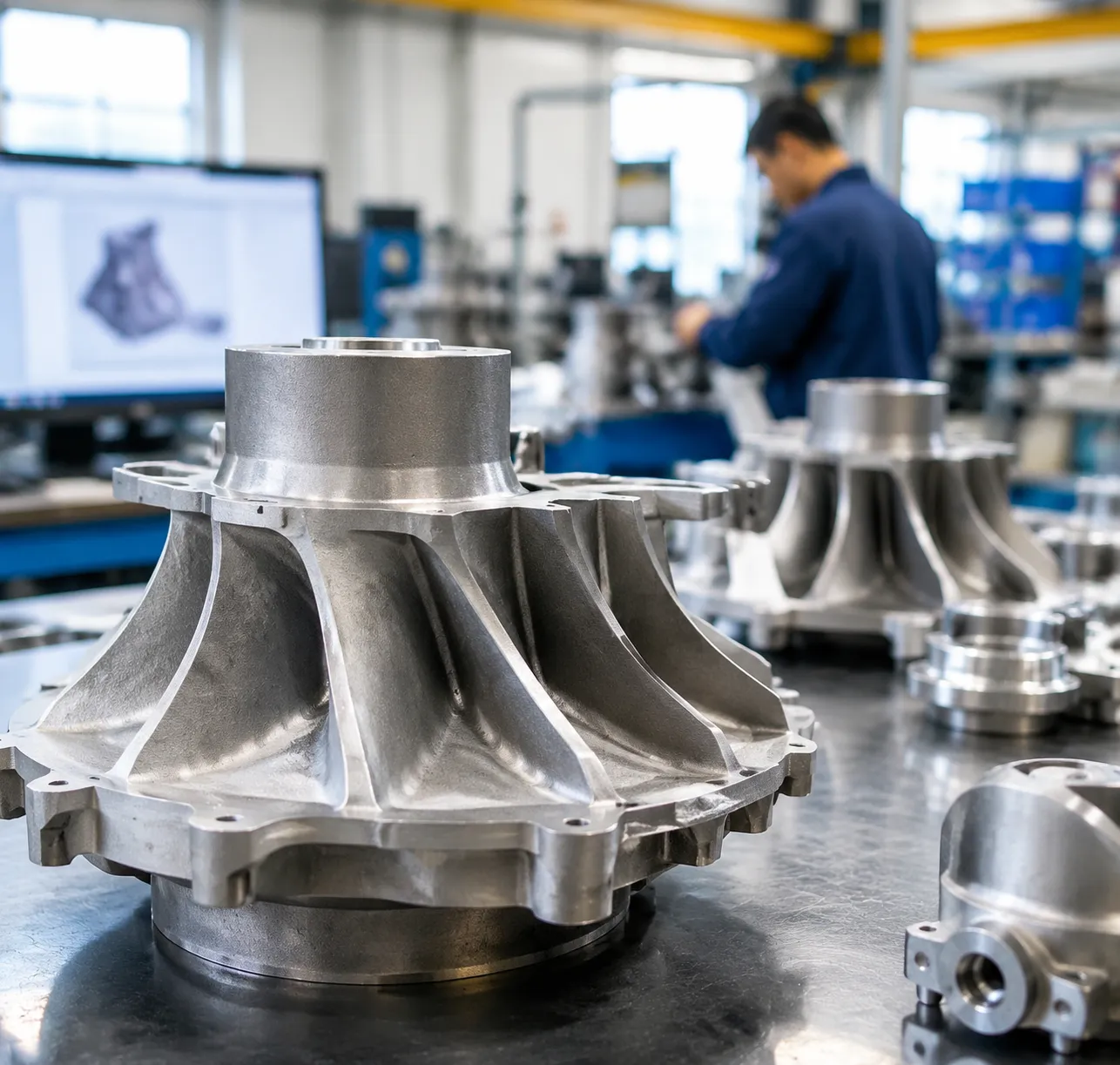
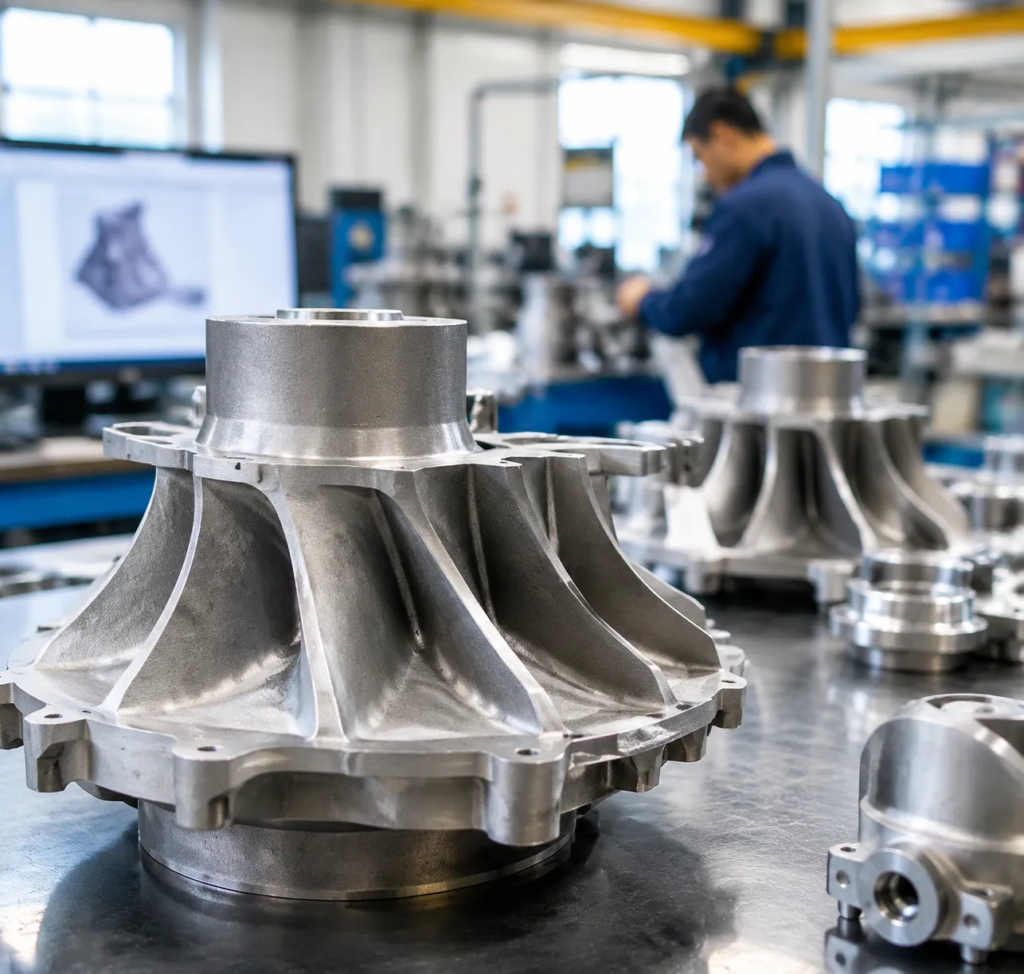
We engineer mission-critical aerospace casting solutions designed to withstand extreme thermal gradients, mechanical fatigue, and high-stress flight environments. By matching specific component geometries to the correct casting methodology, we deliver near-net-shape components that cut machining overhead and satisfy strict aerospace quality standards.
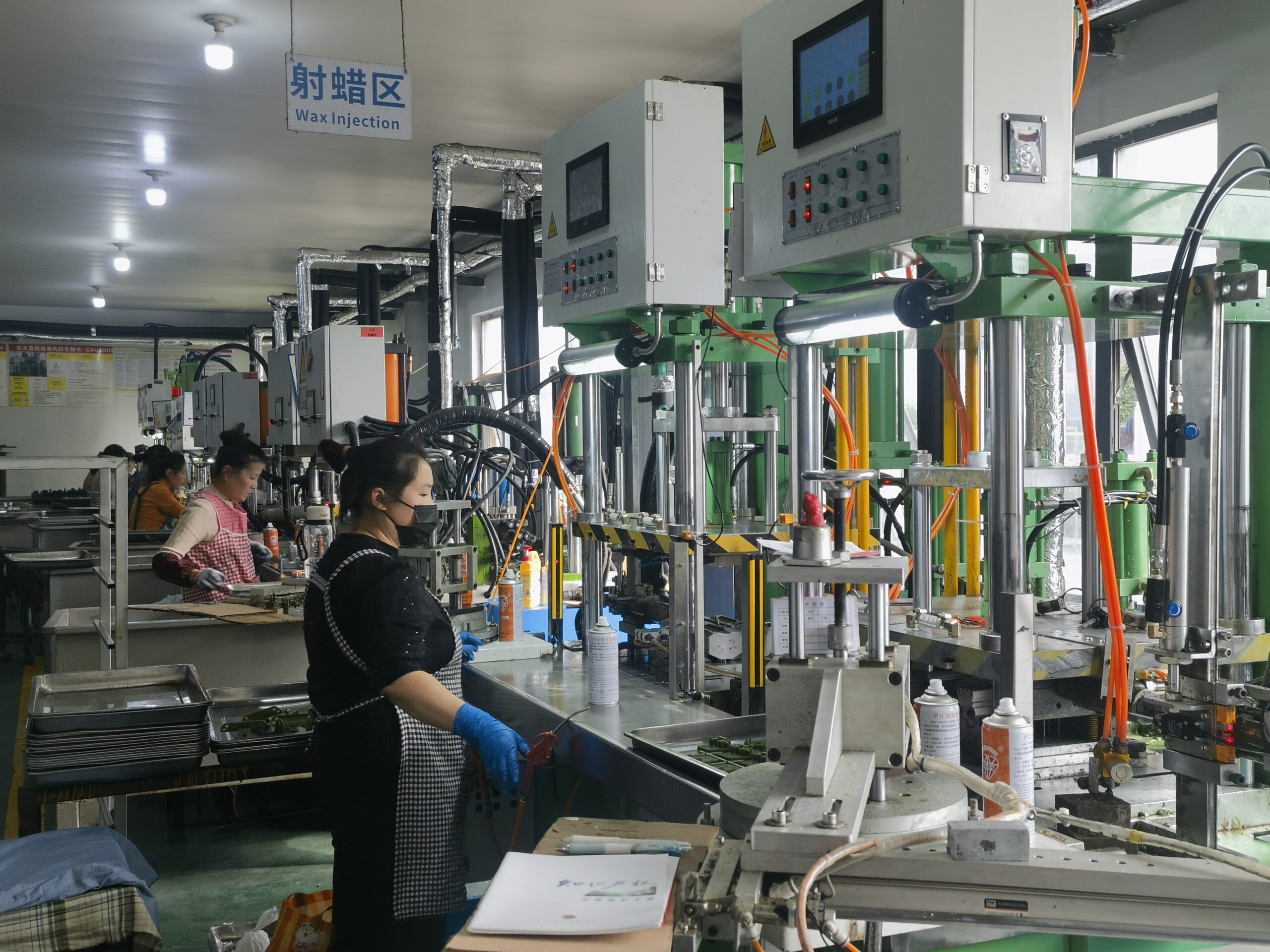
Precision Investment Casting (Lost Wax)
Our aerospace investment casting process targets complex, thin-walled geometries that cannot be produced via conventional subtractive manufacturing. Capabilities: Wall thicknesses down to 1.5 mm with exceptional surface finishes. Best For: Turbine blades, fuel system nozzles, impellers, and complex structural brackets. Key Advantages: Excellent dimensional accuracy, minimal draft angle requirements, and substantial reduction in raw material waste for expensive alloys.
Aerospace Sand Casting
For large-scale airframe sections and heavy structural elements, our advanced sand casting aerospace alloys line provides scale, speed, and structural dependability. Capabilities: High-integrity pours for oversized, structural components weighing up to several thousand pounds. Best For: Gearbox housings, canopy frames, bulkheads, and engine support structures. Key Advantages: Low initial tooling cost, rapid pattern turnaround for prototyping, and adaptability to complex interior core designs.
Vacuum Die Casting and Squeeze Casting
To eliminate standard porosity risks and satisfy critical structural integrity benchmarks, we utilize vacuum-assisted die casting and squeeze casting. Capabilities: High-pressure injection under strict vacuum conditions, combined with high-pressure solidification. Best For: Wing ribs, missile airframe parts, and critical load-bearing mounting hardware. Key Advantages: Drastically reduces gas entrapment, delivers wrought-like mechanical properties, and ensures repeatable dimensional stability across high-volume production runs.
Centrifugal Casting
We deploy vertical and horizontal centrifugal casting systems to manufacture perfectly symmetrical, high-integrity cylindrical parts. Capabilities: High g-force rotation drives impurities toward the inner bore for easy post-cast machining removal. Best For: Jet engine containment rings, bearing cages, and compressor casing components. Key Advantages: Uniform grain structure, complete absence of mid-wall shrinkage, and superior resistance to radial pressure and thermal expansion.
High-Performance Aerospace Casting Alloys and Materials
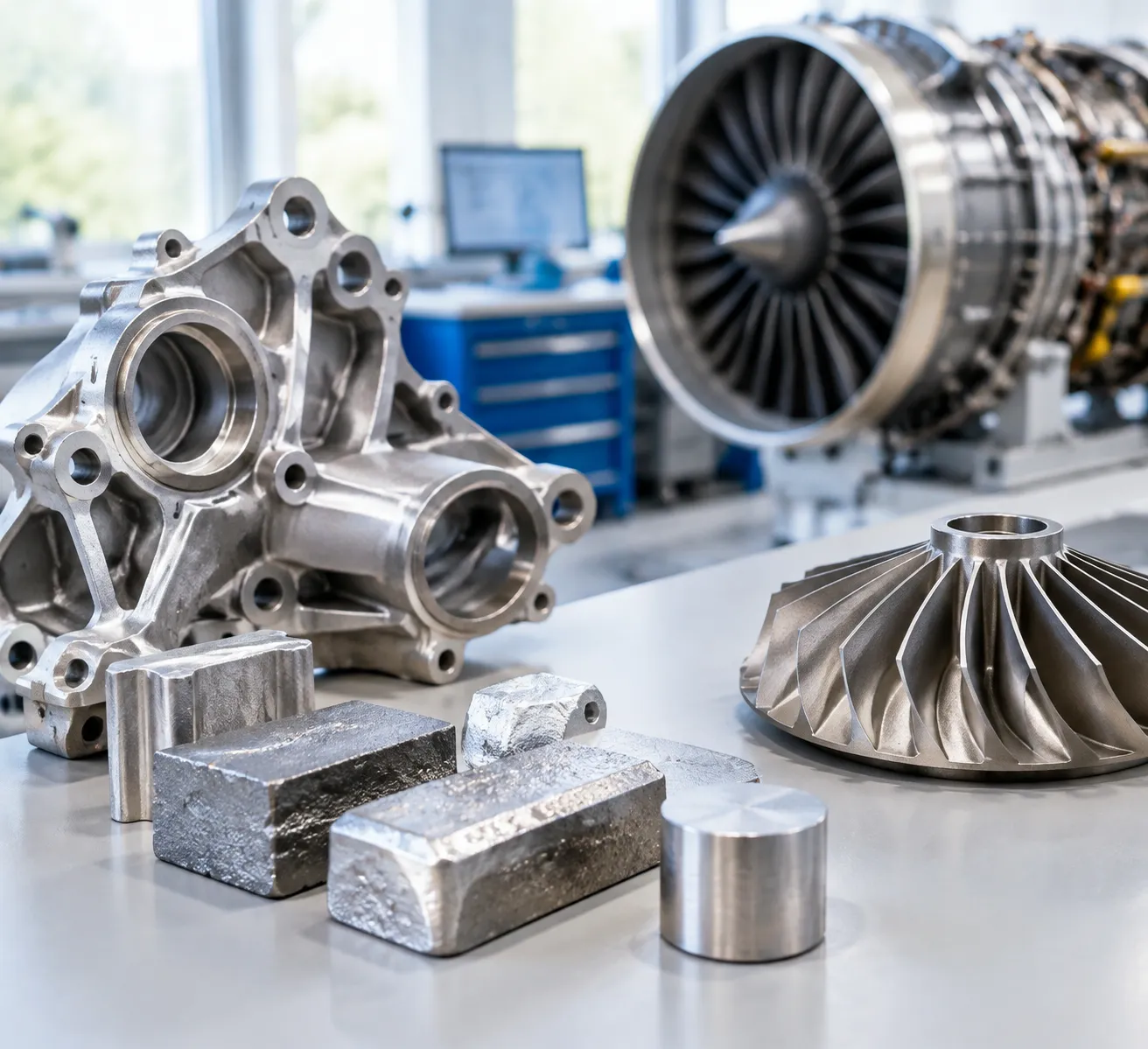
Selecting the right alloy dictates flight performance, thermal stability, and structural longevity. In our aerospace casting operations, we pour certified, flight-grade metals engineered to survive extreme mechanical stress, vibration, and severe thermal cycling.
Titanium Alloys (Ti-6Al-4V)
- Target components: High-load airframe components, wing attachment fittings, and structural joints.
- Key properties: High strength-to-weight ratio, exceptional fracture toughness, and superior corrosion resistance.
- Manufacturing impact: Delivers near-net-shape geometry that drastically cuts buy-to-fly ratios compared to hogging out solid titanium billet.
Nickel- and Cobalt-Based Superalloys
- Target components: Hot-section jet engine casting components, such as turbine vanes, combustion hardware, and exhaust housings.
- Key properties: High creep resistance, surface stability, and tensile strength at sustained temperatures above 1,000°C.
- Material selection: We pour specialized grades, implementing nickel-based alloy for high strength and corrosion resistance along with cobalt-based casting alloys for durable precision parts exposed to extreme mechanical friction and heat.
Aluminum Alloys (A356, 200 and 700 Series)
- Target components: Lightweight structural brackets, avionics enclosures, and environmental control system housings.
- Key properties: Low density, high thermal conductivity, and good weldability.
- Heat treatment: Components are typically processed through hot isostatic pressing and T6 heat treatment cycles to ensure structural integrity and leak-free pressure tightness.
Magnesium Alloys
- Target components: Ultra-lightweight non-structural aviation parts, accessory gearbox covers, and canopy frames.
- Key properties: Significant weight savings—roughly 33% lighter than aluminum—while maintaining damping capacity and dimensional stability.
- Production focus: Controlled melt handling to prevent oxidation and produce clean, thin-wall castings that reduce overall aircraft payload weight.
Critical Flight Components Made via Aerospace Casting
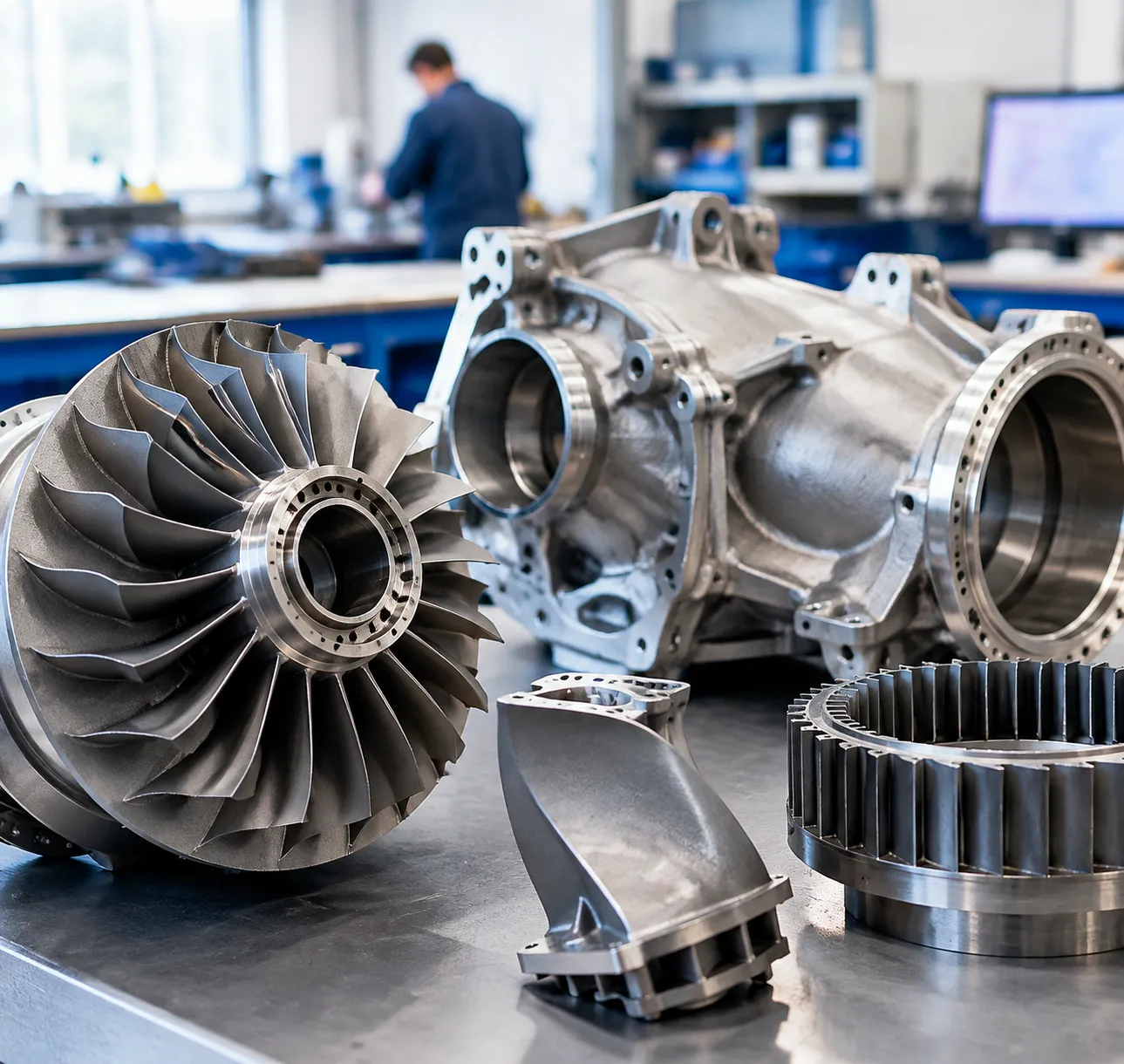
We cast flight-critical parts that meet rigorous durability and weight requirements across modern aviation platforms. By matching the right casting process to each application, we deliver parts that maintain structural integrity in high-vibration and extreme-temperature environments.
- Jet Engine Hot-Section Parts: We produce high-stress components such as turbine blades, guide vanes, and combustion liners designed to endure elevated thermal cycles and rotational stress.
- Structural Airframe Fittings: From hinge brackets and wing attach points to heavy-duty door mechanisms, our foundry delivers complex titanium investment casting for aerospace hardware that strips away dead weight while retaining critical load capacity.
- Landing Gear and Hydraulic Components: We cast high-integrity hydraulic actuator housings, main cylinder bodies, and link assemblies built to handle high-pressure fluids and cyclical shock loads.
- Avionics Enclosures and APU Housings: Our team manufactures thin-walled avionics chassis, heat exchangers, and auxiliary power unit (APU) enclosures that protect sensitive electronics from electromagnetic interference and mechanical fatigue while supporting strict casting quality standards.
Quality Assurance, Certifications, and Aerospace NDT Standards
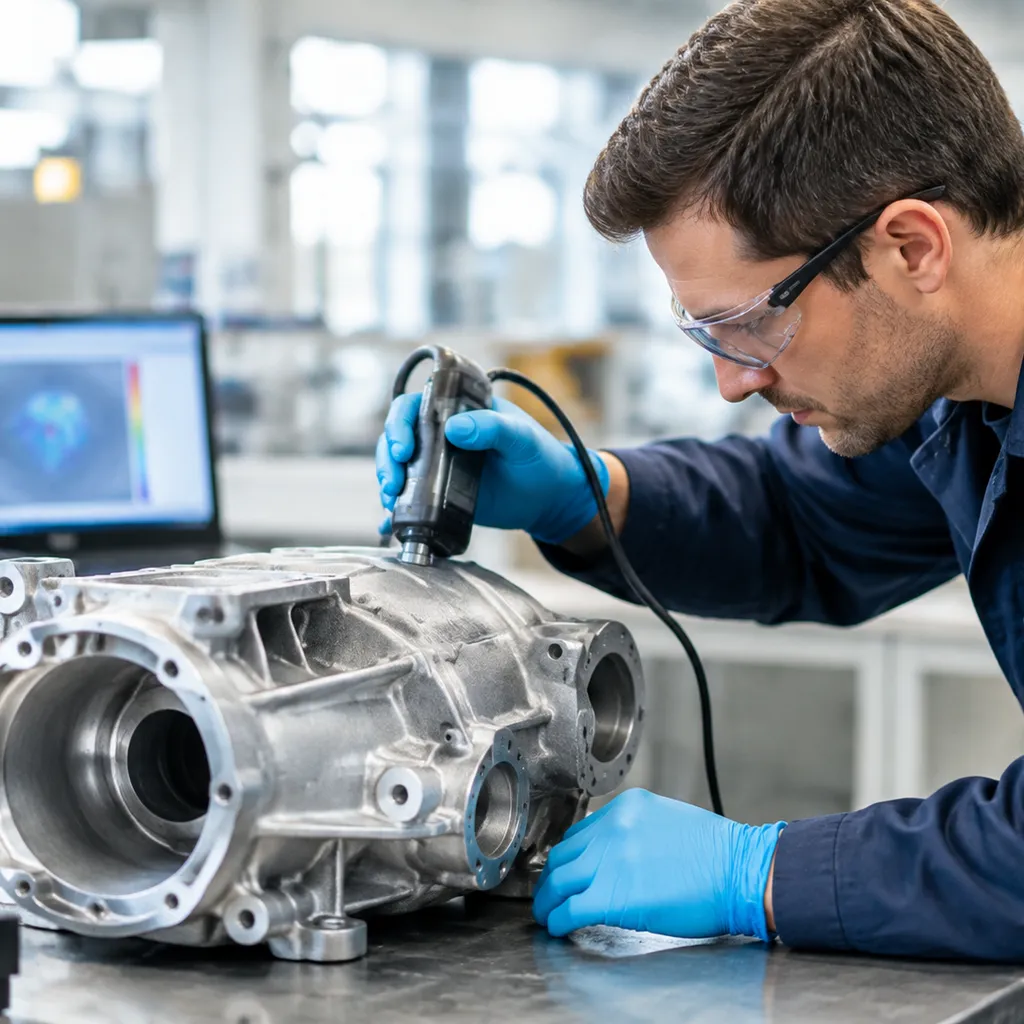
When sourcing flight-critical aerospace casting hardware, zero defect tolerance is non-negotiable. We maintain uncompromising inspection protocols and strict process controls to guarantee every component meets aerospace structural integrity requirements before it leaves our floor.
AS9100 and ISO 9001 Certified Operations
Our manufacturing systems operate under verified AS9100 and ISO 9001 quality management frameworks. This ensures end-to-end traceability, rigorous melt-chemistry tracking, and complete material certification packages for every heat and production batch.
NADCAP Accreditation for Special Processes
Aerospace alloys demand tightly controlled post-cast processing. We align our manufacturing with NADCAP accreditation standards to ensure process repeatability across high-consequence operations: Heat Treatment: Validated solution and aging cycles to achieve specified tensile strength, yield, and fracture toughness. Chemical Processing: Etching, passivation, and surface finishing carried out under strict bath-chemistry controls. Process Verification: Regular pyrometry audits, mechanical testing, and metallographic micro-examinations.
Advanced Non-Destructive Testing (NDT)
We utilize validated inspection and NDT services to identify surface defects, internal gas porosity, and micro-shrinkage without compromising the workpiece: Digital Radiography (DR): High-definition X-ray imaging provides immediate visualization of internal sound-density levels and internal wall uniformity. Fluorescent Penetrant Inspection (FPI): High-sensitivity Level 3 and Level 4 fluorescent dyes reveal tight surface-breaking cracks and micro-voids. Ultrasonic Inspection (UT): Direct acoustic-wave verification detects subsurface laminar inclusions and core integrity flaws in thick-section castings.
Dimensional Metrology: CMM and 3D Optical Scanning
Complex aerospace shapes require exact geometric compliance. We verify parts directly against your native CAD datasets using automated metrology setups: Coordinate Measuring Machines (CMM): Multi-axis touch-probe systems verify datum reference frames, machined hole patterns, and tight positional tolerances. Optical 3D Scanning: Structured blue-light scanning captures full-field point clouds to instantly map freeform turbine geometries, draft angles, and aerodynamic contours.
How We Solve Critical Aerospace Casting Defects
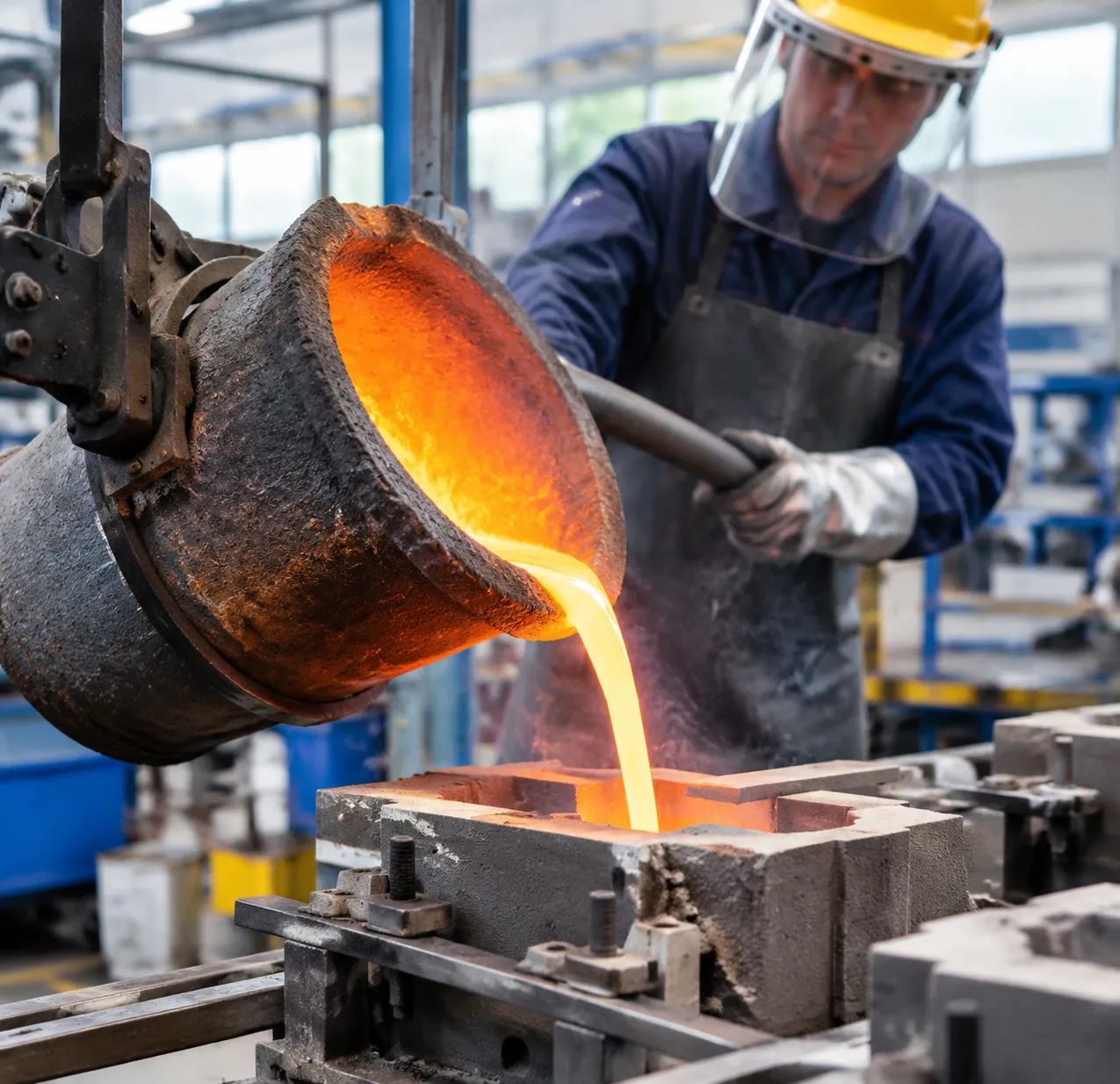
In flight-critical hardware, internal flaws lead to component fatigue and failure. We eliminate structural vulnerabilities through proactive engineering controls, strict melt environments, and post-cast densification.
Eliminating Gas Porosity and Shrinkage Cavities
We identify and resolve defect risks before pouring metal by using advanced mold flow and thermal solidification simulations. Turbulence control: Virtual flow analysis optimizes gating and runner systems to prevent air entrapment and surface oxide folding. Controlled feeding: Feeding paths and chill placements are mapped to ensure directional solidification, eliminating shrinkage cavities in thick-to-thin transitions. Process selection: Evaluating the advantage of investment casting over green sand casting allows us to minimize mold-gas generation and maintain tight wall integrity on thin geometries.
Hot Isostatic Pressing (HIP) for 100% Internal Density
To guarantee parts withstand cyclical flight stress, we use hot isostatic pressing (HIP) on high-integrity alloys: Castings are loaded into a sealed pressure vessel at high temperatures and pressurized with inert argon gas (often up to 100–200 MPa). Simultaneous heat and isostatic pressure collapse internal micro-shrinkage and micro-porosity through creep and diffusion bonding. The process achieves near-100% theoretical internal density, vastly improving tensile ductility, fracture toughness, and fatigue life.
Controlling Grain Structure in High-Stress Zones
Creep rupture and thermal fatigue depend directly on grain boundary orientation. We control cooling rates and thermal gradients to deliver specific crystalline forms: Equiaxed castings: Yield uniform, multi-directional strength for airframe structural components. Directionally solidified (DS) castings: Align grain boundaries parallel to the primary stress axis, significantly increasing thermal creep resistance. Single-crystal (SX) castings: Completely eliminate grain boundaries using specialized spiral grain selectors, allowing turbine blades to operate safely above normal metal melting thresholds.
Preventing Inclusions with Vacuum Induction Melting (VIM)
Reactive aerospace metals like titanium and nickel superalloys oxidize instantly in normal atmospheric air. We utilize vacuum induction melting (VIM) to preserve pure metallurgical chemistry: Raw alloy charges are melted, refined, and poured under high-vacuum conditions. The vacuum prevents contact with oxygen and nitrogen, stopping ceramic inclusions, gas voids, and dross formation. Precise electromagnetic stirring ensures tight chemical homogeneity across every batch before mold filling.
Aerospace Casting vs. Forging and CNC Machining
Selecting the right production method for flight-critical hardware comes down to geometry, scrap rates, and tooling budgets. When evaluating the difference between forging and casting explained across major aircraft programs, aerospace casting consistently wins on complex geometries and material efficiency.
Material Utilization and Near-Net-Shape Scrap Reduction
Machining high-grade titanium or nickel superalloys from solid billet often results in a buy-to-fly ratio worse than 10:1, turning expensive flight-grade metal into scrap shavings. We produce near-net-shape aerospace parts directly in the mold. Raw material waste drops significantly, saving thousands per component on exotic alloys. Final machining is restricted strictly to critical mating faces, datum points, and thread features.
Internal Passage Design Freedom
Forging cannot produce hollow interior cavities, and CNC tools cannot cut around tight internal corners. Aerospace casting solves these design bottlenecks: Complex cooling circuits: We cast intricate, multi-curved cooling channels inside turbine components using ceramic and soluble cores. Thin-wall profiles: Achieve uniform wall thickness down to tight limits without tool chatter or deflection risks. Consolidated assemblies: Merge multi-piece welded brackets into a single, seamless cast component to cut assembly labor and weight.
Tooling Investment Costs vs. Unit Production Economics
- Forging dies require massive capital expenditures and long setup times, making them impractical for low-to-medium aerospace volumes.
- Full CNC hog-outs eliminate upfront tooling costs but carry sky-high cycle times and steep per-part costs.
- Aerospace casting strikes the ideal middle ground: manageable tooling investments paired with low, repeatable unit production costs for production runs.
Lead Times: Rapid Prototyping with 3D-Printed Sand and Wax Molds
We bypass traditional multi-month tooling lead times during development phases by leveraging additive manufacturing: Patternless production: 3D-printed sand molds and direct-printed wax patterns allow us to pour flight-test alloys in weeks rather than months. Fast design iterations: Modify CAD models overnight and cast functional prototypes without altering permanent metal dies. Bridging production: Fulfill urgent spares and pre-series validation runs while hard production tooling is being manufactured.
Aerospace Casting FAQs
What tolerances can aerospace investment casting realistically hold?
We routinely achieve linear tolerances of ±0.005 in/in (±0.13 mm to ±0.25 mm) for standard dimensions without secondary machining. Critical features such as bearing bores, seal faces, and mounting flanges are cast with standard grinding stock and finished via CNC machining. Through precision shell building and standardized shrink rates detailed in our overview of metal investment casting process tolerances and materials, we maintain repeatability across demanding flight-hardware runs.
Why is Hot Isostatic Pressing (HIP) required for aerospace castings?
Flight components cannot tolerate subsurface voids that act as crack initiation sites under cyclic stress. Hot isostatic pressing (HIP) applies simultaneous inert gas pressure (typically argon up to 15,000–30,000 psi) and elevated heat below the alloy melting point. This solid-state diffusion process collapses internal microporosity, heals shrinkage cavities, and yields essentially 100% theoretical density, dramatically improving low-cycle fatigue life and impact resistance.
How do casting lead times compare between rapid tooling and traditional hard tooling?
Choosing between direct 3D printing and machined aluminum or steel dies depends strictly on production volume and lead-time constraints:
| Tooling Approach | First Article Lead Time | Best Suited For | Unit Cost Profile |
|---|---|---|---|
| Rapid Tooling (3D Wax / Sand) | 1 to 3 weeks | Prototypes, low-rate initial production (LRIP), testing | Higher per-unit cost; zero hard tooling investment |
| Traditional Hard Tooling (Metal Dies) | 6 to 12 weeks | Full-rate production, recurring flight programs | Lowest per-unit cost; initial capital tooling expense |
What is the difference between equiaxed, directionally solidified, and single-crystal casting?
The distinction lies in grain boundary control, which dictates thermal creep resistance in extreme environments:
- Equiaxed (EQ): Yields uniform, randomly oriented grains throughout the component. Cost-effective for structural housings, brackets, and moderate-temperature ductwork.
- Directionally Solidified (DS): Aligns longitudinal, columnar grain boundaries parallel to the main stress axis, eliminating transverse boundaries prone to thermal creep.
- Single-Crystal (SX): Removes all internal grain boundaries using a crystal selector grain-chokepoint during solidifying. It offers peak resistance to oxidation and creep deformation in modern high-pressure turbine blades produced through dedicated aerospace casting solutions for high-precision components.
How are flight-critical casting defects detected and documented for certification?
We detect internal and surface discontinuities using non-destructive testing (NDT) compliant with AS9100 and NADCAP standards:
- Digital Radiography (DR) & Computed Tomography (CT): Validates internal sound wall thickness, detecting core shift, gas porosity, and inclusions per ASTM E1742 and ASTM E2104.
- Fluorescent Penetrant Inspection (FPI): Detects surface-breaking cold shuts, hot tears, and microcracks under ultraviolet light per AMS 2644 Level 3 or 4 sensitivity.
- Dimensional Verification: 100% CMM probing and structured light 3D scanning verify profile tolerances against native CAD definitions.
- Traceability Records: Every critical serial number is documented with material test reports (MTRs), chemistry runs, and signed NDT certifications.
 English
 Russian
 German