
2026年11月1日
Explore foundry robots with IP67 and IP69K protection for die casting pouring deburring and machine tending in extreme heat and dust
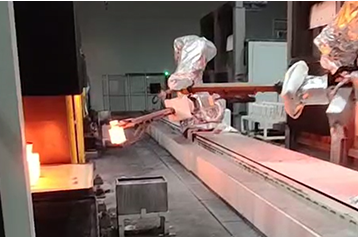
Foundry Automation Solutions
We engineer purpose-built foundry automation / foundry robots to withstand the demanding conditions of modern casting facilities. By replacing hazardous, repetitive manual work with high-rigidity robotic systems, our turnkey installations maintain consistent cycle times and protect operators from heat, dust, and heavy physical strain.
Robotic Systems: Configuration, Axes, Payload, and Reach
Foundry environments demand robust kinematics capable of handling extreme mass with precision. We configure industrial robots for foundries using heavy-duty articulation designed specifically for casting manipulation and tooling support.
| Parameter | Configuration Scope | Operational Function |
|---|---|---|
| Kinematic Structure | 6-axis articulated arm | Multi-angle access for complex casting geometries |
| Payload Capacity | Medium to heavy-duty ratings | Carries heavy rough castings, ladles, or grinding heads |
| Working Envelope | Standard to extended reach | Reaches deep into press openings, furnaces, and conveyors |
| Mounting Options | Floor, shelf, or inverted | Optimizes floor space and machine-tending clearance |
- High-rigidity arm construction minimizes vibration during heavy material handling and high-force finishing tasks.
- Sealed mechanical wrist units prevent abrasive dust ingress during continuous operation.
Workcell and Process Equipment: Fixtures, Conveyors, and Part-Positioning
A complete foundry robot workcell relies on rugged peripheral equipment engineered to withstand severe industrial wear:
- Heavy-Duty Clamping Fixtures: Rigid, high-holding-force pneumatic or hydraulic fixtures secure raw castings reliably against cutting, grinding, and fettling forces.
- Ruggedized Infeed and Outfeed Conveyors: Heat-resistant roller or slat conveyors automate material transfer between casting extraction, cooling zones, and secondary operations.
- Servo-Driven Part Positioners: Rotary tables and tilt-turn positioners orient the casting dynamically, allowing the robot to maintain optimal attack angles without repositioning the entire cell.
Controls and Integration: Architecture, Operator Interface, and Monitoring
We implement open, scalable control architectures that link robotic workcells directly with plant floor operations:
- Centralized PLC Architecture: Seamless communication protocols tie the robot controller directly to casting machines, hydraulic presses, and safety interlocks.
- Industrial Touchscreen HMI: Clear, graphical operator interfaces allow floor personnel to manage part recipes, monitor cell status, and initiate cycle starts without complex programming.
- Real-Time Production Monitoring: Integrated diagnostics track cycle times, equipment utilization, and component throughput to ensure reliable production flow across every shift.
Foundry Applications: Where Foundry Robots Excel
We deploy foundry robots across the most grueling stages of metal casting to eliminate manual hazards and stabilize cycle times. From molten metal management to post-cast finishing, our robotic workcells handle variable payloads and severe operating environments.
Casting Handling and Machine Tending: Loading, Extraction, and Transfer
Handling hot castings straight from the mold requires fast cycles and dependable gripping under thermal stress. We engineer robotic casting handling systems to tend die-casting machines, sand mold lines, and permanent mold cells without thermal fatigue.
- Extraction: Robots equipped with high-temperature mechanical grippers or pneumatic clamping pull parts immediately after solidifying.
- Quench and Cooling Transfer: Immediate transfer into water quench tanks, air cooling tunnels, or intermediate cooling stations.
- Machine Loading: Automated loading into secondary machining fixtures, shot-blast machines, or trim presses.
- Sensor Integration: Optical and mechanical verification sensors confirm complete part extraction to protect expensive dies from closing on retained metal.
Casting Finishing and Fettling: Grinding and Deburring
Manual fettling is one of the most hazardous, labor-intensive tasks in any casting plant. We design dedicated workcells for robotic fettling and casting grinding automation that deliver uniform surface quality across every production shift.
- Parting Line Grinding: High-rigidity arms follow programmed casting contours to strip away parting lines and flash.
- Degating and Riser Removal: Heavy-payload robots use pneumatic cutters, plasma torches, or diamond cutoff wheels to slice off heavy risers and gates cleanly.
- Robotic Deburring for Castings: Integrated force-torque sensors adjust spindle pressure dynamically to compensate for casting variations, preventing gouging and extending tool life.
- Tooling Versatility: Workcells can hold the tool to work on a fixed casting, or manipulate the casting against stationary abrasive belts and grinding wheels depending on part geometry.
Pouring, Trimming, and Secondary Foundry Processes
Beyond extraction and grinding, our foundry automation scope addresses high-risk operations where precision and repeatability directly determine metallurgical quality:
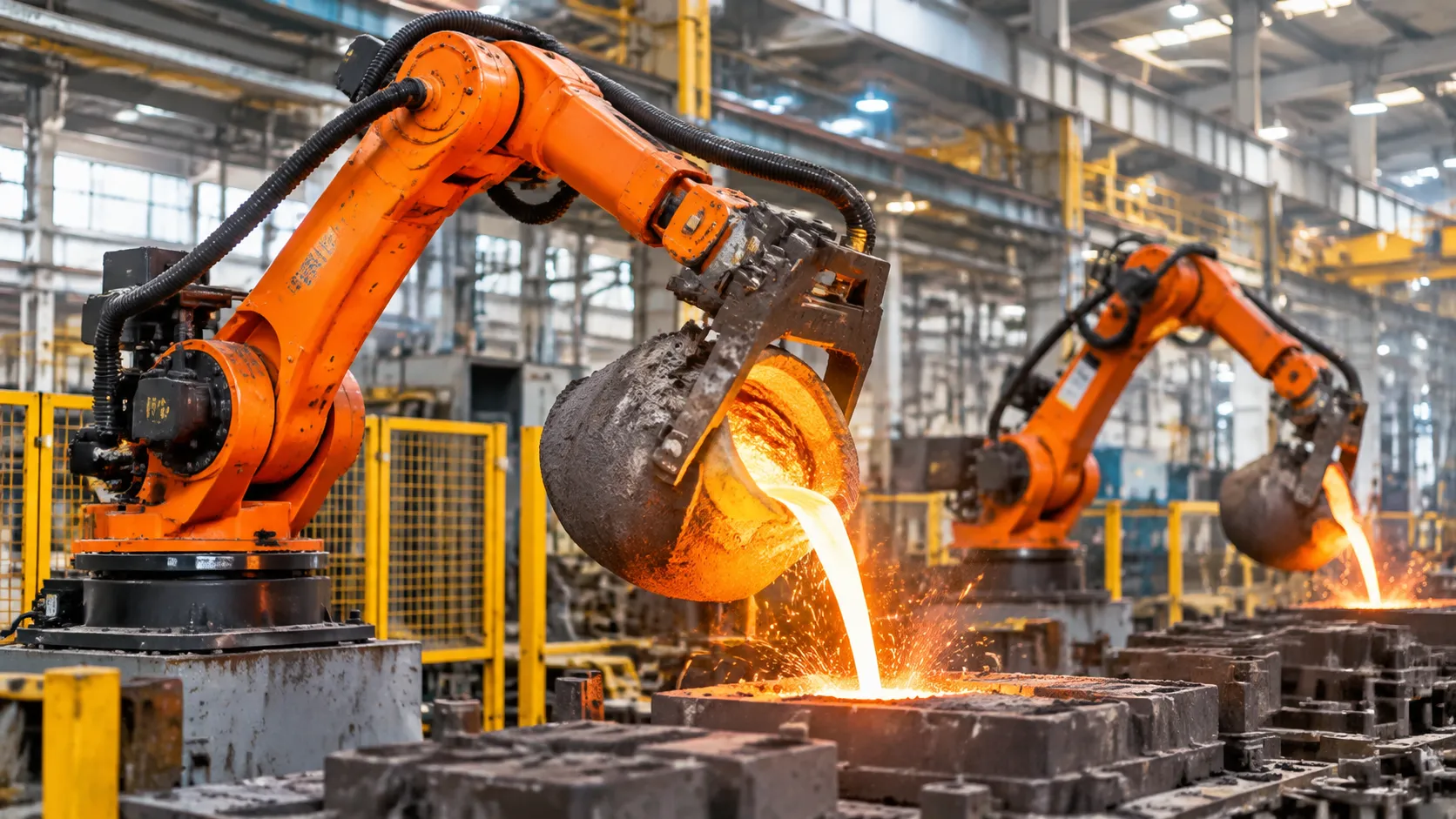
- Automated Molten Pouring: Precision-controlled pouring robots maintain consistent tilt angles, pour rates, and metal temperatures to reduce turbulence, air entrainment, and slag defects.
- Trim Press Tending: High-speed robots transfer freshly extracted parts directly into trim dies, clear off-fall runners, and stack trimmed castings onto exit conveyors.
- Sand Core Assembly: Robots place delicate sand cores into molds with sub-millimeter positioning accuracy, preventing core shifts and mold wall damage. Modern foundries leverage these cells alongside wider smart factory solutions to maintain continuous production flow.
Foundry Automation Application Overview
| Foundry Process | Primary Robot Function | Tooling & Hardware Scope | Operational Impact |
|---|---|---|---|
| Die Casting Extraction | Fast part removal, die spraying, and quench loading | High-temp mechanical grippers, air blowers | Prevents die crashes; reduces machine cycle time |
| Fettling & Grinding | Parting line removal, gate cutoff, and deburring | High-frequency spindles, compliant force tools, diamond wheels | Replaces hazardous manual grinding; standardizes finish quality |
| Pouring Automation | Transfer and controlled pouring of molten alloys | Heated ladles, servo-controlled tilting axes | Minimizes scrap from pouring turbulence and cold shuts |
| Core Manipulation | Sand core pickup, assembly, and mold placement | Compliant vacuum/pneumatic grippers, vision alignment | Eliminates core breakage and misaligned mold cavities |
Designed for Foundry Operating Conditions
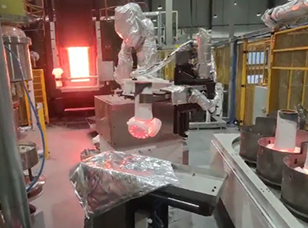
Standard industrial equipment quickly breaks down in casting facilities. Between ambient heat, airborne sand, and abrasive grinding dust, standard factory units face premature joint failure and electrical faults. We configure and deploy foundry automation / foundry robots engineered specifically to withstand these punishing environments 24/7.
Heat Exposure and Thermal Shielding
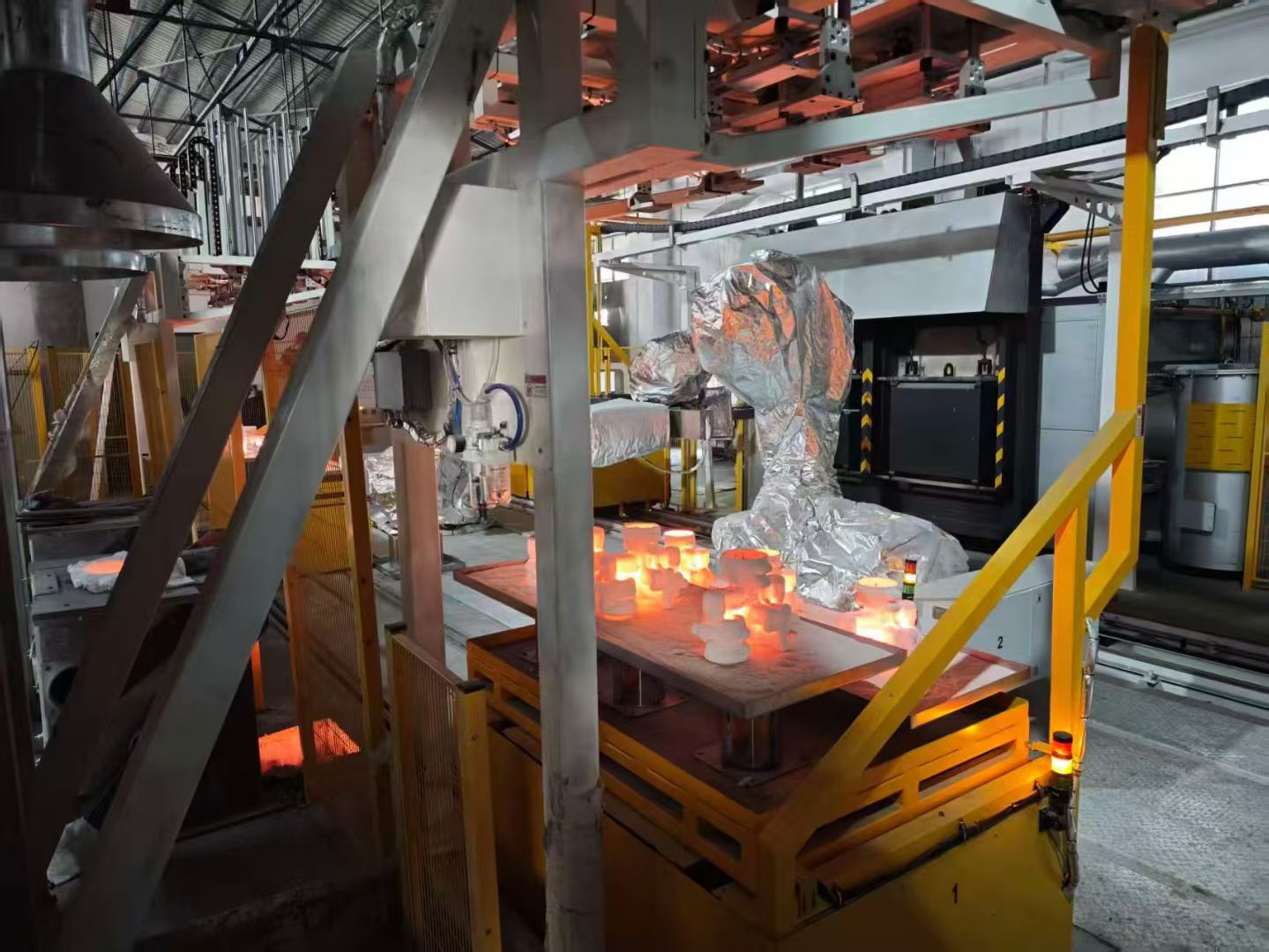
Extreme thermal stress is the primary threat near pouring lines, furnaces, and die-casting machines. We protect robotic systems using active and passive heat mitigation: Thermal Sleeving & Jackets: Multi-layer aluminized jackets reflect radiant heat away from the robotic arm during extraction and handling. Positive Air Purge: Continuous internal air pressurization keeps the internal motors and gearboxes cool while actively pushing out heated ambient air. Heat-Resistant End Effectors: Grippers and mechanical interfaces feature thermal breaks, ceramic isolation pads, and high-temp alloy fingers to handle red-hot castings straight from the mold.
Managing Dust, Abrasives, and Process Fluids
Airborne silica, metallic grinding fines, and cooling fluids destroy unsealed machinery. Our foundry robotic automation workcells tackle these contaminants directly: Sealed Mechanical Joints: Double-lip mechanical seals on all rotary axes stop fine grit from scoring bearings or contaminating lubricants. Corrosion-Resistant Finishes: Specialized epoxy and fluoropolymer coatings shed molten metal spatter, release agents, and water washdowns. Fluid Defense: Robot wrists and bodies are sealed against high-pressure die sprays, water quench baths, and aggressive chemicals common throughout heavy-duty casting process steps.
Cable and Hose Protection Systems
External wiring and pneumatic hoses are primary failure points if left exposed: Fully Enclosed Dress Packs: Utility lines run through internally routed channels or heavy-duty, corrugated protective conduits. Spatter-Proof Sleeving: High-flex silicone and fiberglass sleeving shields essential signal cables from hot metal slag and sparks. Integrated Swivels: Multi-axis slip rings and rotational swivels prevent cable pinch, twisting, and mechanical fatigue during complex degating or machine tending maneuvers.
Protection Ratings and Maintenance Overview
| Feature / Subsystem | Standard Industrial Robot | Our Foundry-Duty Robotic Systems | Foundry Advantage |
|---|---|---|---|
| Ingress Rating (Wrist) | IP54 – IP65 | IP67 / IP69K | Full resistance to direct liquid washdown, slurry, and grit |
| Ingress Rating (Base/Arm) | IP54 | IP65 – IP67 | Blocks fine particulate and abrasive dust penetration |
| Arm Cavity Pressure | Atmospheric | Positive Overpressure Air | Keeps internal electronics and reducers clean |
| Cable Harness | Exposed / Basic conduit | Internal / Armored Conduit | Prevents burn-through from hot spatter and mechanical cuts |
| Surface Treatment | Standard industrial paint | Chemical & Heat-Resistant Coating | Repels die sprays, acids, and parting lubricants |
| Service Intervals | Standard intervals | Reinforced Seals / Extended Lube Life | Maximizes uptime in 3-shift harsh plant operations |
Product Specifications: Foundry Robots and Automation Systems
We configure our foundry automation / foundry robots to withstand extreme thermal exposure, abrasive silica, and continuous mechanical shock. Below are the primary specifications and operating parameters for our standard robotic foundry workcells.
Robot Model and System Configuration
Our installations use rigid, multi-axis articulated robots built specifically for harsh metallurgical environments. Systems are deployed in floor-mounted, shelf, or overhead rail configurations depending on workcell footprint. We engineer each unit to interface directly with existing casting infrastructure, whether tending pour stations or handling parts from a green sand casting line.
Core Technical Parameters
| Specification | Metric / Parameter |
|---|---|
| Payload Capacity | 20 kg to 500+ kg (configured for combined casting and EOAT mass) |
| Working Envelope / Reach | 1,600 mm to 3,200 mm |
| Kinematic Axes | 6 degrees of freedom (optional 7th rail axis or indexing table) |
| Positional Repeatability | ±0.05 mm to ±0.10 mm |
| Wrist Ingress Protection | IP67 (dust-tight, high-pressure liquid resistance) |
| Base / Body Protection | IP65 / IP67 with pressurized internal cavity options |
Environmental Protection Ratings
- Thermal Defenses: Multi-layer thermal jackets, high-temperature seals, and cooling jackets for radiant heat resistance up to direct casting contact zones.
- Abrasive Dust Isolation: Fully enclosed drivetrains with pressurized arm housings to block sand, shot blast media, and airborne grinding dust.
- Fluid and Chemical Shielding: Corrosion-resistant epoxy finishes and fluoropolymer seals rated against water, lubricants, and mold release agents.
- Hose and Cable Dress: Internally routed or reinforced external energy chains shielded against molten spatter and sharp flashing.
Controller, Software, and Installation Requirements
- Control Architecture: Standalone industrial controller housed in an IP54 or NEMA 12 enclosure with integrated heat exchangers for elevated ambient foundry temperatures.
- Process Software: Adaptive force-control feedback for grinding, fettling, and vision-guided part localization matching the standards of custom automated assembly systems with precision robotics.
- Communication Interfaces: Native support for Profinet, Ethernet/IP, and discrete industrial I/O to link directly with presses, blast cabinets, and plant SCADA.
- Site Supply Requirements: 380V–480V 3-phase industrial power, dedicated grounding, and continuous 6–7 bar clean, dry compressed air for pneumatic gripping and arm purging.
How to Select a Foundry Robot or Automation System
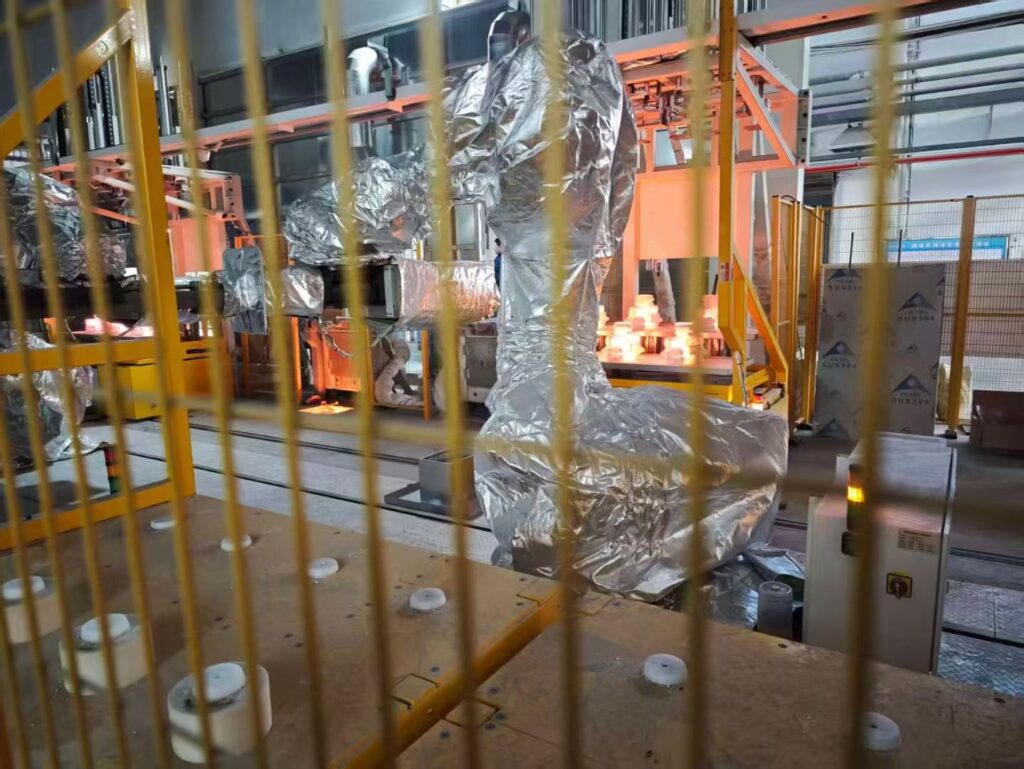
Choosing the right robotic foundry systems requires balancing physical shop-floor constraints with part specifications and production targets. When we engineer a custom foundry automation / foundry robots cell, we evaluate four key operational criteria to ensure long-term reliability and fast cycle times.
1. Defining the Process and Cycle Time
Every process demands a distinct mechanical approach. Before specifying hardware, we map out the exact sequence of movements and target throughput: Task type: Determine whether the robot will handle high-impact robotic fettling, precision pouring, core handling, or heavy machine tending. Takt time: Calculate the required seconds per part to establish robot velocity, acceleration limits, and dual-gripper requirements. Tool change requirements: Identify whether the arm must swap between grippers, cutting saws, and deburring spindles within a single cycle.
2. Characterizing the Casting: Dimensions, Weight, and Temperature
Casting geometry directly impacts arm reach, wrist torque, and thermal protection: Payload calculation: Total payload must include the raw casting, flash, gates, risers, and the end-of-arm tool (EOAT). We factor in center-of-gravity offsets to avoid wrist motor overload. Part temperature: Extracting red-hot castings straight from a mold requires heat-resistant gripper jaws, thermal jackets, and active cooling lines. Material behavior: Different metals exhibit varying cutting resistance and thermal retention. Reviewing alloy characteristics with a casting alloy properties and material selection guide helps us size the spindle motor power and determine abrasive wear rates for finishing cells. Part variation: Casting tolerances differ depending on your manufacturing route. Reviewing an investment casting vs sand casting process comparison allows us to decide if vision guidance or active force-torque compliance is needed to adjust for dimensional shifts.
3. Assessing the Foundry Environment: Space, Heat, and Safety
Foundries present severe operational hazards that destroy standard industrial robots: Footprint and reach: We review overhead clearance, crane paths, and floor load capacities to choose between pedestal mounting, track-mounted transport, or inverted ceiling setups. Environmental ingress: High concentrations of airborne silica dust, metal fines, and cooling water require IP67-rated arms with pressurized foundry jackets and sealed motors. Thermal radiation: We assess proximity to melt furnaces or preheat ovens to specify heat shields and high-temperature hydraulic fluids. Safety architecture: Perimeter safety fencing, light curtains, interlocked access gates, and area scanners must comply with industrial safety standards to separate operators from heavy-duty robot work zones.
4. Confirming Integration Needs: Existing Equipment and Control Interfaces
A successful casting robot integration must communicate seamlessly with existing plant machinery: Machine tending interfaces: We establish hardware interlocks with die casting machines, trim presses, shot-blast units, and CNC machines via discrete I/O or industrial Ethernet (Profinet, Ethernet/IP). PLC and HMI architecture: Centralized cell controllers give operators simple touchscreens to select recipes, monitor tool wear, and troubleshoot faults without modifying raw robot code. Data tracking: Production monitoring hooks directly into your plant SCADA or MES to record cycle counts, scrap tracking, and preventive maintenance intervals.
System Integration and Project Scope
We approach every foundry automation project as a comprehensive system, not just an isolated hardware install. We start with a deep-dive feasibility assessment to ensure the robotic solution aligns with your actual floor requirements. Whether you are managing the transition from dewaxing autoclaves to final finishing or automating a specific pouring line, we map your production flow to identify bottlenecks and operational risks before we touch a single line of code.
Workcell Design and Engineering
Our design phase focuses on precision and durability. We engineer custom fixtures, end-of-arm tooling, and part-positioning systems specifically designed to handle your casting geometries. By modeling the workcell layout beforehand, we ensure the foundry robots maintain consistent cycle times while maximizing the use of your available floor space.
Programming, Commissioning, and Safety
The success of your foundry automation depends on precise execution. Our process includes: System Programming: Tailoring robot logic to your specific casting processes, whether it is grinding, degating, or material handling. Safety Validation: Implementing rigorous safety protocols, including light curtains, laser area scanners, and physical interlocks to protect your personnel in hazardous environments. On-Site Commissioning: We manage the installation to ensure the system communicates seamlessly with your existing equipment.
Training and Ongoing Support
We do not walk away once the robots are running. We provide thorough training for your operators and maintenance staff, covering everything from basic troubleshooting to routine system checks. You receive full documentation for all programs and safety logic, ensuring your team remains capable of managing the equipment. Ongoing technical support is a pillar of our service, designed to keep your production line at peak performance and minimize downtime.
Operational Benefits of Foundry Automation
When we implement foundry automation / foundry robots on the plant floor, the return on investment comes down to four core operational metrics: worker protection, cycle consistency, continuous throughput, and reliable workforce planning.
Reducing Manual Handling of Hazardous Tasks
Pouring molten metal, extracting red-hot parts, and grinding rough parting lines are physically punishing jobs. Our robotic foundry systems take over direct exposure to: Extreme thermal loads: Managing hot castings directly from molds without risk of burns or thermal fatigue. Vibration and ergonomic strain: Eliminating repetitive strain and vibration-induced injuries caused by manual degating and heavy pneumatic grinders. Harmful environments: Working reliably around heavy sand casting equipment where silica dust, metal fumes, and airborne slag present severe respiratory hazards.
Increasing Process Consistency and Production Flow
Human fatigue inevitably leads to cycle variations between the start of a shift and the end. Implementing dedicated casting automation guarantees: Repeatable cycle times: Every degating cut, mold transfer, and grinding pass runs at exact pre-programmed speeds. Scrap reduction: Rigid tool tracking and consistent force control minimize over-grinding, under-cutting, and surface gouging. Bottleneck elimination: Continuous, synchronized part transfer keeps downstream inspection, blasting, and heat-treatment cells fully utilized.
Improving Operator Safety
Moving personnel out of high-risk zones transforms foundry safety records. By isolating hazardous steps inside guarded foundry robot workcells, we convert strenuous manual labor into technical oversight roles. Operators transition from lifting heavy, hazardous metal to managing cell parameters, monitoring tool wear, and staging raw components from safe operator interfaces.
Predictable Staffing and Equipment Utilization
Labor shortages remain one of the most critical bottlenecks across modern foundries. Integrating industrial robots for foundries stabilizes plant output: Continuous multi-shift operations: Run 24/7 production schedules through breaks and third shifts without dropping throughput. Predictable takt times: Accurate, repeatable scheduling allows your management team to quote precise delivery dates. Lower turnover costs: Improving shop-floor working conditions boosts employee retention across technical and supervisory teams.
| Operational Factor | Manual Foundry Operation | Automated Foundry System |
|---|---|---|
| Hazard Exposure | Direct contact with radiant heat, silica dust, and vibration | Full containment within safety-interlocked workcells |
| Takt Time Consistency | Fluctuates due to operator fatigue and shift changes | 100% predictable cycle times around the clock |
| Scrap & Rework | Higher variance from inconsistent manual grinding angles | Minimal rework via precise robotic fettling paths |
| Capacity Planning | Constrained by local labor availability and absenteeism | Scalable 24/7 throughput with fixed asset utilization |
Why Choose Vastpe for Foundry Automation?
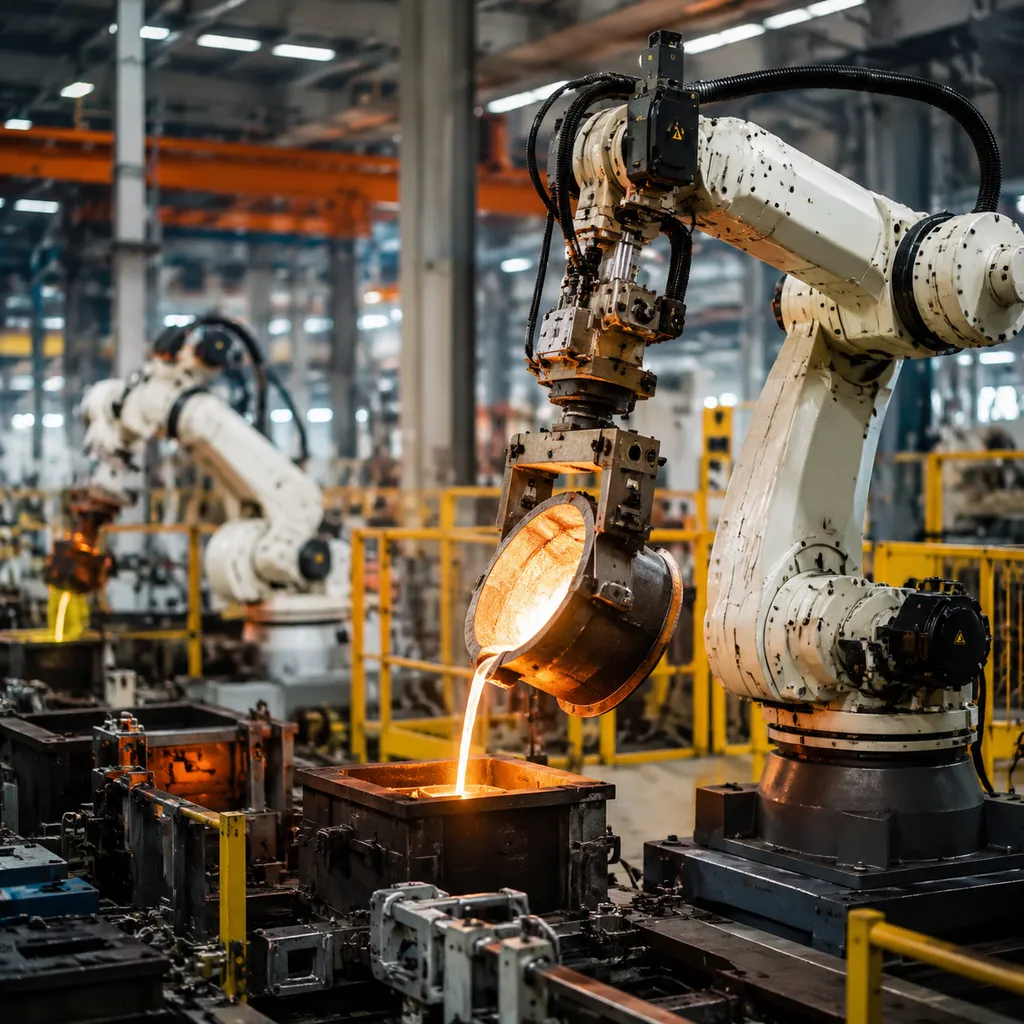
When implementing foundry automation, success depends on selecting an integration partner that understands the specific challenges of the shop floor. At Vastpe, we leverage our deep engineering background to bridge the gap between complex robotic technology and the rugged realities of casting production.
We recognize that every foundry has unique constraints. Whether your facility focuses on heavy-duty steel pouring or intricate die-casting, we provide the technical expertise to integrate foundry robots into your existing workflow without disrupting production. Our team understands the fundamental differences in material properties—much like evaluating the technical distinctions in our forging and casting comparison—which allows us to design workcells that effectively manage heat, debris, and variable cycle-time requirements.
Our Approach to Robotic Integration
We act as an extension of your production team, focusing on delivering turnkey systems that improve operator safety and consistency.
| Capability | Value Added to Your Facility |
|---|---|
| Engineering Expertise | Custom system design tailored for high-heat, high-debris foundry environments. |
| Brand Agnostic Integration | We work with industry-leading robotic hardware to find the right fit for your specific payload and reach needs. |
| Technical Support | End-to-end management from initial feasibility assessment to final commissioning and operator training. |
| Operational Focus | Prioritizing system longevity through appropriate IP-rated equipment and protective measures. |
Our commitment to quality means we do not just install robots; we ensure your automation system is reliable, maintainable, and aligned with your long-term production goals. By focusing on your specific operational pain points, we help you transition from manual, hazardous tasks to an automated, high-output casting process.
Frequently Asked Questions
When exploring foundry automation, we often hear similar questions from plant managers and engineers. Here are the core answers to help you navigate your journey toward foundry robotic systems.
What is foundry automation?
Foundry automation refers to the integration of industrial robots and smart systems to perform hazardous, repetitive, or high-precision tasks within a foundry environment. By replacing manual labor with automated cells, foundries can drastically improve consistency, throughput, and safety.
Which foundry processes can Vastpe automate?
We focus on the most labor-intensive and challenging areas of the foundry floor. Our capabilities include: Material Handling: Loading and unloading machines, casting extraction, and part transfer. Finishing & Fettling: Robotic grinding, deburring, and parting-line removal. Process Automation: Molten metal pouring, core handling, and mold automation.
What information is needed to assess a foundry robot application?
To provide an accurate solution, we need a clear view of your production requirements, including: Casting data: Weight, physical dimensions, material type, and temperature. Process goals: Desired cycle time and current bottleneck points. Environmental factors: Ambient temperature, dust levels, and available floor space. Integration requirements: Details on existing equipment or PLC communication interfaces.
How is a robot selected for casting weight, size, and reach?
We calculate robot requirements based on the total end-of-arm tooling (EOAT) weight plus the casting weight. Reach is determined by the workcell layout, ensuring the robot can access all necessary points—such as the mold, grinding station, or cooling rack—without collision.
Can a foundry robot handle hot castings?
Yes. We select robots specifically engineered for high-temperature environments. We utilize thermal shielding, specialized bellows, and cooling systems to ensure the robot’s motors and electronics remain protected from radiant heat and molten splatter.
What environmental protection is available for foundry applications?
Foundry robots are typically equipped with high IP (Ingress Protection) ratings (e.g., IP67 or higher). We further protect systems with: Pressure-sealed joints to prevent dust ingress. Abrasive-resistant cable management systems. Protective coatings or suits designed for aggressive silica dust and metal debris.
Can a robot be integrated with existing casting equipment?
Absolutely. Modern investment casting foundry equipment is designed to communicate with robotic controllers. We handle the integration layer to ensure the robot talks seamlessly with your existing die-casting machines, furnaces, or conveyors for a synchronized production flow.
How are variations in casting position or dimensions handled?
We utilize vision-guided systems and force-torque sensors. Vision systems locate the casting in 3D space even if it is not perfectly positioned, while force-torque sensors provide "touch," allowing the robot to apply consistent pressure during grinding or deburring, regardless of minor variations in part size.
What safety measures are considered when designing a robotic workcell?
Safety is our top priority. Every workcell design includes: Physical fencing and light curtains to restrict access to moving zones. Safety PLCs that manage emergency stops and interlocking signals. Risk assessments conducted during the design phase to meet international safety standards (ISO/ANSI).
How can I request a quote or application review?
Getting started is straightforward. You can contact our team directly through our website to request a custom workcell assessment. Provide us with your casting specifications and process goals, and we will conduct a feasibility review to map out the most efficient path to automation for your facility.
Request a Foundry Automation Assessment
Deploying dedicated foundry robots requires an accurate evaluation of your facility layout, cycle time targets, and operating environment. We conduct structured feasibility reviews to determine whether machine tending, robotic grinding, or automated material handling aligns with your production metrics.
Required Assessment Details
To design an effective foundry robot workcell tailored to your casting lines, provide the following operational parameters:
- Part Specifications: 3D CAD models (.STEP or .IGES), part weights, physical dimensions, and material grades, whether processing aluminum components or heavy ductile iron castings.
- Thermal & Environmental Conditions: Part temperature at pick-up, ambient cell temperatures, presence of abrasive dust, slag, or exposure to mold release sprays across the foundry casting process.
- Production Targets: Required cycle times per part, shift configurations, changeover frequency, and daily volume requirements.
- Process Scope: Specific tasks designated for automation, including core setting, die-cast extraction, degating, riser cutting, or surface grinding.
- Cell Envelope & Integration: Available floor space, crane clearances, and communication protocols required to interface with your existing trim presses, shot blast machines, or melting units.
How to Get a Consultation
We review production data to engineer robust robotic cells that eliminate bottlenecks and isolate operators from high-heat hazards.
- Data Submission: Send component drawings, target throughput figures, and photos or video clips of your current manual process.
- Engineering Feasibility: Our team evaluates payload requirements, reach envelopes, tooling rigidity, and cycle-time feasibility.
- Layout & Scope Proposal: We deliver a preliminary workcell simulation, tooling strategy, and integration scope defining the complete foundry automation architecture.
 English
 Russian
 German