

2026年11月3日
Automotive casting equipment for precision metal parts with reliable performance advanced technology and efficient production solutions
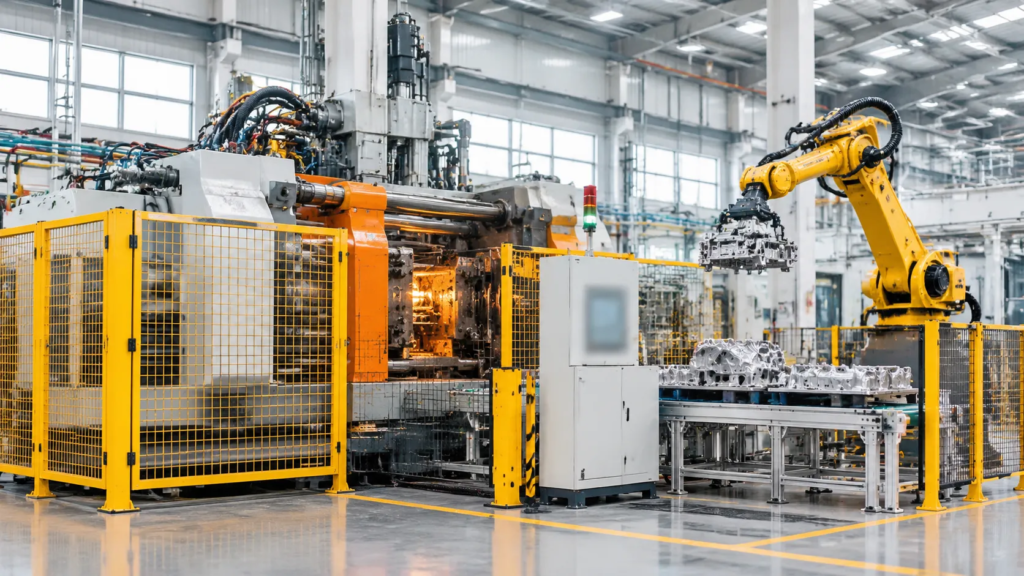
High-Volume Automotive Casting Equipment Overview
Uncontrolled gas porosity, uneven thermal balance, and extended cycle times directly increase scrap rates and erode margins in automotive foundries. We engineer automated casting equipment designed to resolve these shop-floor variables. Our systems provide the process stability and structural repeatability required to meet rigid OEM and Tier-1 quality benchmarks under continuous, high-volume operating conditions.
Core Casting Systems
We supply and integrate casting technologies matched to specific vehicle part geometries, structural loads, and metal types:
- High-Pressure Die Casting (HPDC) Equipment: High-speed real-time injection systems engineered for thin-walled, high-integrity structural components and large powertrain castings.
- Low-Pressure Die Casting (LPDC) Machines: Controlled, smooth bottom-fill feeding with precise riser-tube pressure control to eliminate turbulent flow and minimize oxide formation.
- Automotive Gravity Die Casting (GDC) Systems: Hydraulic tilt-pour stations designed to maintain consistent thermal gradients during mold filling, ideal for parts with complex internal channels.
- Automated Green Sand Molding Lines: High-density, flaskless and tight-flask molding lines delivering the high compaction pressure and mold stability needed for heavy-duty iron vehicle components.
Alloy Compatibility and Operational Performance
Our equipment delivers repeatable mechanical properties across all automotive-grade metals by focusing on scrap rate reduction, precise shot monitoring, and shortened cycle times:
| Casting Process | Compatible Alloys | Core Performance Metrics | Common Automotive Applications |
|---|---|---|---|
| HPDC | A380, A383 Aluminum, AZ91D Magnesium | Fast dry-cycle execution, reduced air entrapment | Transmission cases, structural subframes, battery covers |
| LPDC | A356, A357 Aluminum | Zero turbulence filling, micro-porosity control | Steering knuckles, control arms, alloy wheels |
| GDC | A356, AlSi7Mg Aluminum | High thermal stability, uniform wall thickness | Engine cylinder heads, electric motor housings |
| Green Sand Molding | Ductile Iron (EN-GJS), Gray Iron (EN-GJL) | High mold rigidity, tight dimensional tolerance | Brake rotors, engine blocks, differential carriers |
Modular Machinery Configurations for Automated Foundries
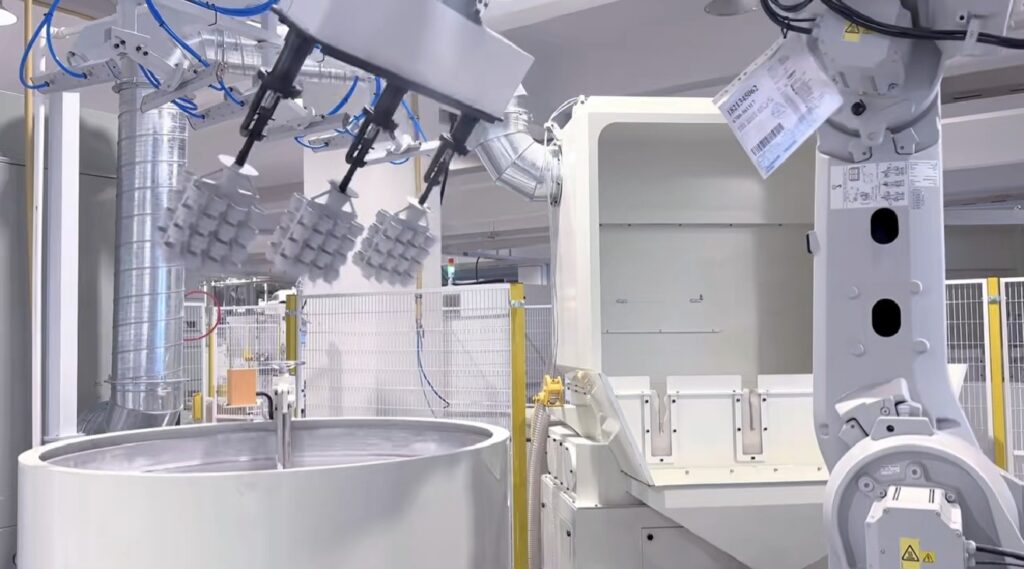
Thermal drift, handling delays, and manual ladle variations directly cause porosity and cycle lag. To eliminate these variables, we configure our automotive casting equipment into modular, automated cells where each station handles a defined phase of the melt, injection, and finishing process.
Automated Melting and Dosing Furnaces
Maintaining strict melt temperatures prevents oxide formation and cold shuts before metal reaches the die. Temperature Stability: ±2°C control using multi-zone immersed heating elements. Dosing Precision: Gravimetric and pneumatic dosing mechanisms deliver exact shot weights, reducing scrap and material overfill. Thermal Efficiency: Insulated holding chambers lower energy consumption during extended shifts, supporting high-throughput production aligned with our aluminum alloy casting guide.
High-Speed Injection and Mold Clamping Units
Our injection systems manage metal velocity throughout every phase of the shot stroke to stop air entrapment. Real-Time Closed-Loop Control: Sensors measure piston velocity and cavity pressure every millisecond, adjusting hydraulic output dynamically. Rigid Platen Clamping: Heavy-duty tie bars and stiffened platens distribute tonnage evenly across the parting line, eliminating flash on thin-walled parts. Multi-Stage Acceleration: Smooth transitions from slow pre-fill to rapid cavity fill prevent premature chilling.
Robotic Pouring, Ladling, and Component Extraction
Manual transfer introduces shot inconsistency and operator risk. We deploy articulated robotic casting cells to standardize every physical transfer: Robotic Ladlers: Multi-axis arms provide smooth, dross-free metal transfer from dosing furnace to shot sleeve. Extraction and Spray Systems: Automated grippers remove hot castings while integrated spray manifolds apply release agents uniformly to both die faces. Downstream Handoff: Unloading systems link cleanly with downstream equipment and custom automated assembly systems with precision robotics and vision inspection for immediate part validation.
Automatic Core Shooters and Core Assembly Machines
Complex engine blocks and cooling channels demand precision sand cores that withstand metal pressure without shifting. Automatic Core Shooters: Dual-station vertical and horizontal split machines shoot amine-cured cold box or hot box sand mixes. Automated Core Deflashing and Assembly: Robotic cells apply core glue, place chills, insert vent cords, and assemble complex multi-piece core packages with repeatable dimensional accuracy.
Post-Casting Equipment: Trimming, De-Gating, and Shot Blasting
Finishing stages must match the cycle speed of the casting machine to avoid floor bottlenecks.
| Equipment Type | Primary Function | Operational Target |
|---|---|---|
| Hydraulic Trimming Press | Shears gates, runners, and overflow wells in a single stroke | Cycle time: < 15 seconds; custom multi-slide tooling |
| Automated De-gating Cells | Separates heavy iron risers and runners using pneumatic wedge breakers | Eliminates manual sledge hammer work and part surface damage |
| Continuous Shot Blasting | Blasts castings with steel shot to strip mold sand and surface scale | Achieves uniform surface roughness (SA 2.5) for post-machining |
Automotive Casting Equipment Specifications and Parameters
We engineer our automotive casting equipment to handle high mechanical loads and tight cycle windows across all vehicle manufacturing platforms. From compact powertrain brackets to integrated EV rear-floor assemblies, our machinery maintains rigid structural alignment and repeatable shot kinematics under non-stop shop-floor operation.
Clamping Tonnage and Machine Envelope
Our high-pressure die casting (HPDC) cells range from 500T to over 4,500T of locking force. Smaller 500T to 1,200T units handle transmission covers, oil pans, and water pump housings. For large-format structural die casting and one-piece battery trays, our 2,500T to 4,500T+ platforms provide the necessary platen stiffness to prevent mold separation and metal flashing.
- Tie-Bar Spacing: Up to 2,600 mm × 2,600 mm on mega-casting frames for oversized multi-cavity dies.
- Platen Stroke Lengths: 900 mm to 2,200 mm to accommodate deep-draw mold designs and auto-extraction clearance.
- Tie-Bar Pre-Stressing: Hydraulic tie-bar nut pulling balances platen loads, minimizing die deflection and uneven wear.
When planning production lines and part performance targets against alternate manufacturing routes, reviewing our forging and casting comparison for strength, cost, and tolerance provides baseline data on tool life and dimensional thresholds.
Technical Performance Metrics
| Parameter | Mid-Range HPDC Cell (500T – 1,600T) | Heavy Structural Press (2,000T – 4,500T+) | LPDC / Gravity Casting Stations |
|---|---|---|---|
| Clamping Force | 5,000 – 16,000 kN | 20,000 – 45,000+ kN | Mechanical / Hydraulic clamping |
| Shot Weight (Al) | 4.0 – 25.0 kg | 20.0 – 85.0+ kg | 15.0 – 120.0 kg |
| Max Injection Speed | 8.0 m/s | 10.0 – 12.0 m/s | Controlled low-velocity fill (0.1–0.5 m/s) |
| Dry Cycle Time | 18 – 35 seconds | 45 – 90 seconds | 90 – 240 seconds |
| Platen Dimensions | 1,400 × 1,400 mm to 2,200 × 2,200 mm | 2,600 × 2,600 mm to 4,000 × 4,000 mm | Custom rotary/tilt mold tables |
Control Architecture and Utilities
Reliable integration with Tier-1 plant networks requires standardized automation backbones. We build every automotive die casting machine with open industrial protocols:
- PLC Systems: Standardized on Siemens S7-1500 or Allen-Bradley ControlLogix platforms with high-resolution touchscreen HMIs.
- Data Integration: Real-time OPC-UA and MQTT protocols push cycle curves, casting temperatures, and shot profiles straight to plant-wide SCADA and MES systems.
- Hydraulic Power: Proportional valve controls running at 140 to 210 bar operational hydraulic pressure, paired with variable-speed servo drives to cut idle energy consumption.
- Facility Utilities: Demands range by frame size, requiring 400V/480V 3-phase power (75 kW to 350 kW connected loads) and industrial cooling water loops rated at 150 to 600 L/min to stabilize die temperatures and machine hydraulics.
Key Vehicle Applications for Automotive Casting Equipment
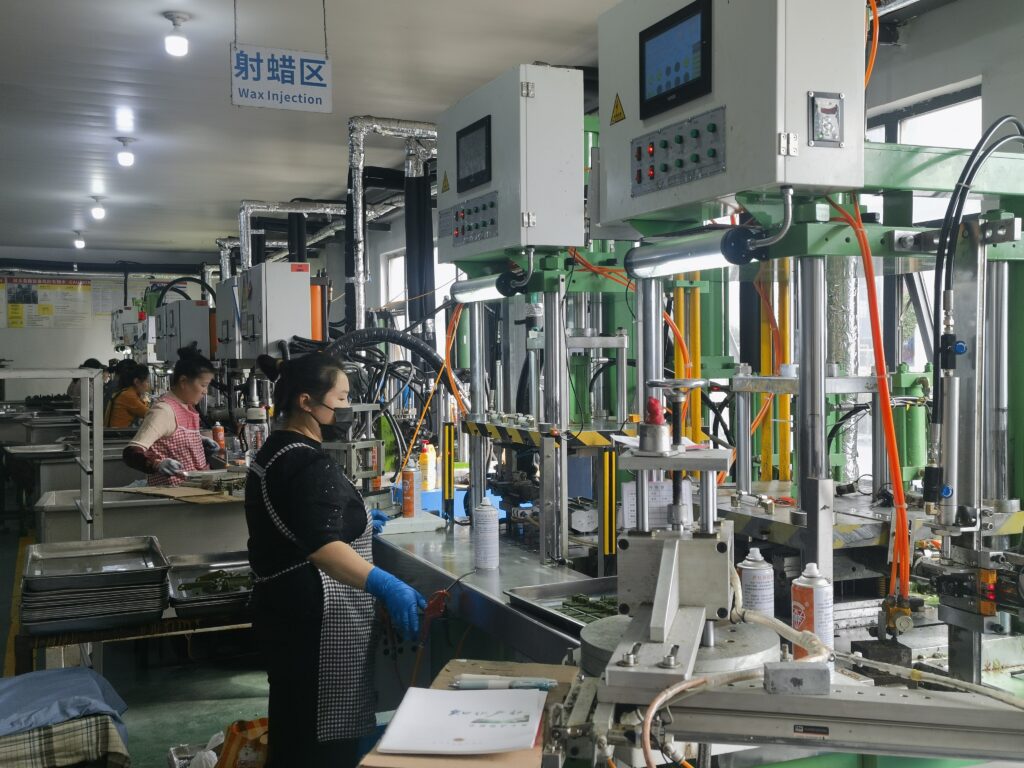
Automotive foundries face strict tolerances, high mechanical loads, and zero-defect mandates across internal combustion and electric platforms. We engineer our automotive casting equipment to address specific metallurgy challenges on the shop floor, from eliminating shrinkage porosity in pressure-tight housings to maintaining dimensional repeatability across thin-walled structural geometries.
Powertrain and Drivetrain Parts
Modern powertrain designs require high thermal stability, pressure containment, and consistent wall thicknesses to prevent fluid leaks under load. Engine Blocks & Cylinder Heads: Demanding complex water jacket cores and precise thermal management. We rely on automated engine block casting equipment, low-pressure cells, and our automated setups as a sand casting manufacturer for custom metal parts to achieve dense, leak-free gray iron and aluminum pours. Transmission & Gearbox Cases: Produced via high-pressure die casting (HPDC) to hold tight bearing-bore tolerances, minimize secondary machining, and prevent fluid seepage under operating pressures.
Structural Chassis Assemblies
Chassis parts demand high elongation and exceptional yield strength to satisfy vehicle crash-management standards. Shock Towers & Subframes: Molded with large-tonnage structural die casting press lines using vacuum assist. This configuration suppresses internal air entrapment and ensures consistent weldability and rivetability. Steering Knuckles & Control Arms: Cast from ductile iron or high-integrity aluminum alloys to withstand sustained cyclic fatigue and road impact forces without crack propagation.
Electric Vehicle (EV) Components
The shift toward e-mobility requires casting machinery capable of managing wide projected areas, thin walls, and integrated cooling passages. Thin-Wall Battery Trays: Cast on high-tonnage HPDC systems to deliver rigid, lightweight enclosures that shield cells while keeping total vehicle curb weight down. Motor Housings & E-Axle Gearboxes: Formed with cast-in cooling jackets that require zero porosity to prevent coolant-to-electrical shorts. Our tooling and shot controls eliminate cold shuts along extended flow paths.
| Vehicle Subsystem | Target Components | Primary Casting Method | Critical Quality Target |
|---|---|---|---|
| Powertrain | Engine blocks, heads, cases | LPDC / HPDC / Sand Casting | Leak-tightness, uniform core sand removal |
| Chassis | Shock towers, knuckles, subframes | Vacuum HPDC / Gravity Die | High elongation, crash performance |
| Electric Vehicle | Battery trays, stator housings | Large-tonnage HPDC (Mega-casting) | Thin-wall flow consistency, zero porosity |
| Braking | Calipers, rotors, cylinders | HPDC / Precision & Sand Casting | Wear resistance, hydraulic pressure seal |
Braking System Parts
Braking systems leave no margin for defect-related failure. Components must handle extreme frictional heat without micro-cracking or losing hydraulic integrity. Ventilated Rotors: Handled on automated molding lines using specialized gray iron mixes to ensure balanced thermal dissipation and damp brake judder. Brake Calipers & Master Cylinders: Utilizing automated die casting and specialized investment and precision casting services for metal parts to hold internal hydraulic passages clean, smooth, and impervious to pressure drop.
In-Line Quality Control and Process Automation
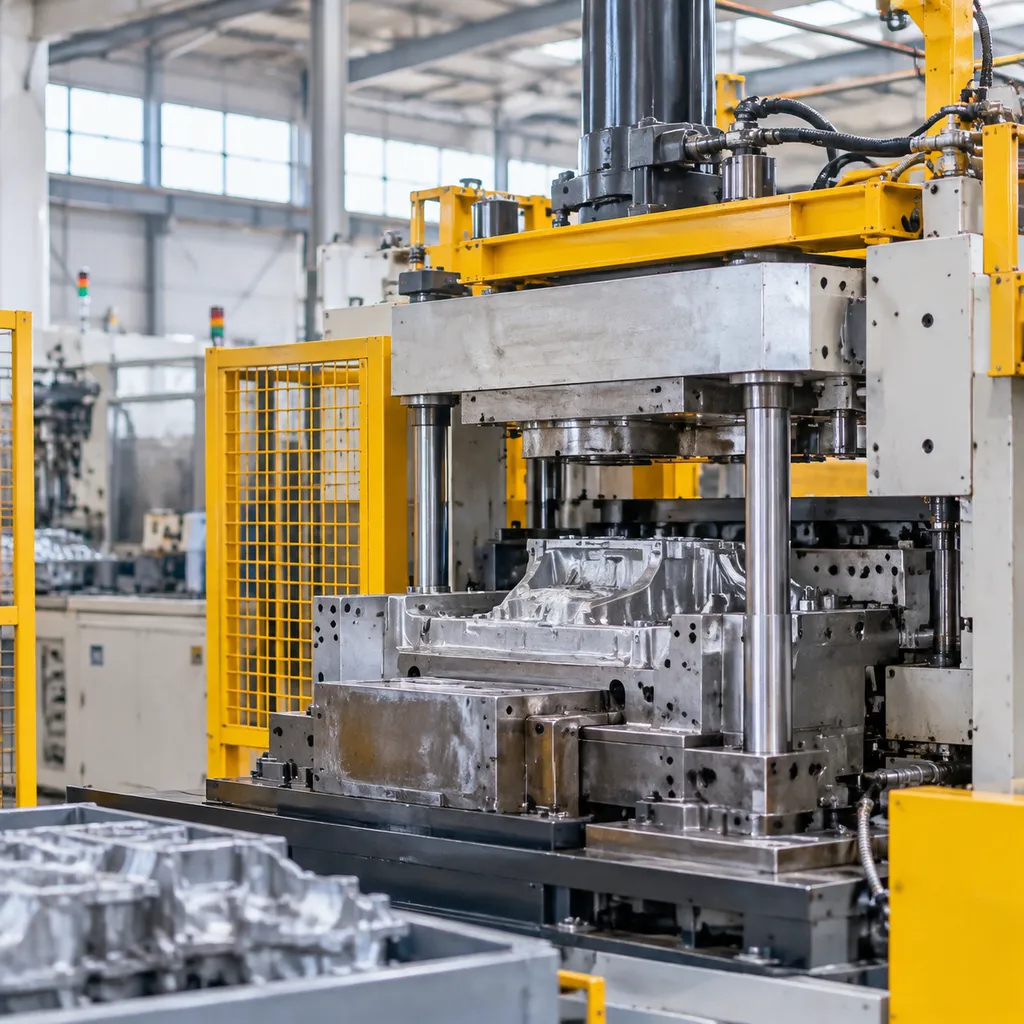
Internal defects like gas porosity, shrinkage voids, and dimensional variation lead to rejected batches and expensive downstream machining losses. To stop defective castings from reaching the assembly line, we integrate closed-loop process monitoring and automated inspection stations directly inside our automotive casting equipment.
Closed-Loop Injection and Shot Monitoring
Our injection units actively regulate hydraulic pressure and plunger speed during every millisecond of the filling stroke.
- Shrinkage Defect Prevention: Real-time feedback sensors detect pressure drops during the intensification phase, instantly adjusting force to eliminate internal shrinkage voids.
- Cold Shut Mitigation: Dynamic velocity controls maintain constant flow front speeds, keeping metal fluid across thin-wall sections.
- Process Repeatability: Every shot profile is compared against target curves, automatically segregating out-of-spec shots via integrated diverter chutes.
In-Line NDT, Digital Radiography, and Optical Scanning
Instead of waiting for off-line lab results, our automated foundry production line sends parts directly to non-destructive testing cells.
| Inspection Station | Technology Applied | Defects Detected | Cycle Impact |
|---|---|---|---|
| X-Ray / Radioscopy | Automated defect recognition (ADR) | Subsurface gas holes, inclusions, shrinkage | Under 30 seconds per part |
| 3D Optical Gaging | Structured light and blue-light scanning | Warpage, parting line mismatch, dimensional drift | 100% in-line verification |
| Acoustic Resonance | Impact frequency analysis | Micro-cracking, casting density inconsistencies | 5–8 seconds per component |
Managing these stages effectively aligns with standard foundry operating procedures; our comprehensive casting process guide covering methods and key steps details how these inspection benchmarks correlate to injection variables.
Infrared Thermal Imaging for Die Temperature Control
Die surface overheating and localized cold spots cause early tooling failure and surface blisters. We mount multi-point infrared cameras on the robotic casting cell framework to scan cavity faces immediately after part extraction:
- Thermal Balancing: Real-time thermographic maps identify cooling channel blockages before scrap is produced.
- Optimized Die Spraying: Spray robots dynamically vary release agent dosage based on hot-spot readings, shortening cycle delays.
- Tool Life Extension: Eliminating severe thermal shock cycles reduces heat checking and prolongs tooling life.
Part Traceability and IATF 16949 Audit Logging
Meeting Tier-1 and OEM quality standards requires full accountability for every vehicle component. Our direct-part marking and data-logging packages deliver complete process automation for automotive parts production:
- Laser Data Matrix Marking: Fiber laser marking heads engrave durable 2D codes onto components directly after the hydraulic trim press stage.
- Shot-to-Part Serialization: The system binds mold cavity ID, shot pressure curve, vacuum level, melt temperature, and operator ID to the serialized code.
- MES / SCADA Interfacing: Inspection data automatically syncs with your plant execution software, generating complete IATF 16949 audit records with zero manual documentation.
Turnkey Automotive Casting Equipment Engineering and Installation
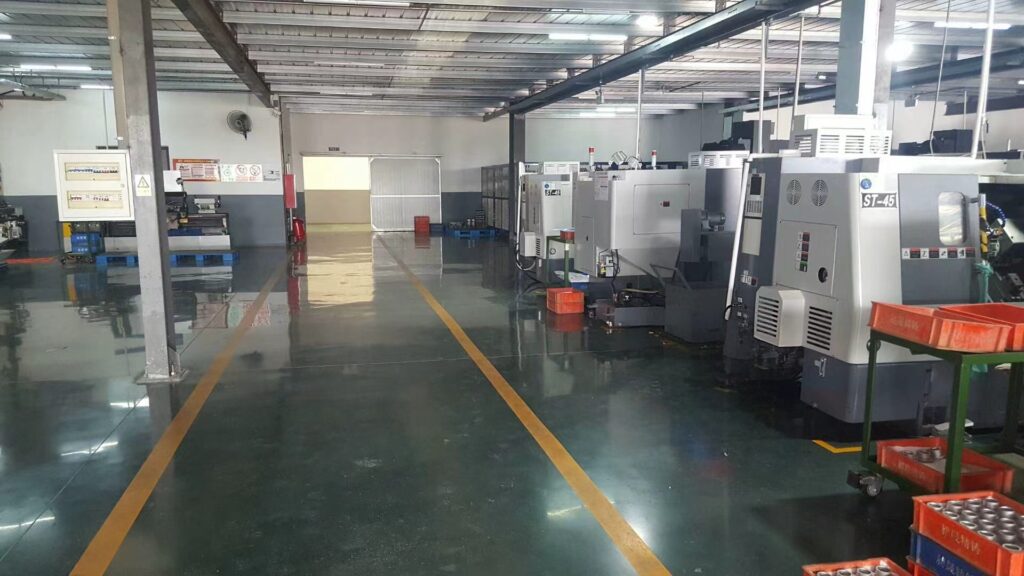
Integrating large-scale casting cells into an active foundry floor frequently introduces spatial bottlenecks, utility mismatches, and extended production downtime. We eliminate these integration risks by managing the entire deployment lifecycle—from initial footprint simulation to full-rate production handover.
Plant Layout Design and Solidification Simulation
Floor space efficiency directly dictates cycle times and operator safety. Our engineering team designs the facility layout around your specific metal flow, scrap returns, and material handling logistics.
- Layout Optimization: CAD-driven cell arrangement mapping the travel paths of ladle transfer systems, robotic extractors, and trim presses to eliminate crane interference.
- Flow & Solidification Analysis: Advanced computer simulation of mold filling and thermal dissipation. We identify cold shuts, air entrapment, and shrinkage porosity virtually before cutting any tool steel.
- Utility Sizing: Precise calculation of closed-circuit cooling water, compressed air volumes, hydraulic power units, and electrical drop requirements for each casting station.
Custom Tooling Fabrication and Prototype Validation
Tooling must withstand severe thermal cycling and extreme mechanical loads. We design and build production-grade molds optimized for structural automotive components and high-volume cycles.
| Tooling Stage | Focus Areas | Primary Objective |
|---|---|---|
| Material Selection | Premium H13, Dievar, or premium alloy blocks | Resisting thermal fatigue, heat checking, and wash-out |
| Cooling Architecture | Conformal cooling lines, jet coolers, and thermal pins | Uniform solidification rates across thick-to-thin transitions |
| Dimensional Tuning | CNC hard-milling, EDM, and automated surface polishing | Tight draft angles and zero-flash parting line tolerances |
Before locking in high-cavity steel tooling, our precise cast prototypes and engineering rapid metal casting processes validate part geometry, wall thicknesses, and structural durability under actual operating conditions.
FAT Protocols and On-Site Commissioning (SAT)
Every machine cell undergoes strict staged verification to ensure field-ready reliability before moving to series production:
- Factory Acceptance Testing (FAT): Completed at our assembly facility. We verify dry cycle run-rates, hydraulic pressure holding, tie-bar strain equalization, and safety circuit interlocks.
- On-Site Installation: Precision laser leveling, anchoring, and utility tie-ins managed directly by our field service technicians.
- Site Acceptance Testing (SAT): Hot-metal commissioning using production alloys. We calibrate the robotic casting cell, fine-tune the molten metal pouring system, and verify CPK values over continuous production runs to meet automotive standards.
Preventative Maintenance and Field Support
Unplanned downtime on high-tonnage machinery quickly idles downstream assembly operations. We supply direct maintenance programs and rapid-response parts networks to keep your automated foundry production line running at peak utilization.
- Rapid-Ship Wear Components: Centralized stocking of shot sleeves, plunger tips, tie-bar bushings, hydraulic seals, and burner nozzles for next-day dispatch.
- Preventative Service Schedules: Scheduled audits covering hydraulic oil contamination testing, platen parallelism realignment, and servo valve calibration.
- Direct Field Engineering: On-site troubleshooting and remote PLC diagnostics to solve cycle delays, hydraulic pressure drops, and automation sequence faults.
Frequently Asked Questions About Automotive Casting Equipment
Which automotive casting method is best for structural aluminum parts?
For thin-wall, high-yield structural components like shock towers and longitudinal rails, vacuum-assisted high-pressure die casting (HPDC) provides the fastest cycle times and required mechanical properties. If your vehicle components require post-weld integrity, T6 heat treatment, or thicker cross-sections with low tooling investment, low-pressure die casting (LPDC) or specialized foundry aluminum casting services for custom parts deliver denser grain structures with minimal shrinkage.
How does modern casting machinery eliminate gas porosity in safety-critical parts?
Our automated casting machines eliminate entrained air through multi-stage process control: Active multi-port evacuation: Pulling cavity vacuum levels down below 50 mbar before shot sleeve injection initiates. Controlled slow-shot curve: Accelerating metal smoothly to avoid turbulent wave breaks and air entrapment in the runner. Dynamic intensification pressure: Delivering up to 1,200 bar of real-time terminal squeeze to crush gas pockets during alloy phase change. Balanced thermal cooling: Spot-cooling mold inserts to ensure directional solidification toward the gating path.
What size clamping tonnage is required for EV mega-castings?
Single-piece electric vehicle subframes and integrated rear floor assemblies require machine locking forces starting from 6,000T up to 9,000T+. The exact tonnage depends on total projected surface area, shot pressure, and runner layout. For smaller battery housing trays or e-axle components, our engineering team standardizes on cells ranging between 1,600T and 3,500T.
Can these automated casting cells integrate with existing plant MES systems?
Yes. Our machine architectures utilize open PLC protocols (OPC UA, Profinet, and Ethernet/IP) to link directly with plant-wide MES and SCADA systems. Every machine cycle pushes critical process parameters directly into production databases: Shot injection velocity profiles and pressure peaks Die surface thermal logs from infrared sensors Melt dosing temperatures and ladling times Automated serial number tagging for IATF 16949 audit compliance
For plants standardizing both sand and metal mold operations, these communication protocols can also synchronize with external aluminum foundry services for precision castings across multi-facility setups.
What are the standard maintenance cycles for high-pressure injection units?
To prevent unscheduled downtime, we set preventative maintenance around operational shot thresholds: Plunger tips and sleeves: Visual inspection and clearance checks every 5,000 shots; replacement between 10,000 and 25,000 shots depending on cycle lubrication and alloy aggressiveness. Nitrogen accumulator bottles: Hydraulic check and pressure charge verification every 3 months. Piston rod seals and hydraulic valves: Preventative replacement every 100,000 cycles or during scheduled annual plant turnarounds.
 English
 Russian
 German