
2026年9月20日
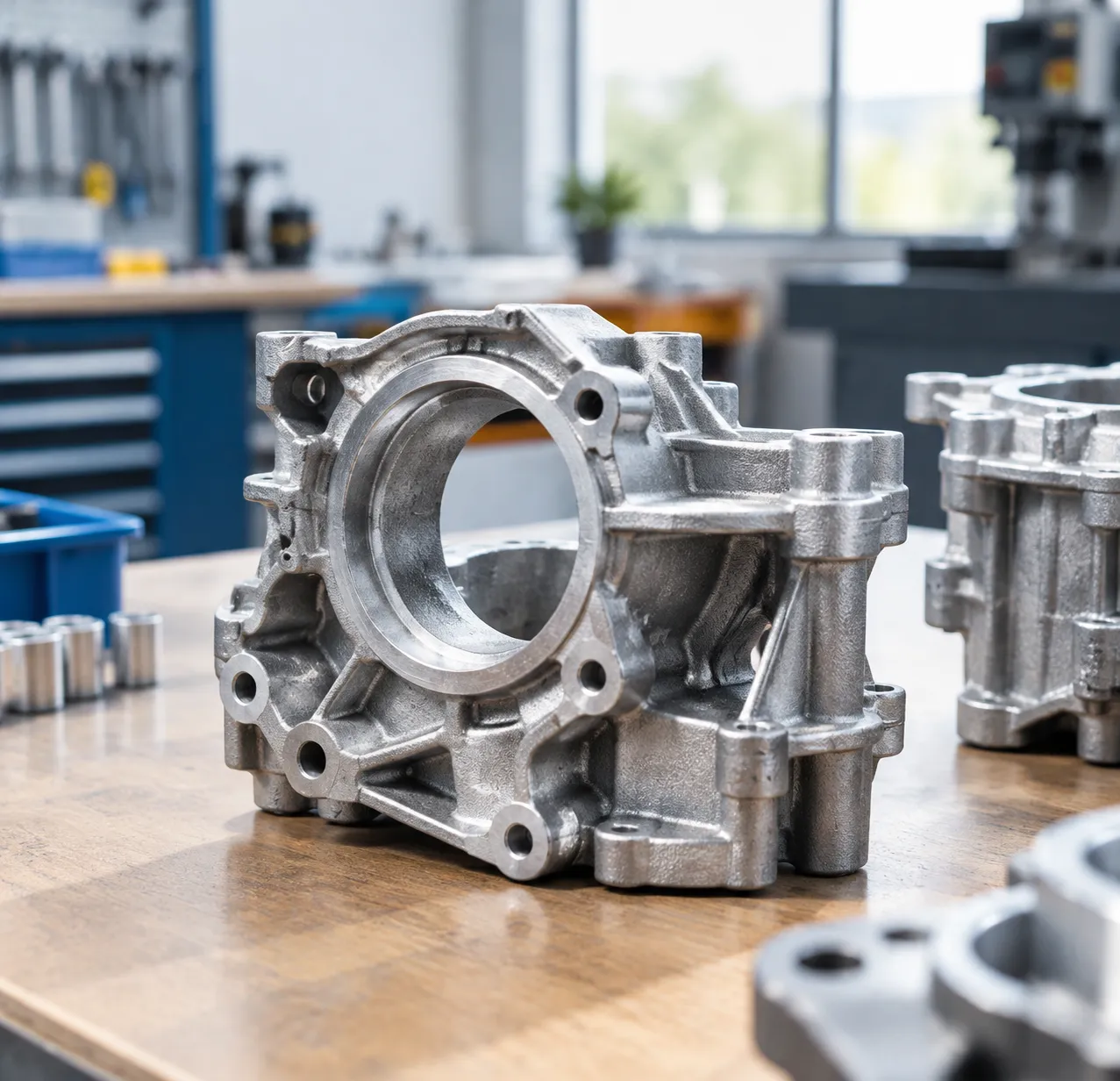
Precision metal casting part for durable industrial applications offering excellent strength accuracy and reliable performance custom made to your nee
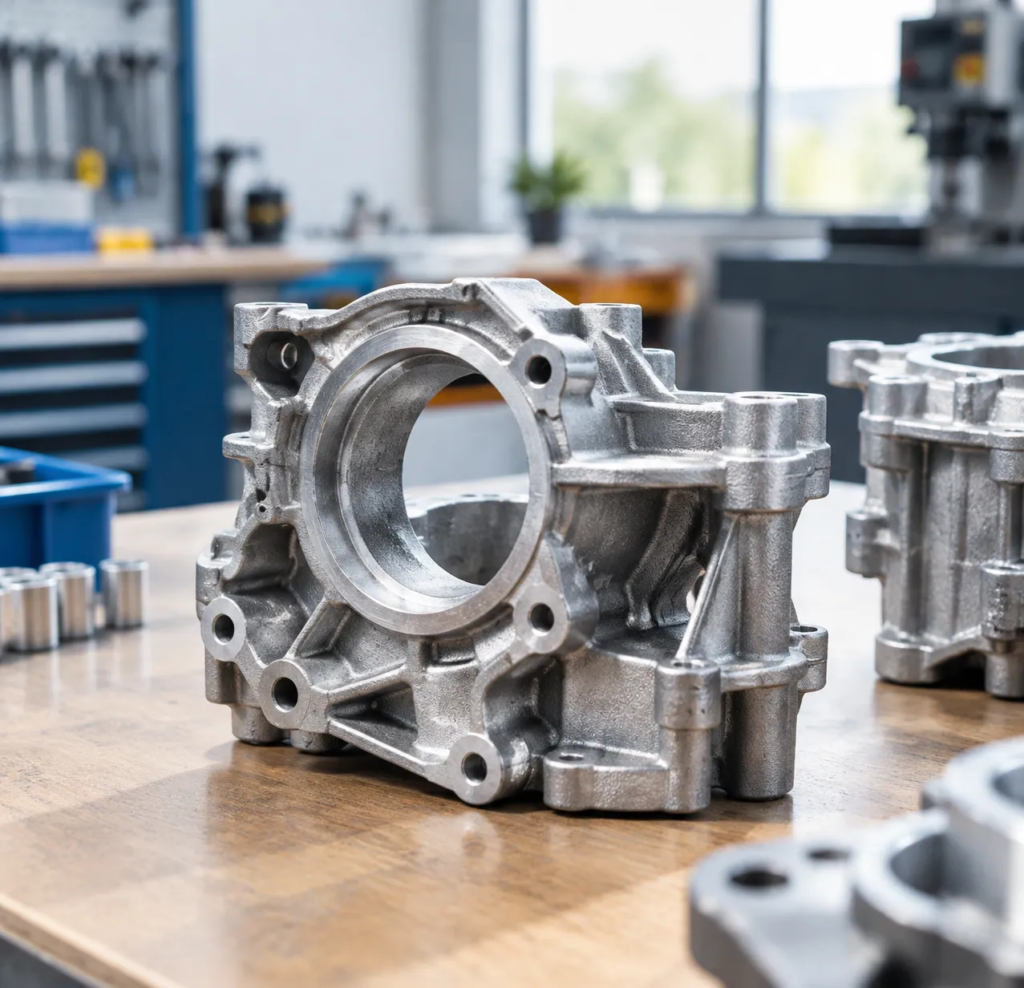
Types of Metal Casting Processes for Custom Parts
Selecting the right casting process determines the structural integrity, surface quality, and production cost of your custom metal casting part. We match your part geometry, order volume, and alloy grade to the optimal casting method to minimize secondary machining and eliminate internal defects.
Sand Casting for Large, Heavy-Duty Metal Components
Sand casting is our primary choice for heavy industrial machinery, pump housings, and large structural components. We utilize green sand and resin sand molding to pour ferrous and non-ferrous alloys with virtually no upper weight limits.
- Best for: Medium-to-large structural frames, valve bodies, and heavy equipment wear parts.
- Key advantages: Low upfront pattern tooling costs, flexible batch sizes, and high versatility across cast iron and carbon steel grades.
- Typical alloys: Gray iron, ductile iron, and cast steel alloys.
Investment Casting (Lost Wax) for Complex, High-Precision Metal Parts
Investment casting delivers near-net-shape accuracy for intricate geometries that cannot be produced via standard sand methods. We offer both silica sol casting for superior surface finish and tight dimensional tolerances, and water glass casting for cost-sensitive commercial hardware.
- Best for: Thin-walled brackets, fluid impellers, turbine fittings, and aerospace hardware.
- Key advantages: Exceptional as-cast surface roughness, reduced secondary machining allowances, and freedom for complex internal passages.
- Typical alloys: Stainless steel (304, 316, 17-4PH), alloy steel, and heat-resistant superalloys.
High-Pressure and Low-Pressure Die Casting for High-Volume Production
For high-speed, repeatable manufacturing runs, our die casting processes inject molten non-ferrous metals into reusable steel dies under controlled pressure.
- High-Pressure Die Casting (HPDC): Rapid cycle times ideal for thin-walled, lightweight components requiring high dimensional consistency across hundreds of thousands of units.
- Low-Pressure Die Casting (LPDC): Slower, laminar cavity filling that delivers dense, pore-free structural integrity for pressure-tight applications.
- Typical alloys: Aluminum (A380, A356, ADC12), zinc, and magnesium alloys.
Centrifugal Casting for Symmetrical Cylindrical Parts
We apply centrifugal casting to manufacture hollow, rotationally symmetrical metal components without using center cores. The high centrifugal force pushes molten metal against the outer mold wall, forcing lighter slag, impurities, and gas porosity toward the inner diameter for easy machining removal.
- Best for: Bushings, cylinder liners, high-pressure pipes, and engine sleeves.
- Key advantages: High material density, uniform grain structure, and exceptional radial tensile strength.
- Typical alloys: Bronze, cast iron, alloy steel, and stainless steel.
Shell Mold Casting for Tight Dimensional Accuracy and Smooth Finishes
Shell mold casting uses resin-precoated sand cured over heated metal patterns to form rigid, thin-walled molds. It bridges the gap between conventional sand casting and precision investment casting.
- Best for: Hydraulic valve manifolds, automotive gear blanks, and small transmission housings.
- Key advantages: Superior dimensional consistency compared to standard sand casting, smoother surface finishes, and automated mold production for medium-to-high volumes.
- Typical alloys: Carbon steel, ductile iron, and brass alloys.
| Process | Typical Tolerance | Surface Finish | Best Volume Range | Tooling Investment |
|---|---|---|---|---|
| Investment Casting | ±0.1 mm to ±0.3 mm | Ra 1.6 – Ra 6.3 µm | Low to High | Moderate |
| Sand Casting | ±0.8 mm to ±2.0 mm | Ra 12.5 – Ra 25 µm | Low to Medium | Low |
| Die Casting | ±0.05 mm to ±0.2 mm | Ra 0.8 – Ra 3.2 µm | High to Mass Production | High |
| Shell Mold Casting | ±0.3 mm to ±0.6 mm | Ra 3.2 – Ra 12.5 µm | Medium to High | Moderate |
| Centrifugal Casting | ±0.5 mm to ±1.5 mm | Ra 6.3 – Ra 12.5 µm | Low to High | Low to Moderate |
Material Selection Guide for Metal Casting Parts
Choosing the right alloy determines the mechanical strength, wear life, and production cost of your custom metal casting part. We pour and machine a wide range of ferrous and non-ferrous alloys, matching exact chemical standards (ASTM, AISI, DIN, JIS) to your operating environment.
Ferrous Casting Alloys: Gray Iron, Ductile Iron, and Carbon Steel
Ferrous metals form the backbone of heavy-duty industrial applications where structural load, wear resistance, and cost efficiency are critical:
- Gray Cast Iron: Excellent vibration-damping capacity and high machinability. Ideal for engine blocks, machine tool bases, and gearbox housings.
- Ductile Iron (Nodular Iron): Features spheroidal graphite nodules that deliver high tensile strength, ductility, and impact resistance. We use it extensively for steering knuckles, heavy machinery brackets, and high-pressure fluid bodies.
- Carbon and Low-Alloy Steel (WCB, 4140, 4340, 8620): Offers superior toughness, impact strength, and weldability for high-stress structural and mining components.
Corrosion-Resistant Stainless Steel and Heat-Resistant Alloy Grades
For aggressive chemical media, marine atmospheres, or high-temperature operating conditions, we cast specialized alloy steel grades:
- Austenitic Grades (304, 304L, 316, 316L): Outstanding corrosion resistance and toughness, making them the standard choice for pump bodies, valves, and food-processing equipment. Review our cast stainless steel custom casting alloys and grades for precise chemical specifications.
- Martensitic and Precipitation-Hardening (17-4PH): Combines high mechanical strength with solid corrosion protection after post-cast heat treatment.
- Duplex Stainless Steels: Delivers superior resistance to pitting and chloride stress corrosion in demanding offshore and chemical processing environments. For in-depth procurement advice, consult our casting stainless steel guide for engineers.
Lightweight Non-Ferrous Metals: Aluminum and Magnesium Casting Alloys
When weight reduction and thermal efficiency drive your design, non-ferrous alloys provide optimal strength-to-weight ratios:
- Aluminum Alloys (A356, A380, ADC12): A356 offers high elongation and structural integrity for investment and sand casting, while A380 and ADC12 provide excellent fluidity for high-pressure die casting. Common applications include automotive housings, heat sinks, and brackets.
- Magnesium Alloys: The lightest structural metals available, delivering high stiffness-to-weight ratios and exceptional damping for specialized lightweight components.
Copper-Based Alloys: Brass and Bronze for Wear and Marine Applications
Copper alloys resist biofouling, galling, and saltwater corrosion while offering low friction against mating steel surfaces:
- Tin Bronze and Aluminum Bronze: Exceptional wear resistance, impact strength, and saltwater endurance for marine propellers, impellers, and heavy-duty sleeve bearings.
- Brass Alloys: High castability, pressure-tightness, and aesthetic appeal, widely used in plumbing fittings, fluid valves, and electrical hardware.
Zinc Alloys for Precision Miniature Parts and High-Speed Production
Zinc casting alloys (such as Zamak 3 and Zamak 5) exhibit high impact strength, natural lubricity, and a low melting point. These properties allow for rapid cycle times, extended die life, and ultra-thin wall sections in high-volume production of precision electronics housings, automotive connectors, and intricate hardware.
| Alloy Group | Common Material Grades | Key Mechanical / Physical Benefits | Primary Industrial Applications |
|---|---|---|---|
| Cast Iron | Gray Iron, Ductile Iron (60-40-18, 65-45-12) | High compressive strength, vibration damping, ductility | Gearbox housings, machine frames, suspension arms |
| Carbon & Alloy Steel | WCB, 4140, 4340, 8620 | Extreme tensile toughness, impact resistance, weldability | Heavy machinery links, structural brackets, mining parts |
| Stainless Steel | 304, 316, 17-4PH, Duplex | Corrosion resistance, chemical stability, heat tolerance | Valve bodies, pump impellers, marine and food hardware |
| Aluminum Alloys | A356, A380, ADC12 | Lightweight, high thermal conductivity, tight tolerances | Automotive powertrain parts, electronic enclosures |
| Copper & Zinc Alloys | Bronze, Brass, Zamak 3/5 | Anti-galling, marine corrosion resistance, thin-wall precision | Bushings, marine fittings, high-volume miniature parts |
Step-by-Step Metal Casting Part Manufacturing Process
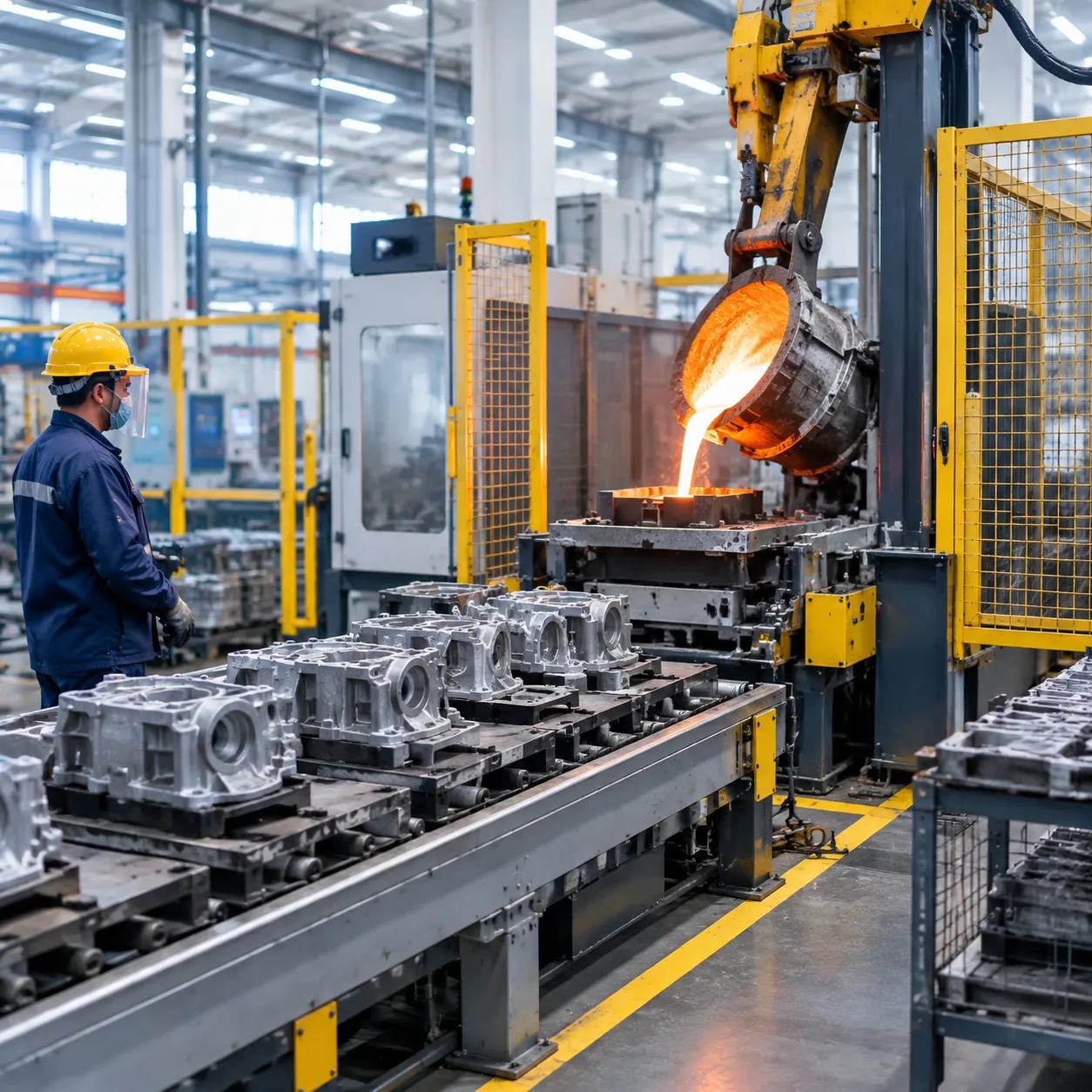
Producing a reliable, defect-free metal casting part requires end-to-end process control. We take every component through a structured workflow—from initial engineering validation to final multi-axis machining—to ensure structural integrity, tight tolerances, and consistent batch-to-batch quality.
1. 3D CAD Modeling, Mold Flow Simulation, and Tooling Design
Every project starts with a detailed Design for Manufacturability (DFM) review. We evaluate your 2D drawings and 3D CAD models (STEP/IGES) to verify wall thickness consistency, draft angles, and parting line placement. Computer-Aided Simulation: We simulate metal flow and thermal solidification to predict turbulence, air entrapment, and hot spots before cutting steel. Gating & Riser Engineering: We optimize runners, sprues, and risers to feed molten metal continuously and compensate for volumetric shrinkage. Shrinkage Allowance Calculations: Tooling dimensions are scaled precisely to offset the natural thermal contraction of specific alloys.
2. Pattern Making, Core Assembly, and Mold Cavity Prep
Once tooling designs are finalized, we produce physical patterns and mold assemblies tailored to the required casting method. Tooling & Patterns: We machine durable metal, resin, or wax patterns depending on whether the job calls for high-volume sand molding or investment and precision casting services. Sand Core Production: For internal passages, undercuts, and hollow cavities, we shoot pre-coated or resin sand cores that hold their shape under high heat. Mold Assembly & Clamping: Mold halves (cope and drag or ceramic shells) are aligned with guide pins, clamped securely, and preheated if necessary to prevent thermal shock.
3. Metal Melting, Degassing, and Controlled Pouring
Clean molten metal is the foundation of structural strength. We melt certified raw ingots in medium-frequency induction furnaces under strict thermal monitoring. Melt Chemistry Verification: We test molten samples via direct-reading optical emission spectrometers (OES) before tapping to verify chemistry compliance. Degassing & Slag Removal: We remove dissolved gases (like hydrogen) and dross to eliminate internal gas porosity and non-metallic inclusions. Controlled Pouring: Metal is poured at precise temperatures and laminar flow rates to minimize oxidation and prevent cold shuts.
[Melt Chemistry Check via OES] ➔ [Degassing & Deslagging] ➔ [Temperature Verification] ➔ [Controlled Pouring]
4. Solidification Cooling and Part Shakeout
After pouring, the casting part undergoes controlled cooling inside the mold cavity. Solidification Management: We monitor cooling times to achieve uniform grain structure and prevent internal cracking or warping. Mechanical Shakeout: Once fully solidified, parts are extracted from the mold using vibratory tables, knockout drums, or high-pressure water blasting. Core Knockout: Sand cores are broken down and shaken out of internal ports and fluid channels.
5. Post-Cast Cleaning, Riser Removal, and Fettling
Raw castings leave the mold with gating systems attached and require initial surface conditioning. Cut-Off Operations: We saw, torch-cut, or press-shear gates, risers, and overflow vents from the primary casting body. Fettling & Grinding: Operators grind parting lines, flash, and seam marks down to a smooth, uniform contour. Shot Blasting: Castings pass through automatic shot blasting or sandblasting chambers to strip residual mold material, scale, and oxides, leaving an even casting surface.
6. Precision Secondary CNC Machining for Critical Dimensional Tolerances
While casting gives parts their near-net shape, secondary machining achieves mating surfaces, bearing bores, and threaded holes that demand micro-inch precision. Following our proven sand mold casting guide and machining workflows, we clamp raw castings directly into multi-axis CNC centers.
| Machining Operation | Purpose | Typical Engineering Features |
|---|---|---|
| CNC Milling & Facing | Creates flat, leak-tight mating faces | Flanges, pump covers, mounting pads |
| CNC Turning & Boring | Delivers concentric internal and external diameters | Shaft seats, cylinder bores, bearing journals |
| Drilling & Tapping | Adds accurate fastener locations and threads | Bolt patterns, pipe ports, set screw holes |
| Precision Grinding | Provides ultra-smooth surface finishes | Dynamic seal areas, precision guide ways |
By pairing qualified foundry practices with in-house CNC machining, we deliver turnkey custom metal casting parts that drop straight onto your assembly lines without fitment issues.
Essential Design Guidelines for Custom Metal Cast Parts
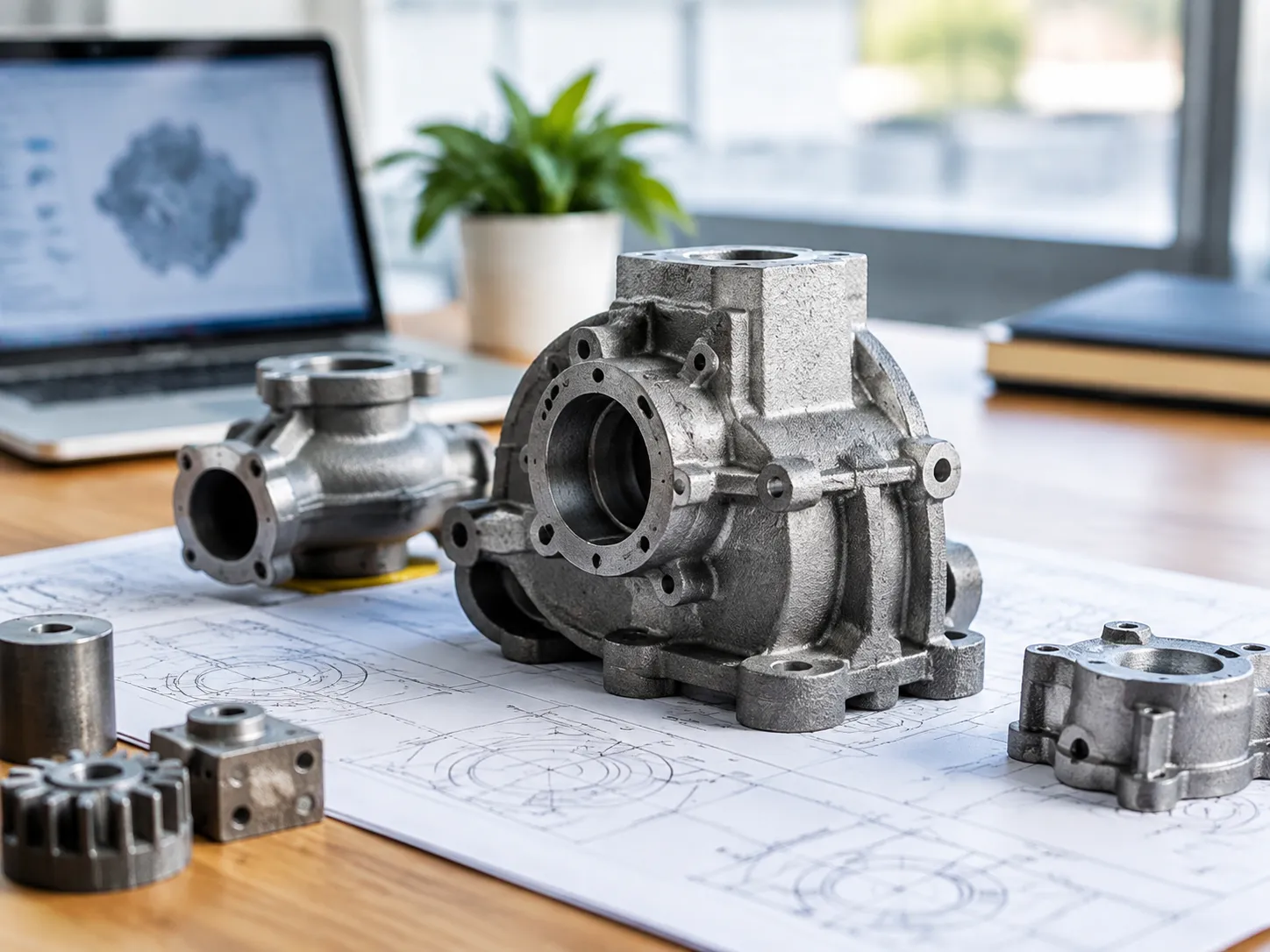
Designing a reliable metal casting part requires balancing functional requirements with the physical realities of molten metal flow, cooling rates, and mold separation. When we conduct Design for Manufacturability (DFM) reviews for custom components, we focus on key geometry rules that eliminate structural defects and reduce overall tooling and machining costs.
Maintaining Uniform Wall Thickness to Eliminate Hot Spots and Warping
Inconsistent wall thickness is one of the primary causes of shrinkage cavities, internal hot spots, and post-cooling warpage. Thicker sections stay molten longer than surrounding thin walls, pulling material away as they solidify.
- Keep nominal walls uniform: Maintain a consistent cross-section across the entire casting part whenever possible.
- Use gradual transitions: When wall variations are unavoidable, blend the thickness change using a gradual taper (typically a 3:1 slope ratio) to ensure smooth thermal gradients.
- Cored openings and ribs: Instead of solid heavy sections, design hollow pockets with internal ribs to provide mechanical strength without adding unnecessary thermal mass.
Draft Angle Rules for Clean Mold Separation
Draft angles allow patterns to release cleanly from sand molds or cast parts to eject smoothly from permanent metal dies without scuffing the tooling or tearing the casting surface.
| Casting Method | Recommended External Draft | Recommended Internal Draft |
|---|---|---|
| Sand Casting | 1.0° – 2.0° | 2.0° – 3.0° |
| Investment Casting | 0.0° – 0.5° (often zero draft possible) | 0.5° |
| Die Casting | 1.0° – 1.5° | 1.5° – 2.5° |
Applying proper draft angles directly reduces tooling wear, improves cycle times, and keeps surface finishes clean and uniform.
Generous Fillets and Radius Sizing to Minimize Stress Concentration
Sharp internal corners create severe stress concentrations during cooling, often leading to hot tearing, cracking, and turbulence during the pour.
- Inside Radii (Fillets): We design internal fillets to equal at least the adjacent wall thickness to distribute structural stress and encourage laminar metal flow.
- Outside Radii (Rounds): External corners should feature smooth radius blends to prevent premature chilling and eliminate weak edge planes.
- Fatigue Resistance: Rounded transitions significantly increase the working lifespan of load-bearing structural castings under cyclic stress.
Strategic Parting Line and Gating System Placement
The parting line defines where the two halves of the mold separate. Placing it strategically simplifies tooling construction and keeps secondary fettling to a minimum.
- Planar alignment: Whenever feasible, we position the parting line along a single flat plane to avoid complex stepped molds and minimize flash formation.
- Directional solidification: We arrange the molding and gating system so molten metal feeds progressively from thin sections toward risers positioned at the thickest sections, eliminating isolated shrinkage zones.
- Accessible gate locations: Inflow gates and risers should sit on flat, non-critical faces where they can be sawed off or ground flush without interfering with mounting surfaces.
Calculating Shrinkage Allowance and Secondary Machining Offsets
Every metal alloy contracts as it changes from liquid to solid state. Tooling must be scaled upward to compensate for this volumetric contraction. Material-specific contraction rates vary widely depending on the chosen alloy, as detailed in our aluminum alloy casting guide and ferrous metal processing standards.
- Shrinkage scaling: Pattern dimensions must include precise contraction factors—ranging from roughly 1% for cast iron up to 2% or more for cast steel and specific non-ferrous alloys.
- Machining allowances: On surfaces requiring precision CNC milling, turning, or bore finishing, we add a standardized machining stock allowance (typically 1.5 mm to 4.0 mm, depending on raw casting size and process).
- Datum reference points: Establish stable casting datum targets away from parting lines and gating cuts so secondary CNC machining setups remain rigid and repeatable.
Quality Control and Defect Prevention in Metal Casting
Every custom metal casting part we produce undergoes rigorous inspection protocols to prevent internal flaws, verify material integrity, and guarantee exact print dimensions. By combining advanced melt controls with non-destructive and mechanical validation, we ensure structural reliability across critical industrial applications.
Common Casting Defects and Prevention
Defects compromise component strength and pressure retention. We target the root causes during tooling design, gating setup, and melt preparation:
- Porosity: Gas bubbles trapped during pouring or turbulence. We prevent gas porosity through proper melt degassing, vented tooling, and controlled pouring speeds.
- Shrinkage Cavities: Voids caused by volumetric contraction during cooling. We eliminate shrinkage by optimizing gating, riser placement, and chilling blocks to promote directional solidification.
- Cold Shuts: Seams created when two metal streams fail to fuse completely due to low pouring temperatures. We prevent this by optimizing melt temperatures and mold flow simulation.
- Inclusions: Slag, sand, or oxide particles caught in the cast metal part. We use ceramic filtration systems and clean ladle practices to ensure clean metal delivery.
When assessing structural density risks against alternative production methods, reviewing our forging and casting comparison on strength, cost, and tolerance highlights how process controls bridge raw material performance gaps.
In-House Testing and Validation Protocols
Our quality assurance lab performs multi-stage testing at every phase—from raw melt analysis to finished machining inspection.
| Inspection Type | Equipment / Method | Target Metric & Defect Detection |
|---|---|---|
| Chemical Analysis | Optical Emission Spectrometry (OES) | Validates precise chemical composition against ASTM, DIN, and ISO alloy standards before pouring. |
| Volumetric NDT | Radiographic (X-Ray) & Ultrasonic Testing (UT) | Detects deep subsurface shrinkage cavities, internal voids, and hidden cracks without damaging the part. |
| Surface NDT | Dye Penetrant (PT) & Magnetic Particle (MPI) | Identifies micro-cracks, cold shuts, and surface discontinuities on critical load-bearing areas. |
| Dimensional Inspection | Coordinate Measuring Machine (CMM) & 2.5D Projectors | Measures true position, flatness, concentricity, and tight CNC machining tolerances against 3D CAD models. |
| Mechanical Validation | Universal Tensile & Hardness Testers (Rockwell/Brinell) | Verifies yield strength, ultimate tensile strength, elongation, and surface hardness requirements. |
Rigorous Standards Compliance
By documenting heat-lot traceability, spectrometry certificates, and full CMM inspection reports, we ensure every metal casting part delivers consistent mechanical performance in demanding working conditions.
Post-Casting Surface Finishing and Heat Treatment Options
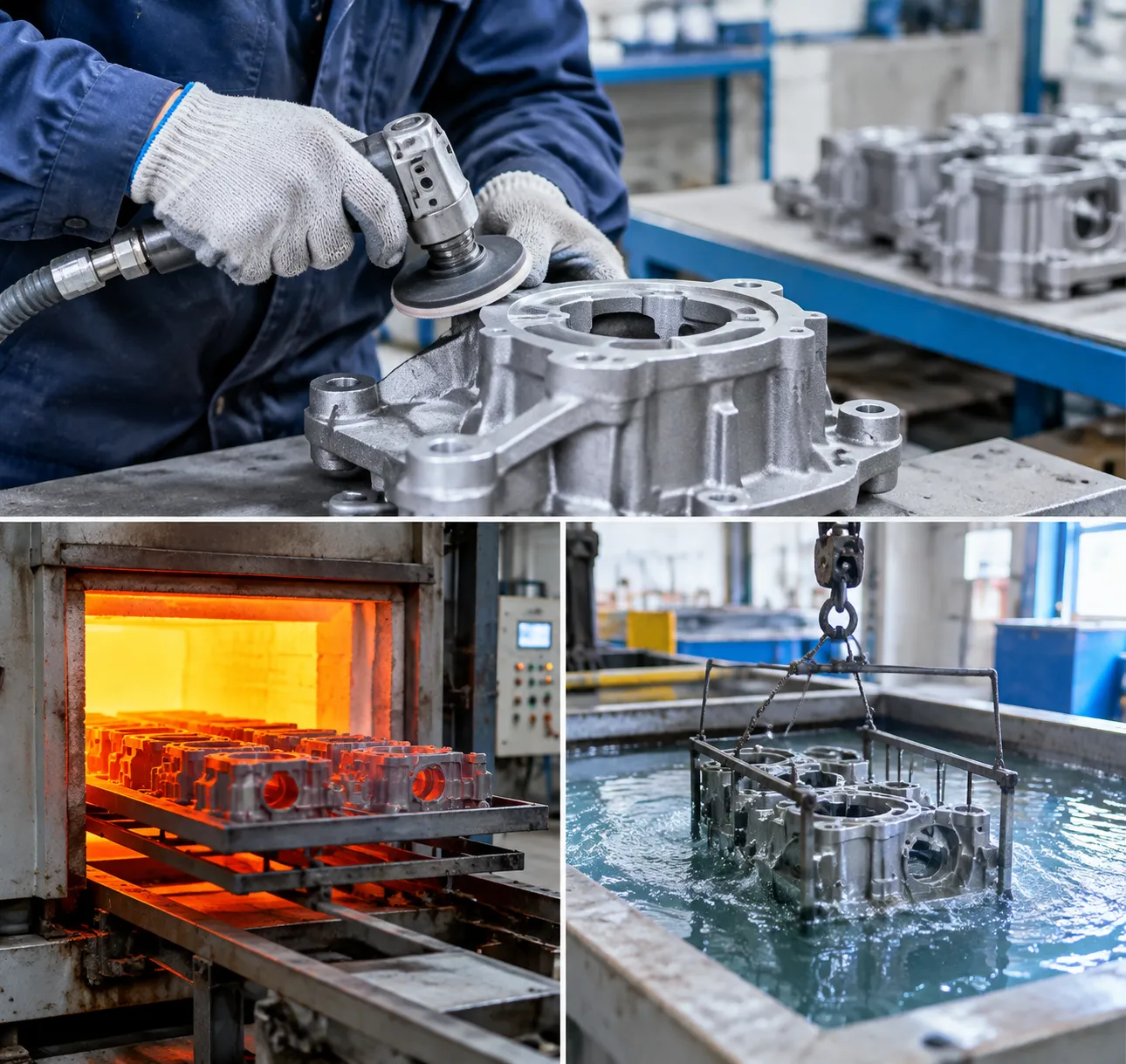
A raw metal casting part rarely ships straight from the mold to the assembly line. To meet specific mechanical properties, eliminate internal stresses, and withstand harsh operating environments, we apply targeted thermal cycles and precision surface finishing for castings.
Heat Treatment Methods for Metal Casting Parts
Thermal processing refines the internal microstructures of cast alloys, improving tensile strength, ductility, and machinability.
- Annealing: Softens the alloy, relieves internal casting stresses, and enhances machinability for secondary CNC operations.
- Normalizing: Refines coarse grain structures in carbon and alloy steels, providing uniform mechanical properties throughout thick and thin sections.
- Quenching and Tempering: Rapid water or oil cooling followed by controlled reheating to achieve high yield strength, surface hardness, and fracture toughness.
- Carburizing: Diffuses carbon into the outer layer of low-carbon steel castings to produce a wear-resistant case with a shock-absorbing ductile core.
Surface Preparation and Cleaning
Before applying coatings or critical machining, every casting metal part undergoes mechanical surface conditioning to eliminate scale, parting lines, and mold residues.
- Shot Blasting: Uses high-velocity metallic media to remove oxidation, burnt-in sand, and heat-treat scale, leaving a clean, uniform matte casting surface.
- Sandblasting: Utilizes finer abrasive media for delicate components and precision-detailed profiles, such as those produced in aluminum investment casting runs.
- Vibratory Tumbling: Deburrs sharp edges, smooths parting line flash, and prepares small-to-medium parts for plating.
Protective Coatings and Chemical Conversion
| Treatment Category | Process Options | Key Engineering Benefits |
|---|---|---|
| Mechanical Surface Prep | Shot blasting, Sandblasting, Tumbling | Strips scale, deburrs edges, prepares anchor profile for coatings |
| Thermal Processing | Annealing, Normalizing, Quenching & Tempering | Relieves residual stress, increases hardness, maximizes tensile strength |
| Protective Coatings | Powder coating, Wet painting, E-coating | Long-term barrier against moisture, UV, and aggressive chemical exposure |
| Electroplating | Zinc plating, Chrome plating, Nickel plating | Sacrificial galvanic protection and enhanced surface wear resistance |
| Chemical Passivation | Nitric/Citric passivation, Electropolishing | Strips free iron from stainless steel, maximizing natural oxide corrosion barriers |
| Conversion Treatments | Black oxide, Anodizing (Type II/III) | Corrosion resistance without altering critical dimensional tolerances |
These post-casting operations ensure every custom metal casting part delivers reliable field performance, tight fitment, and robust protection against premature wear and corrosion.
Cost Factors and Sourcing Strategies for Metal Casting Parts
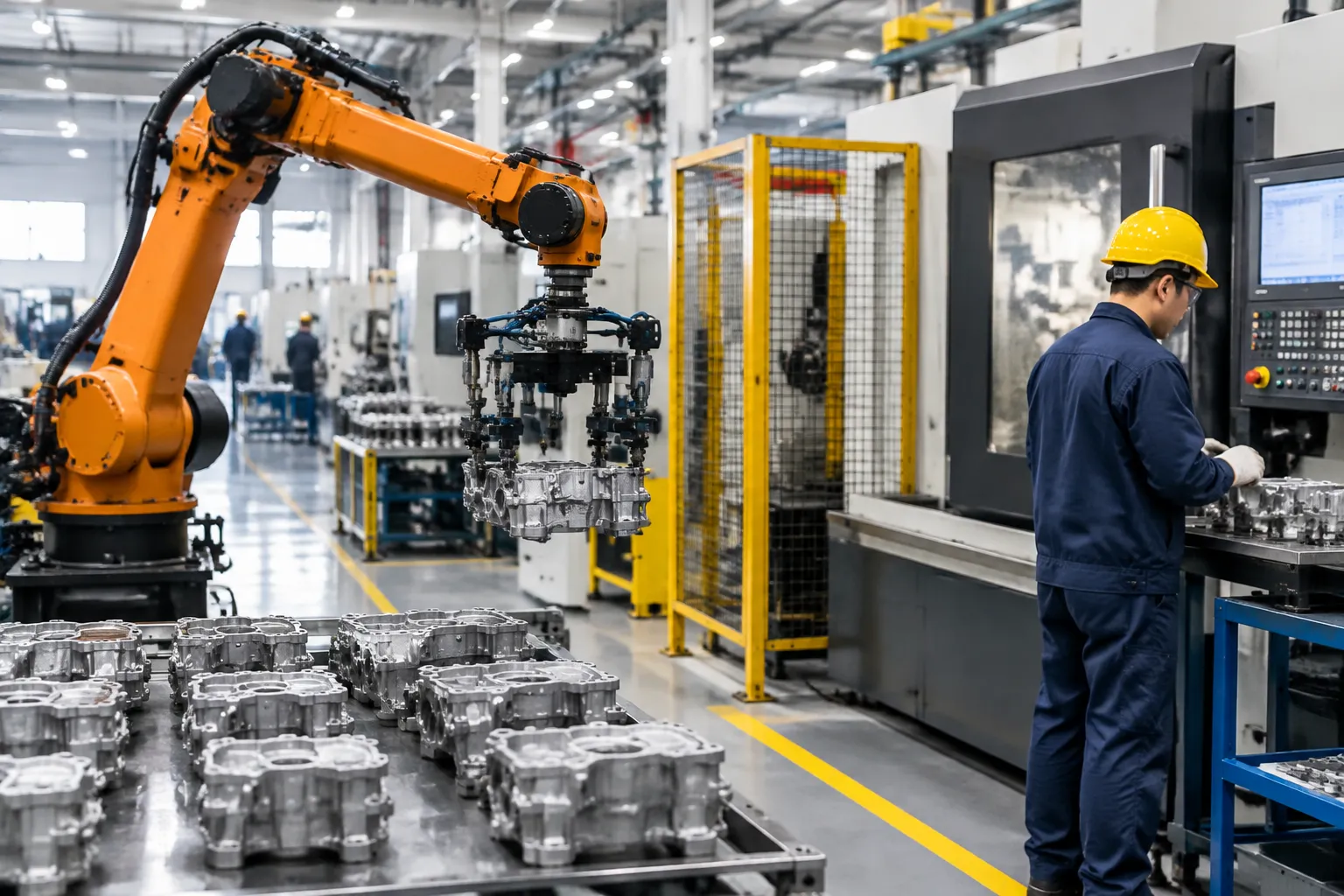
Managing the total cost of any metal casting part requires balancing upfront capital with recurring piece prices. We work closely with procurement teams and design engineers to optimize budgets across every phase of production, from initial pattern fabrication to final finishing.
Balancing Tooling Investments Against Unit Production Volume
Tooling represents the largest initial expense when sourcing a custom metal casting part. Selecting the right casting process depends heavily on your projected production runs:
| Production Volume | Recommended Casting Method | Tooling Investment | Unit Cost |
|---|---|---|---|
| Low (1 – 500 pcs) | Sand Casting / Rapid Tooling | Low | Moderate to High |
| Medium (500 – 5,000 pcs) | Investment Casting (Lost Wax) | Moderate | Balanced |
| High (5,000+ pcs) | High-Pressure Die Casting | High | Low |
When evaluating your program lifecycle, reviewing our guide on die casting vs sand casting cost helps identify the exact volume threshold where permanent metal tooling yields a lower total part cost than consumable sand molds.
Material Yield Optimization and Scrap Reduction
Material efficiency directly influences production costs. Inefficient gating, oversized risers, and excessive scrap rates inflate raw material usage. We minimize these expenses by:
- Optimizing Gating and Riser Design: Using mold simulation software to maximize metal yield while guaranteeing complete mold filling without shrinkage voids.
- In-House Scrap Recycling: Reclaiming clean runners and sprues directly within controlled melting cycles to reduce alloy waste.
- Molten Metal Degassing: Preventing gas porosity before pouring to ensure fewer scrapped parts during final inspection.
DFM Tips to Reduce Secondary Machining Costs
Secondary CNC machining often accounts for 30% to 50% of the total component price. Applying practical DFM for metal casting allows us to keep machining cycles to a minimum:
- Specify As-Cast Tolerances Where Possible: Keep standard casting surface tolerances on non-critical mounting surfaces, aesthetic covers, and structural brackets.
- Standardize Machining Stock Allowances: Limit stock addition to 1.5 mm – 3.0 mm on functional faces to prevent excessive tool wear and long milling cycle times.
- Incorporate Cast Datums: Design dedicated locating bosses and clamping points directly into the casting geometry to simplify CNC fixturing.
- Avoid Deep Internal Pockets: Design features that can be formed cleanly with standard tooling cores rather than expensive EDM or complex five-axis setups.
How to Evaluate and Audit an ISO 9001-Certified Casting Foundry
Selecting the right manufacturing partner protects your supply chain from quality failures and delivery delays. When auditing a casting foundry, we recommend verifying the following core capabilities:
- In-House Quality Control Lab: Ensure the facility uses optical emission spectrometers (OES) for melt verification, coordinate measuring machines (CMM) for layout inspection, and non-destructive testing (NDT) setups like X-ray and ultrasonic testing.
- Traceability and Certifications: Confirm ISO 9001 compliance, heat-lot batch tracking, and raw material mill test certificates (MTRs).
- Integrated Secondary Machining: Working with a single-source custom casting manufacturer for precision metal parts eliminates vendor disputes between raw casting foundries and downstream machine shops.
Industrial Applications of Metal Casting Parts
We produce OEM and ODM metal casting part solutions built to withstand extreme mechanical loads, pressure, and corrosive environments across global industrial sectors. Combining casting processes like silica sol investment casting, sand casting, and die casting with precision CNC machining, we deliver ready-to-install components tailored to demanding operating conditions.
Automotive Powertrain, Chassis, and Brake System Components
Automotive applications demand high strength-to-weight ratios, dynamic fatigue resistance, and tight tolerances. Engine & Transmission: Engine brackets, transmission housings, flywheel components, and manifold mounts. Chassis & Suspension: Control arms, steering knuckles, and heavy-duty suspension links. Brake Systems: Brake calipers, mounting brackets, and ductile iron rotors built for reliable heat dissipation and cyclic mechanical stress.
Heavy Construction, Mining, and Agricultural Machinery Wear Parts
For off-highway vehicles and earthmoving equipment, we produce rugged sand cast components that endure abrasive wear, severe impact, and high shock loads. Wear Parts: Excavator bucket teeth, track shoes, ripper points, and crusher liners. Structural Hardware: Axle housings, pivot pins, hitches, and tractor gearboxes. Development Support: We utilize rapid metal casting prototypes to validate new field-tested geometries before scaling to mass foundry production.
Aerospace Structural Brackets, Turbine Housings, and Manifolds
Critical structural and fluid-handling applications require high internal integrity, minimal porosity, and strict non-destructive testing (NDT) validation. Airframe Hardware: Structural mounting brackets, flap track components, and hinge arms cast from lightweight aluminum and high-strength alloy steels. Thermal Management: Turbine housings, exhaust manifolds, and heat exchangers engineered for creep resistance under elevated thermal cycles.
Industrial Pumps, Valves, and Fluid Power System Bodies
Fluid power and flow control systems rely heavily on pressure-tight casting metal parts capable of handling corrosive media, cavitation, and continuous working pressure. Pump Components: Impellers, pump casings, diffusers, volutes, and suction covers in 316 stainless steel, duplex alloys, and bronze. Valve Assemblies: Gate valve bodies, ball valve discs, check valve covers, and industrial butterfly valves. Dimensional Consistency: Utilizing our standard metal investment casting process tolerances and materials, we ensure smooth internal flow passages with minimal as-cast surface roughness to reduce fluid turbulence.
Energy, Oil, and Gas Pressure-Retaining Hardware
Upstream, midstream, and power generation installations demand certified pressure-retaining hardware compliant with strict ASTM and ISO standards. Pressure Equipment: High-pressure pipeline fittings, wellhead flanges, chokes, and blowout preventer components. Power Generation: Compressor housings, generator brackets, and turbine nozzles cast from alloy steel grades such as 4140, 8620, and WCB carbon steel. Quality Verification: Every pressure-critical metal casting part undergoes hydrostatic pressure testing, ultrasonic inspection, and spectrometer verification to prevent downhole or pipeline failures.
Frequently Asked Questions About Metal Casting Parts
What is the difference between die casting and investment casting for custom parts?
Both methods create near-net-shape components, but they fit different materials, volumes, and geometries:
| Feature | Die Casting | Investment Casting |
|---|---|---|
| Compatible Metals | Non-ferrous alloys (Aluminum, Zinc, Magnesium, Copper) | Ferrous & non-ferrous (Stainless steel, carbon steel, nickel alloys, aluminum) |
| Tooling Cost | High initial investment (hardened steel dies) | Moderate tooling cost (wax injection molds) |
| Production Volume | Best for high-volume runs (10,000+ units) | Economical for low-to-high volumes (100 to 50,000+ units) |
| Design Complexity | Limited by draft angles and parting lines | Exceptional freedom for complex, thin-walled, undercut geometries |
When you partner with our team as your manufacturer of investment casting precision metal parts, we help evaluate which process fits your production volume and structural requirements best.
How tight are the standard tolerances for raw metal cast parts?
As-cast dimensional tolerances depend entirely on the casting method, component size, and alloy shrinkage rate:
- Investment Casting (Lost Wax): Typically achieves ±0.1 mm to ±0.3 mm (ISO 8062-3 DCTG 4–6).
- High-Pressure Die Casting: Typically holds ±0.05 mm to ±0.15 mm on smaller aluminum or zinc dimensions.
- Sand Casting: Ranges between ±0.5 mm to ±2.0 mm depending on pattern type and flask size.
For critical mating surfaces, bearing journals, and tight thread locations, we apply secondary precision CNC machining after casting to hit tolerances down to ±0.005 mm.
Which metal casting method is most cost-effective for low-volume prototypes?
For low-volume runs (1 to 100 units), sand casting with 3D-printed sand molds or machined wood/resin patterns delivers the lowest upfront tooling investment.
If your component requires steel alloys or complex internal channels, rapid-prototype investment casting using 3D-printed wax or SLA patterns eliminates hard tooling costs entirely, allowing us to produce functional metal casting parts within short turnaround times.
How do foundries prevent and fix porosity in critical metal castings?
Porosity typically comes from trapped gases or improper shrinkage cooling. We eliminate porosity risks through strict engineering controls:
- Mold Flow Simulation: Optimizing runners, risers, and gating channels during tooling design to ensure directional solidification.
- Melt Degassing & Fluxing: Purging hydrogen and oxides before pouring molten metal.
- Controlled Pouring Dynamics: Regulating pour speed, temperature, and mold preheat levels to prevent cold shuts and turbulence.
- NDT Inspection: Detecting subsurface defects using X-ray radiography, ultrasonic testing, and dye penetrant inspection before secondary machining.
When should I choose metal casting over machining from solid billet?
A cast-and-machine approach is significantly more cost-effective when:
- Material Waste Exceeds 30–40%: Milling complex housings or deep pockets from solid billet wastes expensive raw stock.
- Internal Cavities Are Required: Casting easily forms curved fluid passages, internal cooling jackets, and hollow chambers that CNC cutting tools cannot reach.
- Production Reaches Medium-to-High Volumes: Casting near-net shapes cuts cycle times on CNC milling centers, lowering the total unit cost for each metal casting part.
 English
  Russian
  German